AI hallucination
When an AI model generates an answer that sounds confident and fluent but is factually wrong or entirely made up.
What an AI hallucination means
An AI hallucination is when an AI model generates an answer that sounds confident and fluent but is factually wrong, unsupported, or entirely invented. The model is not lying in any deliberate sense; it produces the most plausible-looking text it can, and when it lacks the right information it fills the gap with something that reads as true but is not.
The term applies to any generative model, but it is most consequential in places where a wrong answer has real cost. In customer support, a hallucination is when an AI replies with a refund window, a feature, or a troubleshooting step that does not actually exist, stated with the same confident tone it would use for a correct answer. Because the reply reads well, a customer has no way to tell it apart from the truth, which is what makes hallucinations dangerous rather than merely annoying.
Why AI hallucinations happen
A model hallucinates not because it is broken but because of how it works. The main drivers:
- It optimizes for plausibility, not truth. A large language model predicts likely text, so a confident wrong answer can score as well as a right one.
- It has no built-in source. Without grounding, it answers from a vague average of its training data, not from your facts.
- It abhors a gap. Asked something it does not know, it tends to produce an answer anyway instead of saying "I am not sure."
- Outdated training. The model's knowledge is frozen at training time, so it can confidently cite policies or prices that have since changed.
- Ambiguous prompts. A vague or under-specified question gives the model more room to fill in details that were never supplied.
What makes these so slippery is how ordinary they look. Pull one apart and the tells are easy to spot.
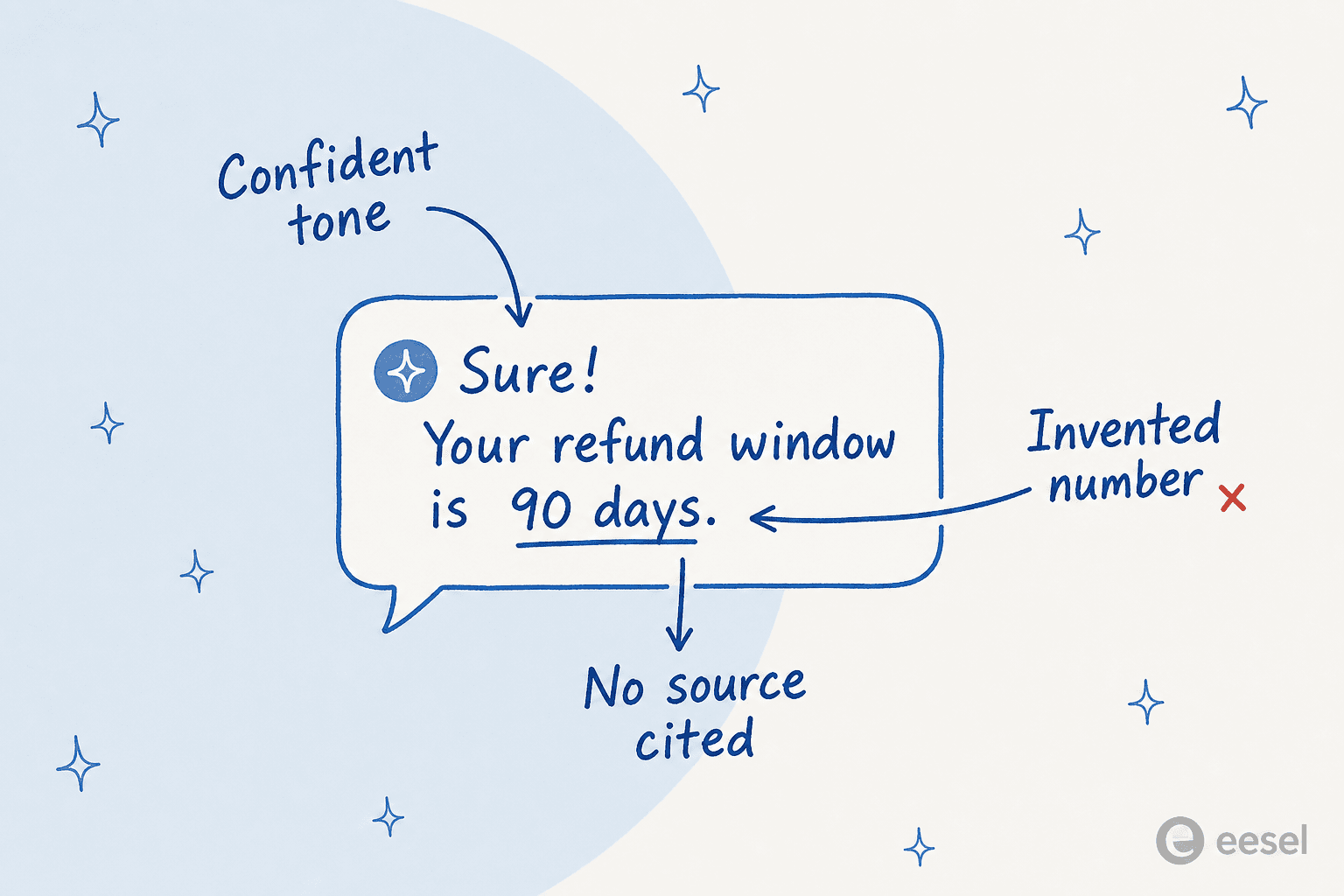
The reply reads like any helpful message: a friendly opener, a specific number, a clean sentence. The problem is the number was invented and nothing backs it up, yet the confident tone hides all of that. A customer reading it has no way to tell it apart from a real answer, which is exactly why hallucinations slip through.
How to prevent AI hallucinations
In support, the goal is not a model that never errs but a system that refuses to guess. The pattern looks like this:
- Ground every answer. Retrieve relevant passages from your real knowledge first, so the reply is built from source material. This is AI grounding.
- Cite the source. Surface where each answer came from, so a reviewer can verify it at a glance.
- Escalate on low confidence. When no good source is found, hand off to a person rather than inventing a reply.
- Test against history. Simulate the AI on past tickets before go-live to catch where it would have hallucinated.
A support agent like eesel AI answers only from your own knowledge and is built to escalate when it has no confident source, and it can be simulated against thousands of historical tickets first, so the conditions that cause a hallucination are caught before a customer ever sees one.
AI hallucinations in practice
The most expensive hallucinations are the believable ones. An obviously absurd answer gets caught; a confident, well-worded answer that is subtly wrong slips through and erodes trust quietly. That is why mature teams measure hallucinations not by how clever the model sounds but by how reliably it declines to answer when it should. A system that says "let me get a human" at the right moments is worth more than one that always has something to say, because the second one is the one that will eventually invent a policy on a real customer.
We go deeper on this in preventing AI hallucinations.
Stop hallucinations before they reach customers
eesel AI answers only from your own knowledge and escalates when unsure, so it does not invent answers.