RAG for customer service
The support-applied form of retrieval-augmented generation, where an AI fetches relevant content from a company's own knowledge before generating a customer-facing answer.
What RAG for customer service means
RAG for customer service is the support-applied form of retrieval-augmented generation, where an AI first retrieves relevant passages from a company's own knowledge and then uses them to generate the answer a customer sees. The general technique, retrieval-augmented generation, pairs a language model with a search step so the model answers from fetched documents rather than from its training data alone. "RAG for customer service" is simply that same pattern pointed at support content: help center articles, internal docs, policy pages, and resolved tickets.
In a support setting this matters because the answer reaches a paying customer, not a developer testing a demo. The retrieval step is what lets the AI reply with your refund policy, your shipping times, and your product's actual behavior, instead of a plausible-sounding average of every company on the internet.
Why RAG for customer service matters
- It answers from your facts, not the model's memory. Every reply is built on retrieved passages from your own content, which is what makes the answer specific to your product and policies.
- It keeps answers current without retraining. Update a help article and the next answer reflects it, because the AI reads live content at query time rather than relying on a frozen training snapshot.
- It cuts hallucination on high-stakes replies. Forcing answers to trace back to a source reduces the confident-but-wrong hallucination that erodes customer trust fast.
- It makes answers auditable. Because each reply maps to retrieved documents, you can show why the AI said what it said, which support and compliance teams need.
- It scales with the knowledge base, not headcount. Coverage grows as your documentation grows, so a small team can answer a wide range of questions.
The difference is easiest to feel on a single live question, where retrieval is the only thing separating a guess from a fact:
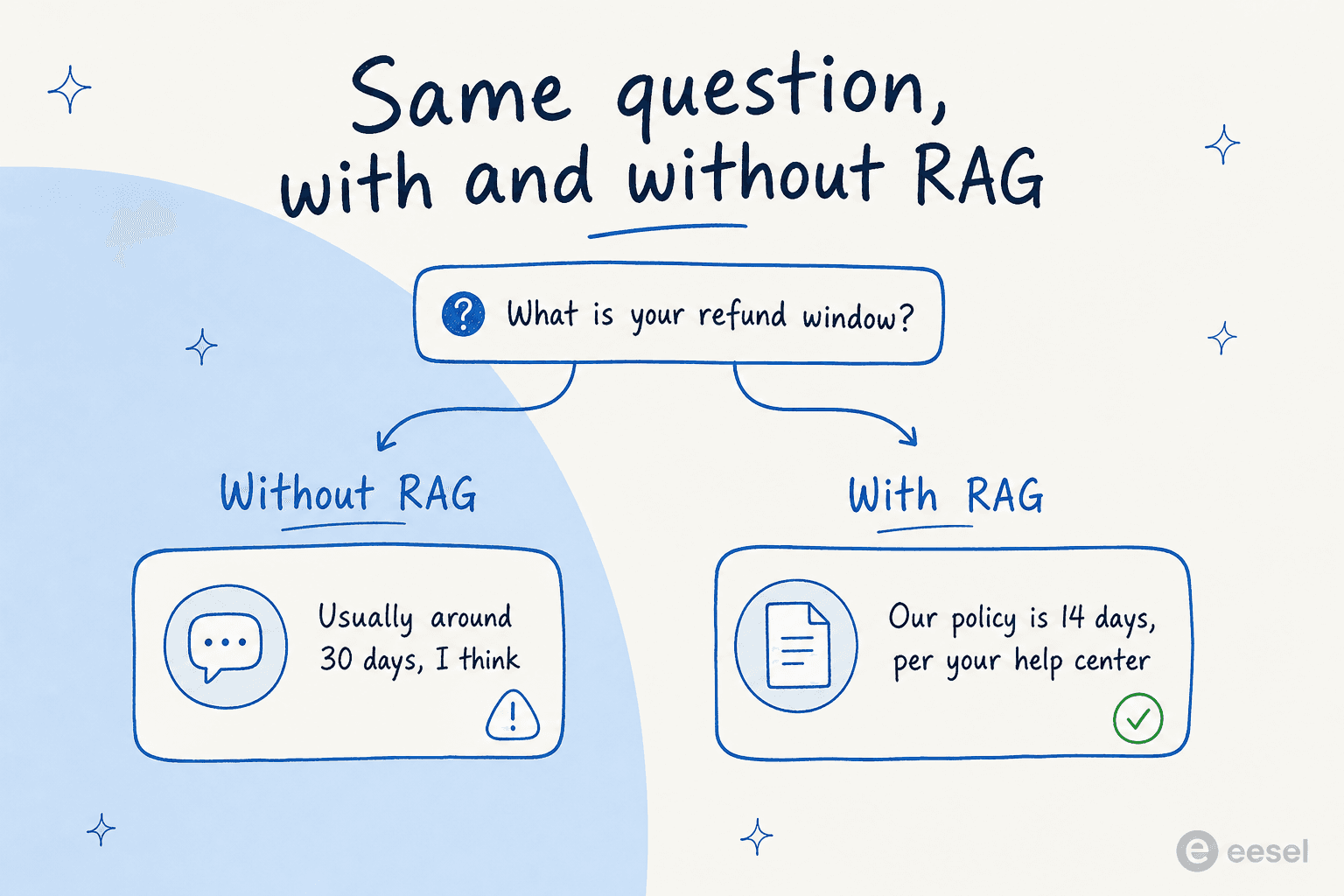
Without retrieval, the model leans on a plausible average and lands on a number that may not be yours. With RAG, the same question pulls your actual policy from the help center, so the reply is both correct and traceable back to a source the customer could be pointed to.
How RAG for customer service works
A support agent like eesel AI runs this loop on every incoming message:
- Read the request. It interprets what the customer actually wants, the way intent detection reads the goal behind a message.
- Retrieve. It searches connected knowledge, help center, docs, macros, and past tickets, and pulls the passages most relevant to the question, often using semantic search over embeddings.
- Generate, grounded. It writes the reply using those passages as the source of truth, a practice called grounding, so the answer stays tied to your content.
- Resolve or escalate. If retrieval surfaces nothing solid, a well-built agent says so or hands off to a person rather than inventing an answer.
RAG for customer service in practice
The quality of support RAG is set almost entirely by the knowledge behind it. Retrieval can only return what exists, so gaps, stale articles, and contradictions in the knowledge base show up directly as bad answers. The teams that get the most out of it treat content hygiene as part of the AI rollout, then simulate the agent against historical tickets before go-live to see where retrieval comes up empty. That test, run against real past conversations, is usually more honest than any benchmark about whether the AI is ready for live traffic.
Want the full playbook? See our guide to RAG for help centers.
Put RAG to work on your support queue
eesel AI retrieves from your help center, docs, and past tickets, then answers customers from your own facts.