Retrieval-augmented generation (RAG)
A technique that retrieves relevant documents at query time and feeds them to a language model so its answer is grounded in those sources.
What retrieval-augmented generation means
Retrieval-augmented generation (RAG) is a technique that retrieves relevant documents at query time and feeds them to a language model, so the model's answer is grounded in those specific sources rather than its training data alone. Instead of relying purely on what the model memorized, a RAG system first searches a knowledge store for passages related to the question, then passes those passages into the prompt as context for the answer. It is the standard way to make a general-purpose model answer accurately about private, current, or specialized information.
In customer support, RAG is the architecture behind any AI that answers from your own documentation. The general technique here is RAG; the support-applied flavor, retrieving specifically from your help center and ticket history, is RAG for customer service. Both rest on the same idea: retrieve the right facts first, then generate the answer from them.
Why RAG matters
RAG solves problems a standalone model cannot:
- Current knowledge lets answers reflect today's pricing or policy, because you update a document rather than retrain a model.
- Private data brings your internal docs, help center, and past tickets into scope without exposing them in training.
- Source traceability ties each answer to the passages it came from, so a reviewer can check it against the original.
- Lower hallucination risk improves grounding by giving the model real text to anchor to instead of inventing plausible details.
- Cost efficiency avoids the expense of fine-tuning every time the underlying facts change.
The difference is easiest to see when you put the two paths next to each other.
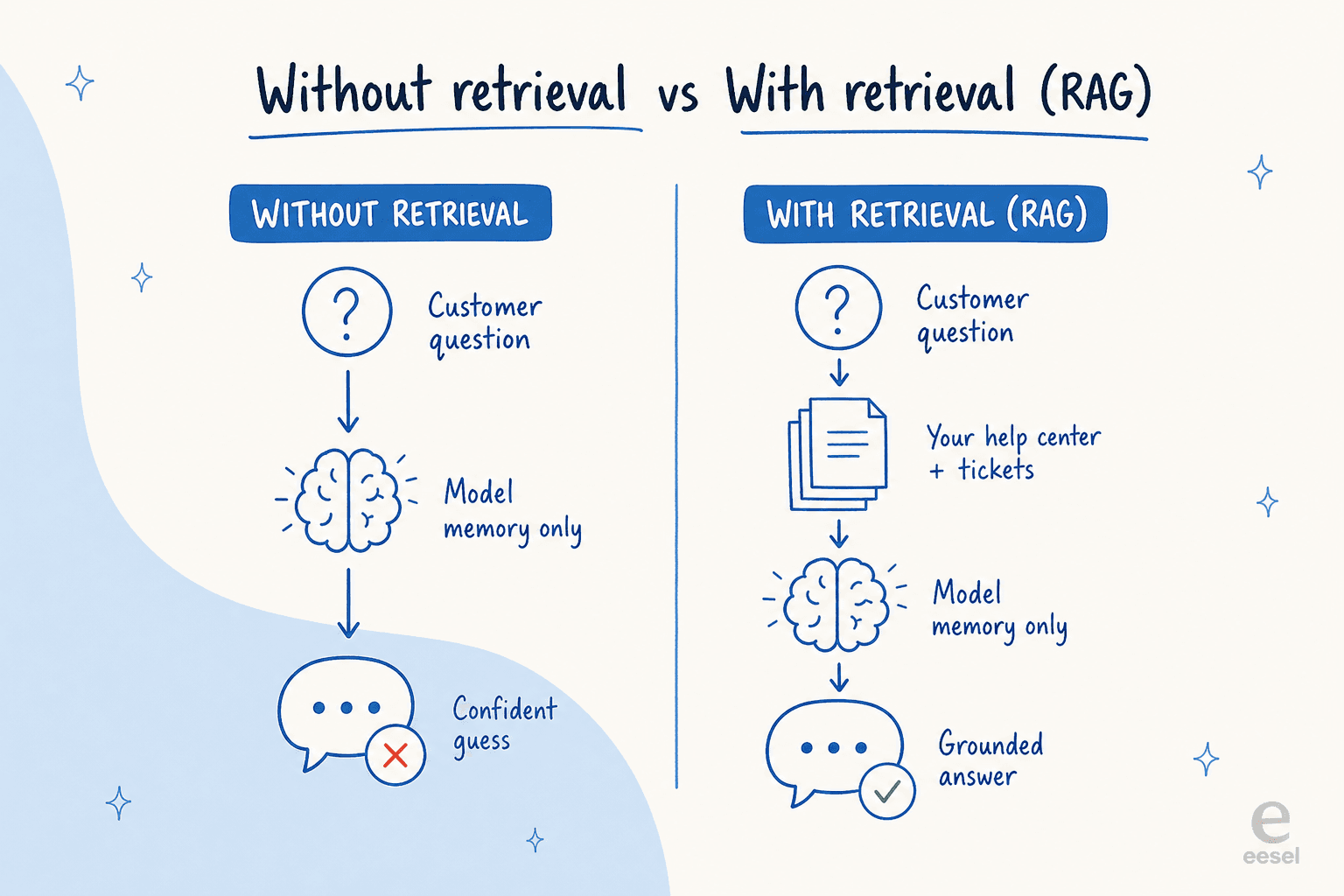
Without retrieval, the same customer question goes straight to the model's memory and comes back as a confident guess. With RAG, the question first pulls the matching passages from your help center and past tickets, so the reply is anchored to what those sources actually say.
How RAG works
A RAG pipeline runs in two phases:
- Index the knowledge. Source documents are split into chunks and converted to embeddings, then stored in a vector database for fast lookup.
- Retrieve at query time. When a question arrives, the system embeds it and runs a semantic search to find the closest matching chunks.
- Augment the prompt. The retrieved passages are inserted into the model's context alongside the question.
- Generate the answer. The model writes a response constrained to what those passages actually say.
A support agent like eesel AI is built on this pattern: it indexes your help center, docs, and historical tickets, retrieves the relevant ones for each incoming question, and answers from them, so the reply reflects your policies rather than the open web.
RAG in practice
The weak link in most RAG systems is retrieval, not generation. If the search step surfaces the wrong chunk, the model writes a confident answer about the wrong thing, and the fluent output masks the bad fetch. That is why teams running RAG in production spend their tuning effort on chunking, embedding quality, and a clear fallback for when nothing relevant is found. A model that says "I don't have that information" beats one that answers smoothly from an irrelevant document.
We go deeper on this in Retrieval-Augmented Generation explained.
Answers grounded in your own knowledge
eesel AI uses retrieval-augmented generation to answer from your help center, docs, and past tickets instead of guessing.