Fine-tuning
Fine-tuning is the process of taking a pre-trained machine learning model and training it further on a smaller, task-specific dataset to adapt its behavior.
What fine-tuning means
Fine-tuning is the process of taking a model that has already been pre-trained on a large general dataset and training it further on a smaller, task-specific dataset so it performs better on a narrower job. The base model keeps everything it learned about language or images, and fine-tuning adjusts its internal weights so its outputs match the new examples more closely. It sits between using a model exactly as shipped and training one from scratch, giving you a specialized model for a fraction of the cost of the latter.
In customer support, fine-tuning has historically been one way to make a general model sound like your brand or classify tickets the way your team does. In practice, though, most support AI today adapts to your business through retrieval and grounding rather than weight changes, because a help center that updates weekly would otherwise demand constant re-training.
Why fine-tuning matters
- It specializes a general model for a specific tone, format, or task without the data and compute cost of training from zero.
- It bakes behavior into the weights, so the model produces the desired style or structure even with a short prompt, instead of relying on long instructions every time.
- It is distinct from retrieval. Fine-tuning teaches the model how to behave, while RAG supplies what facts to use at the moment of the answer.
- It does not solve freshness. A fine-tuned model only knows what it was trained on, so any policy or price that changed after training is stale until you fine-tune again.
- It carries maintenance overhead, since every meaningful change in your knowledge means assembling new examples and running another training pass.
At its core the idea is a small piece of arithmetic: you start with what the base model already knows and add your own examples to it.
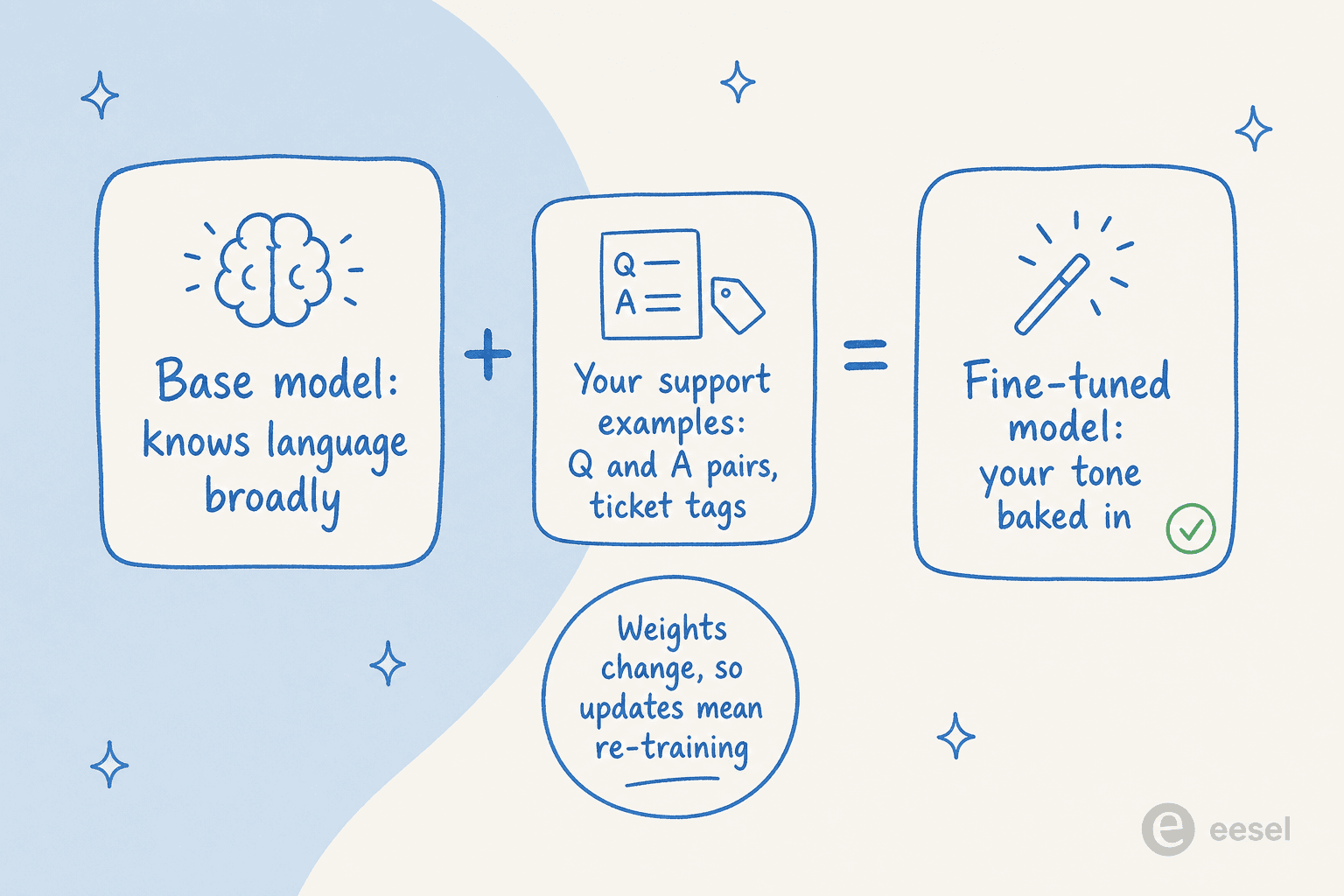
A base model that knows language broadly, combined with your Q-and-A pairs and tagged tickets, produces a model with your tone baked in. The catch is that it lives in the weights, so a changed policy or price means assembling fresh examples and running the pass again.
How fine-tuning works
The typical workflow looks like this:
- Start from a pre-trained base. Choose a foundation model that already handles language broadly.
- Assemble a labeled dataset. Gather task-specific examples, like pairs of customer questions and ideal answers, or tickets tagged with the right category.
- Run the training pass. The model processes those examples and adjusts its weights to reduce the gap between its outputs and your target outputs.
- Evaluate and iterate. You test the tuned model on held-out examples and repeat until quality holds.
For a support agent, this is usually the harder path. A tool like eesel AI skips it: instead of fine-tuning, it grounds every answer in your help center, docs, and past tickets at query time, so when a policy changes you edit the source, not the model. That keeps answers current without a training cycle. Fine-tuning is optional; grounding is what keeps the answers right.
Fine-tuning in practice
The honest operator's rule is to reach for fine-tuning only when prompting and retrieval have hit a real ceiling, usually around consistent formatting or a tricky classification job that examples teach better than instructions do. For everything that depends on facts that move, like prices, policies, and product details, retrieval beats fine-tuning because you update a document instead of retraining a model. Many teams that assumed they needed a custom-trained model find that a well-grounded general model already covers the work, at a fraction of the effort.
We go deeper on this in RAG vs fine-tuning.
Adapt AI to your support without fine-tuning
eesel AI learns your tone and policies by grounding answers in your help center and past tickets, no model fine-tuning required.