Large language model (LLM)
A type of AI model trained on huge amounts of text that predicts language well enough to understand and generate human-like writing.
What a large language model means
A large language model (LLM) is a type of AI model trained on very large amounts of text to predict language, learning the patterns of how words follow one another well enough to understand a prompt and generate coherent, human-like writing. The "large" refers to both the size of the training data and the number of internal parameters the model uses, often billions, which is what lets it handle open-ended language rather than a narrow, pre-scripted set of inputs.
At its core an LLM does one thing: given some text, it predicts what comes next. Repeated over and over, that simple mechanism produces answers, summaries, translations, and code. In customer support, an LLM is the engine that reads a customer's message in plain language and drafts a reply that sounds like a person wrote it, instead of forcing the customer through a rigid menu of buttons.
What makes a large language model different
Earlier language tools matched keywords or followed fixed rules. An LLM is a step change because it can:
- Handle open-ended language rather than a fixed list of intents, so it copes with the messy way people actually phrase questions.
- Generalize across tasks it was never explicitly programmed for, like summarizing a thread, then rewriting a reply in a softer tone.
- Hold context within a context window, so it can follow a multi-turn conversation instead of treating each message in isolation.
- Produce fluent, natural output, which is why its replies read like writing rather than canned responses.
- Adapt to instructions given in plain language, no retraining required for most changes in behavior.
The catch: an LLM is optimized to sound right, not to be right, so on its own it has no built-in connection to your facts.
That catch is why a production support system never ships the raw model. The LLM sits at the center, and the parts that make it trustworthy are layered around it.
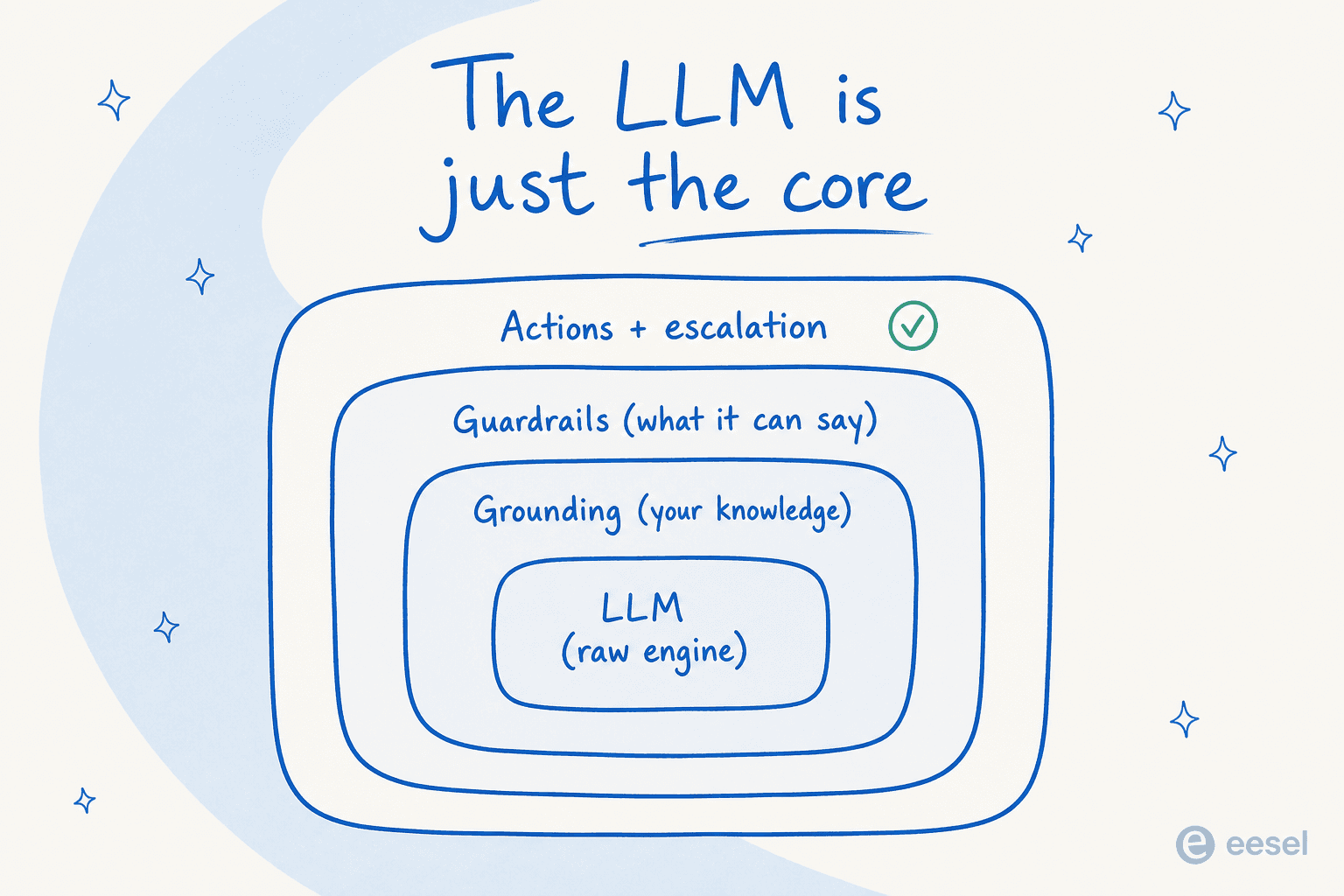
The model supplies fluency. Grounding ties answers to your real content, guardrails bound what it can say, and the outer layer lets it act or escalate. Swap the core model and those layers are still what decide whether the deployment works.
How a large language model works
A support system built on an LLM usually runs a pattern like this:
- Receive the input. The customer's message, plus relevant context, is turned into tokens the model can process. Each unit is an LLM token.
- Predict a response. The model generates the reply one token at a time, each one conditioned on everything before it.
- Ground the answer. Production systems retrieve real source material first so the model writes from your facts, not its training average. This is AI grounding.
- Act or escalate. A capable system can take an action or hand off to a person when it has no confident answer.
A support agent like eesel AI uses an LLM as its reasoning engine but wraps it in retrieval from your help center and past tickets, action-taking inside your helpdesk, and escalation rules, so the fluency of the model is paired with the accuracy of your own knowledge.
Large language models in practice
The model is rarely the deciding factor in whether an AI support deployment works. Two teams using the same underlying LLM can get wildly different results, because the difference is in what surrounds the model: the quality of the knowledge it can retrieve, the guardrails on what it can say and do, and whether it escalates instead of guessing. Treat the LLM as a powerful but ungrounded engine, and build the trust around it.
Put an LLM to work on your support queue
eesel AI wraps a large language model in retrieval, actions, and guardrails so it answers tickets from your own knowledge.