Conversational AI
Technology that lets software hold natural, back-and-forth conversations with people through text or voice.
What conversational AI means
Conversational AI is technology that lets software understand and hold natural, back-and-forth conversations with people through text or voice. Rather than forcing a person through a fixed menu, it interprets messages in everyday language, keeps track of context across turns, and responds in a way that feels like talking to a person rather than operating a machine.
It is an umbrella term that covers the building blocks needed for dialogue: understanding what was said, deciding how to respond, and generating a natural reply. In customer support, conversational AI is what powers a chat widget that a customer can type into freely, or a phone line they can simply describe their problem to, and get a relevant answer instead of "press 1 for billing."
What makes conversational AI different
A scripted phone tree or a keyword bot is not conversational AI. The real thing differs because it can:
- Understand free-form language and pull out intent and details, using natural language understanding rather than matching exact keywords.
- Maintain context across a multi-turn conversation, so it remembers what was said three messages ago instead of resetting each reply.
- Handle variation in how people phrase the same request, where a rigid script would break.
- Work across channels, the same underlying system serving chat, email, and voice through omnichannel support.
- Generate natural responses instead of returning a fixed block of canned text.
The distinction that matters most: understanding a conversation is not the same as resolving the underlying request, which is where action-taking comes in.
Because the terms get tangled together so often, it is worth seeing where they actually overlap.
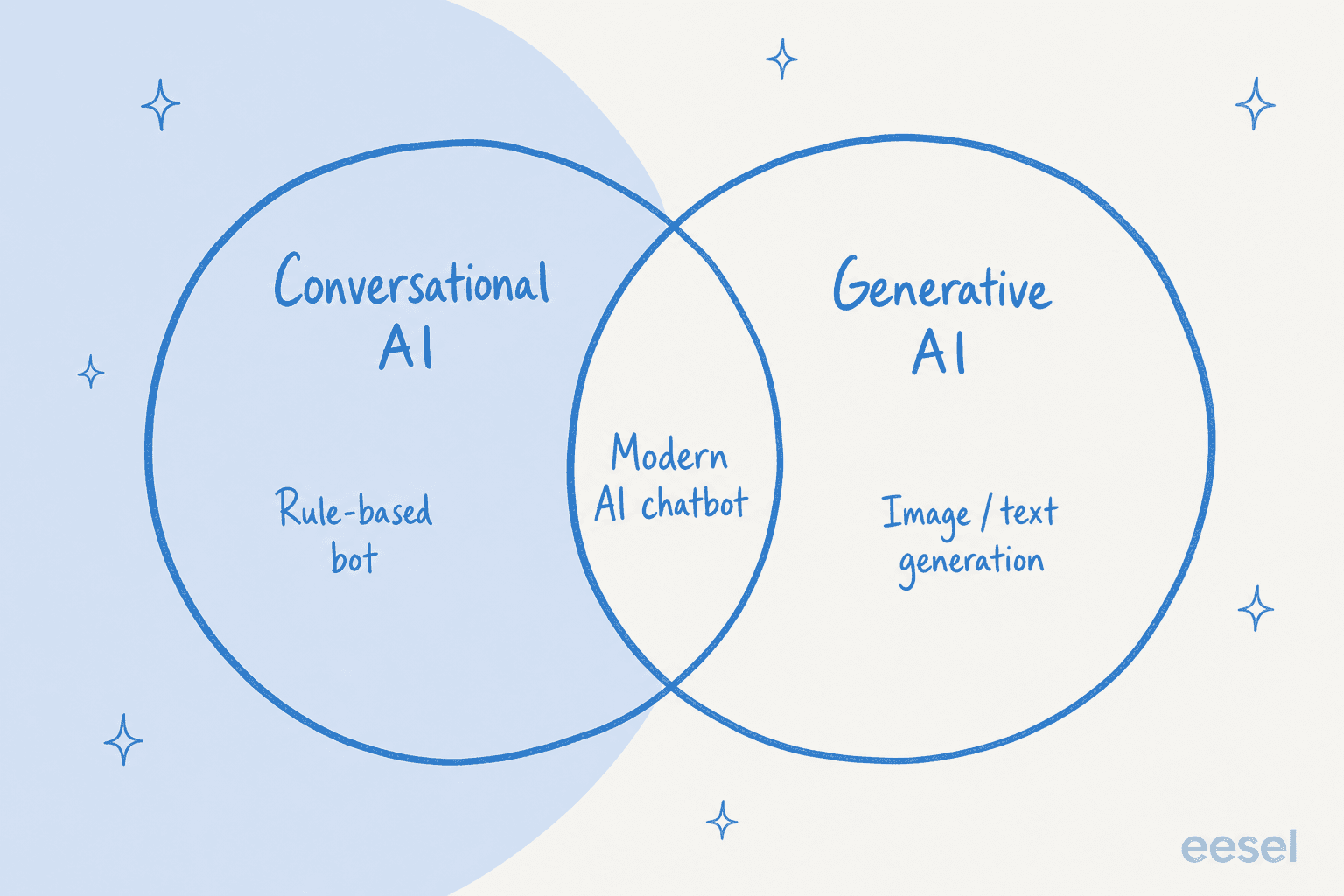
Conversational AI and generative AI are separate sets that overlap rather than the same thing. A rule-based bot is conversational without being generative, image and text generation is generative without being conversational, and a modern AI chatbot lives in the overlap where the two meet.
How conversational AI works
A support conversation usually moves through a pattern like this:
- Capture the input. The customer's message arrives as text, or as speech that is transcribed to text.
- Understand it. The system extracts intent and key details, often via intent detection.
- Decide the response. It retrieves the relevant knowledge and works out what to say or do next.
- Generate the reply. It produces a natural-language answer, or triggers an action like updating a ticket.
- Continue or hand off. It keeps the conversation going, or escalates to a person when it cannot help confidently.
A support agent like eesel AI is conversational AI that also resolves: it talks with the customer in natural language, but grounds every reply in your help center and past tickets and can take real actions in your helpdesk, so the conversation ends in a resolution rather than just a polite exchange.
Conversational AI in practice
The trap with conversational AI is mistaking a good conversation for a good outcome. A system can chat fluently and still leave the customer's problem unsolved, which is more frustrating than an honest "let me get a human." The teams that get the most from it judge it on resolution, not on how natural the dialogue sounds, and they make sure the conversational layer is connected to real knowledge and real actions, so a smooth conversation actually leads somewhere.
We go deeper on this in the benefits of conversational AI.
Conversational AI for your help desk
eesel AI holds natural conversations with customers and resolves tickets using your own knowledge.