Omnichannel support
A support approach that connects every channel a customer might use into one continuous conversation with shared context.
What omnichannel support means
Omnichannel support is an approach to customer service that connects every channel a customer might use, such as email, live chat, phone, and social media, into a single continuous conversation with shared context. The defining feature is continuity: a customer can start on one channel and continue on another without repeating themselves, because the history and context follow them.
This is what separates it from simply being present on many channels. In customer support, omnichannel means an agent (or an AI agent) sees the full history of a customer across every channel, so a chat that began this morning, an email from last week, and a phone call yesterday all read as one relationship rather than three disconnected tickets.
What makes omnichannel support different
The contrast is with multichannel support, where each channel is its own silo. Omnichannel adds connective tissue:
- Shared context across channels, so switching from chat to email does not reset the conversation or lose the history.
- A unified customer view, where every past interaction, regardless of channel, sits in one place inside the helpdesk.
- Consistent answers, because every channel draws from the same knowledge base instead of channel-specific scripts.
- Channel-appropriate handoffs, letting a customer move to the channel that suits the moment, like escalating a chat to a call, without losing thread.
- One reporting surface, so metrics like CSAT and resolution time are measured across the whole experience, not per channel.
Picturing the structure helps explain why the experience feels seamless. Rather than five separate inboxes, every channel points back to the same shared record of the customer.
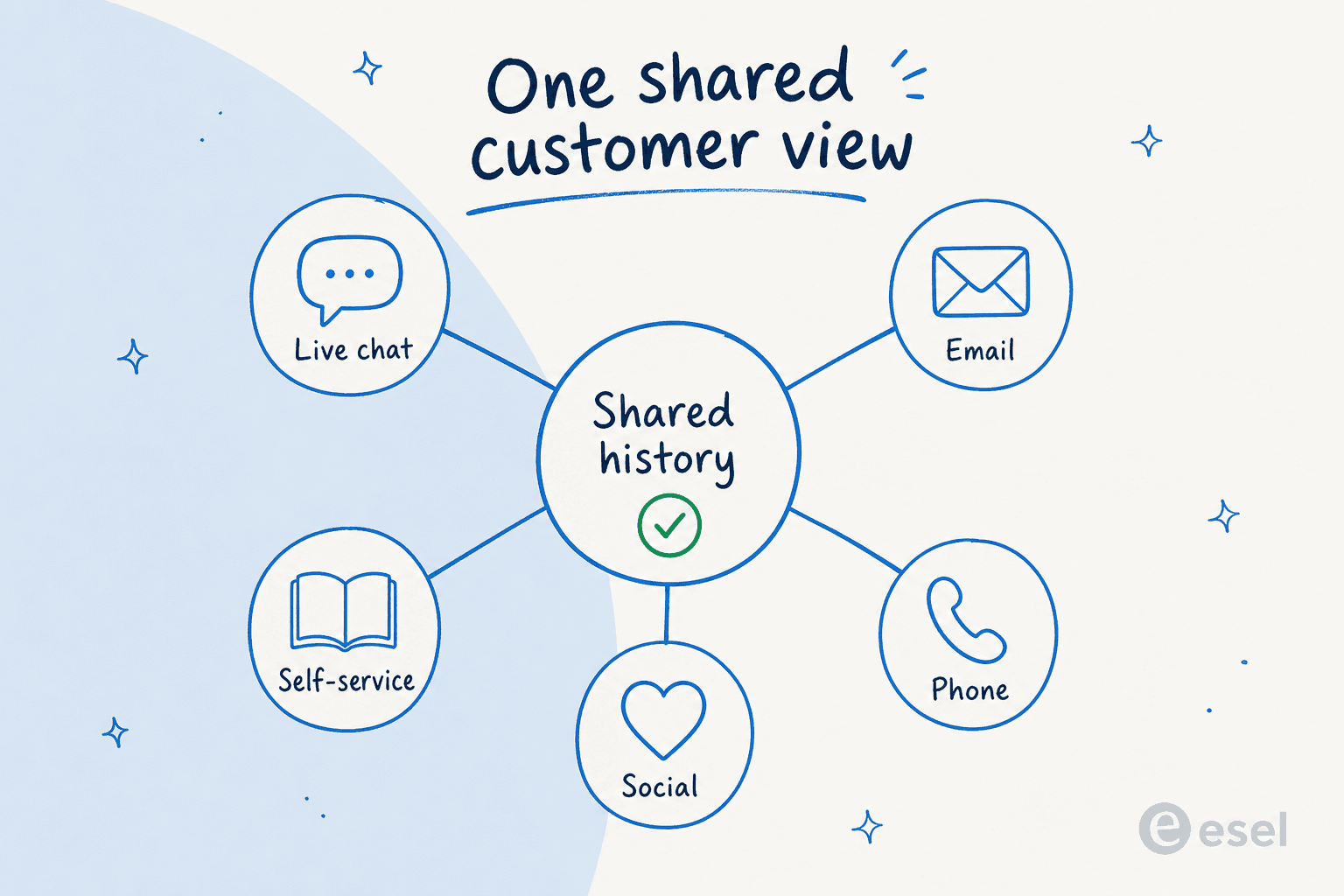
Each channel is a spoke into one hub of shared history, which is exactly what lets a customer move from chat to phone to email without re-explaining. Take away the hub and you are back to multichannel, where every spoke is its own disconnected silo.
How omnichannel support works
In practice, omnichannel support runs on a central system that ingests every channel:
- Unify the inbox. All channels feed into one queue, so each message is linked to the right customer record.
- Carry the context. Past interactions are attached to the customer, so whoever picks up the request can see what came before.
- Answer from one source. Replies pull from a single knowledge base, keeping answers consistent everywhere.
- Route and escalate. Requests move to the right agent or channel with their history intact.
AI fits this model well because it scales the same answer across every channel at once. An agent like eesel AI works inside the helpdesk you already use, answers from one shared knowledge base whether the customer arrives by chat, email, or social, and escalates to a human with the full cross-channel history attached.
Omnichannel support in practice
The hard part of omnichannel is rarely adding another channel, it is keeping the experience coherent once you have several. Teams that do it well treat the helpdesk as the single source of truth and resist letting any channel develop its own separate playbook or knowledge. The payoff is concrete: customers stop re-explaining their problem, customer effort drops, and the team answers from one consistent voice no matter where the conversation started.
Automate support across every channel
eesel AI works across the channels in your helpdesk, answering from one shared knowledge base no matter where the customer reaches out.