CSAT (Customer Satisfaction Score)
A metric that measures how satisfied customers are with a specific interaction, product, or service, usually from a short rating survey.
What CSAT means
CSAT, short for Customer Satisfaction Score, is a metric that measures how satisfied a customer is with a specific interaction, product, or service. It is usually collected with a short survey right after the interaction, asking the customer to rate their experience on a simple scale, and the results are reported as the percentage of responses that count as satisfied.
The math is straightforward: take the number of positive responses, divide by the total responses, and multiply by 100. In customer support, CSAT is the most direct read on whether a given conversation actually left the customer happy, which is why it sits next to metrics like first response time and resolution time on most support dashboards.
Why CSAT matters
CSAT earns its place as a core support metric for a few reasons:
- It is interaction-level, so it captures how a specific ticket or chat went, not a vague overall impression. That makes it actionable.
- It is fast to collect, usually a one-click rating, so response rates are higher than longer surveys.
- It ties to outcomes. Low scores flag friction; sustained low CSAT correlates with churn, while high scores track with retention.
- It can be segmented by agent, channel, topic, or queue, so you can see exactly where satisfaction breaks down.
- It benchmarks automation. When you add an AI agent, CSAT tells you whether automated resolutions are landing as well as human ones.
CSAT is easy to confuse with the two metrics that usually sit beside it on a dashboard, and each answers a different question:
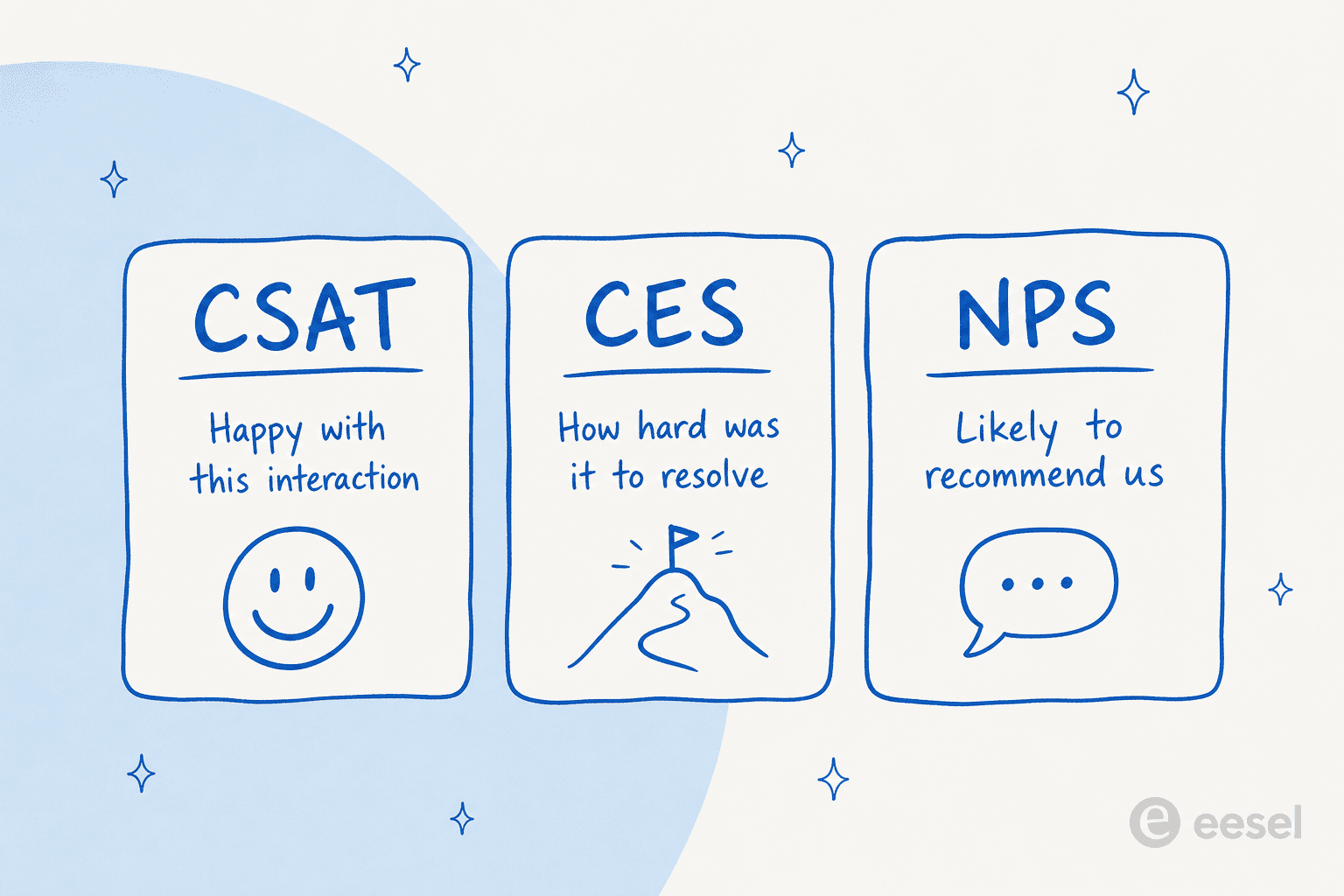
CSAT asks whether a single interaction left the customer happy, CES asks how much effort it took to get the issue resolved, and NPS asks how likely they are to recommend you overall. They are complementary, not interchangeable.
How CSAT works
A CSAT program runs in a simple loop:
- Trigger the survey. Just after an interaction closes, the customer gets a short rating prompt. This is the CSAT survey.
- Collect responses. Customers rate the experience, often with an optional comment.
- Calculate the score. Positive responses are divided by total responses to get the CSAT percentage.
- Act on the gaps. Teams dig into low scores by segment to find and fix the root cause.
CSAT is also how you keep automation honest. An agent like eesel AI grounds its answers in your help center and past tickets and escalates when it is unsure, and because every resolution can be measured against CSAT, you can confirm that automated replies are scoring as well as your human team rather than quietly dragging satisfaction down.
Drop in your own survey numbers to see where your score lands:
Enter your positive, neutral, and negative response counts to watch the gauge fill and land in the needs-work, solid, or strong band.
CSAT in practice
The trap with CSAT is reading the headline number and stopping there. The score on its own rarely tells you what to fix; the value is in the segments and the comments behind it. A team might sit at a healthy overall CSAT while one channel or one topic quietly tanks. The operators who get the most from CSAT pair it with customer effort, watch it per topic and per agent, and treat each low rating as a thread to pull rather than a number to average away.
For a hands-on walkthrough, read CSAT with AI.
Protect CSAT while you automate
eesel AI answers from your own knowledge and escalates when unsure, so automating support does not cost you customer satisfaction.