CSAT survey
A short questionnaire that asks customers to rate how satisfied they were with a specific interaction, product, or service.
What a CSAT survey means
A CSAT survey is a short questionnaire that asks customers to rate how satisfied they were with a specific interaction, product, or service, usually with a single question such as "How satisfied were you with the support you received?". Respondents answer on a simple scale, often 1 to 5 or a set of faces from very unsatisfied to very satisfied, and the results roll up into the CSAT metric. Because it is short and asks about one moment, a CSAT survey captures satisfaction while the experience is still fresh.
In customer support, a CSAT survey is the most common way to find out whether a resolved ticket actually left the customer happy. It usually fires automatically when a conversation closes, and the rating gets attached to that ticket, the agent who handled it, and the channel it came through, so a team can see satisfaction at the level of a single interaction rather than a vague overall impression.
Why a CSAT survey matters
- It measures one interaction, not the whole relationship. Unlike loyalty metrics, a CSAT survey is tied to a specific resolved ticket, which makes it actionable: you can trace a low score back to the exact conversation that produced it.
- It catches problems while they are fixable. A 2 out of 5 on a just-closed ticket is an early warning, often early enough to reopen the conversation and recover the customer.
- It segments cleanly. Scores can be sliced by agent, channel, topic, language, or product area, so a team can see whether a dip is everywhere or isolated to one queue.
- It is short enough to get answered. A one-question prompt has a far higher response rate than a long questionnaire, which keeps the sample large enough to trust.
- It pairs with operational metrics. A CSAT survey explains the "how did it feel" side, while metrics like first response time and resolution time explain the "how fast" side.
It also helps to know where a CSAT survey sits next to the other two questionnaires teams reach for, since each one is really asking something different:
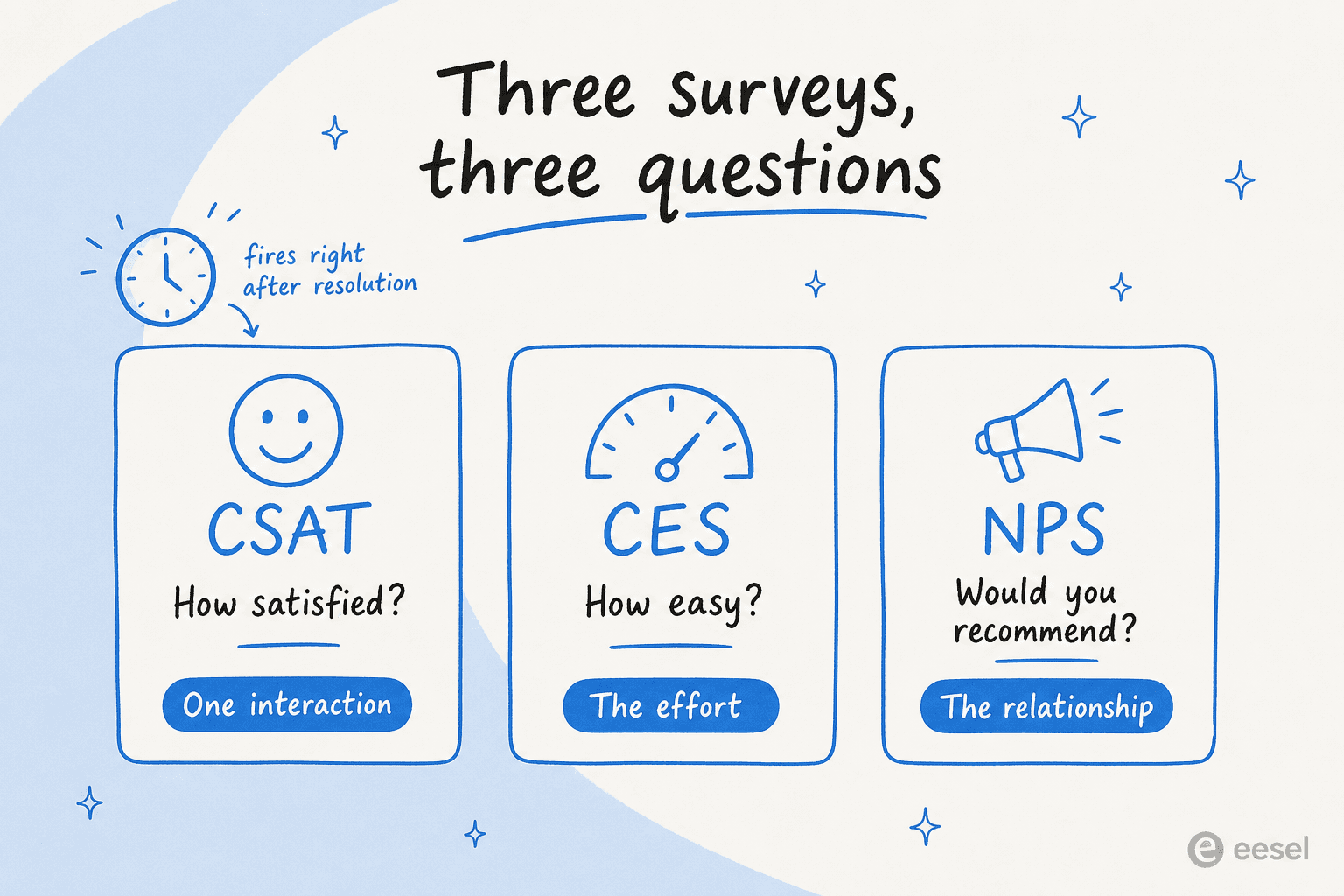
CSAT asks how satisfied a customer was with one interaction and fires right after a ticket closes. CES asks how easy it was to get help, and NPS zooms out to the whole relationship. Reaching for the right one starts with knowing which question you actually need answered.
How a CSAT survey works
A typical CSAT survey runs in a few steps:
- Pick the trigger. Decide the moment to measure, most often ticket resolution, and configure the survey to fire automatically at that point.
- Ask one clear question. Keep it to a single satisfaction question on a fixed scale, with an optional free-text follow-up for context.
- Collect responses. The rating is logged against the ticket, agent, and channel so it can be filtered later.
- Calculate CSAT. Divide the number of positive responses (for example, 4s and 5s on a 5-point scale) by the total responses, then multiply by 100 to get a percentage.
- Act on the comments. Read the free-text replies for the "why," then route recurring complaints back into knowledge gaps or process fixes.
When an AI agent like eesel AI handles the front line, the CSAT survey still fires on resolution, so AI-resolved tickets are measured on the same scale as human-resolved ones. Because eesel AI grounds every answer in your help center and past tickets and escalates when it is unsure, the conversations behind those scores stay accurate, which is what keeps automated CSAT from sliding.
A CSAT survey in practice
The trap with a CSAT survey is reading the headline number and stopping there. The free-text box is where the real signal lives: a string of 3-star ratings with comments like "took three replies to get it sorted" is telling you the issue is effort and follow-ups, not tone. Tie low scores back to the originating tickets, watch the trend rather than any single week, and treat the survey as a starting point for investigation, not a scoreboard. A score that is high but slowly slipping usually means something specific broke recently, and the comments will name it before the number does.
Keep CSAT high while you automate
eesel AI resolves repetitive tickets with grounded answers and escalates the hard ones, so the conversations behind your CSAT scores stay good.