NPS (Net Promoter Score)
A loyalty metric that measures how likely customers are to recommend a company, based on a single 0 to 10 question.
What NPS means
NPS, or Net Promoter Score, is a loyalty metric that measures how likely customers are to recommend a company, product, or service to others, based on a single question: "How likely are you to recommend us to a friend or colleague?" answered on a 0 to 10 scale. Respondents are sorted into three groups: promoters (9 to 10), passives (7 to 8), and detractors (0 to 6). The score is the percentage of promoters minus the percentage of detractors, producing a single number between -100 and +100.
In customer support, NPS is the metric that connects day-to-day service to long-term loyalty. While a CSAT score tells you how one ticket felt, NPS tells you whether the overall relationship is strong enough that the customer would put their own reputation on the line to recommend you, and support is one of the biggest levers on that answer.
Why NPS matters
- It predicts growth, not just mood. A recommendation is an action with social risk attached, so promoters tend to drive referrals and renewals, which ties NPS to customer retention and revenue.
- It is a single, comparable number. Because everyone calculates it the same way, NPS travels well across teams, products, and industry benchmarks.
- It separates loyalty from satisfaction. A customer can be satisfied with a recent ticket yet still a detractor overall, and NPS surfaces that gap that a transactional survey misses.
- It flags churn risk early. A growing pool of detractors is an early signal that something structural is wrong, often before it shows up in customer churn numbers.
- It frames the follow-up question. Pairing the score with "what is the main reason for your rating?" turns a number into a list of fixable causes.
What makes NPS actionable for a support team is seeing which everyday service moments actually push a customer between groups. The score does not drift on its own, specific experiences move it.
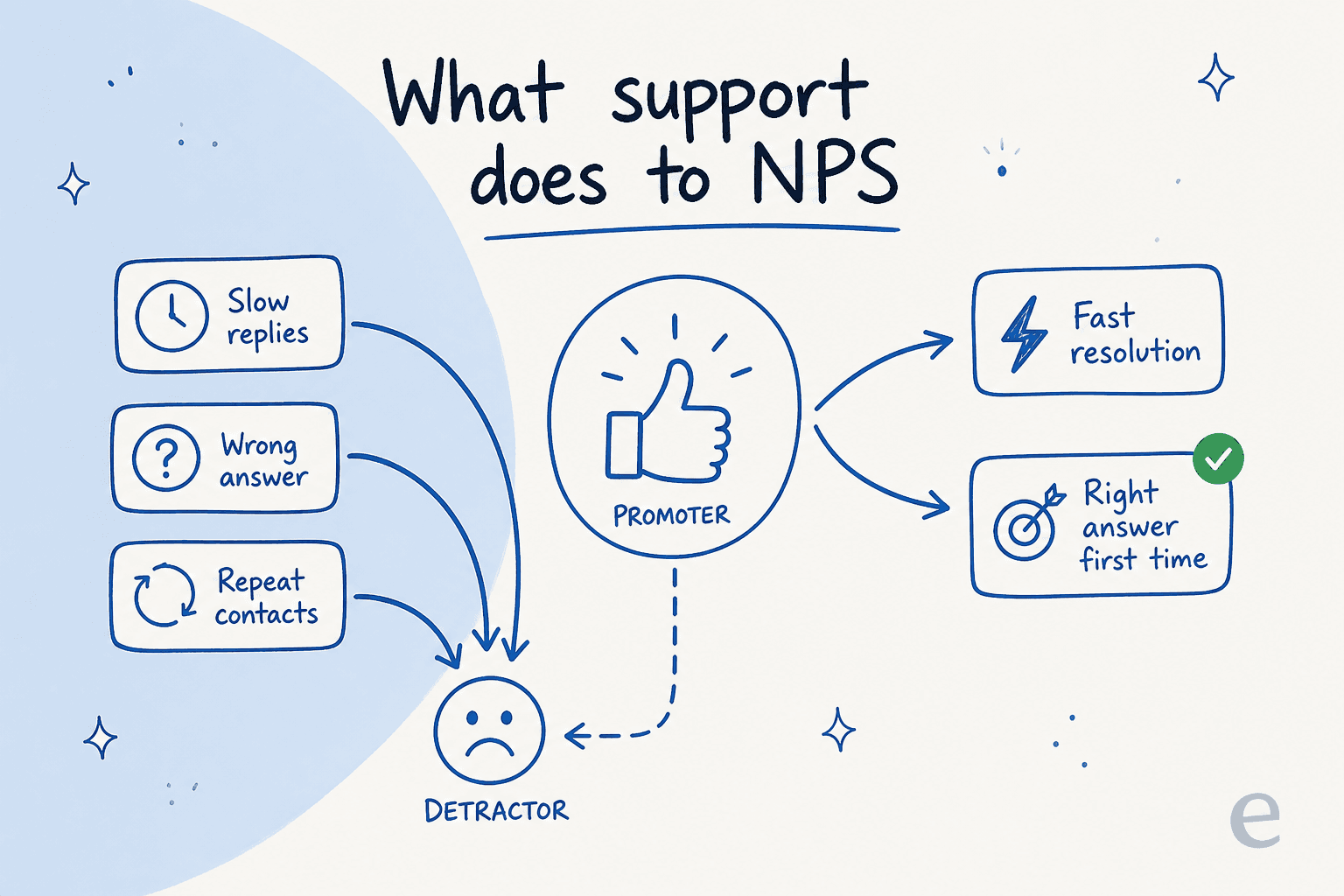
Slow replies, a wrong answer, or being forced to ask the same thing twice are the classic ways a promoter quietly slides toward detractor. A fast, correct resolution on the first try pulls the other way, which is why support is one of the highest-leverage places to move the number.
How NPS works
Calculating NPS follows a fixed pattern:
- Ask the question. Send the 0 to 10 recommendation question, usually on a relationship cadence (quarterly or after a milestone) rather than after every interaction.
- Bucket the responses. Sort answers into promoters (9 to 10), passives (7 to 8), and detractors (0 to 6).
- Calculate the score. Subtract the percentage of detractors from the percentage of promoters. For example, 60 percent promoters minus 15 percent detractors gives an NPS of 45.
- Read the follow-up. Use the free-text reason to understand what is driving each group.
- Close the loop. Follow up with detractors directly, and feed recurring themes back into product and support.
Support is one of the clearest places NPS moves, because a slow or wrong answer is a fast way to create a detractor. An AI agent like eesel AI keeps resolutions fast and grounded in your own knowledge, and escalates the cases it should not guess on, which removes one of the most common reasons a promoter quietly slips toward a detractor.
NPS in practice
NPS is most useful as a trend with a "why" attached, not as a vanity number on a slide. The headline score tells you direction, but the verbatim reasons tell you what to do, and the most valuable segment to read closely is the detractors who left a comment. Watch the score by cohort and by recent support volume, because a sudden dip often traces back to a specific release, outage, or policy change. Used well, NPS is less a report card than a queue of the relationships most at risk, and the customers worth calling this week.
Protect loyalty as you automate support
eesel AI resolves repetitive tickets with grounded answers and clean escalations, so support stops being the reason customers turn into detractors.