Customer churn
The rate at which customers stop doing business with a company over a given period, usually expressed as a percentage of the starting customer base.
What customer churn means
Customer churn is the rate at which customers stop doing business with a company over a set period, usually expressed as the percentage of the starting customer base that left. It is the headline measure of how many relationships a business is losing, and it sits at the opposite end of the scale from how many it keeps. Churn can be measured by number of customers, by accounts, or by the recurring revenue those customers represented.
In customer support, churn is the metric the support team quietly influences more than almost any other. A customer rarely leaves over one issue alone, but a string of slow replies, unresolved tickets, or being passed between agents is one of the most common reasons people walk. Support is where dissatisfaction either gets defused or hardens into a decision to cancel.
Why customer churn matters
- It is more expensive to replace than to keep. Winning a new customer typically costs far more than retaining one, so every churned account erodes the return on acquisition spend.
- It compounds against growth. High churn means a business has to acquire faster just to stand still, because new customers are filling a leaking bucket.
- It is a lagging signal of a real problem. Churn shows up after the dissatisfaction, so the moments that caused it, a bad onboarding or a frustrating ticket, happened weeks earlier.
- It hits revenue unevenly. Losing a few large accounts can do more damage than losing many small ones, which is why teams track revenue churn alongside the customer count.
- It is partly preventable at the support stage. A meaningful share of churn traces back to service friction, which makes resolution speed and quality a direct retention lever.
A useful way to hold all of this in your head is the leaky bucket: acquisition pours customers in the top while churn drains them out through holes in the side.
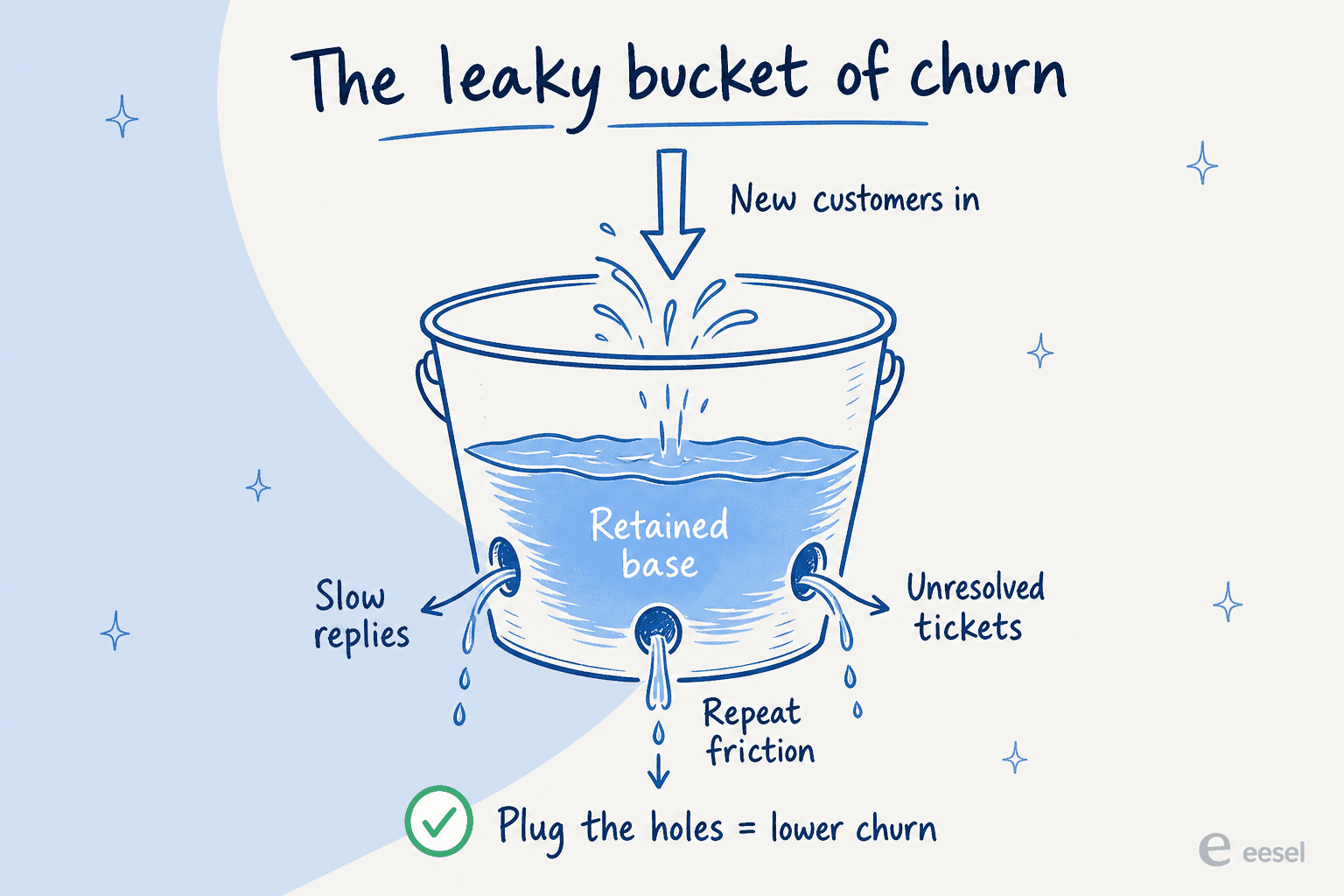
The water level is your retained base, and many of the holes are support-shaped: slow replies, unresolved tickets, and the same friction coming back again. Pouring in more customers raises the level for a while, but plugging the holes is what actually keeps the bucket full.
How customer churn works
Reducing churn through support follows a clear pattern:
- Spot the at-risk signals. Repeated tickets, falling CSAT, and long resolution times often precede a cancellation.
- Resolve issues before they fester. The faster and more completely a problem is solved, the less it weighs on the renewal decision.
- Remove the repeat friction. If the same question keeps coming back, fix the underlying gap in docs or product, not just the individual ticket.
- Make help effortless. A customer who can get an instant, accurate answer is far less likely to give up than one stuck in a queue.
This is where a tool like eesel AI earns its place: it answers customers instantly from your help center and past tickets, takes actions in the helpdesk, and escalates to a person when it is unsure. By cutting wait times and unresolved tickets, it removes some of the most common service-driven reasons customers leave.
Customer churn in practice
The trap with churn is treating it as a single number to report rather than a symptom to diagnose. The teams that actually move it dig into why customers left, segment churn by cohort and cause, and trace a worrying share of it back to the support experience. Fixing the slow, repetitive, or unresolved tickets that quietly push people out is usually cheaper and faster than any new acquisition campaign aimed at backfilling the loss.
Want the full playbook? See our guide to AI churn prevention.
Cut the support friction that drives churn
eesel AI resolves customer questions fast and accurately so a slow support experience stops pushing people out the door.