Customer lifetime value (CLV)
The total revenue a business can expect from a single customer across the entire length of their relationship.
What customer lifetime value means
Customer lifetime value, often shortened to CLV or LTV, is the total revenue a business can expect from a single customer across the entire length of their relationship. Instead of looking at a single purchase, it estimates the full economic worth of a customer from their first transaction to their last. It is usually calculated from the average value of a purchase, how often the customer buys, and how long they stay before leaving.
In customer support, CLV is the metric that reframes what support is for. A resolved ticket is not just a closed case, it is a small investment in keeping a relationship alive long enough to realize its full value. When support extends how long customers stay and how much they trust the brand, it lengthens the lifespan and the spend that CLV is built on.
Why customer lifetime value matters
- It sets the acquisition budget. Knowing what a customer is worth over time tells you how much you can sensibly spend to acquire and serve them.
- It rewards retention over churn. Because lifespan drives the formula, anything that keeps customers longer raises CLV more than a one-off upsell does.
- It exposes the cost of bad service. A short, frustrated relationship has a low lifetime value, which makes service failures a measurable hit to the bottom line.
- It guides where to invest. Segments with high CLV justify more attention, including faster, higher-touch support.
- It connects support to revenue. CLV gives the support team a clear line from a fast resolution to a longer, more valuable relationship.
There are really only a handful of places the number can move, and it helps to see them side by side.
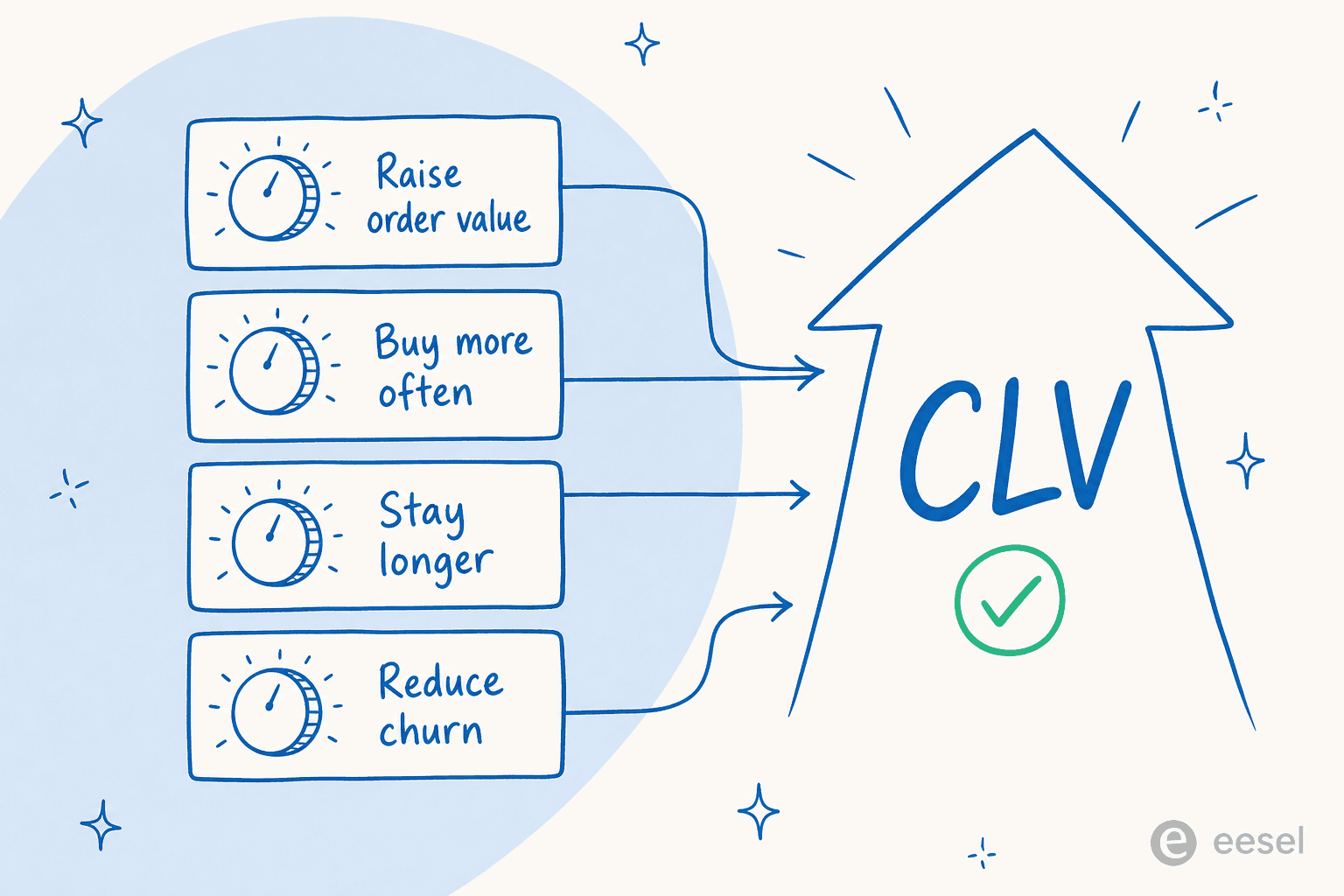
Each dial is a lever you can turn: a bigger average order, more frequent purchases, a longer relationship, or less churn. Turn any of them and the CLV figure on the right climbs, with the two that touch lifespan usually carrying the most weight.
How customer lifetime value works
Teams influence CLV through support in a repeatable way:
- Keep customers longer. Every churned customer cuts their lifespan short, so reducing the service friction behind churn directly protects CLV.
- Encourage repeat purchases. A customer who trusts the support behind a product buys again with less hesitation.
- Lower the cost to serve. CLV is about value, so resolving issues efficiently keeps the relationship profitable, not just long.
- Build the trust that drives advocacy. Customers who feel well looked after refer others, adding value beyond their own spend.
A tool like eesel AI contributes on both sides of the equation: it resolves customer questions instantly from your help center and past tickets, which keeps customers happy and extends the relationship, while handling volume efficiently so the cost to serve stays low. The result is longer, more profitable relationships rather than ones cut short by poor service.
To see how those inputs combine, plug your own numbers into the estimate below.
Step the four factors up or down and watch each line of the math build toward what one customer is really worth.
Customer lifetime value in practice
The mistake teams make is treating CLV as a finance metric that lives far from day-to-day support. In reality the support queue is one of the most direct places it gets made or broken, because every slow or unresolved ticket nudges the customer's lifespan shorter. Operators who connect support performance, resolution speed, satisfaction, and reopen rates, to CLV tend to make better calls about where to invest, because they can see that keeping a customer one more renewal cycle is often worth more than the entire campaign that won them.
Protect lifetime value at the support stage
eesel AI keeps customers happy with fast, accurate resolutions, extending the relationships that drive lifetime value.