Customer retention
The ability of a company to keep its existing customers over time, usually measured as the percentage of customers who remain across a given period.
What customer retention means
Customer retention is a company's ability to keep its existing customers over time, usually expressed as the percentage of customers who remain across a given period. It measures the strength of the relationships a business already has, rather than its ability to win new ones, and it is the direct counterpart to churn: a high retention rate means few customers are leaving. Most teams track it monthly, quarterly, or annually depending on how their billing works.
In customer support, retention is the outcome the team most directly shapes. The support experience is where an existing relationship is tested, and a customer who gets fast, accurate help has one more reason to stay, while one stuck in a queue has one more reason to look elsewhere. Support is a retention function as much as a service one.
Why customer retention matters
- It is cheaper than acquisition. Keeping a customer costs a fraction of winning a new one, so retention is among the highest-return uses of a team's effort.
- Retained customers spend more. Existing customers tend to buy more over time and try new products, which lifts customer lifetime value.
- Small gains compound. A few points of improved retention can outweigh a large acquisition push, because the effect stacks period after period.
- It signals product and service health. Steady retention shows the product delivers and the service holds up, while a dip is an early warning that something is going wrong.
- Support has direct leverage. Resolution speed and quality are concrete, controllable inputs to retention, unlike many broader loyalty drivers.
The economics behind all of this come down to a simple gap:
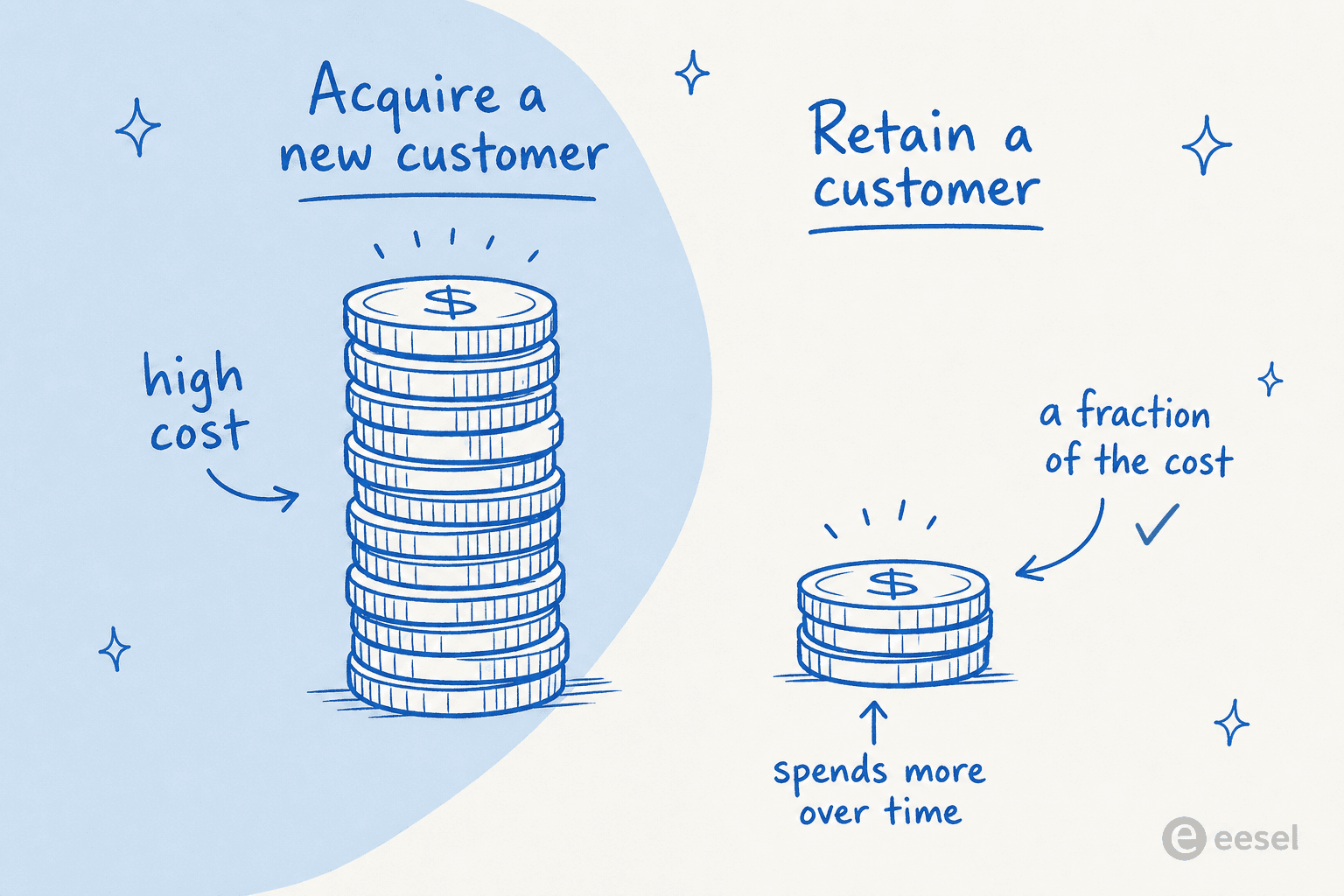
Winning a brand-new customer is expensive, while keeping one already in the door costs a fraction of that and tends to pay back more over time. That gap is why a few points of retention can outweigh a much larger acquisition push.
How customer retention works
Improving retention through support follows a familiar loop:
- Make help fast and accurate. The quicker a customer gets a correct answer, the less friction sits between them and renewal.
- Resolve fully, not partially. A half-answered ticket that reopens later does more damage than a slightly slower complete resolution.
- Remove recurring pain. When the same issue keeps surfacing, fix the underlying cause so it stops eroding the relationship.
- Keep the experience consistent. Reliable service across every contact builds the trust that keeps people around.
A tool like eesel AI supports this directly: it learns from your help center, docs, and past tickets, answers customers instantly, takes actions in the helpdesk, and escalates to a human when confidence is low. By resolving more questions faster, it turns the support stage into a reason to stay rather than a reason to leave.
Customer retention in practice
The practical lesson is that retention is rarely won with a single grand gesture, like a loyalty program. It is won by removing the small, repeated frustrations that quietly accumulate, and support is where most of those live. Teams that treat the support queue as a retention lever, watching resolution speed, reopen rates, and satisfaction, tend to hold onto customers better than those that pour the same energy into acquisition while the back door stays open.
For a deeper look, read retaining customers with AI.
Turn support into a retention engine
eesel AI resolves customer questions quickly and accurately, making the support experience a reason to stay rather than a reason to leave.