AI content detection
AI content detection is the use of software that estimates the probability a piece of text was generated by an AI model rather than written by a human.
What AI content detection means
AI content detection is the use of software that estimates the probability a passage of text was generated by an AI model rather than written by a person. These tools analyze statistical patterns in the writing, things like how predictable each word is given the words before it, and return a score or label suggesting how likely the text is machine-generated. The output is always a probability, not a definitive answer.
In content marketing and SEO, AI detection has become a gatekeeping step that editors, agencies, and publishers run drafts through before publishing. The underlying worry is that mass-produced, unedited AI text reads as generic and adds nothing original, which is the exact pattern search engines and readers learn to discount. So detection is less about catching a machine and more about flagging content that has not had enough human judgment applied to it.
Why AI content detection matters
- It is a proxy for effort, not authorship. A high "AI" score usually correlates with flat, templated prose, which is the same thing that hurts rankings and reader trust regardless of who or what wrote it.
- Detectors are probabilistic and beatable. They flag false positives on human writing and miss edited AI text, so no team should treat a score as proof.
- Search engines do not rank by detector score. Google's stated position is that helpful, original content is fine however it was made, which shifts the real question from "is this AI" to "is this good."
- It pressures content velocity strategies. Teams scaling output with AI content generation have to pair volume with editing, sourcing, and voice, or the work reads exactly like everything else a model produces.
- It intersects with disclosure norms. Some industries and clients require labeling AI involvement, so detection feeds compliance as much as quality control.
Plotting detector score against actual quality shows why the two are easy to confuse.
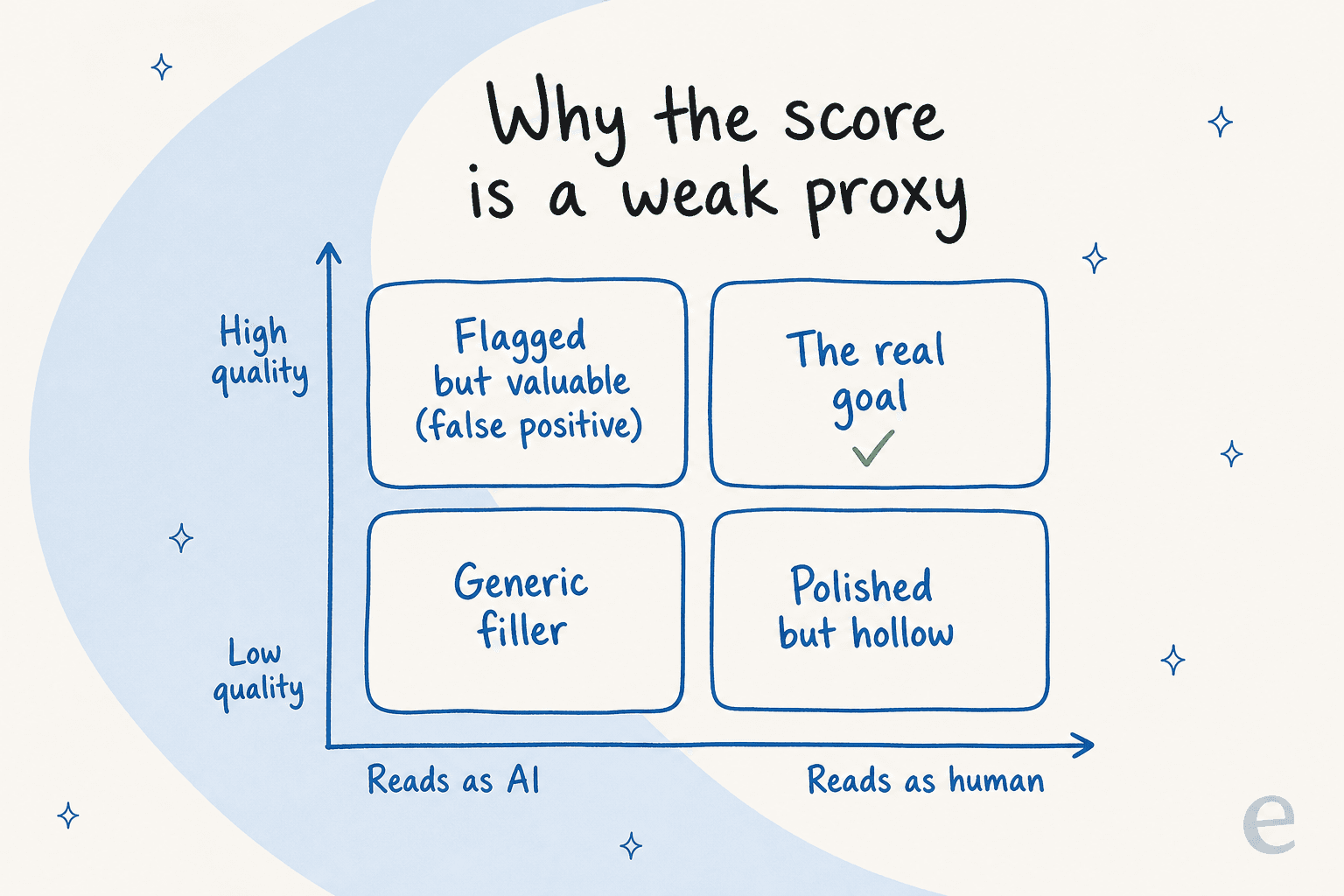
Valuable writing sometimes lands in the flagged corner, and polished text can be hollow, so the score and the quality sit on different axes. The goal lives in the top-right quadrant: text that reads as human because it actually is good.
How AI content detection works
- Tokenize the text. The detector breaks the passage into tokens and looks at the sequence the way a language model would.
- Measure predictability. It scores how "surprising" each token is. AI text tends to be smoother and more predictable (low perplexity, low burstiness) than the uneven rhythm of human writing.
- Compare against learned patterns. A classifier trained on human and machine samples maps those statistics to a probability.
- Return a score. The tool outputs a likelihood or a label, often with sentence-level highlights.
This is the failure mode a tool like eesel AI is built to avoid on the production side. Its blog writer researches a topic against real sources, drafts long-form articles, and writes in your defined voice, so the output carries original framing and specific detail rather than the generic, high-predictability text that detectors and readers both flag. The point is not to trick a detector, it is to produce content worth keeping.
AI content detection in practice
Treat detector output as a review trigger, never a publishing gate. A flagged draft is a prompt to ask whether the piece says anything a competitor could not have generated in thirty seconds: original research, a real example, a point of view, a specific number. Teams that chase a "100% human" score by paraphrasing tend to produce worse content than teams that ignore the score and invest in making the piece truly useful. The durable strategy is to write so well that the question of detection stops mattering.
We go deeper on this in how AI content detectors work.
Write content that reads like a person
eesel's AI blog writer drafts long-form, source-grounded articles in your voice, so the output reads like editorial work, not a generic model dump.