E-E-A-T
E-E-A-T stands for Experience, Expertise, Authoritativeness, and Trustworthiness, the qualities Google's raters use to judge content quality.
What E-E-A-T means
E-E-A-T stands for Experience, Expertise, Authoritativeness, and Trustworthiness, a set of qualities that Google's human Search Quality Raters use to assess how good a piece of content is. It comes from Google's Search Quality Rater Guidelines: Experience is first-hand involvement with the topic, Expertise is the depth of knowledge behind the content, Authoritativeness is the reputation of the author and site on the subject, and Trustworthiness, which Google calls the most important of the four, is whether the page and its claims can be relied on.
E-E-A-T is not a number the algorithm calculates, and Google is clear that it is not a direct ranking factor. It is a framework for what good content looks like, and Google tunes its systems to reward pages that demonstrate these qualities. In content marketing and SEO, that makes E-E-A-T a useful target even though you cannot optimize it directly: the signals that satisfy a human rater, like named expert authors, cited primary sources, and demonstrable first-hand experience, are the same signals that tend to correlate with strong rankings, especially on topics where being wrong carries real consequences.
Why E-E-A-T matters
E-E-A-T has become central to content strategy, particularly as AI-generated text floods the web. It matters because it:
- Separates credible content from filler, rewarding pages that show real experience and expertise over generic rewrites of the same material.
- Weighs heaviest on high-stakes topics, where health, finance, and safety content (Google's "Your Money or Your Life" pages) is held to the strictest trust bar.
- Rewards verifiable claims, since trust comes from citing primary sources a reader can check, not from confident assertion.
- Counters thin AI content, the exact pattern that AI content detection and quality raters are designed to catch.
- Builds on topical authority, where a site known for deep, accurate coverage of a subject inherits credibility on each new page in that area.
The four letters are not a flat checklist. They stack, with trust as the base that everything else rests on.
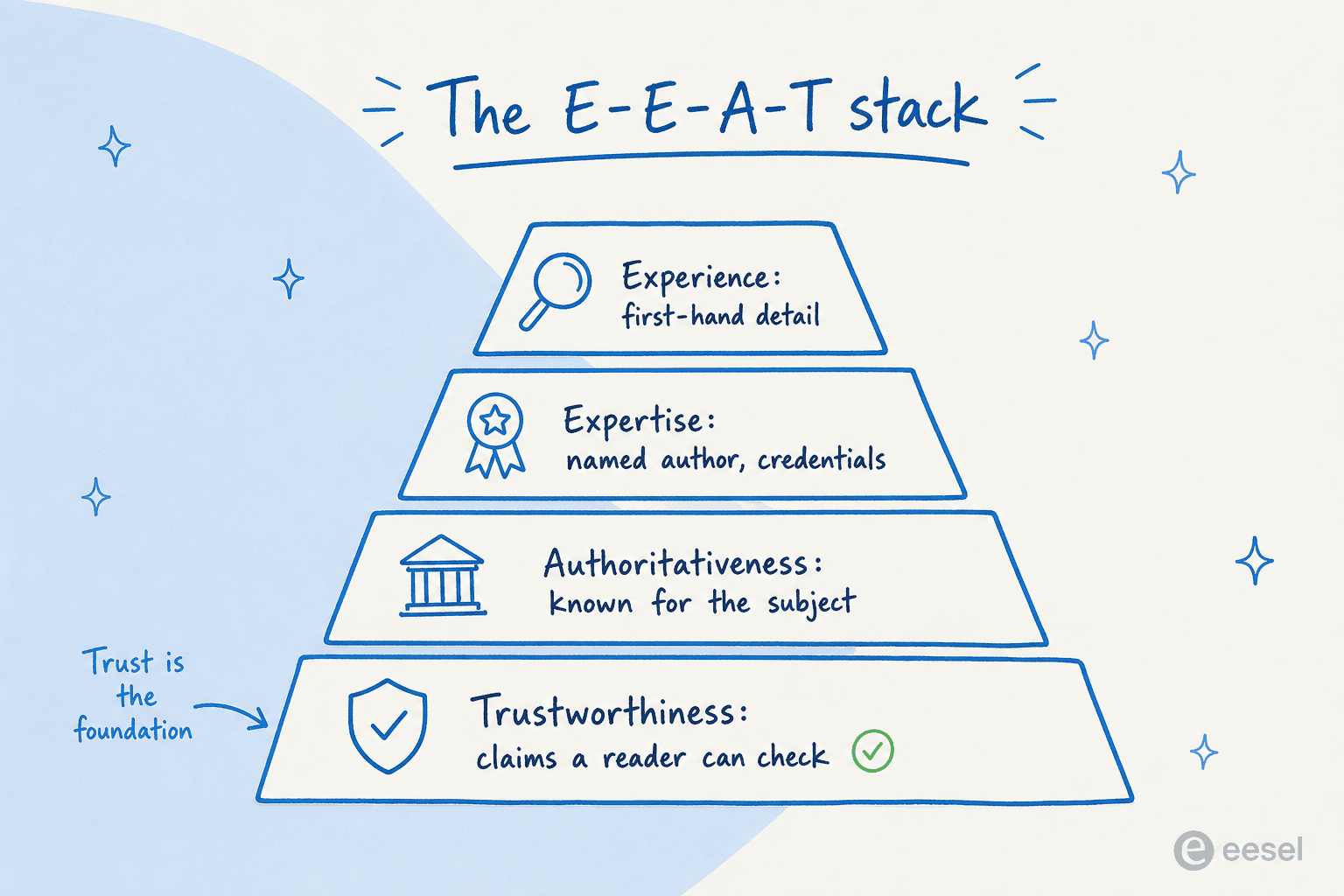
Google calls trustworthiness the most important of the four, so claims a reader can verify sit at the bottom and hold up the layers above. Each layer also maps to a concrete signal, from cited sources at the base to first-hand detail at the top.
How E-E-A-T works in content
Demonstrating E-E-A-T comes down to the signals on and around a page:
- Show experience. Include first-hand detail, specifics, and evidence that the writer actually used or lived the subject, not just researched it.
- Attribute expertise. Name the author, show relevant credentials, and have subject experts write or review the content.
- Cite authoritatively. Link to primary sources and reputable references so claims are traceable.
- Build trust. Keep facts accurate and current, be transparent about who you are, and avoid misleading or unsupported statements.
For AI-assisted content, this is the dividing line. An AI blog writer like eesel AI grounds each draft in real sources and surfaces citations, so the output carries the verifiable, source-backed quality E-E-A-T rewards, then a named human expert reviews and adds genuine experience. AI content that skips that grounding and review is exactly the thin material the framework is built to demote.
E-E-A-T in practice
The practical takeaway is that E-E-A-T cannot be faked at scale, only earned. There is no markup, plugin, or score to set; the qualities have to actually exist in the content and the people behind it. The teams that win on E-E-A-T treat it as an editorial standard rather than an SEO tactic: real authors with real names, claims backed by sources a reader can click, and first-hand experience woven into the writing. AI can speed up the research and drafting, but the experience, the expertise, and the accountability still have to come from a real operator, which is precisely the signal the framework exists to reward.
For a deeper breakdown, see E-E-A-T SEO explained.
Write content that signals E-E-A-T
eesel AI grounds every draft in real sources and cites them, so AI-assisted content carries the trust signals that thin content lacks.