Topical authority
Topical authority is the depth and breadth of trustworthy content a site has on a subject, which helps it rank across an entire topic.
What topical authority means
Topical authority is the depth and breadth of trustworthy content a website has on a particular subject, which makes search engines more likely to rank it across the whole topic rather than for a single page. A site with topical authority is one that has covered a subject so thoroughly, and so credibly, that it reads as a real expert source on it. Authority here is earned at the level of the topic, not the individual article.
In SEO, topical authority has become a central goal because search engines increasingly reward sites that demonstrate real expertise over sites that publish one optimized page and move on. The way a site earns it is by covering a subject from many angles with interlinked, high-quality content, signaling that it understands the whole subject area. This is why structures like topic clusters and pillar pages exist: they are the practical mechanism for building and demonstrating authority on a topic.
Why topical authority matters
- It lifts the whole topic, not one page. Once a site is seen as authoritative on a subject, individual pages within that subject tend to rank more easily, even newer ones.
- It is built on real expertise. Topical authority is closely tied to E-E-A-T, so real experience and trustworthiness on a subject are part of what earns it, not just page count.
- It compounds over time. Each strong page on the topic adds to the signal, so the authority grows as the coverage deepens rather than resetting with each post.
- It is topic-specific, not site-wide. A site can hold deep authority on one subject and none on an unrelated one, which is what separates it from domain authority.
- It rewards structure, not just volume. Interlinked, well-organized coverage signals authority far better than a pile of disconnected articles on the same theme.
One way to picture it is as a climb rather than a switch that flips. A site moves up rung by rung, from a single optimized page to a few related posts, then an interlinked cluster, and only at the top does it start to own the whole topic in the eyes of search engines.
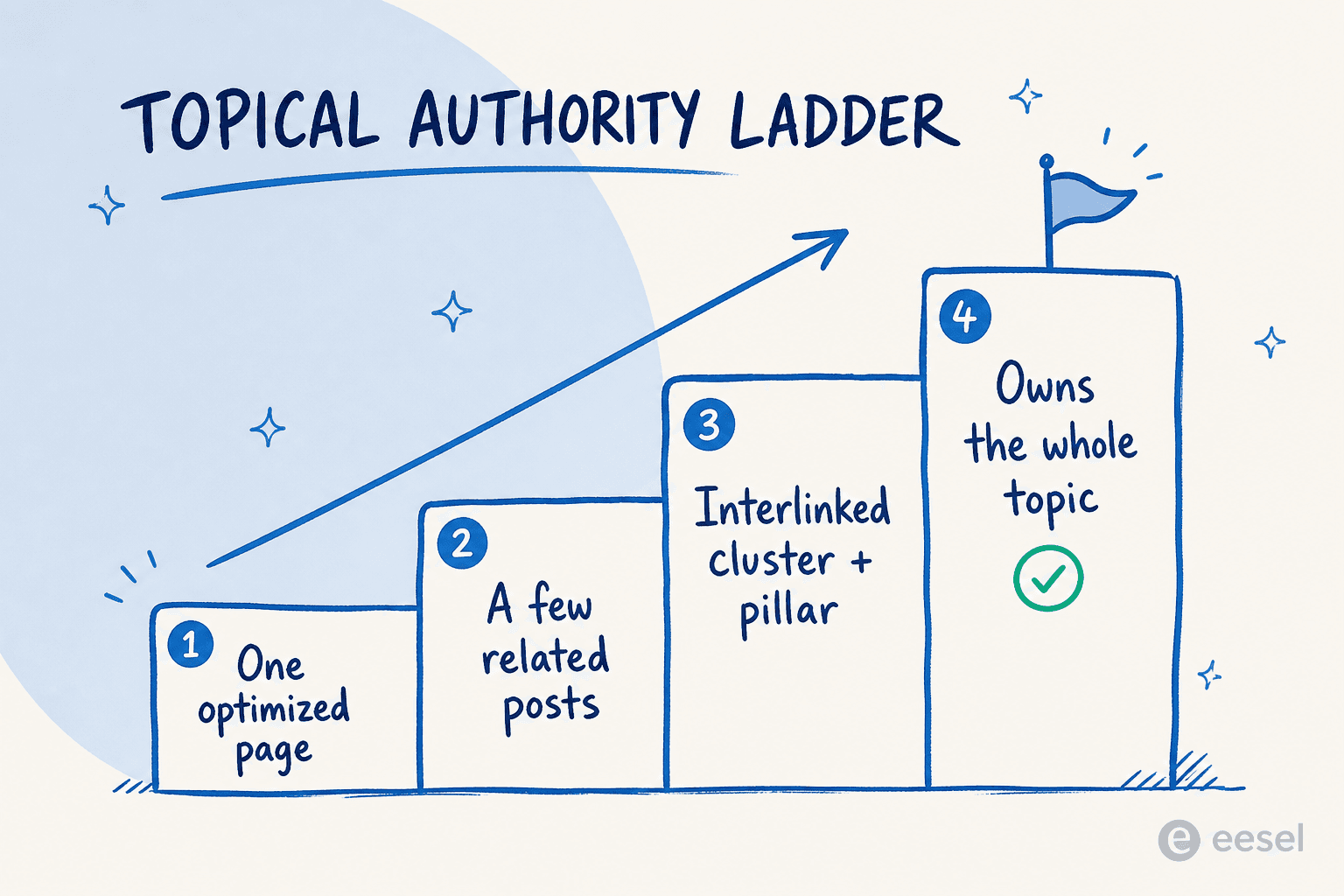
Each rung is harder to reach than the last, which is why most sites stall on the lower steps. The top rung is where individual pages start ranking on the strength of the topic itself.
How topical authority works
- Map the topic completely. Lay out every subtopic and question that makes up the subject, so coverage can be planned for the whole area rather than a few obvious keywords.
- Build the cluster. Create a pillar page for the broad topic and supporting pages for each subtopic, all interlinked.
- Cover with real depth. Make each page truly useful and grounded, since thin coverage signals the opposite of authority.
- Sustain and update. Keep adding to the cluster and refreshing existing pages, because authority is read from consistent, current coverage over time.
The breadth requirement is what makes topical authority hard to fake: a site has to publish a lot of strong pages, not one. A tool like eesel AI helps close that gap, since its blog writer researches each subtopic against real sources and drafts the supporting articles a cluster needs, letting a team cover a subject broadly instead of stalling after the pillar and two posts.
Topical authority in practice
The mistake teams make is treating topical authority as a volume play, publishing dozens of shallow pages and waiting for rankings. Search engines read depth and trust, not word count, so a small set of deeply expert pages will outperform a large set of generic ones. The other half is patience: authority accrues over months as the coverage holds up and earns links, and it erodes if the content goes stale. The teams that win a topic tend to pick a subject they can credibly own, cover it completely, and keep it current, rather than chasing every adjacent keyword at once.
We go deeper on this in building topical authority.
Build topical authority at depth
eesel's AI blog writer drafts the breadth of source-grounded coverage a site needs to become the authority on a subject, not just rank one page.