Pillar page
A pillar page is a comprehensive page covering a broad topic at a high level, linked to and supported by more detailed cluster pages.
What a pillar page means
A pillar page is a comprehensive page that covers a broad topic at a high level and links out to a set of more detailed pages, each going deep on one subtopic. It acts as the central reference for a subject: a reader can land on the pillar, get the full overview, and follow links to the specific page that answers their precise question. The supporting pages, called cluster pages, link back to the pillar in return.
In content marketing and SEO, the pillar page is the organizing centerpiece of a topic cluster. Rather than competing with itself across many overlapping articles, a site designates one authoritative page for the head topic and points all the related detailed content toward it. That structure tells search engines which page is the main entry point for the subject, and the interlinking concentrates ranking signals on the pillar so it can compete for the broad, high-value query.
Why a pillar page matters
- It owns the head term. A single, comprehensive page focused on the broad topic is far better positioned to rank for the competitive head keyword than scattered posts each chasing it.
- It concentrates internal links. Every cluster page links back to the pillar, so internal authority pools on it, lifting its ranking power.
- It clarifies site structure. The pillar is the obvious top of the topic, which helps both crawlers and readers understand how the content fits together.
- It prevents keyword cannibalization. Without a designated pillar, several similar articles compete for the same query and split their own signals, which a clear hierarchy avoids.
- It is the hub in a hub-and-spoke model. A pillar page is the practical embodiment of the hub in a hub-and-spoke content structure, with cluster pages as the spokes.
The clearest way to see the payoff is to compare a topic with and without a designated pillar. Without one, several similar posts fight over the same keyword and split their ranking signals between them.
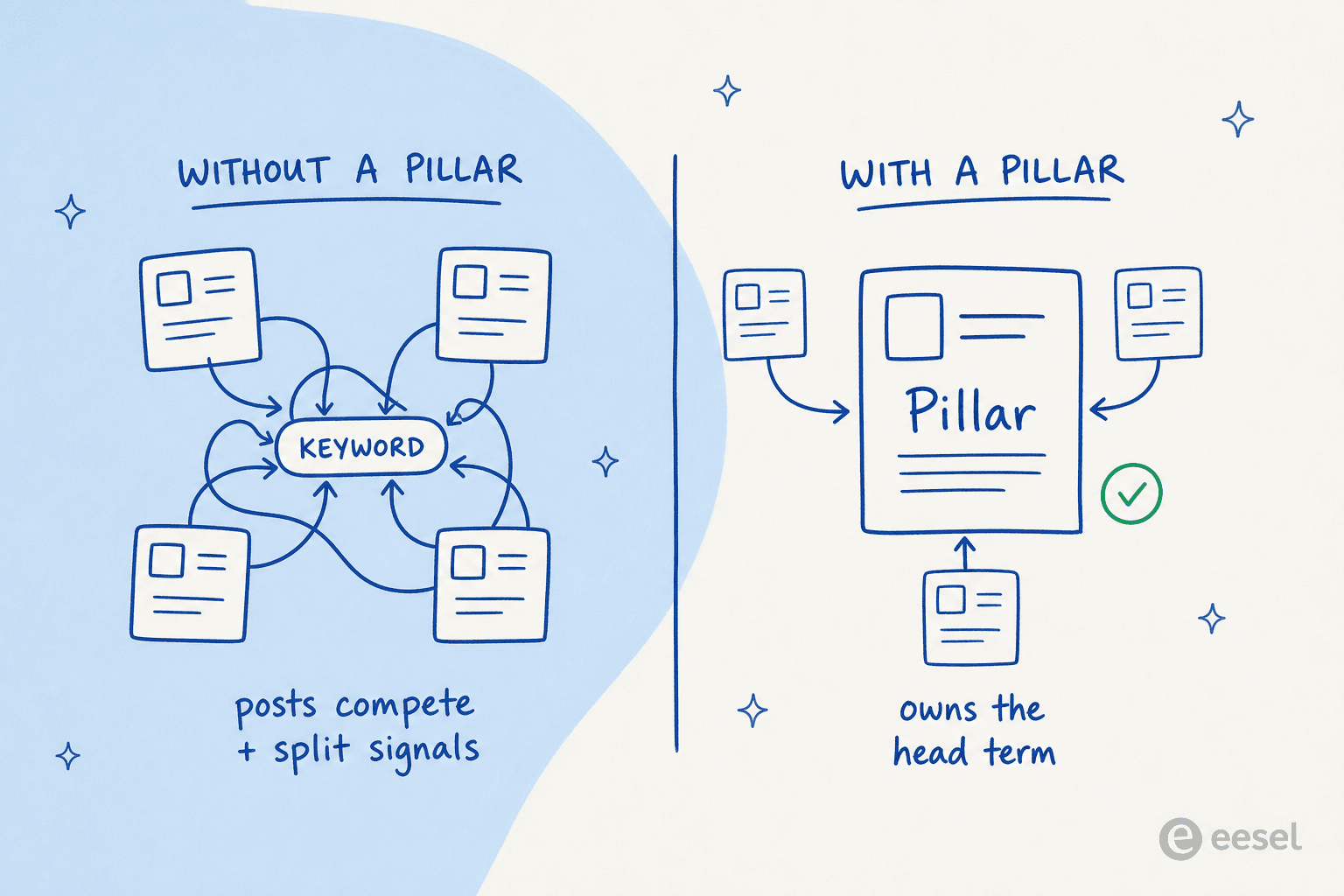
With a pillar in place, the supporting pages point their authority at one page instead of cannibalizing each other, and that page is the one positioned to win the broad term.
How a pillar page works
- Choose the core topic. Pick a subject broad enough to support a cluster of subpages but specific enough that the site can credibly own it.
- Outline comprehensively. Plan the pillar to cover the whole topic at a high level, with a section for each major subtopic that a cluster page will expand.
- Write the cluster pages. Create a focused page for each subtopic, each targeting its own narrower keyword.
- Interlink deliberately. Link the pillar down to each cluster page and every cluster page back up to the pillar, using clear anchor text.
Writing a true pillar is heavy work, because it has to cover a whole topic without going shallow. A tool like eesel AI helps here: its blog writer researches the subject against real sources and drafts a structured, in-depth page, which gives a team a strong pillar draft to refine rather than a blank document and a daunting outline.
A pillar page in practice
A pillar page fails when it tries to be everything at once and ends up being a wall of shallow paragraphs. The skill is in calibrating depth: the pillar should fully introduce each subtopic and then hand off to the cluster page that covers it properly, instead of trying to exhaust every detail itself. The pages that work best read as a confident overview with clear routes to deeper answers, and they are maintained as a unit, so when a cluster page is added or updated the pillar's links are updated with it. Treated that way, the pillar becomes the durable anchor the whole topic hangs from.
Want the full playbook? See our guide to AI pillar pages.
Draft your next pillar page
eesel's AI blog writer researches a topic against real sources and drafts the comprehensive, well-structured page a pillar needs to rank.