Hub-and-spoke content
Hub-and-spoke content is a structure where one broad hub page links out to many focused spoke pages on related subtopics, all interlinked.
What hub-and-spoke content means
Hub-and-spoke content is a way of organizing a site so that one broad hub page covers a subject at a high level and links out to many focused spoke pages, each going deep on a single subtopic. The spoke pages link back to the hub, creating a wheel-shaped structure where the hub is the center and the spokes radiate outward. The name borrows from the airline routing model, where flights pass through a central hub rather than connecting every city directly.
In content marketing and SEO, this model is the standard way to organize coverage of a large topic. Instead of stuffing everything into one enormous article or scattering disconnected posts, a team writes a central overview and surrounds it with detailed pages, then interlinks them deliberately. To search engines, that web of related, interlinked pages reads as a site covering the subject thoroughly, which is one of the strongest signals of expertise on a topic.
Why hub-and-spoke content matters
- It signals depth, not just a single page. A hub with a dozen interlinked spokes tells search engines the site covers the topic comprehensively, which a lone article cannot do.
- It concentrates link equity on the hub. Because every spoke links back to the center, the hub accumulates internal authority and tends to rank for the broad, competitive head term.
- It captures the long tail through spokes. Each spoke targets a specific, lower-competition query, so the cluster ranks for many long-tail keywords the hub alone never could.
- It maps cleanly to search intent. Broad browsers land on the hub, while people with a precise question land on the relevant spoke, and the linking moves them between the two.
- It scales without chaos. New pages have an obvious home, either a new spoke or a deeper sub-cluster, so the content library grows in a structure rather than as a pile.
A useful way to think about a hub is as something that matures in stages, not a structure you build complete on day one.
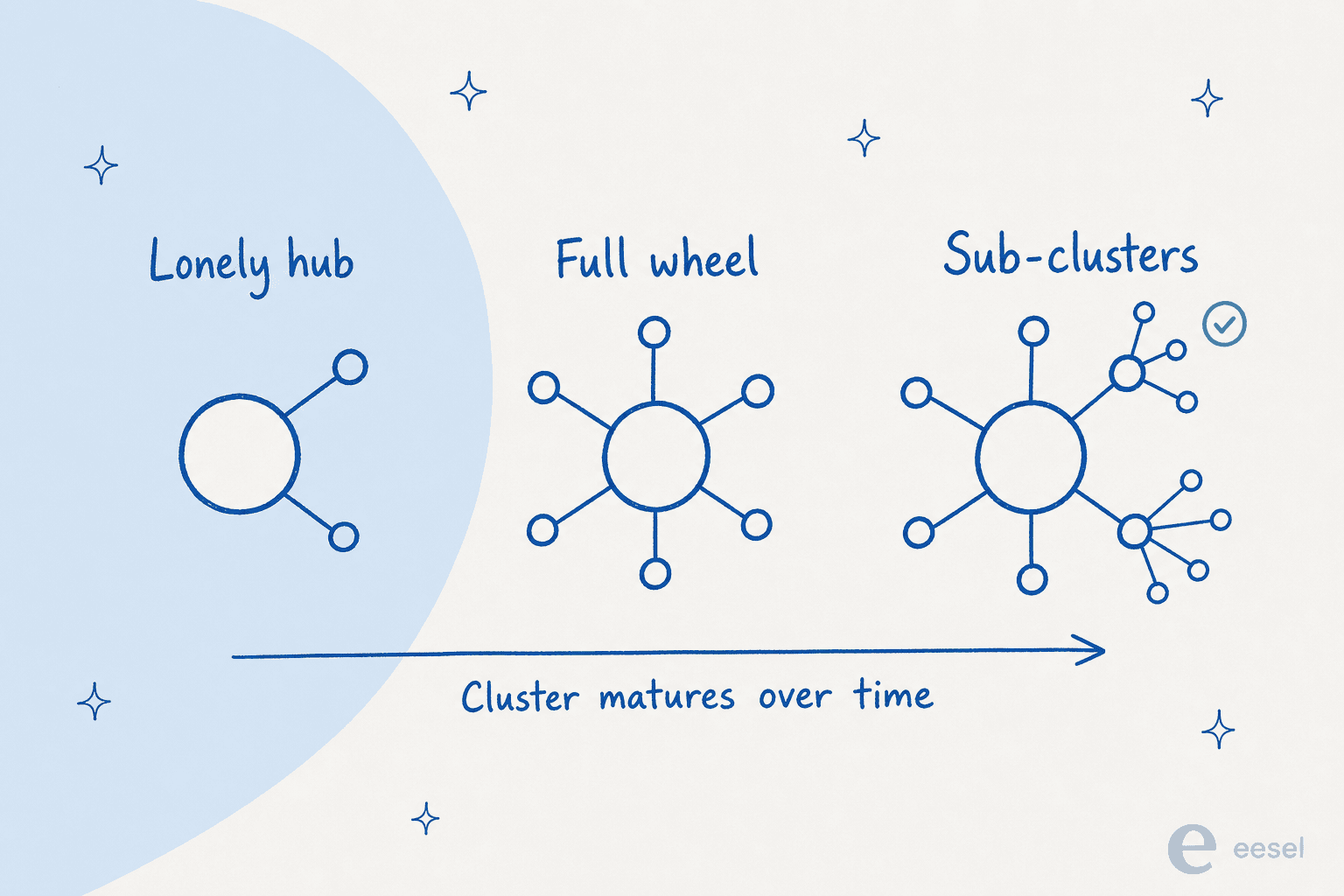
Most hubs start out lonely, with a center page and a couple of supporting articles. As the cluster fills in, it becomes a full wheel of spokes, and the strongest spokes eventually grow their own sub-clusters. Knowing which stage a hub is at tells you whether the next move is more spokes or deeper nesting.
How hub-and-spoke content works
- Pick the hub topic. Choose a subject broad enough to support many subpages but specific enough to own, then plan the hub as the overview page.
- Map the spokes. Break the topic into the distinct questions and subtopics a reader would have, with each becoming its own spoke page.
- Write and interlink. Draft the hub and spokes, link every spoke to the hub, and link the hub down to each spoke, often using descriptive anchor text.
- Expand over time. As new subtopics appear, add spokes and connect them to the existing wheel.
Building out a full hub is where most teams stall, because a wheel needs many spokes to work and writing them one at a time takes months. A tool like eesel AI addresses that bottleneck: its blog writer researches each subtopic against real sources and drafts the spoke articles, so a team can populate an entire cluster rather than ship a hub with three lonely supporting pages.
Hub-and-spoke content in practice
The structure only pays off if the interlinking is real. Plenty of sites publish a hub and a set of spokes but never connect them properly, so the pages sit as orphans and the topical signal never forms. The discipline that separates a working hub from a folder of related posts is the linking: every spoke points back to the hub, the hub points out to every spoke, and the anchors describe what is on the other side. Done well, the cluster behaves as one authoritative unit; done loosely, it is just a content calendar with a theme.
For a hands-on walkthrough, read building hub-and-spoke clusters.
Fill out a whole content hub
eesel's AI blog writer drafts the dozens of spoke articles a hub needs, each grounded in real sources, so you can build out a cluster without stalling.