Internal linking
Internal linking is the practice of connecting pages within the same website using hyperlinks.
What internal linking means
Internal linking is the practice of connecting pages within the same website to each other using hyperlinks. An internal link points from one page on a domain to another page on that same domain, as opposed to an external link or a backlink, which crosses between different sites. It is one of the few SEO levers a publisher controls completely, because every link sits on a page you own.
Internal links do two jobs at once. For readers, they are navigation: a way to move from an article to a related one, from an overview to a detailed page, or from a definition to the product it describes. For search engines, they are a map: crawlers follow internal links to discover pages, and the link structure tells them which pages are most important and how topics relate. In content marketing, internal linking is what turns a pile of individual posts into a connected body of work, which is exactly the structure search engines reward with stronger topical authority.
Why internal linking matters
- It helps search engines discover pages. Crawlers find new and updated pages by following links, so a page with no internal links pointing to it can sit undiscovered, effectively orphaned.
- It distributes authority across a site. Link equity from strong pages flows through internal links to others, lifting pages that would struggle to rank on their own.
- It signals topic relationships. Linking related pages together, especially around a pillar page and its supporting articles, tells search engines they form a coherent cluster on one subject.
- Anchor text adds context. Descriptive anchor text on an internal link tells both readers and search engines what the destination covers, so it should name the topic, not say "click here."
- It keeps readers on the site. A well-placed internal link gives readers a logical next step, which deepens engagement and reduces the chance they leave after one page.
The clearest way to think about internal linking is as the shape of your own site, where every page is a node and every link is an edge.
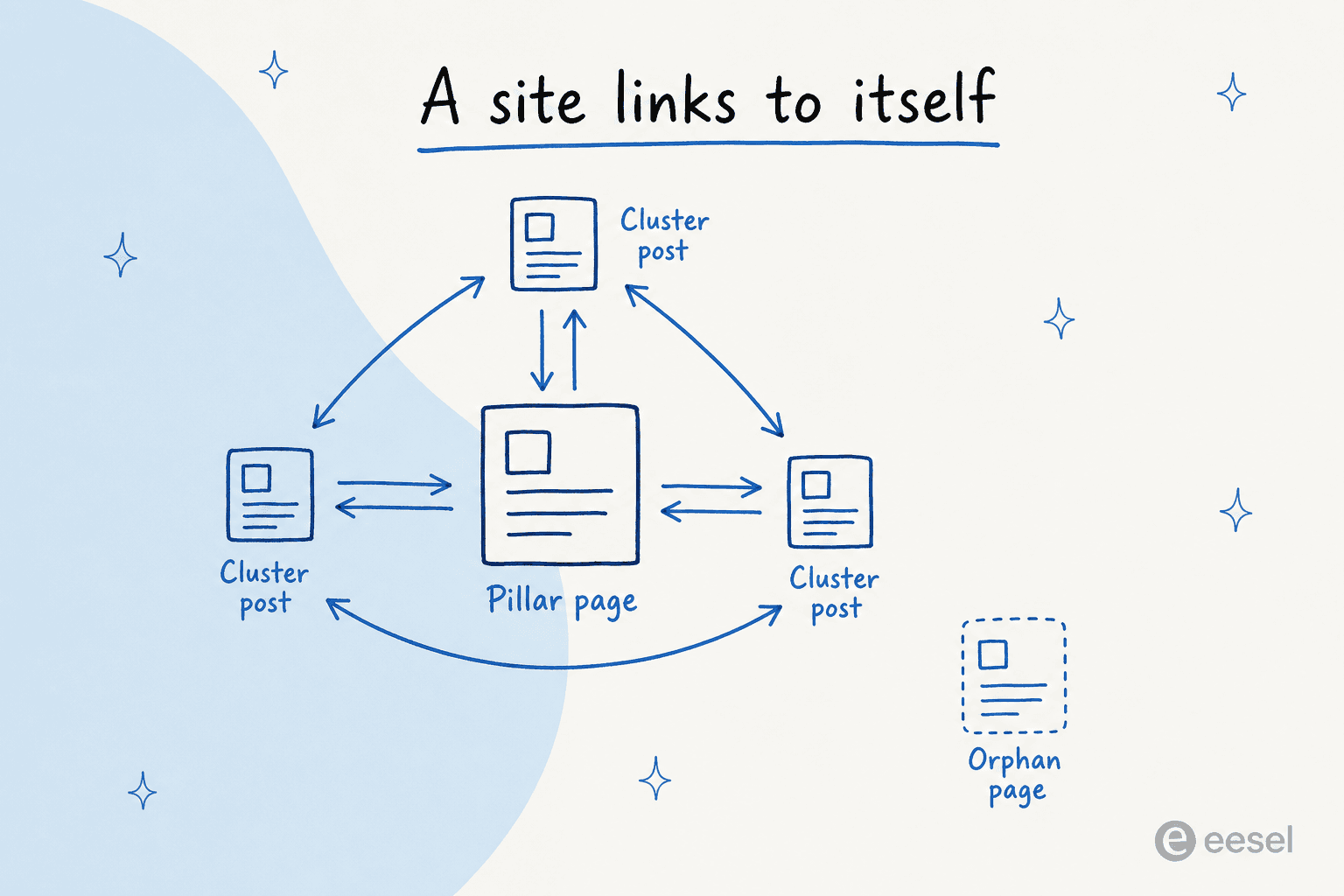
A healthy graph clusters supporting posts around a pillar and cross-links the related ones, so crawlers and readers can reach any page. The orphan in the corner, with no links pointing in, is the failure mode internal linking exists to prevent.
How internal linking works
Good internal linking follows a deliberate structure rather than scattering links at random:
- Map the content into clusters. Group related pages around a central pillar page that covers a broad topic, with supporting posts on its sub-topics.
- Link supporting pages to the pillar, and back. Each detailed article links up to the pillar, and the pillar links down to its supporting pages, forming the cluster.
- Cross-link related pages. Where two articles clearly relate, link them, using anchor text that names the destination's topic.
- Maintain the graph as the site grows. New pages get linked in from relevant existing ones so nothing ends up orphaned.
This is the SEO term that ties most naturally to content tooling. When eesel's AI blog writer drafts a post, it can reference and link to the existing pages a topic relates to, so each new article slots into the site graph instead of sitting in isolation. The links still need a human eye for relevance, but building them in at draft time is far easier than retrofitting them later.
Internal linking in practice
The common mistake is treating internal links as a number to hit rather than a structure to build. A page can carry plenty of links and still read as link-soup if the anchors are vague or the destinations are barely relevant. The version that works is unglamorous: link where a reader would actually want to go next, name the destination in the anchor, and make sure every important page has a clear path in. Because internal links are fully within your control, they are often the highest-leverage and most neglected fix in a content strategy.
We go deeper on this in how many internal links per page.
Build a site graph as you publish
eesel's AI blog writer drafts posts that link naturally to your existing pages, building the internal structure search engines reward.