Backlink
A backlink is a hyperlink on one website that points to a page on another website.
What a backlink means
A backlink is a hyperlink on one website that points to a page on a different website. Also called an inbound link or an incoming link, it is the basic unit of how the web connects pages across domains, and the basic unit search engines use to understand which pages other sites consider worth referencing.
When site A links to site B, search engines read that link as a signal: A is, in effect, vouching for B's page. This is the idea behind the original PageRank model, where a link counts as a vote, and pages with more high-quality votes are treated as more authoritative. In content marketing, backlinks are the currency of reputation; they are why two pages with near-identical content can rank very differently, because one has earned references from trusted sites and the other has not.
Why backlinks matter
- They are the strongest external authority signal. A link from a respected, relevant site is an endorsement you cannot give yourself, which is why backlinks anchor a domain's overall standing.
- Relevance beats volume. One link from a leading site in your field usually outweighs many from unrelated or low-quality pages, and search engines are tuned to discount the latter.
- Anchor text adds context. The clickable words in a backlink hint at what the destination page is about, so descriptive anchor text carries more on-page signal than a bare URL.
- Dofollow versus nofollow changes what passes. A standard link passes authority; a link tagged nofollow tells search engines not to, which is common for paid or user-generated links.
- They drive referral traffic too. Beyond ranking signals, a well-placed backlink sends real readers from the linking site, which is value on its own.
If you picture each backlink as a vote, the part people miss is that the votes are weighted, not counted.
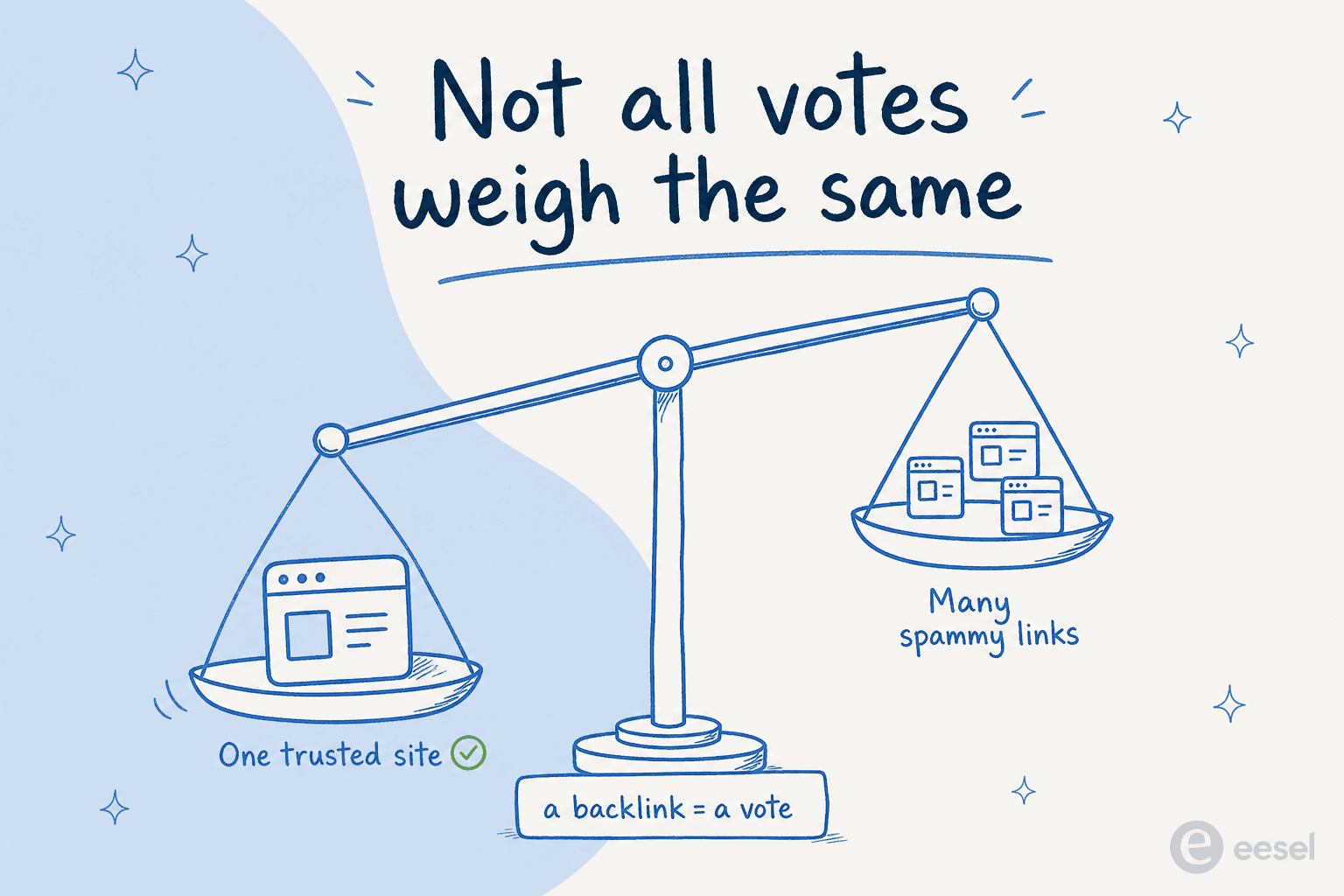
One editorial link from a respected site in your field outweighs a pile of links from low-quality pages. Search engines discount the spammy side of the scale, which is why a backlink count on its own says very little about a page's standing.
How a backlink works
A backlink does its job through a chain that search engines follow:
- A page on another site includes a link to yours. Often inside an article, a resource list, or a citation.
- A crawler follows the link. It discovers your page through that link and notes the relationship between the two domains.
- The link is weighed. Search engines assess the linking site's trust, the relevance of the two pages, and the anchor text, then factor it into your page's perceived authority.
- Authority accumulates. As more credible sites link in, the destination page and its domain are treated as more trustworthy over time.
The honest connection to content tooling is upstream of the link itself. Backlinks are earned by content people choose to cite, not generated by software. eesel's AI blog writer helps on that earlier step, drafting well-sourced posts that are worth referencing, but the link is still a decision made on someone else's site.
Backlinks in practice
The temptation is to chase backlinks as a number to grow, which leads straight to the tactics search engines penalize: bought links, link farms, and reciprocal exchanges. The durable approach treats backlinks as a downstream result of being useful: publish data, tools, or explainers worth citing, and links follow. A handful of editorial links from authoritative sites in your space will outperform a thousand low-quality ones, every time.
Publish posts worth linking to
eesel's AI blog writer drafts source-grounded content other sites cite, which is how backlinks get earned in the first place.