Off-page SEO
Off-page SEO is the set of signals from outside your own website that shape how search engines judge its authority and trustworthiness.
What off-page SEO means
Off-page SEO is the set of ranking signals that come from outside your own website and influence how search engines judge its authority, relevance, and trustworthiness. While on-page work is everything you change on your pages directly, off-page SEO is largely about what other people and other sites do in relation to yours: linking to it, mentioning your brand, reviewing your product, or citing your content as a source.
The single largest off-page signal is the backlink, a link from another site pointing to yours, which search engines read as a vote of confidence. But off-page also takes in unlinked brand mentions, reviews on third-party platforms, and the general reputation a domain accumulates over time. In content marketing, off-page SEO is the half of the equation you cannot fully control: you can publish a great post, but whether the web links to it is decided elsewhere.
Why off-page SEO matters
- It signals authority you cannot self-declare. Anyone can call their own page authoritative; a link from a trusted, relevant site is an external endorsement that search engines weigh heavily.
- It is the main input to domain authority. A site's overall standing is built mostly from the quantity and quality of sites linking to it, which is why off-page work compounds slowly.
- Relevance of the linking site matters more than raw volume. One link from a respected industry publication often outweighs dozens from unrelated or low-quality directories.
- Unlinked mentions still count. Modern search engines can associate brand mentions with your entity even without a clickable link, so coverage and reputation feed off-page on their own.
- It is hard to fake at scale. Bought or spammy link schemes are exactly what search algorithms are tuned to discount, so durable off-page SEO has to be earned.
Picture your site at the center of a web of inbound signals, where not every link carries the same weight.
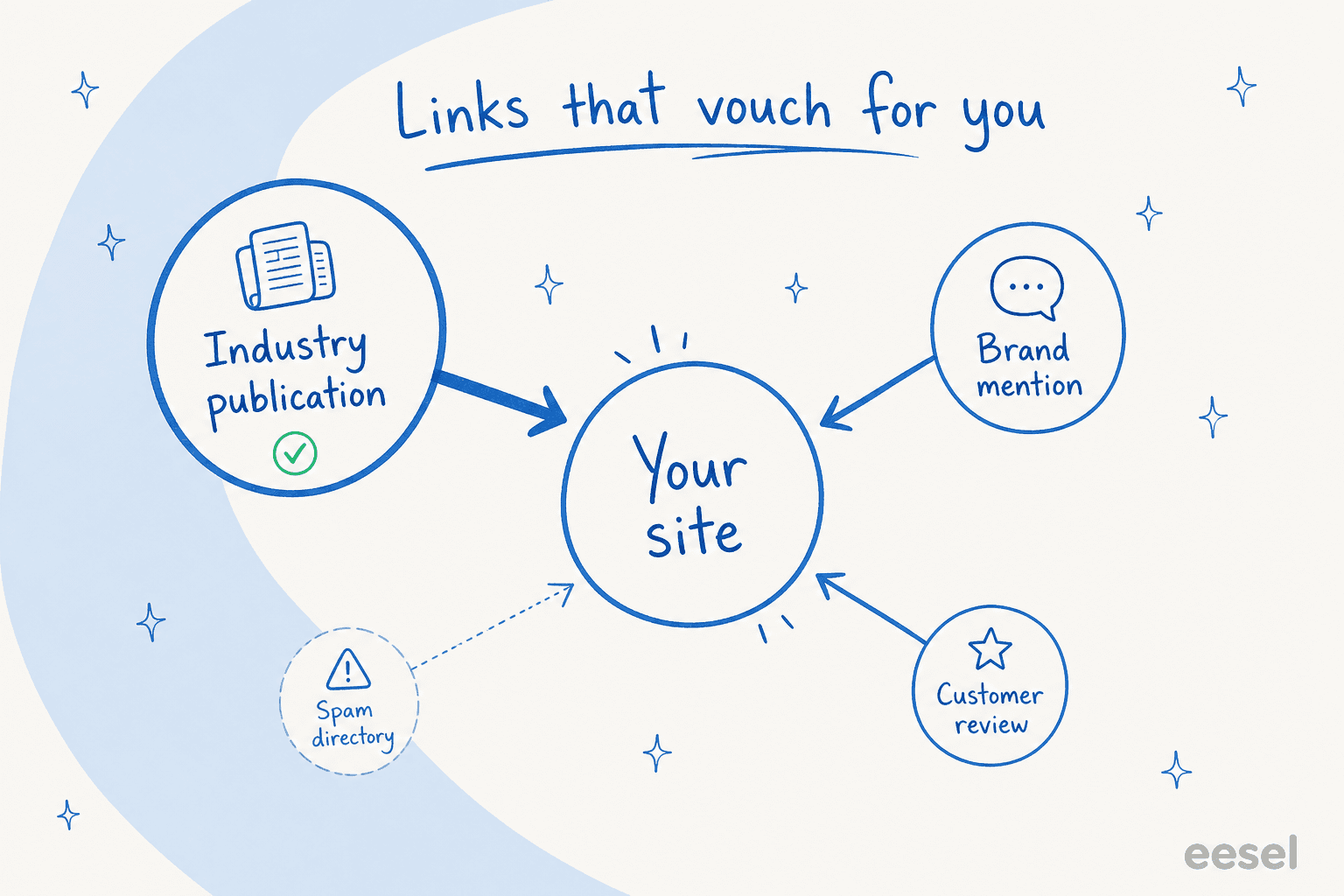
The thick arrow from a respected industry publication does far more for your authority than a pile of links from low-quality directories. Relevance and trust of the source, not raw link count, are what move the needle.
How off-page SEO works
Off-page SEO works less like a checklist and more like reputation that accrues:
- You publish something worth citing. A data point, an original analysis, a clear explainer, or a tool other people want to reference.
- Other sites link to or mention it. Editors, bloggers, and operators reference your page when it helps their own readers.
- Search engines re-evaluate trust. As links and mentions accumulate from relevant, credible sources, the domain's perceived authority rises, lifting its pages in results.
This is the step where good content does the heavy lifting. eesel's AI blog writer is built around grounding each draft in real sources rather than thin rewrites, which is the honest precondition for off-page SEO: nobody links to a generic AI summary, but a well-sourced, useful post earns citations on its own. The blog writer cannot manufacture backlinks, and it should not try to; what it can do is produce the kind of article other sites choose to reference.
Off-page SEO in practice
The trap in off-page SEO is treating links as something to acquire rather than earn. Tactics that chase link volume directly, paid placements, link exchanges, low-quality directories, are precisely what search engines are built to detect and discount, and they can do active harm. The durable approach is unglamorous: publish content good enough that linking to it is the natural move, build real relationships in your space, and let authority compound. Off-page is the slowest lever in SEO, but it is also the hardest for a competitor to replicate.
Earn the links off-page SEO depends on
eesel's AI blog writer drafts source-grounded, citable posts, the kind of content other sites actually link to.