

What an AI pillar page generator actually does
I've spent the last couple of years mapping keywords to what people actually search for, and at eesel I've watched our AI blog writer draft thousands of posts across live customer sites. A pillar page generator is a particular shape of that work: instead of one isolated article, you feed it a topic, and it returns the broad overview page plus the scaffolding for the cluster pages that hang off it.
The model itself isn't new, and it's worth knowing where it came from. HubSpot coined the framing: topic clusters link a broad pillar page to a set of focused cluster pages on related subtopics, with internal links from each cluster page back to its pillar. The structure, in HubSpot's words, "signals to search engines and answer engines that your site covers a subject thoroughly, instead of in scattered, one-off posts." It traces back to 2015 research by Anum Hussain and Cambria Davies, then both at HubSpot, who tested it on HubSpot's own content team.
The pillar is the hub. HubSpot defines it plainly: "A pillar page is the basis on which a topic cluster is built. A pillar page covers all aspects of the topic on a single page, with room for more in-depth reporting in more detailed cluster blog posts that hyperlink back to the pillar page." Ahrefs frames the same thing as "a hub with spokes": the pillar is the broad overview, the cluster content is the detailed deep-dives, and the internal links knit them together.
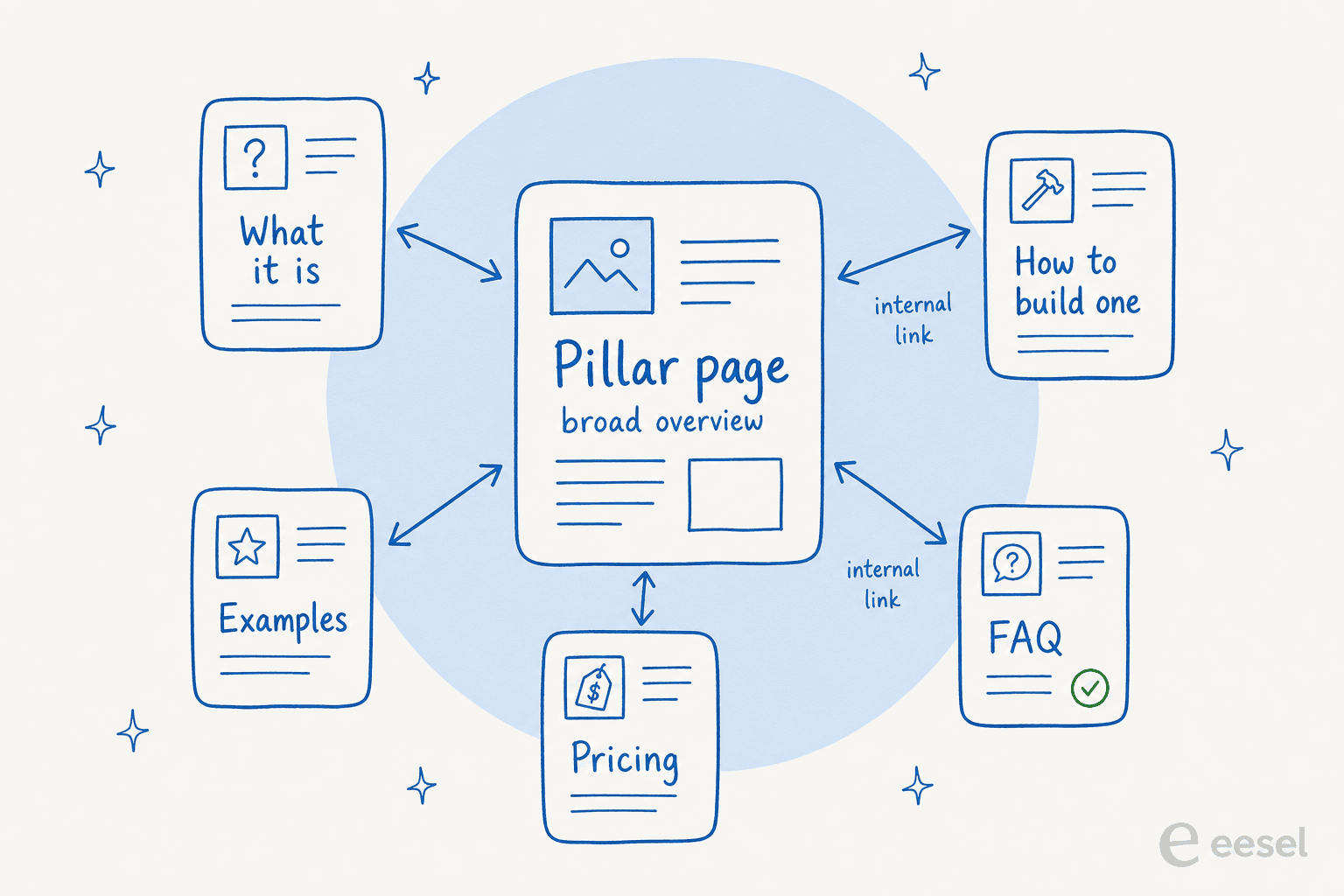
So an AI pillar page generator is really automating three jobs at once: drafting the broad pillar, drafting (or outlining) the cluster pages, and wiring the internal links between them. The first two are what every AI content generator claims to do. The third one is the part most of them quietly skip, and it's the part that actually makes a cluster work.
Why a pillar page still earns its keep
Three things make the pillar-and-cluster structure punch above its weight, and they're worth being specific about, because they're also the things a lazy generator throws away.
It builds topical authority. Ahrefs describes topical authority as "when search engines recognize your site as the expert source on a specific subject, not just for individual keywords, but for the full range of related queries within a topic." The payoff is that you start ranking "for a much broader range of related queries, including ones you never explicitly optimized for." Ahrefs' example is blunt: a site at DR 15 outranks Amazon at DR 96 for competitive e-bike keywords, simply by covering the niche more completely. Topical depth can beat raw domain authority. Semrush makes the same point: pillar pages "aid in building topical authority by forcing you to comprehensively cover a topic."
It's an internal-linking engine. This is the underrated one. The original HubSpot research found that the more internal links they added between related pages, the higher those pages climbed in search results and the more impressions they earned. A pillar is a natural hub: every cluster page links up to it, and it links back out. If you want the mechanics of doing that at scale, I've written separately on how to automate internal linking and how many internal links per page is sensible.
It avoids keyword cannibalization. Semrush flags this one: because you plan pages by topic rather than by a raw keyword list, you stop publishing five posts that all fight over the same query. Semrush also notes that in-depth pillar pages "often attract more backlinks" and get cited more often, which compounds the authority effect.
There's a newer reason too, and it's the one I'd lead with in 2026. The same comprehensive, well-structured coverage that ranks in Google is what AI search engines pull from. Ahrefs' Healthline example makes it concrete: a single deep article ranks for 2,500 Google keywords and shows up across 473 AI Overview queries, 279 ChatGPT prompts, and 200 Perplexity prompts. A pillar page built for topical authority is, increasingly, a pillar page built for citations.
The catch: the same tool builds a spam farm
Here's where most "AI pillar page generator" pitches go quiet. The tool that drafts a great cluster in an afternoon is exactly the tool that drafts a worthless one in the same afternoon, and Google has a specific name for the worthless version.
Google's spam policy is explicit: "Scaled content abuse is when many pages are generated for the primary purpose of manipulating search rankings and not helping users... no matter how it's created." The very first example it lists is "using generative AI tools or other similar tools to generate many pages without adding value for users."
The important nuance is that AI itself isn't the trigger. Google's own guidance on generative AI content says AI "can be particularly useful when researching a topic, and to add structure to original content," and tells you to "focus on accuracy, quality, and relevance, especially when automatically generating the content." If you're worried about this, I dug into whether Google penalizes AI content separately, the short version is that it doesn't penalize AI, it penalizes value-less mass production.
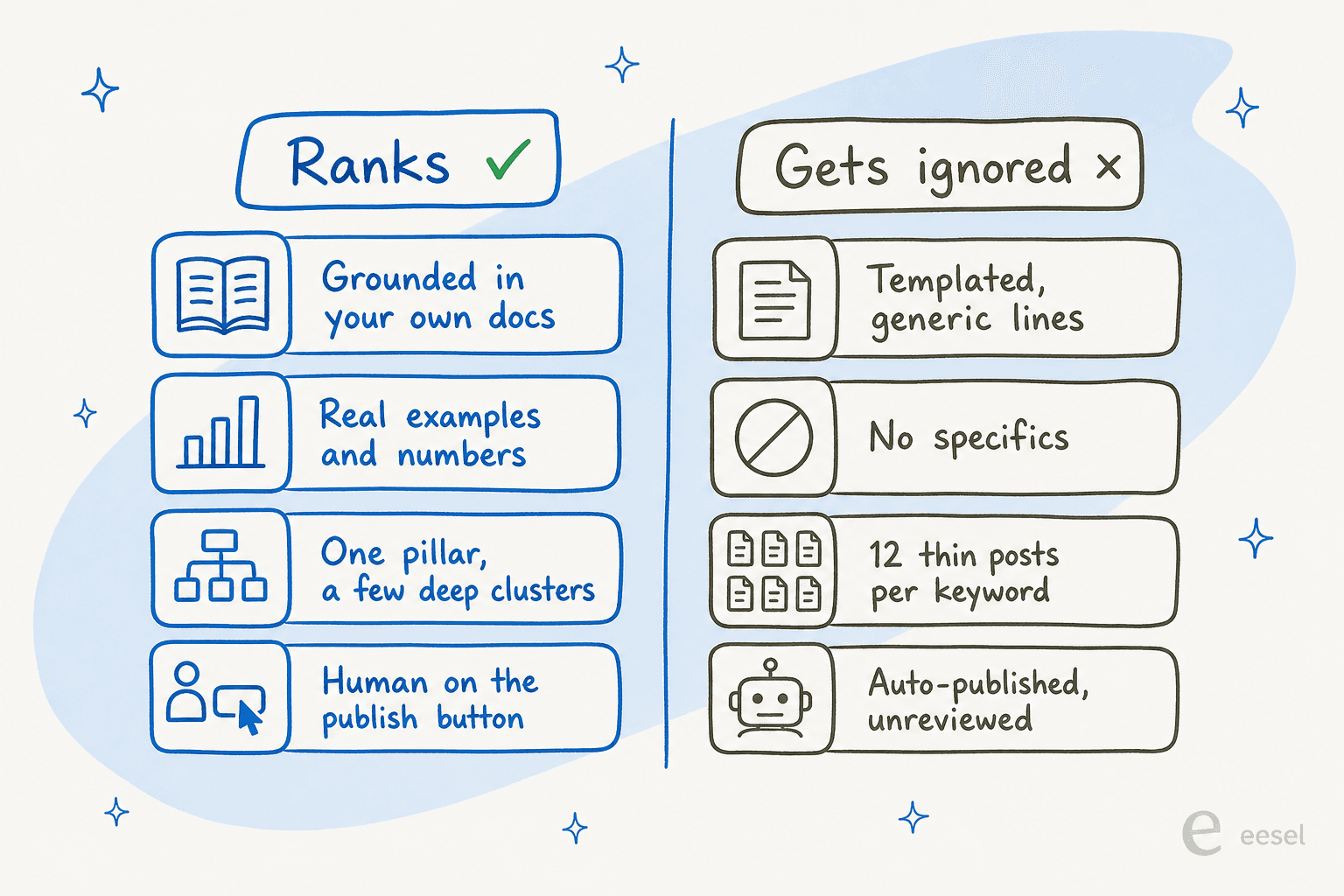
This isn't theoretical. On r/SEO, one operator described a client auto-publishing AI content and watching "4 of his AI based blogs traffic facing a sudden drop and the posts are crawled but not indexed" despite no flagged violations in Search Console. Crawled-but-not-indexed is Google's quietest way of saying "we saw it and didn't think it was worth keeping." The fix isn't to stop using AI, it's to stop publishing pages that don't add anything, which is also the theme of AI blog posts sounding generic.
How to actually generate a pillar page with AI
Here's the workflow I'd use. The order matters, and the human checkpoint at the end is not optional.
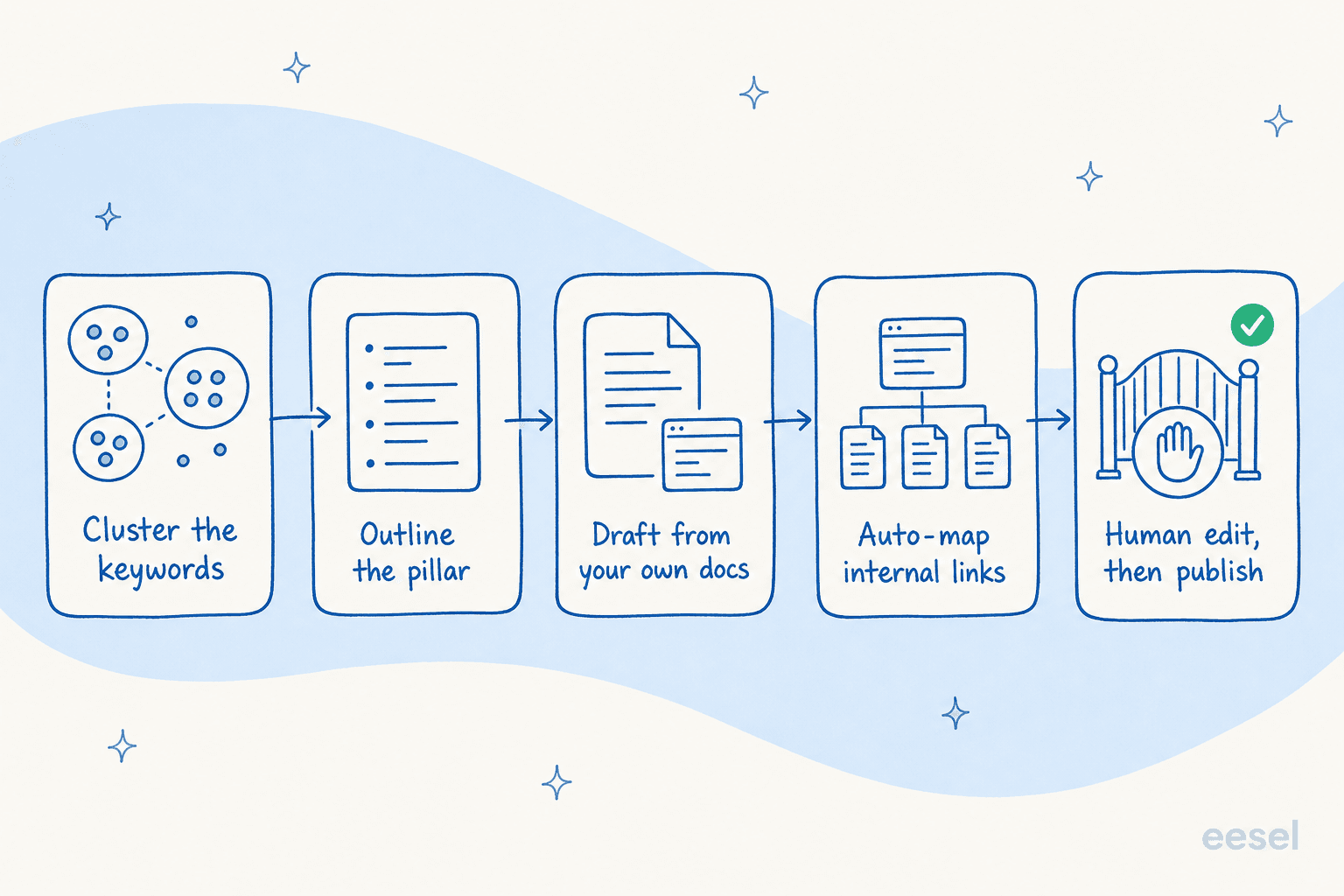
1. Cluster the keywords first, not the pages. Before you draft anything, group the queries into a topic and its subtopics. This is what stops you from writing five pages that cannibalize each other. A keyword clustering tool or a topic cluster generator does the grouping; if you want to do it programmatically, here's how to cluster keywords automatically. Start from real demand, eesel's free SEO keyword generator is a quick way to surface the terms people actually search.
2. Scope the pillar, then the spokes. Pick a topic that has, as Ahrefs puts it, between 10 and 20 subtopics, narrow enough that the pillar isn't 50,000 words, broad enough to support a real cluster. Decide upfront which subtopics live as sections on the pillar and which deserve their own cluster page. An AI content brief per page keeps the scope honest, and you can turn keywords into outlines automatically to speed this up.
3. Draft from your own knowledge, not the open web. This is the single step that separates a pillar that ranks from one that gets ignored. If the generator drafts from a generic prompt, you get a generic page that says what every other AI page says. If it drafts from your own docs, product, and data, each page carries a specific example or number a competitor can't copy. That grounding is the whole reason to use a tool that connects to your knowledge base, and it's also how you keep AI content human.
4. Auto-map the internal links. A cluster without links isn't a cluster, it's a pile of pages. Each cluster page should link up to the pillar, the pillar should link down to each cluster page, and related cluster pages should cross-link. Doing this by hand across a 15-page cluster is the chore everyone skips, which is exactly why an internal linking automation tool earns its place here.
5. Put a human on the publish button. Read every page before it goes live. Add the one example, number, or opinion the model couldn't have known. This is the step that turns "generated many pages" into "added value," and it's the difference Google's policy actually cares about. If you're publishing at any volume, build it into your AI content pipeline as a required gate, not a nice-to-have.
What the SEO crowd actually thinks
Pillar pages get declared dead every six months, so it's worth checking what people running real sites say. The verdict is more nuanced than "dead" or "still works."
On whether the structure still holds up, the answer is mostly yes:
"Pillar pages are still a great strategy! They help organize your existing content, boost SEO, and show search engines you're an authority on a topic, plus, you can still write new blogs to keep building on them."
That's a commenter on r/SEO, answering a small-business marketer asking whether to build pillar pages at all. But the shape of the advice has shifted hard away from the old "build a dozen thin posts" playbook:
"i still do clusters but way fewer posts per cluster than i used to. one solid pillar post and maybe two supporting articles max. the old approach of writing ten thin posts around variations of the same keyword just creates a bunch of pages competing with each other now."
That's a blogger on r/Blogging, and it lines up exactly with Semrush's cannibalization warning above. Another in the same thread put the AI-specific caution well: "AI can help map the angles, but I wouldn't let it decide the final structure alone."
And on whether AI-drafted cluster content can rank at all, the most useful framing I saw came from r/seogrowth:
"Google (and the newer 'AI summary' style results) rewards the pages that have real specifics, examples, and answers that match search intent, no matter if the draft started with a tool or a human."
That's a working SEO on r/seogrowth. The same person warned, in a nearby comment, that "once the site starts sounding generic, rankings usually stall hard because there's nothing for people (and other sites) to cite." Which is the whole argument for grounding, restated by someone who learned it the hard way.
Try eesel for pillar content
If you want to generate a pillar page and its cluster without landing on the wrong side of Google's scaled-content line, the deciding factor is where the draft comes from. eesel's AI blog writer drafts each page from your own knowledge base, docs, product, past posts, so the pillar and every cluster page carry specifics that a generic prompt never could, and it handles the internal linking between them so the cluster is wired from day one.
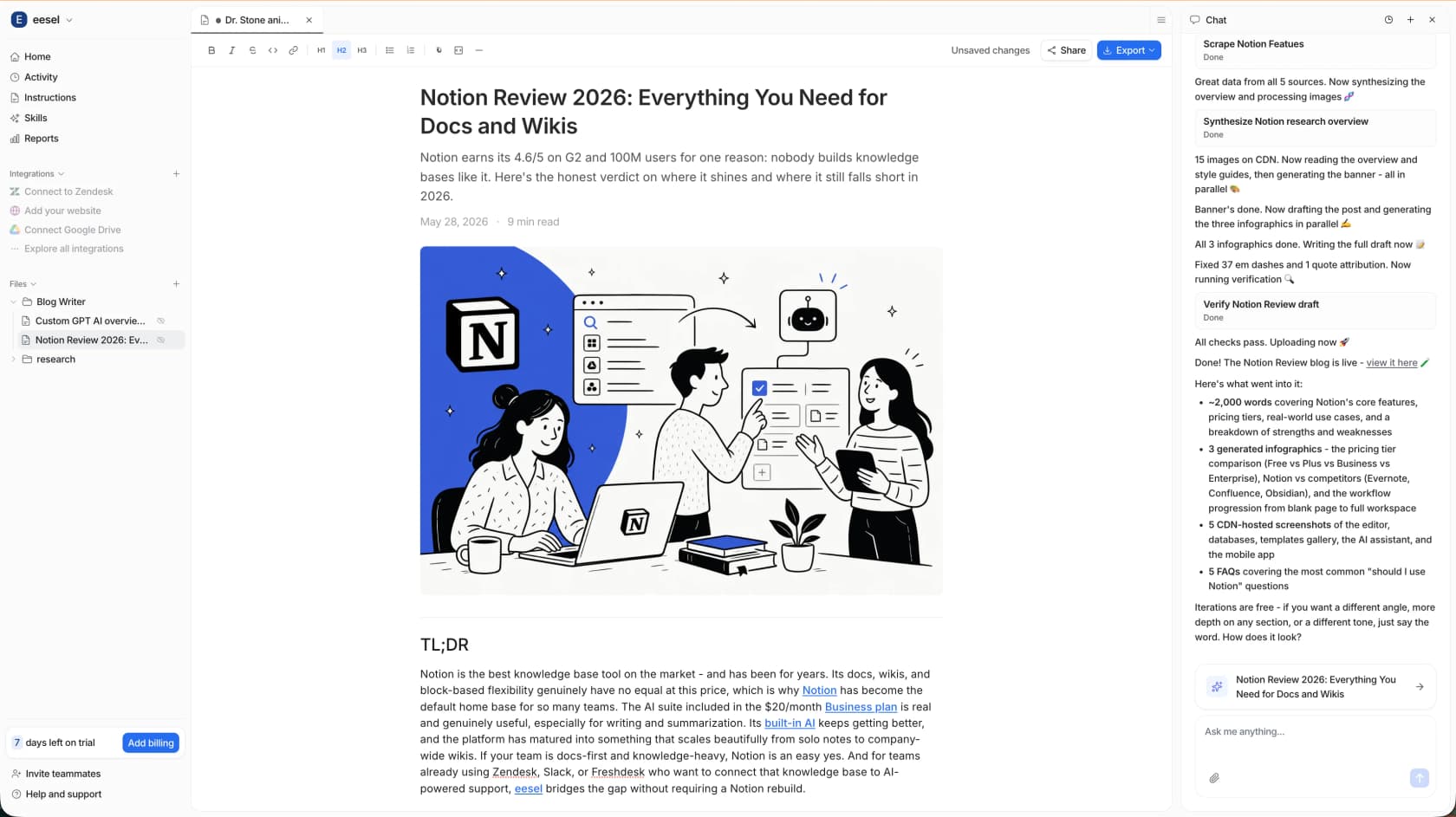
It also keeps you in your brand voice and aims at E-E-A-T-compliant content, which is the bar a pillar page needs to clear to earn topical authority. There's a free AI blog writer tier to start with, so you can draft a pillar and see how it reads before committing. Try eesel and build the cluster, then keep a human on the publish button, that part's still on you.
Frequently Asked Questions
What is an AI pillar page generator?
Do AI-generated pillar pages hurt your SEO?
How long should a pillar page be?
How many cluster pages do I need per pillar?
Can an AI pillar page generator help with AI search and AI Overviews?


Article by
Kurnia Kharisma Agung Samiadjie
Kurnia is a software engineer and writer at eesel AI with two years of SEO experience, writing about AI tools, helpdesk software, and customer support. He pairs a developer's understanding of how these products are built with search-driven research into what actually ranks and resonates with the people searching for them.