


What a content cluster is (and why Google rewards it)
A content cluster is a deliberate group of pages on one theme. At the center sits a pillar page, a broad guide to a big topic. Around it sit cluster pages (the "spokes"), each going deep on one narrow subtopic, and every spoke links back up to the pillar while the pillar links down to each spoke.
The point isn't tidiness. When a search engine sees a pillar on "B2B content marketing" surrounded by ten well-linked posts on keyword research, content briefs, distribution, and measurement, it reads that as topical authority: you've covered the subject, not just one keyword. That's the same signal AI search engines lean on when they pick which page to cite in an answer, and it's why semantic SEO content tends to outrank a scattering of one-off posts targeting isolated keywords.
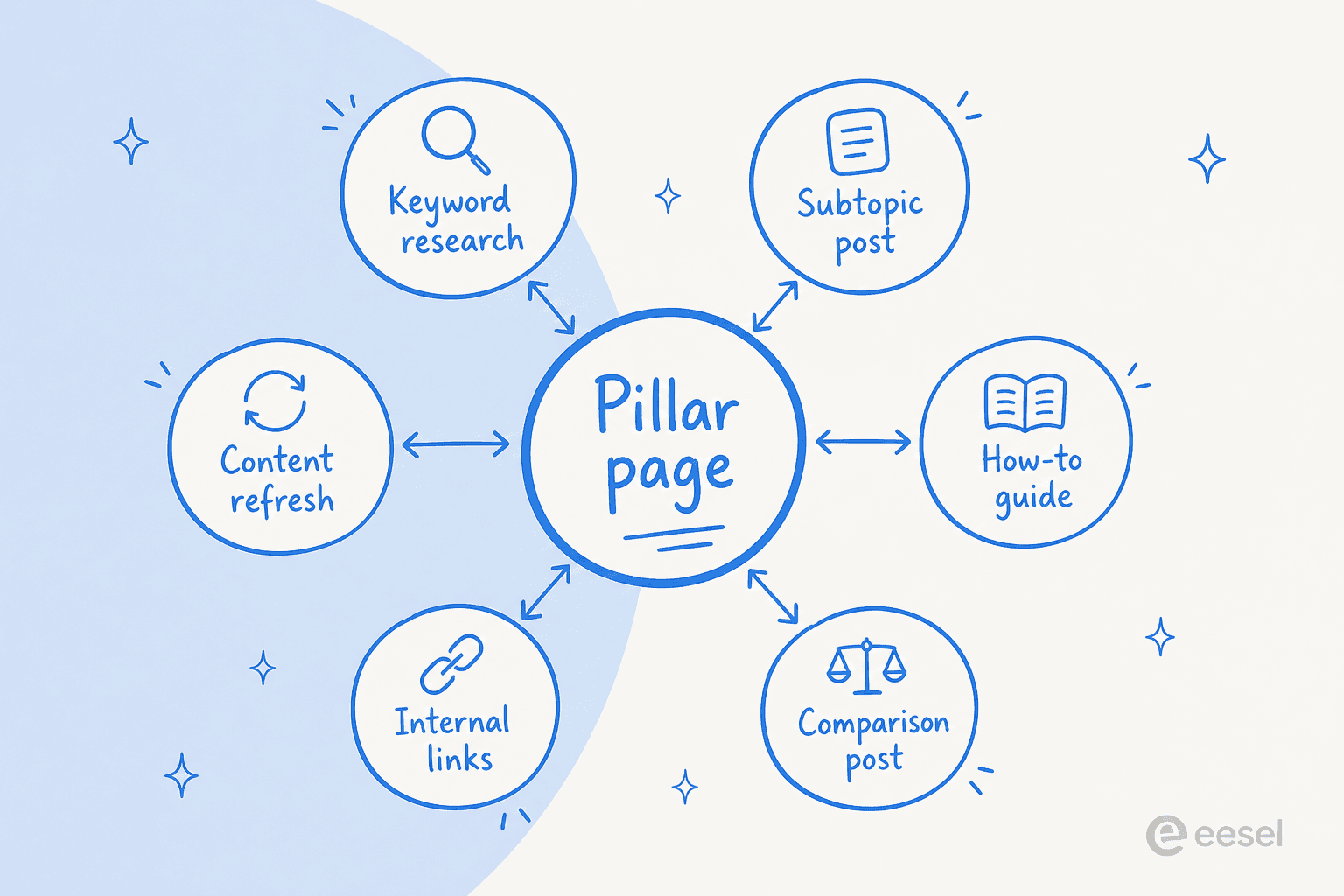
Building one by hand is slow. You map the subtopics, write a pillar, write each spoke, then go back and wire up the internal links so nothing is orphaned. For a single cluster that's a couple of weeks of focused work. For a content team trying to own a category, it's a quarter. That gap between "we know clusters work" and "we have time to build them" is exactly what AI tooling showed up to close.
What an AI content cluster generator actually does
Strip away the marketing and a content cluster generator does five jobs in sequence. The better tools chain them so you start with a keyword and end with published, interlinked posts; the weaker ones do one or two and leave you to glue the rest together.
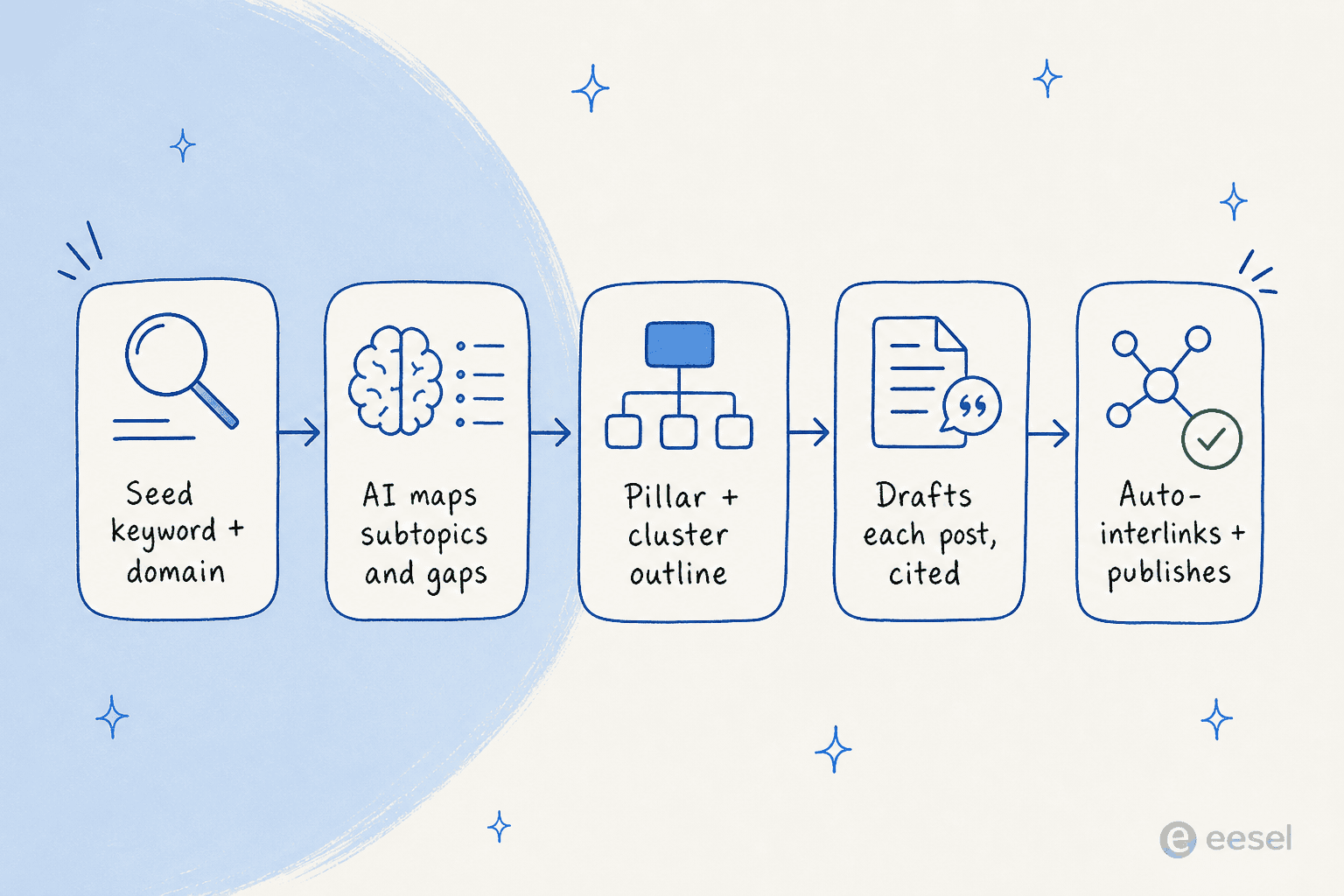
- Expand a seed into subtopics. You give it a topic; it returns the questions and long-tail variants real people search, plus the gaps your competitors haven't covered. This is the part a free SEO keyword generator gets you started on in seconds.
- Shape the architecture. It decides what's the pillar and what's a spoke, so you don't end up with ten posts and no center of gravity.
- Draft each page. A pillar outline plus a draft for every spoke, ideally researched and cited rather than hallucinated.
- Interlink. Pillar-to-spoke and spoke-to-pillar links wired in automatically, which is the whole reason it's a cluster and not a content dump.
- Publish. Push to your CMS, on a schedule if you want it.
The dividing line between a real generator and a glorified prompt is how many of those steps it owns end to end. A tool that hands you a keyword spreadsheet has done step one. A tool that researches, drafts, interlinks, and publishes has done the job. If you want to see how that full pipeline reads in practice, our AI content pipeline tool breakdown and our tested AI content tools for SEO post both go deeper than I can here.
How to build a content cluster with AI, step by step
Here's the workflow I'd actually run, whether you use eesel or one of the dedicated SEO tools like Surfer, Clearscope, MarketMuse, or Frase.
1. Pick a pillar topic that maps to a buying question. Not the highest-volume keyword, the one your buyers actually ask before they purchase. "How to scale B2B content" beats "content" every time. This is the SEO instinct that's hard to automate: volume is easy to read, intent isn't.
2. Expand it into subtopics. Feed the topic into a keyword tool and let it surface the long-tail questions and competitor gaps. eesel's free generator returns up to 30 keywords from a single topic description, which is usually enough to see the shape of a cluster.
3. Group them into a pillar plus spokes. Cluster the keywords by intent: broad ones inform the pillar, specific ones become individual posts. Cut anything that's really the same post twice.
4. Draft with research and your voice baked in. This is where generic AI content dies. Insist on a tool that reads primary sources and cites them, and that learns your brand voice rather than defaulting to the same flat register every other blog uses. (More on getting that right in our best AI content writer guide.)
5. Interlink and publish. Every spoke links to the pillar, the pillar links to every spoke, and related spokes cross-link where it's natural. Then schedule the publish. If WordPress is your stack, publishing AI content to WordPress covers the mechanics.
The steps are simple. Doing them consistently across dozens of clusters is what separates a blog that ranks from one that just exists, and it's where scaling SEO content safely becomes the real skill.
What makes a B2B content cluster different
A consumer blog can chase volume and win on traffic alone. B2B can't. Your buyer is a small, specific group, and the cluster's job is to be the page that answers their question so well that both Google and an AI assistant reach for it. That changes how you build.
First, intent beats volume. A cluster built around topical authority on the questions a buyer asks before they purchase will outperform a higher-traffic cluster of informational fluff, because the few hundred right readers convert. Second, citations carry more weight. A B2B reader checking a claim, and an AI search engine deciding what to quote, both reward primary sources over confident assertions, which is why I push so hard on sourced drafting.
And increasingly, the cluster has to win in two places at once: classic search and AI answers. Optimizing for AI search isn't a separate project from your cluster, it's the same well-linked, well-sourced architecture doing double duty. A generic AI content generator that ignores intent and skips citations gives you neither; a real AI content writer that researches and links gives you both.
Where AI cluster generators fall short
I'd be doing you a disservice if I pretended these tools just work. After years watching AI write content at scale, here's where I see them break, and what to check before you trust one.
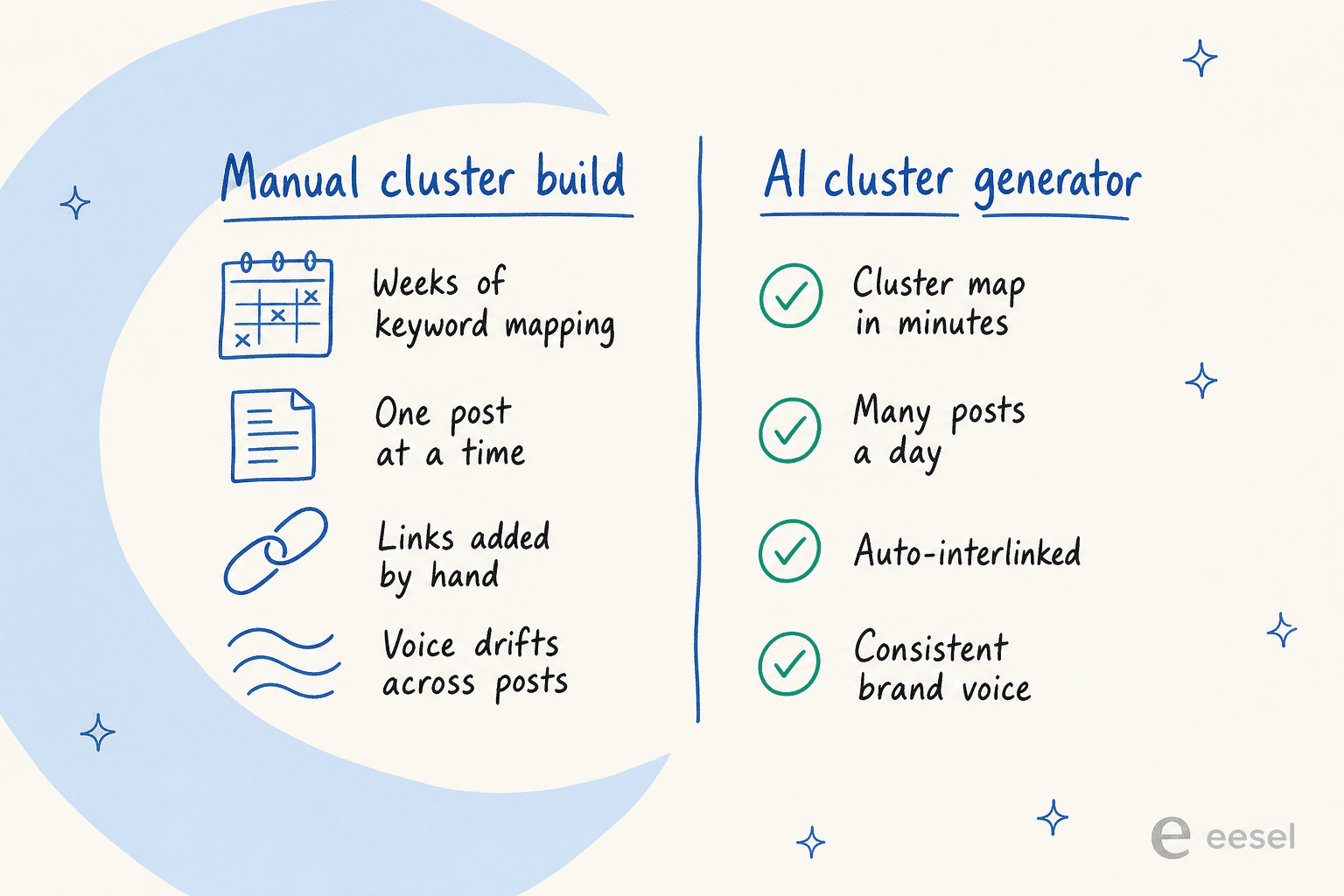
They sound generic. The cheapest tools prompt a model and ship the first draft. You get grammatically fine prose that could belong to any company, which is the fastest way to read as AI slop and get skipped by both readers and Google's quality reviewers. The fix is real brand-voice matching plus actual research, not a longer prompt.
They hallucinate, then cite nothing. A confident wrong stat in a B2B post is worse than no post. If a generator can't tell you where a claim came from, assume it made it up, and budget time to fact-check the AI content before publishing.
They skip the internal links. This is the one that frustrates me most. A tool will happily generate ten posts on a theme and leave them as ten orphans, no pillar, no cross-links. That's not a cluster, it's a folder. If the tool doesn't wire the links, the SEO benefit you were chasing never shows up.
They forget the cluster after it ships. Rankings decay. A cluster that doesn't get refreshed slowly slides, and most generators have no concept of going back. Pairing generation with automatic content refreshes is what keeps a cluster earning.
"Hey, this article is great, but it's got too much phrasing that's identical to this article... Can you compare the two and adjust any longer phrases (more than 4 or 5 words) that are identical."
That's a real request we got from a marketer at a tour-operator booking-software company, mid-way through co-editing a cluster (from an eesel customer session). It's the kind of judgment a cluster needs and a fire-and-forget generator never applies: catching near-duplicate phrasing between two posts on adjacent subtopics, so they don't cannibalize each other. Clusters are about overlap done deliberately; you want related, not identical.
Try eesel for your content clusters
Most tools I've described do one slice of this well. eesel's AI blog writer is built to own the whole arc, because it's framed as a teammate you hire rather than a prompt box you babysit. It does keyword research and competitor-gap analysis to find the cluster, researches and cites every claim from primary sources and Reddit threads instead of guessing, matches your brand voice at around 94% from day one, generates the visuals, wires the internal links, and publishes on schedule, in 80+ languages.
Here's the part that makes me confident recommending it for clusters specifically: we've watched a content team run this as a keyword-to-publish pipeline and scale to 360 SEO posts a month, 12 a day, with a consistent brand voice across hundreds of posts and #1 rankings on competitive keywords. A typical post lands at 2,000 to 2,900 words with a hero image, three to five infographics, FAQs, and internal links, generated in roughly 12 to 20 minutes. That's the kind of throughput a cluster strategy needs to actually compound.
If you want to start smaller, the free SEO keyword generator, meta description generator, and meta title generator are a no-signup way to map a cluster before you commit. When you're ready for the full pipeline, you can try eesel free.
Frequently asked questions
What is an AI content cluster generator?
How do I build a content cluster with AI?
Are AI content cluster tools good for B2B SEO?
Can AI handle the internal linking inside a cluster?
How much content can an AI cluster generator realistically produce?
Will an AI content cluster sound generic?
Do I need a separate SEO tool to build a content cluster?


Article by
Kurnia Kharisma Agung Samiadjie
Kurnia is a software engineer and writer at eesel AI with two years of SEO experience, writing about AI tools, helpdesk software, and customer support. He pairs a developer's understanding of how these products are built with search-driven research into what actually ranks and resonates with the people searching for them.