Traditional search can be a tedious process. Typing a simple question often leads to a long list of ads, SEO-focused blogs, and affiliate links, requiring users to piece together answers from multiple pages.
This is where AI search engines are changing things. They represent the next big step in how we find information, promising direct, synthesized answers instead of just a long list of links. This shift is huge for everything from answering a quick question to diving deep into research. In this article, we'll look at the top tools available, each designed for a different kind of task.
We'll explore tools that answer your questions directly, but we'll also check out one that takes research a step further by turning a topic into a complete, publish-ready blog post. It's a process we used ourselves to grow our own traffic from 700 to 750,000 daily impressions in just three months.
What are AI search engines?
AI search engines are advanced information retrieval systems. They're powered by large language models (LLMs) and natural language processing (NLP), which means they understand the meaning behind your query, not just the exact words you type.
Here’s what sets them apart:
- They give you summaries, not just links. You get a direct answer, often in a conversational style.
- They cite their sources. The good ones will show you where they got their information, so you can check it for yourself.
- They let you ask follow-up questions. The search becomes more of a conversation, letting you dig deeper and clarify what you're looking for.
This changes how we interact with information. You’re no longer just "finding links" you're "getting answers."
Our criteria for the best AI search engines
To put this list together, we didn't just read feature lists. We actually used these tools to see how they held up in the real world. Here’s what we paid attention to:
- Accuracy and Citations: Are the answers reliable? Can you easily click through to the original sources to check the facts? This was a must-have.
- User Experience: Is the interface clean and simple, or is it a mess of ads and extra fluff? A good tool should be easy to use and stay out of your way.
- Response Quality and Speed: Does it give you shallow, surface-level answers, or does it provide deep, insightful responses? And does it do it quickly?
- Specialization and Use Case: Who is this tool really for? We looked at how well each engine served its intended audience, whether they’re casual users, academics, or content creators.
- Practicality: At the end of the day, does it solve a real problem better than a simple Google search? The best tools are the ones that actually save you time and effort.
Comparison of the top AI search engines
Want a quick overview of how the best AI search engines compare? Here’s a table to help you find the right tool for your needs at a glance.
| Tool | Best For | Key Feature | Starting Price |
|---|---|---|---|
| eesel AI blog writer | Proactive research & content creation | Generates complete, publish-ready blog posts with assets | Free to try |
| Perplexity | General research with clear citations | Conversational interface with source-backed answers | Free plan available |
| Google AI | Everyday integrated search | AI Overviews directly in Google search results | Free to use |
| Consensus | Evidence-based academic research | Searches over 250M+ peer-reviewed papers | Free plan available |
| Komo | Exploratory research & building AI agents | "Playbook" feature for creating custom AI agents | Not publicly listed |
The 5 best AI search engines
Now, let's get into the details of each tool to see what makes it stand out, where it excels, and where it might not be the best fit.
1. eesel AI blog writer
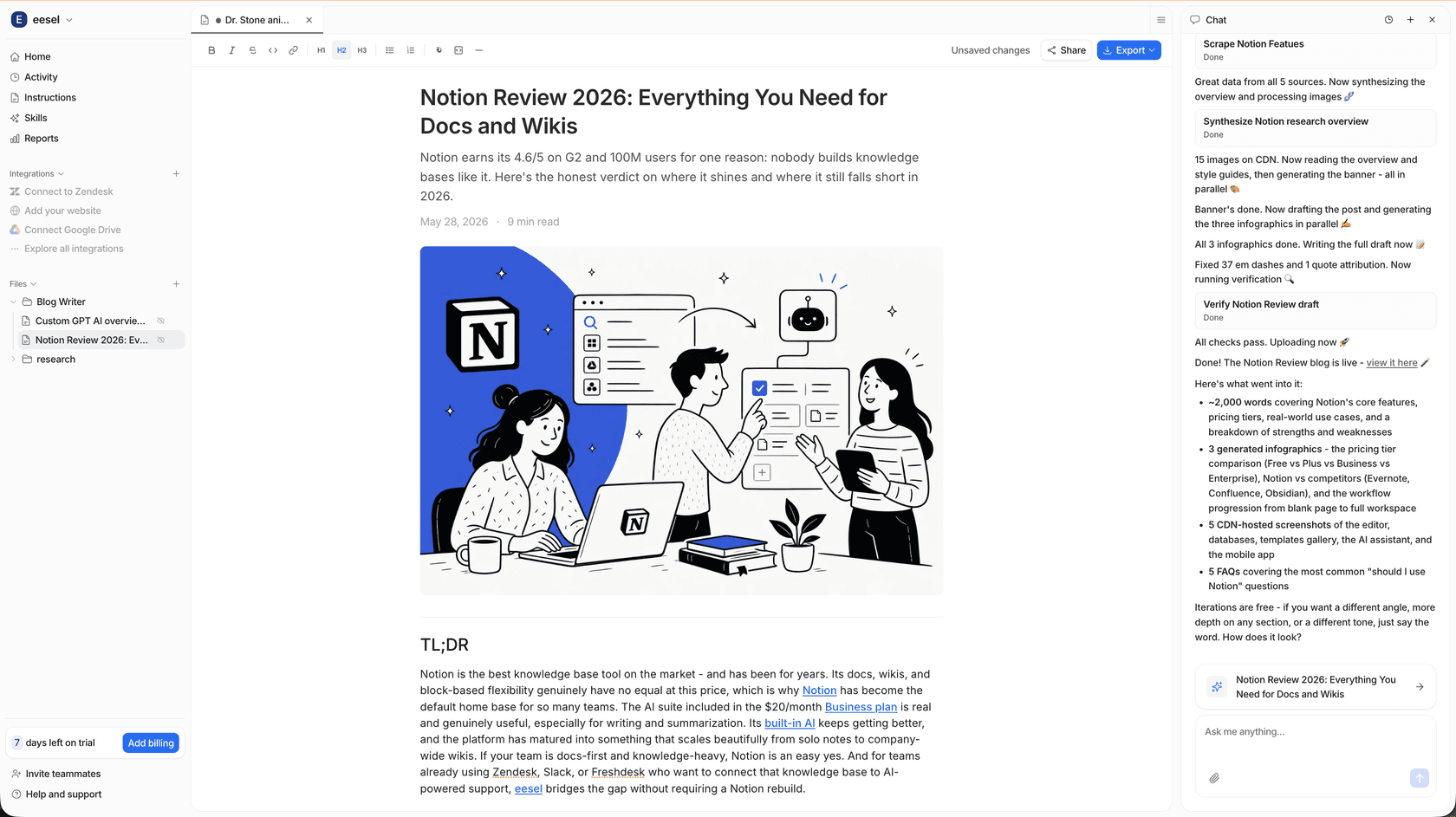
The process is straightforward: you give it a keyword or topic, and it generates a complete, SEO-optimized blog post with everything you need to publish.
Pros: The biggest advantage here is that eesel AI blog writer automates the whole research-to-publish workflow. Its context-aware research pulls in relevant data, stats, and even pricing to generate a thorough article. It doesn't just give you text; it builds a full post with AI-generated images, tables, and infographics. It even finds real Reddit quotes and relevant YouTube videos to add social proof and make the content more engaging. The final product is a high-quality, SEO and AEO-optimized article that’s ready to rank.
Cons: This tool isn't for quick, one-off questions like "what's the weather?" or "who won last night's game?" Its entire purpose is to generate in-depth, long-form content. That makes it a specialized tool for marketers, SEOs, and content creators, not a general answer engine for your day-to-day questions.
Pricing:
- Free to try.
- Early Bird plan starts at $99/month for 50 monthly blog generations.
2. Perplexity
Perplexity has become a crowd favorite. It calls itself an "answer engine," and it does a great job of giving direct, source-backed answers to almost any question. Its conversational interface feels intuitive, and its "Focus" feature is useful, letting you narrow your search to specific sources like Academic, YouTube, or Reddit.
Pros: Perplexity's best feature is its transparent citation system. Every statement in its answer is linked to a source, so you can easily click through and check the information yourself. This is a big deal for anyone who needs to trust the answers they're getting. The clean, ad-free interface is also a nice change of pace, and the option to choose different AI models (like GPT-4 and Claude 3 on the Pro plan) makes it a powerful tool for students, writers, and researchers.
Cons: While it's great for general research, its deep research capabilities can sometimes be less robust than more specialized tools. Some users have also noted that it can occasionally hallucinate sources or misinterpret information from a cited paper, so it's always smart to double-check the original links.
Pricing:
- Free plan with limited Pro searches.
- Perplexity Pro: $17/month (when billed annually).
- Perplexity Enterprise Pro: $40/month per seat.
3. Google AI (AI Overviews)
Google is the giant in the search world, and it's integrating AI directly into its search results with a feature called AI Overviews. For billions of people, this is their first and most common interaction with an AI search engine, giving them quick summaries right at the top of the results page.
Pros: The main benefit is its convenience and familiarity. It’s built into the search engine most of the world already uses every day. You don't have to visit a different website or learn a new interface. It uses Google's massive index of the web and is great for quick, informational questions where a short summary is more useful than a list of ten blue links.
Cons: The convenience of AI Overviews has also highlighted some challenges. The feature has faced scrutiny for sometimes providing inaccurate summaries, particularly for sensitive topics. In response, Google has been actively refining these results. Additionally, the presence of ads within the search experience may be a drawback for users seeking a more focused, ad-free environment compared to dedicated AI search tools.
Pricing:
- Free to use.
- Enhanced features are available through paid Google Gemini subscriptions.
4. Consensus

For students, academics, or researchers, Consensus is a useful tool. It's a specialized search engine that pulls its answers only from a large database of over 250 million peer-reviewed papers. You won't find any blog posts or news articles here: just hard data and evidence-based insights.
Pros: Its biggest strength is its reliability. By sticking to academic literature, Consensus provides answers you can trust for serious research. It has great features like the "Consensus Meter," which shows how much the scientific community agrees or disagrees on a topic. This can save researchers hours of work sifting through papers.
Cons: Its specialization is also its main limitation. It’s not suitable for general web searches, current events, or any topic outside its academic focus. If you want to know the latest movie reviews, this isn't the right tool. The free plan is also pretty limited, offering only three "Deep Searches" per month, which may not be enough for heavy users.
Pricing:
- Free plan with 3 Deep Searches per month.
- Pro plan: $10/month (billed annually).
- Deep plan: $45/month (billed annually).
5. Komo
Komo started out as a conversational search engine but has since become something more. Its main feature now is called "Komo Playbook" which lets you build your own custom AI agents. It's designed for users who want to turn their expertise into automated workflows for things like content generation, data analysis, and market research.
Pros: Komo's key advantage is its focus on action. Instead of just finding information, you can build reusable agents that perform complex, multi-step tasks for you. This is ideal for anyone looking to automate research-based workflows, like generating weekly competitor reports or analyzing customer feedback from various sources. It’s all about putting information to work.
Cons: As the platform has shifted its focus to building agents, its core search function can feel less polished compared to dedicated answer engines like Perplexity. Some users have found its citation relevance to be inconsistent at times, which suggests the platform is still a work in progress.
Pricing:
- Pricing is not publicly listed on their website.
How to choose the right AI search engines for your needs
With so many options, how do you pick the right one? It really depends on what you're trying to do.
- For Everyday Questions: For quick, on-the-fly questions, Google AI's integration is tough to beat for convenience. It's already where you are.
- For In-Depth Research and Writing: Perplexity is a great place to start for finding and verifying sources. Its clean interface and clear citations make it a solid choice for most research tasks.
- For Content Creation at Scale: If your goal isn't just an answer but a finished piece of content like a blog post, a tool like the eesel AI blog writer is much more efficient. It handles the research, writing, SEO, and asset creation in one go, saving you hours.
- For Academic and Scientific Work: Consensus is the clear winner here. When you need reliable, evidence-based answers from peer-reviewed literature, there's no better option.
- For Automating Workflows: If you find yourself doing the same research tasks repeatedly, Komo is worth a look. It's best for users who want to build custom AI agents to put their research on autopilot.
For a deeper dive into how these new tools stack up against each other and traditional search, the video below offers a great comparison, testing their speed, accuracy, and ability to access recent data.
The future is about creating, not just searching
AI search engines are changing our relationship with information. We're moving away from the days of passively clicking links and into an era of active conversations with data. It’s an exciting time that’s making it faster and easier than ever to learn and explore.
But the real change isn't just about getting answers faster; it's about what you do with those answers. The next wave of powerful AI tools is focused on creation and action, helping you turn raw information into something valuable.
This is where the eesel AI blog writer is leading the pack. Instead of just getting a summary of a topic, you can generate a complete, SEO-optimized article that's ready to attract readers and build your brand. See the difference for yourself and generate your first blog post for free.