

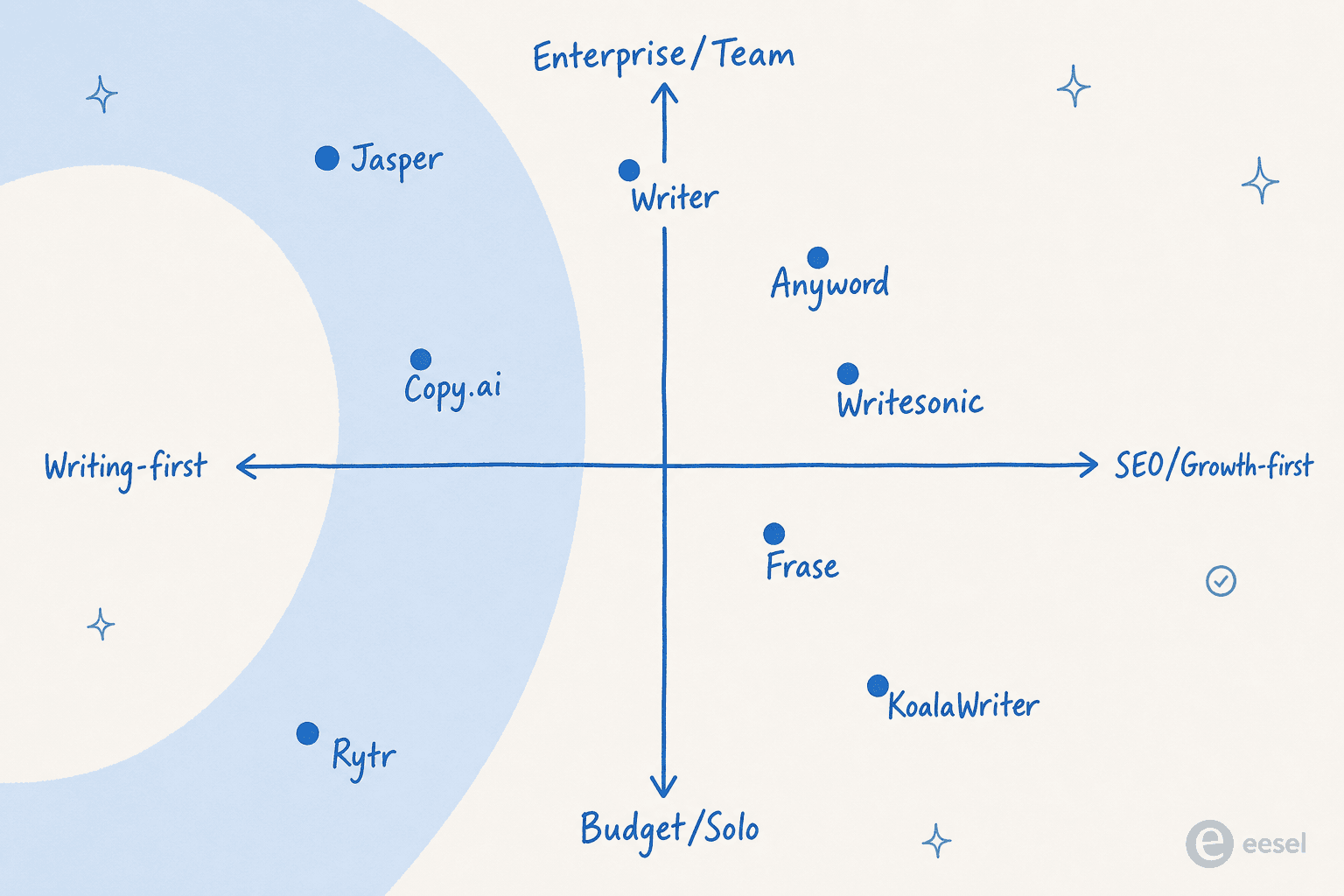
Jasper is still the strongest choice for brand-consistent long-form content across teams. Its Brand Voice feature extracts tone and style from reference documents, and the Business tier unlocks unlimited voice profiles, multi-seat workflows, and API access. If you need every piece of content to sound like it came from the same writer, Jasper is the tool that enforces that at scale.
Writer.com sits in a different category entirely - a full-stack enterprise AI platform with its own proprietary Palmyra LLMs, SOC 2 Type II, ISO 27001, and HIPAA compliance, and customer deployments at Vodafone, Vanguard, and Salesforce. There is no self-serve pricing to compare against Jasper; Writer is a platform decision, not a subscription. Anyword is the outlier in performance terms: its predictive scoring model predicts which copy variation will convert with 82% accuracy, versus 52% for GPT-4o - and that gap is the product, not a footnote.
For SEO and GEO, Frase and Writesonic both cover the full loop: SERP research, AI draft, live optimization scoring, and AI visibility tracking across ChatGPT, Perplexity, Claude, and Gemini. Copy.ai has pivoted hard from "AI writer" to GTM platform - Workflows, Agents, Actions, and a Brand Infobase - and is most useful when the goal is automating the full sales and marketing funnel, not just drafting copy. KoalaWriter at $9/month and Rytr at $7.50/month (or free) close out the budget end of the market, each with a clear, narrowly-defined value: one-click SEO blog publishing and no-friction short-form generation, respectively.
The 8 best AI content generators in 2026
- Jasper - best for brand voice and long-form consistency
- Writer.com - best for enterprise AI deployment
- Copy.ai - best for GTM workflow automation
- Anyword - best for performance prediction
- Writesonic - best for SEO + GEO content
- Frase - best for content research and AI visibility
- KoalaWriter - best for SEO blogging on a budget
- Rytr - best free tier
At a glance: how the 8 tools compare
| Tool | Starting price | Free tier | Brand voice | SEO/GEO | Performance scoring | Team seats | SOC 2 / ISO 27001 | G2 rating |
|---|---|---|---|---|---|---|---|---|
| Jasper | $59/mo (1 seat, annual) | No (7-day trial) | 2 profiles on Pro | No | No | Business tier only | Business tier | 4.7/5 (1,270 reviews) |
| Writer.com | Contact sales | 14-day trial | Yes | No | No | Yes (all tiers) | SOC 2 + ISO 27001 + HIPAA | N/A |
| Copy.ai | $29/mo (Chat, monthly) | No (7-day trial) | Yes (Infobase) | No | No | Growth+ | N/A | N/A |
| Anyword | $49/mo (Starter, monthly) | No (7-day trial) | Yes | No | 82% accuracy | 3 seats (Data-Driven) | SOC 2 + ISO 27001 + GDPR + HIPAA | 4.8/5 (1,226 reviews) |
| Writesonic | $79/mo (Starter, monthly) | No | Yes | Yes + GEO (Enterprise) | No | All tiers | N/A | 4.8/5 (2,031 reviews) |
| Frase | $49/mo (Starter, monthly) | No | Yes | Yes + GEO | No | Up to 5 seats | SOC 2 (Enterprise) | 4.8/5 (500+ reviews) |
| KoalaWriter | $9/mo (Essentials, monthly) | 5,000 words (no CC) | Yes (Brand DNA) | SEO focused | No | Solo only | N/A | 3.5/5 (Trustpilot, 21 reviews) |
| Rytr | $0/mo (Free tier) | Yes - no expiry | 1 custom tone (Unlimited) | No | No | Solo only | N/A | 4.7/5 (819 reviews) |
1. Jasper - best for brand voice {#jasper}
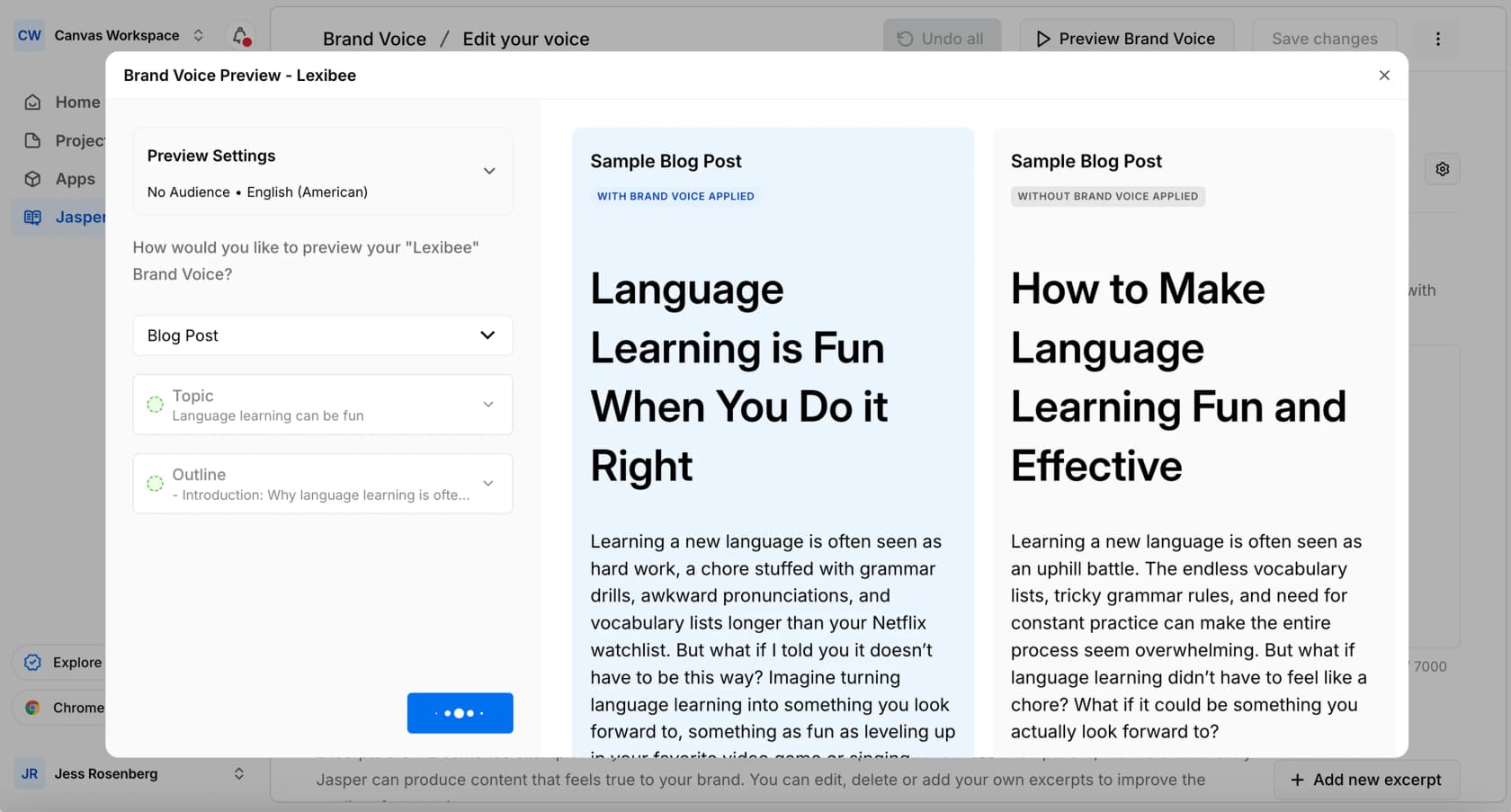
Jasper (jasper.ai) is the most mature of the dedicated AI writing tools and the one most anchored to brand consistency. The product has four main components: Jasper Canvas (the long-form editor), Jasper Chat (the conversational interface), Jasper IQ (knowledge integration from docs, URLs, and previous content), and Jasper Grid (a bulk content batch tool, Business-only). The flagship differentiator is Brand Voice: you upload brand guidelines, past content, and style references, and Jasper extracts rules it applies to every subsequent generation. Pro plans support 2 Brand Voice profiles; Business unlocks unlimited.
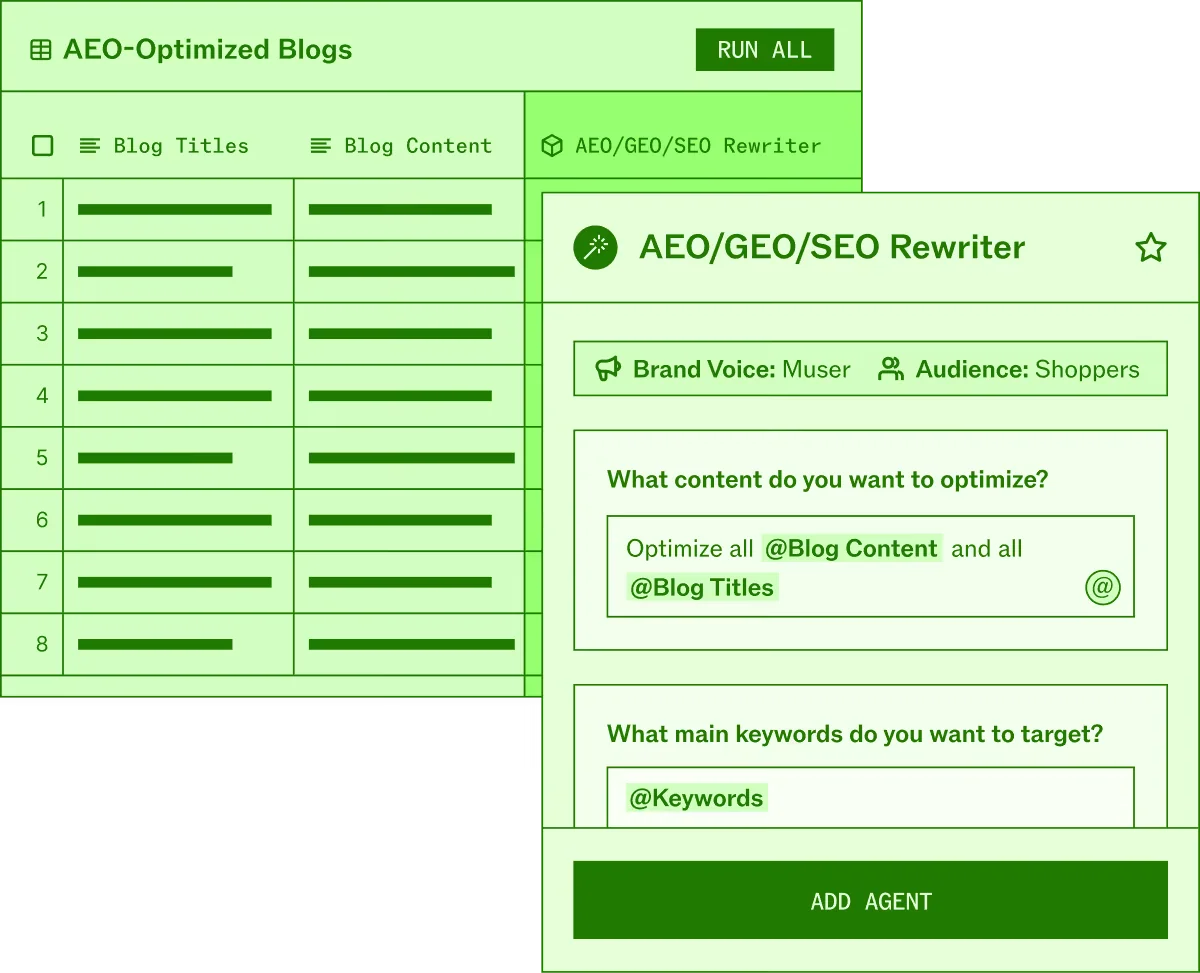
In 2026, Jasper has leaned into AEO/GEO territory - the Grid view now runs AEO-optimized blog pipelines in batch, with an AEO/GEO/SEO Rewriter agent available inside the workflow builder. It's still not a SERP-mirroring platform in the way Frase or Writesonic are, but content teams running brand-consistent volume now have a tighter SEO loop than in prior years.
With 4.7/5 stars across 1,270 G2 reviews (84% five-star, 93% small-business), user satisfaction is high - but there is a billing gotcha worth flagging: pausing your Jasper subscription immediately removes access, even if you have days or weeks of paid time remaining. One paying customer documented this publicly on G2: "CAUTION. If you choose to not use Jasper for 1-2 months and click 'Pause Subscription', it will immediately prevent you from using the product even if you have days/weeks of use paid for already." The community's dominant complaint beyond pricing is repetitive output - a G2 reviewer noted they ended up switching to ChatGPT 4o because it followed their brand voice better on simpler tasks.
Features
- Brand Voice - extracts tone, vocabulary, and style from uploaded docs; 2 profiles on Pro, unlimited on Business
- Jasper IQ - integrates knowledge from brand URLs, documents, and past content into every generation
- Jasper Canvas - long-form doc editor with real-time AI editing, reformatting, and polish commands
- Jasper Grid - batch content generation across keyword lists and templates (Business-only)
- AI Studio - custom AI apps and automations within Jasper (Business-only)
- Content Pipelines - templated multi-step content workflows
- 30+ languages - multilingual output on all plans
Pros
- Most mature brand voice enforcement in the category
- Jasper IQ keeps generations grounded in brand knowledge
- Business Grid enables genuine bulk production at scale
- Large, active user community with extensive prompt libraries
Cons
- Pro tier is a single-seat plan - you can't add more seats without moving to Business (custom pricing)
- Grid, AI Studio, Style Guide, Visual Guidelines, API, and SSO are all Business-only
- Output can read generic without careful Brand Voice setup; community agrees ChatGPT can sometimes match it on simpler tasks
- Pause billing immediately removes access - unusually harsh for a subscription product
Pricing
| Plan | Price | Seats | Brand Voice profiles |
|---|---|---|---|
| Pro | $59/mo (annual), $69/mo (monthly) | 1 | 2 |
| Business | Custom - 12-month commit | Multiple | Unlimited |
Full Jasper AI pricing breakdown, including what's gated at Business, is covered in our dedicated guide. If Jasper's price feels steep, see the Jasper AI alternatives roundup.
Bottom line
Jasper earns its place as the go-to for brand-consistent content at scale - but only if the Brand Voice system is properly loaded. Without it, the output is competent but not differentiated from any other AI copywriting tool. The Pro tier's single-seat limit means any team use requires Business pricing conversations. Right for: marketing teams with defined brand guidelines and a content volume problem.
2. Writer.com - best for enterprise AI deployment {#writer}
Writer (writer.com) is a different class of product from everything else on this list. Where Jasper and Copy.ai are SaaS subscriptions, Writer is an enterprise AI deployment platform - it ships its own Palmyra large language models, integrates into a company's knowledge base and data stack, and rolls out across an organization as a controlled, compliant AI layer. Customers include Vodafone, Vanguard, Salesforce, KPMG, and Qualcomm. The ACV is in the five-to-six-figure range.
The core product surface in 2026 is built around four pillars:
- Writer Agent - agentic workflows where the AI runs multi-step tasks autonomously (campaign generation, churned customer re-engagement, content audits)
- Palmyra LLMs - Writer's own models, available for fine-tuning on company data
- Playbooks - pre-built workflow templates for common enterprise use cases
- Connectors and Skills - integrations into Salesforce, HubSpot, Slack, and other enterprise systems
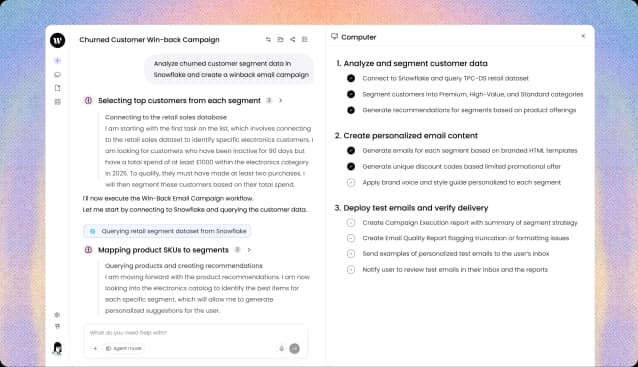
Trust and compliance are load-bearing features: Writer holds SOC 2 Type II, ISO 27001, GDPR, and HIPAA certifications, and offers a private LLM deployment option for organizations that cannot let content touch third-party infrastructure. This is the tier of compliance that healthcare, financial services, and government-adjacent enterprises require.
Features
- Palmyra LLMs - proprietary models fine-tunable on company data
- Writer Agent - autonomous multi-step task execution
- Brand Voice and Knowledge Graph - company-specific voice and terminology enforcement across all outputs
- Playbooks - enterprise workflow templates
- Connectors - Salesforce, HubSpot, Slack, Google Workspace, and more
- SOC 2 + ISO 27001 + HIPAA - full enterprise compliance suite
- Private LLM option - no content transmitted to shared infrastructure
Pros
- The only platform with its own proprietary LLMs in this comparison
- Full enterprise compliance (SOC 2, ISO 27001, HIPAA, private LLM)
- Genuinely agentic - Writer Agent runs multi-step workflows, not just one-shot generations
- Strong reference customer list (Vodafone, Vanguard, Salesforce scale)
Cons
- No public pricing - every deal requires a sales conversation
- Not appropriate for solo writers or small teams; minimum commitment and contract structure puts it out of reach for most SMBs
- Feature parity with a simpler writing tool requires significant configuration time
Pricing
No published pricing. Starter tier runs on a 14-day free trial before moving to paid; Enterprise is contact-sales with custom contracts. Writer.com pricing guide covers what's known from public sources and community reports. Writer AI alternatives exist if enterprise commitment is too steep.
Bottom line
Writer.com is not competing with Jasper for the $59/month marketing writer. It's competing with enterprise content platforms for five-to-six-figure contracts where compliance, proprietary LLMs, and deep system integrations are requirements. Right for: enterprises with compliance requirements, data security concerns, or the need to deploy AI as an infrastructure layer - not a writing assistant.
3. Copy.ai - best for GTM workflow automation {#copyai}
Copy.ai (copy.ai) rebranded itself from "AI writer" to "AI-Native GTM Platform" in 2024, and the 2026 product reflects how far that pivot has gone. The chat interface and template library are still there, but the real product is now Workflows (multi-step automations), Agents (AI that runs tasks end-to-end), Actions (individual AI-powered steps that connect to external systems), and a Brand Infobase (a shared knowledge layer of brand voice, positioning, and reference content).
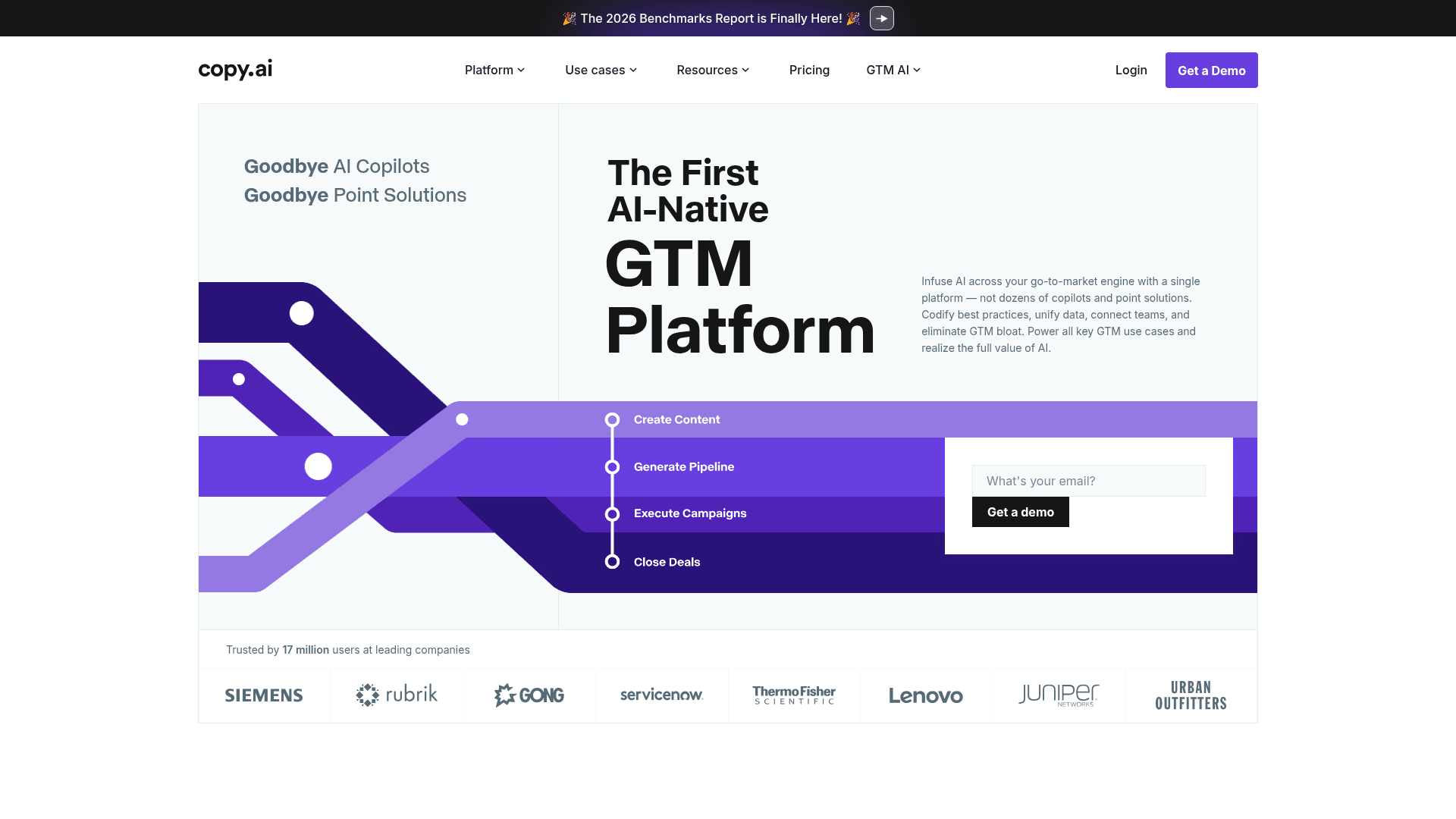
The 17 million users figure Copy.ai promotes reflects the legacy platform - a free-to-use AI writer for short-form copy that captured a huge audience at the beginning of the GPT-3 wave. The current product is aimed at GTM teams running content at scale: lead nurturing sequences, persona-driven outbound, landing page variants, and content pipelines that touch CRM and messaging infrastructure. The First Draft Wizard (a branded multi-step blog generation flow) remains the most-praised specific feature in community discussions, cited by name in Reddit threads as the entry point that converted casual users into paid subscribers.
The pricing structure creates friction: the jump from the Chat plan ($29/month) to Growth ($1,000/month) is the largest gap in the category, with nothing in between for teams that need more than the single-user Chat tier but don't have a five-figure SaaS budget. Community discussions on Reddit consistently name this gap as the reason mid-market buyers stall.
Features
- Workflows - multi-step content pipelines with conditional logic, loops, and external integrations
- Agents - AI that autonomously executes multi-step GTM tasks
- Brand Infobase - unified brand voice, personas, product information, and messaging guidelines
- First Draft Wizard - guided multi-step blog generation
- Tables - structured data layer for content operations at scale
- 30+ languages - multilingual output
Pros
- 17 million users; one of the most established products in the category
- Workflow automation depth is unmatched for GTM teams
- First Draft Wizard converts well as a no-friction entry point
- Brand Infobase creates a genuinely shared knowledge layer across teams
Cons
- Chat → Growth gap ($29 → $1,000) leaves mid-market buyers with no intermediate option
- No free forever tier; only a 7-day trial
- Pivoted so far toward GTM automation that pure writing use cases are underserved vs. Jasper or Anyword
- No native SEO/GEO tooling; building for ranking requires integrations
Pricing
| Plan | Price | Key limits |
|---|---|---|
| Chat | $24/mo (annual), $29/mo (monthly) | 1 user, limited Workflow runs |
| Growth | $1,000/mo | Teams, higher Workflow volume |
| Expansion | $2,000/mo | Enterprise-scale Workflow volume |
For a head-to-head, see Jasper AI vs Copy.ai and Writesonic vs Copy.ai.
Bottom line
Copy.ai is the strongest choice for GTM teams that need AI embedded into the workflow - not just a writing assistant on the side. The First Draft Wizard and Brand Infobase are genuinely well-executed; the pricing cliff between Chat and Growth is the product's biggest limitation. Right for: growth and demand-gen teams willing to invest in the Growth tier or above; wrong for solo writers who need a capable AI content tool without a $1,000/month commitment.
4. Anyword - best for performance prediction {#anyword}
Anyword (anyword.com) has a core bet that no other tool in this roundup has made: AI-generated copy can be ranked by predicted conversion performance before it's published, and that prediction is meaningfully more accurate than guessing. The headline accuracy claim, verbatim from the homepage: "Anyword's AI delivers industry-leading performance prediction - accurately determining which of two content variations will perform better based on audience, business goal, and channel - with 82% accuracy. In comparison, generic AI models like GPT-4o achieve only 52%."
That means Anyword isn't just generating variations - it's scoring them against a dataset trained on real marketing campaign A/B tests. The platform claims ~30% average conversion rate lift across its customer base. G2 reviewers echo this: predictive scoring is the most-cited buying reason across 1,226 verified reviews (4.8/5).
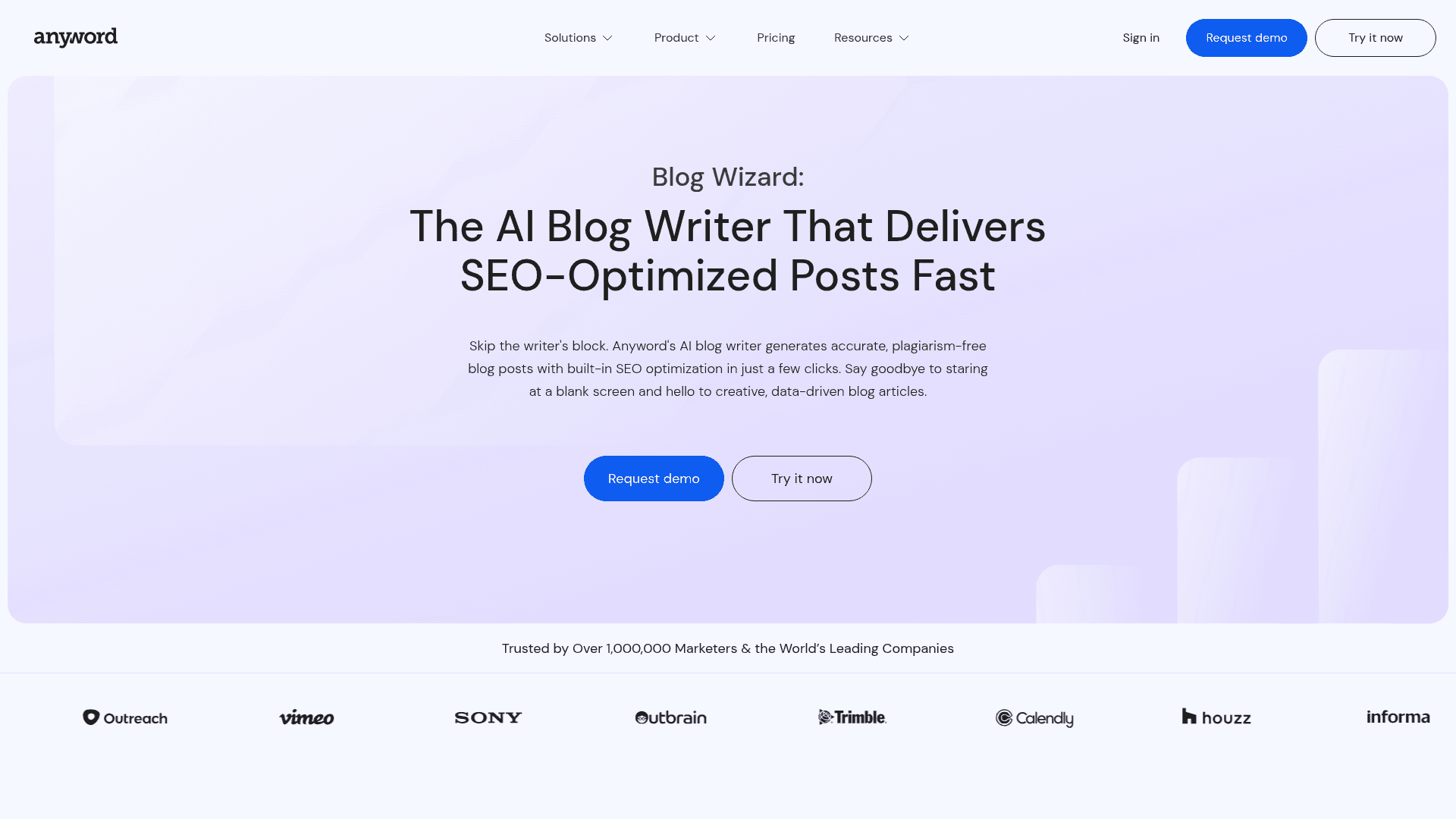
Community evidence confirms the efficiency claim. One Software Advice verified reviewer: "Yesterday, I executed an entire landing page strategy in 1 day. It would have taken several weeks… before Anyword." The platform's Blog Wizard handles long-form with an SEO score, plagiarism checker, brand voice alignment, and research panel. A Chrome extension overlays predictions directly on ChatGPT, Notion, and Gemini - so teams that aren't ready to move their entire workflow into Anyword can still access predictions in their existing tools.
The limitations are structural: API access and SSO are Enterprise-only, and custom-built AI models trained on the customer's own performance history don't unlock until Business tier. Solo users on Starter at $49/month get the product working but not at full depth.
Features
- Predictive Performance Scoring - numeric prediction of which copy variant performs better, before publishing
- Data-Driven Editor - short-form with inline scoring
- Blog Wizard - long-form AI blog writer with SEO score, plagiarism check, and research panel
- Content Intelligence - benchmarks live published content against A/B test corpus (Business+)
- Brand Voice Hub - tone, audience profiles, messaging bank, brand formulas
- Custom-Built AI Models - trained on customer's own performance data (Business+)
- Performance API + Performance-RAG - embed predictions into third-party apps and agents (Enterprise)
- Chrome extension - overlays predictions on ChatGPT, Notion, Gemini
Pros
- 82% prediction accuracy is the best-documented performance claim in the category
- 4.8/5 G2 across 1,226 reviews - one of the highest satisfaction scores here
- SOC 2, ISO 27001, GDPR, HIPAA - strong compliance posture
- Chrome extension extends value into existing workflows without migration
Cons
- API access and SSO are Enterprise-only (a common mid-market friction point for ops teams)
- Custom AI models require Business tier; Starter is limited to canned predictions
- Niche/sensitive-topic handling is a documented weakness for content outside mainstream marketing verticals
- Reddit signal is weak - the phrase "any word" floods search results, making community research difficult
Pricing
| Plan | Monthly | Yearly (per mo) | Seats | Predictions/mo |
|---|---|---|---|---|
| Starter | $49 | $39 | 1 | 50 (or 100 yearly) |
| Data-Driven | $99 | $79 | 3 | 100 (or 175 yearly) |
| Business | Custom | Custom | 3+ | 250 |
| Enterprise | Custom | Custom | Custom | 500+ |
Extra Data-Driven seats: $59/mo ($49/mo annual). 7-day free trial on Starter and Data-Driven. For more context, see our Anyword review and best Anyword alternatives comparison.
Bottom line
Anyword's unique value is the predictive scoring - that's the reason to pick it over every other tool here. If your content's primary job is conversion, the 82% vs. 52% accuracy gap over GPT-4o justifies the price at any tier. If you're writing for brand or SEO without a CRO feedback loop, the differentiation is weaker and a cheaper tool likely fits. Right for: performance marketers, demand-gen, and conversion-focused teams; less useful for editorial/SEO content where ranking signals matter more than A/B conversion data.
5. Writesonic - best for SEO + GEO content {#writesonic}
Writesonic (writesonic.com) has rebranded from "AI writer" to "AI Search Growth Engine" - and the 2026 product earns the label. The platform covers the full loop from keyword research to draft to optimization score to AI search visibility tracking, with an explicit focus on ranking in both traditional search (Google) and AI search (Perplexity, ChatGPT, Grok, Claude).
The GEO tracking is the newest and most differentiated layer: Writesonic monitors how often your content is cited by AI engines and surfaces gaps. The caveat is that Perplexity, Claude, and Grok tracking are Enterprise-only - Starter and below get limited AI visibility data. This matters for buyers who are evaluating Writesonic specifically for GEO; the headline GEO features aren't fully accessible below the Enterprise tier.
Nikki Lam, VP of SEO at NP Digital, has publicly cited switching to Writesonic from a "$1 billion-valued competitor" specifically because of its SEO tooling. Community feedback from r/SEO is more mixed: "you're always gonna be heavily editing" is a common refrain, placing Writesonic alongside Frase as a platform that does the research and structural lift but still requires human editing before publishing.
4.8/5 on both G2 (2,031 reviews) and Capterra (2,102 reviews) - the highest review volume of any tool in this roundup at each platform - with consistent praise for SERP research speed and GEO-readiness prompts.
Features
- AI Search Growth Engine - SEO draft + optimization + GEO tracking in one workflow
- SERP analysis - real-time scrape of top-ranking content for target keywords
- GEO optimization - structure and cite content for AI engine citation readiness
- AI visibility tracking - monitors citation share across AI engines (full GEO tracking at Enterprise)
- Chatsonic - conversational AI interface for ideation and research
- Brand Voice - all plans
- Bulk content creation - generate articles across keyword lists
- 100+ languages - multilingual generation
Pros
- Highest review volume in the roundup (2,031 G2, 2,102 Capterra)
- Full SEO + GEO loop in one platform
- SERP analysis speeds up keyword-to-outline time significantly
- Strong multilingual support
Cons
- Perplexity, Claude, and Grok GEO tracking locked to Enterprise
- Community consensus: output quality "requires heavy editing" before it's publishable
- Starting price ($79/mo Starter monthly) is higher than most competitors in the table
- No free tier
Pricing
| Plan | Monthly |
|---|---|
| Starter | $79 |
| Basic | $199 |
| Growth | $399 |
| Enterprise | Custom |
See the full Writesonic pricing guide and Writesonic review 2026. Head-to-heads: Writesonic vs Rytr, Writesonic vs Frase AI.
Bottom line
Writesonic is the most complete SEO + GEO platform available at sub-Enterprise pricing - as long as buyers understand that full GEO tracking (including the AI engines buyers most care about in 2026) requires Enterprise. For a team that writes primarily for search and wants to track AI engine visibility, Writesonic and Frase are the two tools worth evaluating side by side. Right for: content and SEO teams running volume content for Google and AI search; wrong for solo writers looking for a cheap AI assistant.
6. Frase - best for content research and AI visibility {#frase}
Frase (frase.io) has one distinctive and durable architecture: the top-ranking SERP pages for a target keyword are the explicit input that shapes everything else - the content brief, the outline, the semantic keyword targets, the optimization score, and now the GEO structure recommendations. You don't start with a blank prompt in Frase; you start with what's already working.
The workflow in practice: enter a keyword, Frase scrapes the top 10 results in ~30 seconds, surfaces content gaps, generates an H2/H3 outline based on what top-ranking competitors covered that you haven't, then writes a draft with a real-time SEO score (moving from 40 to 90 as you hit the right topics). Every plan - including Starter - includes GEO content optimization and AI visibility tracking, which puts Frase ahead of Writesonic on accessibility of these features at lower price points.
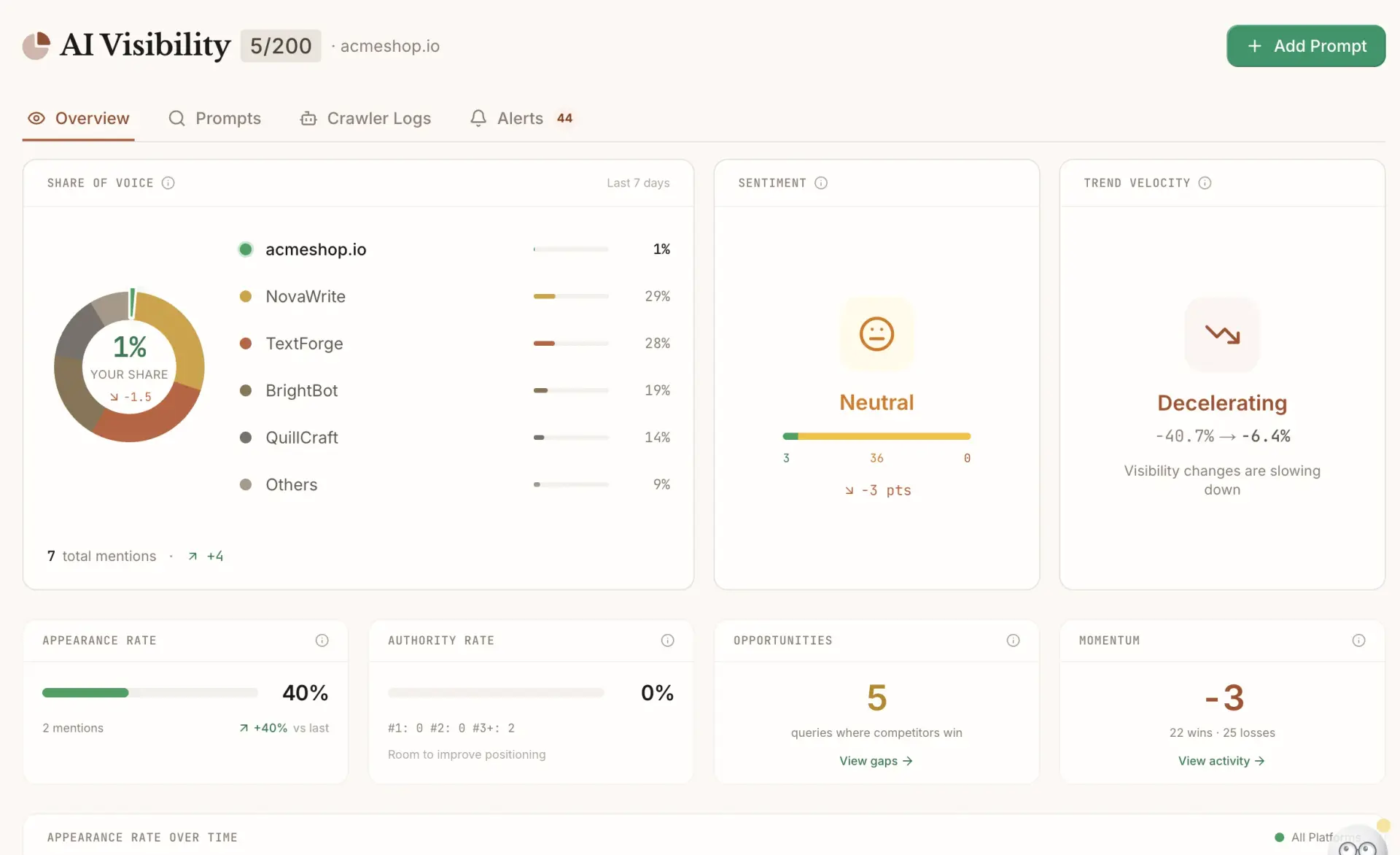
The AI visibility tracking dashboard is one of the most developed in the market: Share of Voice, Sentiment, Trend Velocity, Appearance Rate, Authority Rate, Momentum, and a query-level Opportunities view showing where competitors are winning in AI engines while you're not.
Kevin Indig, Director of SEO at Shopify, is the most frequently cited customer testimonial: "Our organic traffic is up 3x since we started." Red 11 Media, an agency customer, reported going from 1 to 3–4 posts per week per client. 4.8/5 on G2 across 500+ verified reviews; 98% would recommend.
The community comparison context is helpful: Frase is consistently positioned against Surfer SEO - Frase wins on price and integrated content creation, Surfer wins on optimization depth. The r/seogrowth community's active 2026 threads questioning whether SERP-mirroring tools are still relevant are Frase's biggest category-level headwind; Frase's GEO pivot is a direct response.
Features
- SERP-driven research - 30-second top 10 scrape, gap analysis, keyword extraction
- AI brief + outline - H2/H3 outline based on competitor content gaps
- Real-time SEO scoring - 0–100 score updating live as you write
- GEO optimization - cite and structure for AI engine readability (every plan)
- AI visibility tracking - Share of Voice, Appearance Rate, Authority Rate, Momentum across ChatGPT, Perplexity, Claude, Gemini
- 37+ AI writing tools - 6 categories covering blog, copywriting, social, email, SEO, creative
- Content Atomization - one blog → LinkedIn carousels, Twitter threads, newsletters (Scale+)
- Programmatic SEO - 10,000+ pages from structured data templates
- SOC 2 Type II + GDPR - Enterprise tier
Pros
- GEO tracking is included on every plan (not Enterprise-gated like Writesonic)
- SERP-to-outline speed is the best documented workflow efficiency in the category
- 98% would recommend is an unusually strong signal for B2B SaaS
- Kevin Indig (Shopify SEO Director) public endorsement is a credible primary source citation
Cons
- SERP-mirroring architecture means output can feel like a better version of what's already ranking - not a differentiated take
- Scale and Programmatic SEO require the $299/mo Scale tier
- SOC 2 is Enterprise-only (a gap vs. Anyword, which includes it on all plans)
- Content intelligence depth is less than Surfer SEO for granular optimization nerds
Pricing
| Plan | Monthly | Seats | Articles/mo | AI platforms tracked |
|---|---|---|---|---|
| Starter | $49 | 1 | 10 | 2 |
| Professional | $129 | 3 (+$29/seat) | 40 | 3 |
| Scale | $299 | 5 (+$29/seat) | 100 | 5 |
| Enterprise | Custom | Custom | Custom | 8 |
Plans differ in volume, not capabilities. Frase AI pricing deep dive and Frase AI review cover the full picture. For comparisons: Frase vs Surfer SEO, Writesonic vs Frase AI.
Bottom line
Frase is the most complete SEO + GEO research tool for teams that start with a keyword and need to ship a draft that's already structured for both Google and AI engines. GEO tracking on every plan - not locked to Enterprise - is the most buyer-friendly access model for AI visibility in this roundup. Right for: SEO content teams and agencies; solo operators who want SERP-grounded content without the manual research phase.
7. KoalaWriter - best for SEO blogging on a budget {#koalawriter}
KoalaWriter (koala.sh/writer) has a simple pitch that community data confirms: one-click publish to WordPress, long-form output (3,500+ words), and plans starting at $9/month. For solo bloggers and lean content operations running SEO-first affiliate or niche sites, this is the value case that consistently beats the alternatives in Reddit threads comparing budget AI writers.
The April 2026 Brand DNA + KoalaWriter v2 launch was described by Koala itself as "the biggest update in Koala AI's history" - adding a structured business context layer (Brand DNA) that feeds every subsequent generation, and a new Service Pages article type alongside the existing Blog Post, Listicle, Local Places, Amazon Roundup, Amazon Single, YouTube-to-Blog, and Rewrite types.
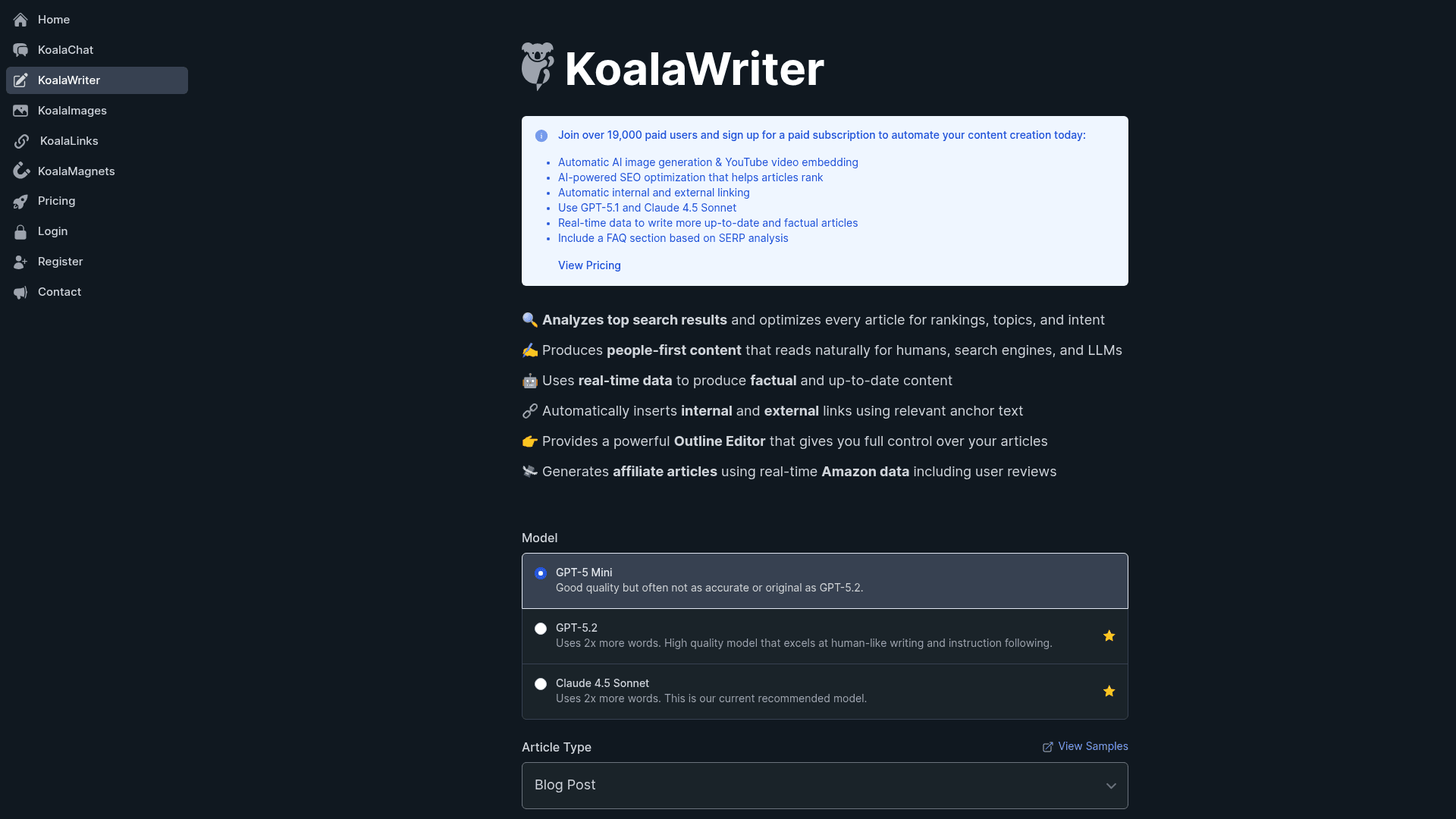
The model selection matters more here than on most platforms: word counts are billed at the GPT-5 Mini rate, and selecting the recommended Claude 4.5 Sonnet or GPT-5.2 doubles the effective word cost. A $49 Professional plan's stated 100,000 words becomes effectively 50,000 high-quality words per month. Community users who don't notice this footnote are often the source of the platform's mixed Trustpilot scores.
The Trustpilot gap is worth flagging directly: on-site testimonials are uniformly 5-star (mostly Capterra-curated), but the public Trustpilot aggregate sits at 3.5/5 across 21 reviews - meaningfully lower than what Koala's own website presents. The user base on Reddit is enthusiastic about the WordPress push and long-form output, but less happy with pricing transparency and credit accounting.
Features
- One-click publishing - WordPress (official plugin), Shopify, Webflow, Ghost, Zapier/Make webhooks
- KoalaWriter - seven article types including Blog Post, Listicle, Amazon Roundup, YouTube-to-Blog, Rewrite
- Brand DNA - structured business context feeding every generation (April 2026)
- Deep Research mode - "100x more context" using authoritative web sources
- Real-time SERP analysis - top-ranking content analyzed for entity and semantic keywords
- Automatic internal linking - indexes full site, adds contextual links (Professional+)
- KoalaLinks - 10+ million internal links created to date
- KoalaImages - AI images tuned for blog embedding
- Bulk content creation - many articles simultaneously
- Model choice - GPT-5 Mini (standard rate), GPT-5.2 or Claude 4.5 Sonnet (2× word cost)
Pros
- Cheapest entry point in the roundup ($9/month Essentials)
- One-click WordPress publish is the #1 community-cited time-saver
- Long-form output (3,500+ words) beats raw ChatGPT for solo operators
- Brand DNA (v2) addresses the "generic output" complaint with a structured context layer
- Free trial (5,000 words) without a credit card
Cons
- Solo-use only - no team or workspace tier at any price point
- Claude 4.5 Sonnet and GPT-5.2 double the effective word cost (critical footnote on all plan pages)
- Trustpilot public aggregate (3.5/5, 21 reviews) vs. curated on-site testimonials (uniformly 5-star) - a transparency gap
- Deep Research, auto internal linking, and AI editing are Professional ($49+), not Essentials
Pricing
| Plan | Monthly | KoalaWriter words (GPT-5 Mini rate) |
|---|---|---|
| Essentials | $9 | 15,000 |
| Professional | $49 | 100,000 (50,000 at Claude 4.5 Sonnet rate) |
| Boost | $99 | 250,000 |
| Growth | $179 | 500,000 |
| Elite | $350 | 1,000,000 |
Full plan details: Koala AI pricing. Longer review: KoalaWriter review 2026 and Koala AI review.
Bottom line
KoalaWriter's value is unambiguous at $9/month for solo SEO bloggers. The one-click WordPress publish plus 3,500+ word output is the specific combination that keeps KoalaWriter relevant against raw ChatGPT, which requires manual CMS steps and doesn't auto-link internally. Right for: solo affiliate, niche site, and SEO content operators who value publishing speed over output quality; wrong for teams or anyone who needs compliance, security, or white-label features.
8. Rytr - best free tier {#rytr}
Rytr (rytr.me) wins on one axis clearly: cost. The free tier (10,000 characters/month, no credit card required) and Unlimited plan ($7.50/month on annual billing) are the cheapest sustained-access options in the AI blog writing tools category. With 8 million users and 4.7/5 across 819 G2 reviews (85% five-star), satisfaction is high - but the context matters: most five-star reviews describe Rytr as an augmentation tool, not a primary drafting engine.
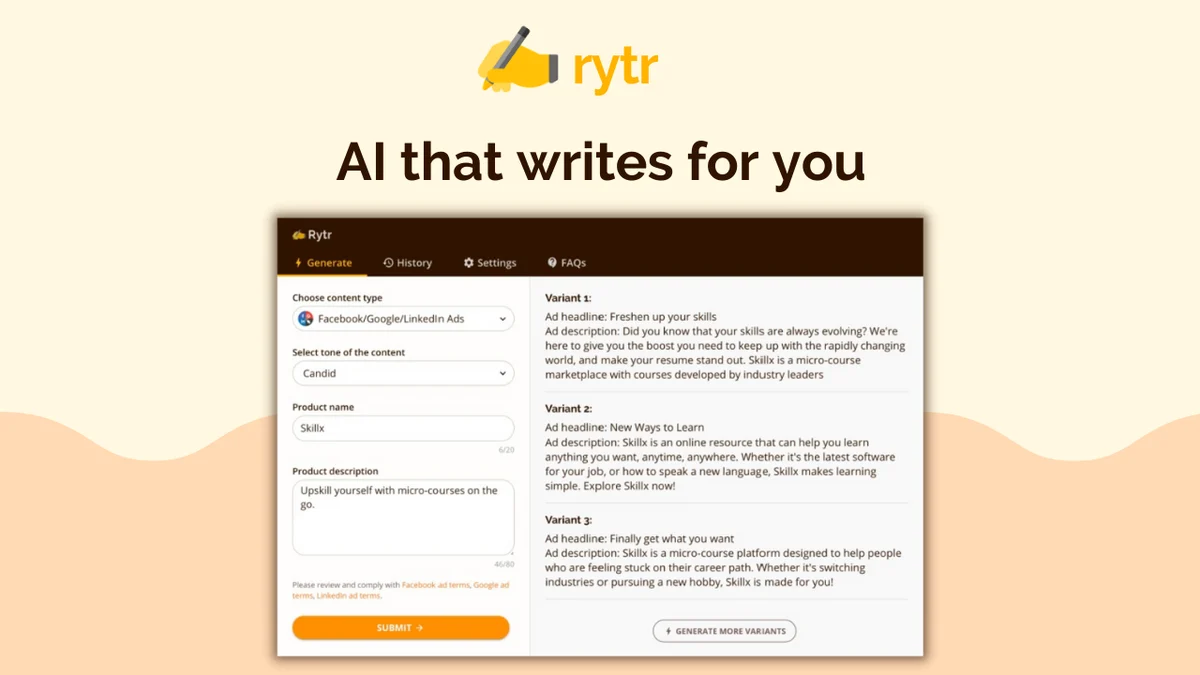
The 40+ templates cover a wide range, including Facebook/Google/LinkedIn Ads, Blog Section Writing, AIDA frameworks, Magic Commands, and a Chrome extension for in-context generation. The core use case community reviewers describe is "beats the blank page" - Rytr provides a first draft, a starting point, a headline variant, or a paragraph expansion, not a finished piece. Reviewers who try to generate complete long-form content without editing report the generic output problem that has followed AI content tools since 2022.
Two specific limitations compound at scale: no team or workspace tier (all three plans are individual-seat, with Premium described as "for freelancers managing multiple brands"), and no native integrations beyond the Chrome extension - no WordPress push, no Google Docs, no Notion connector. The /features page returned a 404 in June 2026, and the blog-section use-case page was marked "under construction" - minor signals, but they suggest the marketing site isn't being actively maintained, which matters for buyers evaluating long-term platform stability.
The ChatGPT pressure angle is real in the Reddit community: threads from 2023–2026 increasingly ask whether a paid Rytr subscription is justified when ChatGPT can do similar short-form work for free. The honest answer is that Rytr's templates, tone controls, and 35+ language support (Premium only) still provide enough structure to justify the $7.50/month for users who find the blank ChatGPT interface intimidating. At $0/month on Free, the justification is moot.
Features
- 40+ use-case templates - ads, blog sections, AIDA, landing pages, creative, email
- 20+ preset tones - on every plan
- Custom tone cloning - 1 custom tone on Unlimited, up to 5 on Premium
- Magic Command - natural language instructions within the editor
- AI Autocomplete, Continue Writing, Rewording, Sentence Shortener - editing toolkit
- Chrome Extension - in-context generation in any web text field
- 35+ languages - Premium only
- Plagiarism checker - 50 checks/month (Unlimited), 100/month (Premium)
Pros
- Only tool in this roundup with a genuinely free forever tier (no credit card, 10K chars/month)
- Unlimited plan at $7.50/month is the lowest paid price in the category
- 4.7/5 G2 across 819 reviews; clear user satisfaction at the price point
- Template variety covers most short-form content needs without customization
Cons
- No team or workspace tier at any price point - Premium is still single-seat
- No native CMS or app integrations (Chrome extension only)
- 35+ language support is Premium-only
/featurespage is a 404 (as of June 2026) - maintenance signal worth monitoring- Output is widely described as requiring editing before it's publishable; not suitable as a single-pass drafting tool for anything over 500 words
Pricing
| Plan | Price (annual) | Characters/month | Custom tones | Languages |
|---|---|---|---|---|
| Free | $0 | 10,000 | 0 | 1 |
| Unlimited | $7.50/mo | Unlimited | 1 | 1 |
| Premium | $24.16/mo | Unlimited | Up to 5 | 35+ |
Monthly billing is higher: Unlimited ~$9/mo, Premium ~$29/mo. Rytr pricing guide and Rytr AI overview. If you need more, see Rytr AI alternatives for the next tier up.
Bottom line
Rytr's free tier is genuinely useful for freelancers and students who want AI-assisted short-form content without a financial commitment. The $7.50/month Unlimited plan is the cheapest functional subscription in the best AI writing tools category - the right pick if budget is the primary constraint. Right for: solo content creators, students, and freelancers who want AI augmentation at near-zero cost; wrong for anyone needing team features, CMS integrations, or long-form output above 500 words without heavy editing.
How to choose the right AI content generator
The category has fragmented enough that picking the wrong tool is a real cost - either overpaying for enterprise features you won't use, or underbuying and spending time compensating for a tool's gaps.
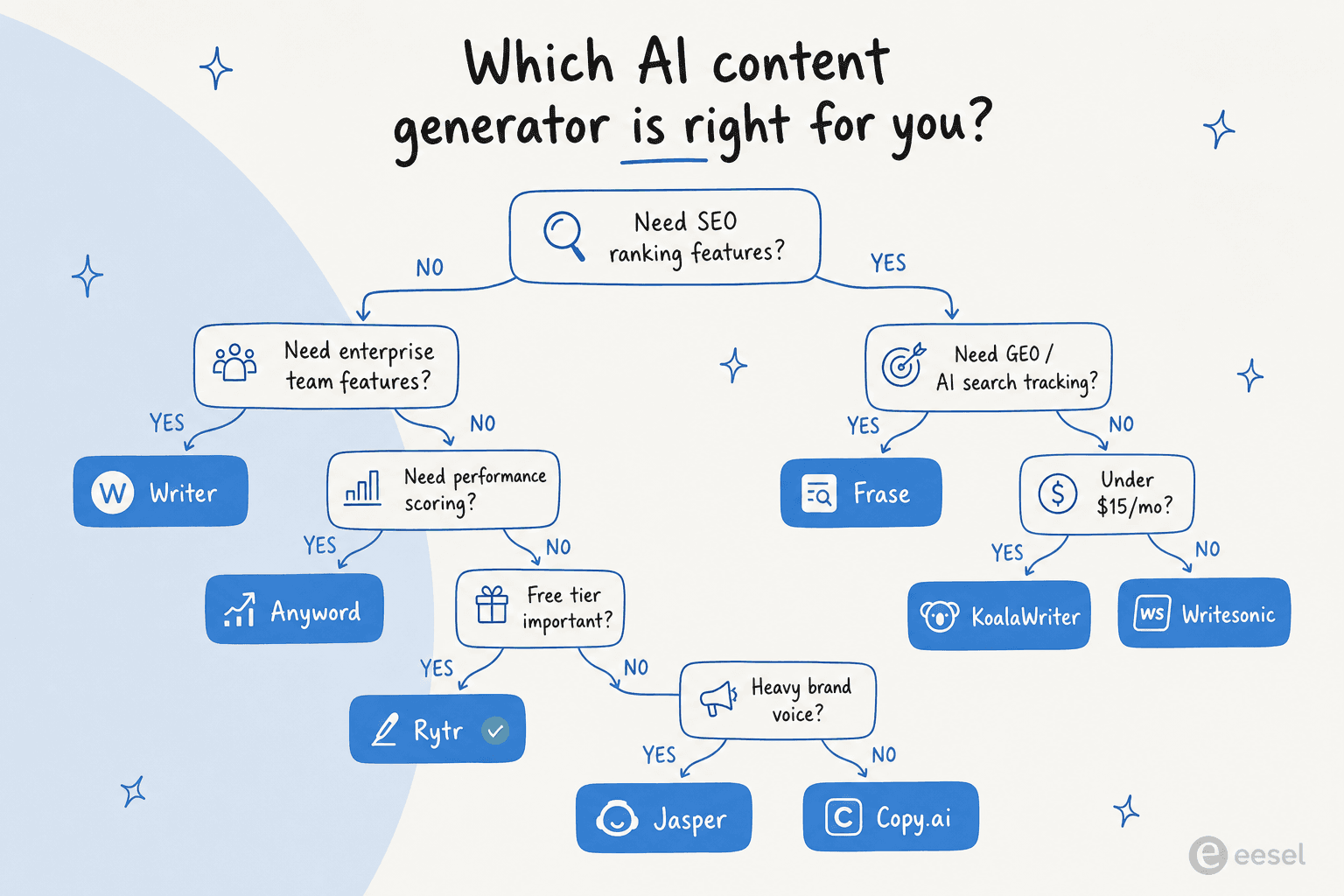
Start with the job, not the tool:
- Ranking in Google and AI search → Frase or Writesonic. Frase includes GEO tracking on every plan. Writesonic has a higher review volume and stronger SERP research tooling, but locks AI engine tracking (Perplexity, Grok, Claude) to Enterprise.
- Brand-consistent content across a team → Jasper (if under enterprise threshold) or Writer.com (if compliance and custom LLMs are requirements).
- Conversion optimization → Anyword. No other tool in the roundup offers predictive performance scoring; this is the only product genuinely designed to answer "which copy version converts better?"
- GTM automation and sales/marketing funnels → Copy.ai, specifically the Growth tier and above. The Chat tier is a solo writing assistant; the GTM automation layer requires Growth.
- SEO blogging, solo, budget → KoalaWriter at $9/month. The WordPress publish pipeline and 3,500-word output are the differentiators. Check the model rate footnote before picking a plan.
- Free tier → Rytr. 10,000 characters/month, no credit card. For paid-but-cheap: Rytr Unlimited at $7.50/month.
If SEO matters: use an SEO-optimized AI content generator or a platform with built-in SERP research - Frase or Writesonic. A general-purpose writer like Jasper or Rytr won't surface competitor gaps or track whether your content is being cited by ChatGPT.
If AI detectability matters: all AI-generated content will fail some detectors regardless of tool. The more relevant question is whether the output needs human editing - and for every tool in this list, the honest answer is yes. AI writing detection tools can test output before publishing, but editing for naturalness beats any detection-evasion technique.
If you're evaluating a free AI blog writer: Rytr's free tier is the only genuine no-credit-card option in this roundup. KoalaWriter offers a free 5,000-word trial without a credit card but doesn't have an ongoing free tier.
Try eesel for AI-powered content at scale
If you're running a content team or helpdesk and want AI that connects to your existing knowledge base - docs, tickets, Notion, Confluence, Google Drive - eesel.ai plugs your whole knowledge stack into a custom AI that writes in your voice and answers questions with actual company context.

Try eesel - no seat fees, no platform fee on self-serve, and 100 free credits for support, no card.
Frequently Asked Questions
What is the best AI content generator in 2026?
The best AI content generator depends on the use case. Jasper is the strongest for brand-consistent long-form content. Frase and Writesonic lead for SEO + GEO. Anyword is uniquely positioned for performance prediction. Writer.com is the enterprise-grade option with proprietary LLMs and full compliance. For budget use cases, KoalaWriter ($9/month) and Rytr (free tier) are the most accessible entry points.
What is the cheapest AI content generator?
Rytr offers a free forever tier (10,000 characters/month, no credit card) and an Unlimited plan at $7.50/month on annual billing - the cheapest paid tier across all AI writing tools. KoalaWriter's Essentials plan at $9/month is the next cheapest and includes one-click WordPress publishing.
Which AI content generator is best for SEO?
Frase and Writesonic both cover the full SEO + GEO loop. Frase's key advantage: GEO tracking (AI search visibility) is included on every plan, not locked to Enterprise. Writesonic has higher review volume and a strong SERP research layer, but its most relevant GEO tracking features (Perplexity, Claude, Grok) require the Enterprise tier. For keyword-focused SEO blogging on a budget, KoalaWriter's SERP analysis and best AI blog writer functionality at $9/month is worth considering for solo operators.
Does Jasper have a free trial?
Jasper offers a 7-day free trial. There is no free forever tier. The Pro plan is $59/month on annual billing (1 seat). Note the billing gotcha: pausing your subscription immediately removes access even if you have paid days remaining. For alternatives, see the Jasper AI alternatives roundup. For a direct comparison, see Jasper AI vs Copy.ai.
What AI content generator is best for teams?
For teams, the options split by budget and use case. Jasper Pro is single-seat; Business tier is required for multi-seat. Writer.com is designed for enterprise deployment. Anyword's Data-Driven plan includes 3 seats. Copy.ai's Growth tier ($1,000/month) unlocks team automation. Frase Professional includes 3 seats at $129/month - the most cost-effective team option for SEO content. See our best AI copywriting tool guide for team-specific evaluation criteria.
What is the difference between an AI content generator and an AI writing assistant?
AI writing assistants (Rytr, the Chat interfaces in most tools) augment a human writing session - autocomplete, expand, reword. AI content generators (KoalaWriter, Frase, Writesonic) produce full draft content from a keyword or brief with minimal human input in the generation phase. The line has blurred considerably in 2026; most platforms now offer both modes. The relevant question is whether you want to write with AI assistance or have AI produce a first draft you then edit - the answer changes which product class fits. See our AI content generator guide for more on the distinction.
Does AI-generated content rank on Google?
Google's stated position is that content is evaluated on E-E-A-T signals (Experience, Expertise, Authoritativeness, Trustworthiness) regardless of how it was produced. AI content that is well-researched, edited by a human expert, and structured for the reader's intent ranks - AI content that is generic, unedited, and keyword-stuffed does not. The tools in this roundup that are most explicitly built to help content rank (Frase, Writesonic, KoalaWriter) do so by grounding output in SERP data and building in optimization scoring, not by claiming to evade detection. See our SEO-optimized AI content generator guide for practical guidance.
How does AI content generator pricing work?
Most tools in this roundup bill per seat or per word/credit consumption on monthly or annual cycles. Key variants: per-seat (Jasper Pro = 1 seat, $59/month), per-word (KoalaWriter bills by word at GPT-5 Mini rates; choosing Claude 4.5 Sonnet doubles the word cost), per-article (Frase), per-prediction (Anyword), and per-plan-tier (Rytr - unlimited characters above the Free tier). Annual billing typically saves 20-30% across all platforms. Rytr pricing, Koala AI pricing, and Writesonic pricing each have dedicated deep dives.


Article by
Riellvriany Indriawan
Riell is a designer and writer at eesel AI with about two years of experience researching CX platforms, AI chatbots, and helpdesk software. She combines her design background with a sharp eye for how these tools actually look and feel in practice — making her comparisons unusually visual and user-focused.