SEO Keyword Generator
Generate up to 30 SEO keywords from your topic description. Use each keyword to create blog posts with our AI blog generator.
The complete guide
What is an SEO keyword? A plain-English guide
An SEO keyword is the phrase people type into search and that your page targets. Here's what that means, the types that matter, and how to find yours.
10 min read

So, what actually is an SEO keyword?
I've spent the last couple of years mapping keywords to what buyers actually search for, and the cleanest definition is still the simplest one. An SEO keyword is the term a person searches for, and that a page is written to target. Google's own SEO Starter Guide frames the whole job around this: SEO is "about helping search engines understand your content, and helping users find your site." The keyword sits in the middle, connecting the two.
Google even spells out the human side in its "expect your readers' search terms" advice: "Users who know a lot about the topic might use different keywords in their search queries than someone who is new to the topic." Their example is lovely in its plainness, some people search for "charcuterie" and others search for "cheese board" for the exact same thing.
Ahrefs puts the stakes bluntly in its keyword research guide: keywords are "the foundation of SEO," and "if you publish a page on a topic that no one is searching for, that article won't receive any traffic from Google, no matter how hard you try." That's the whole reason keywords exist as a discipline. They're how you check there's an audience before you spend a day writing.
Keywords vs queries vs topics
These three words get used interchangeably, and that's where a lot of confusion starts. The distinction is real and worth keeping straight.
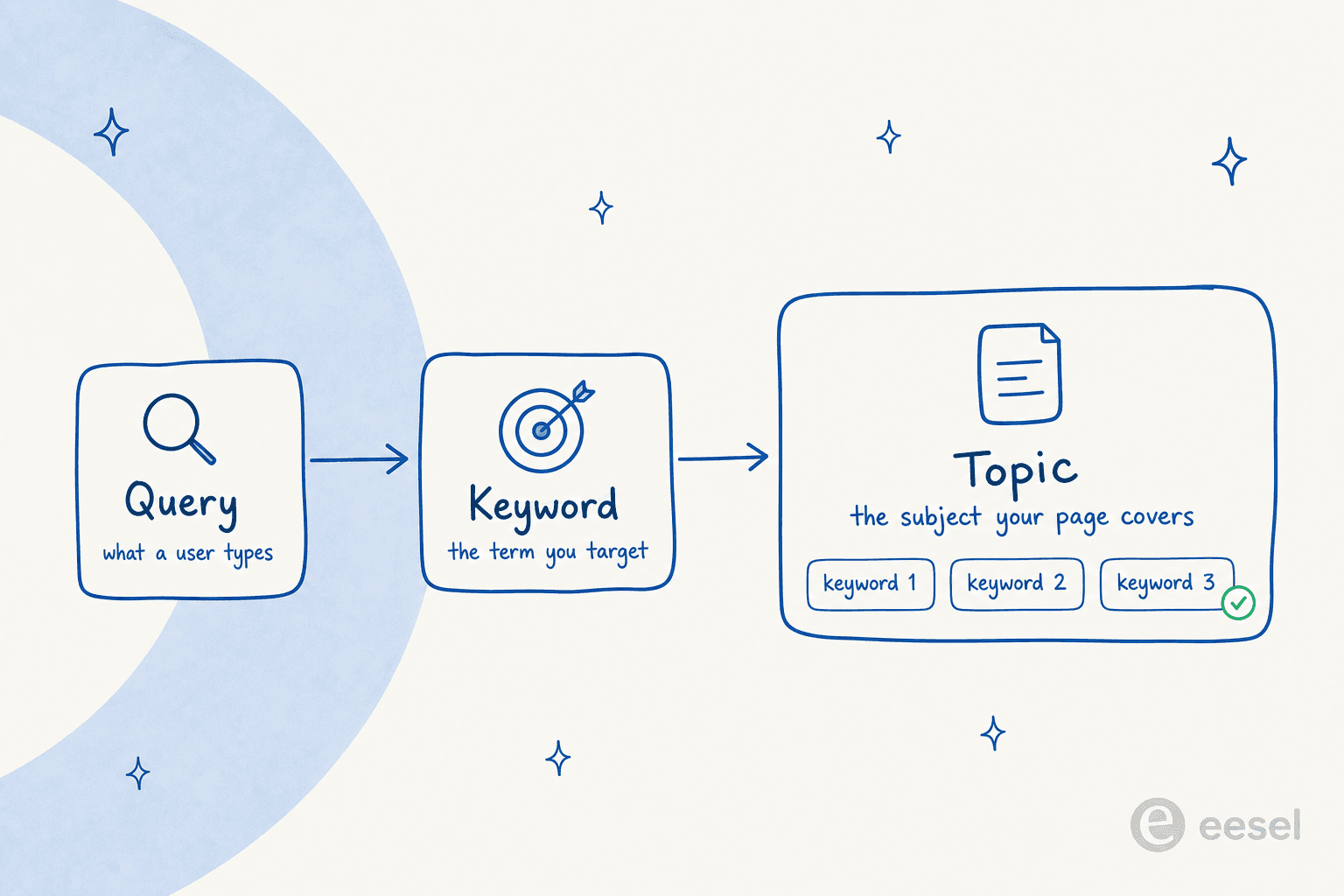
- Query: the exact string a user types in the moment, like "can meditation make you smarter." It's their raw input.
- Keyword: the normalized term you choose to target, usually a representative version of the many queries that mean the same thing.
- Topic: the broader subject a page covers, which naturally spans dozens of keywords and queries.
Google nudges site owners toward topics over single phrases, recommending you "group topically similar pages" and noting you don't need to catch "every variation of how someone might seek your content." The practical takeaway: one page targets one topic, which answers a cluster of related queries, not one rigid keyword string. This is the core idea behind semantic SEO content, and it's why keyword research today is really topic research wearing a keyword's clothes.
The two jobs a keyword actually does
If search is intent-based now (more on that below), why bother choosing keywords at all? Because a keyword does two jobs that nothing else does.
First, it's a demand signal. It tells you whether anyone is actually searching for what you're about to write. This is not a minor point: per Ahrefs' study of the web, 90.63% of pages get no traffic from Google at all, largely because they target things nobody searches for. A keyword with real search volume is your proof the audience exists.
Second, it's a language guide. It tells you the words your readers actually use, so your content speaks their language. Not by repeating the phrase robotically, but by genuinely covering the thing they're looking for in the terms they'd recognize.
Types of SEO keywords: short-tail vs long-tail
The first split you'll hit is head (short-tail) versus long-tail keywords. And the common explanation for the difference is wrong.
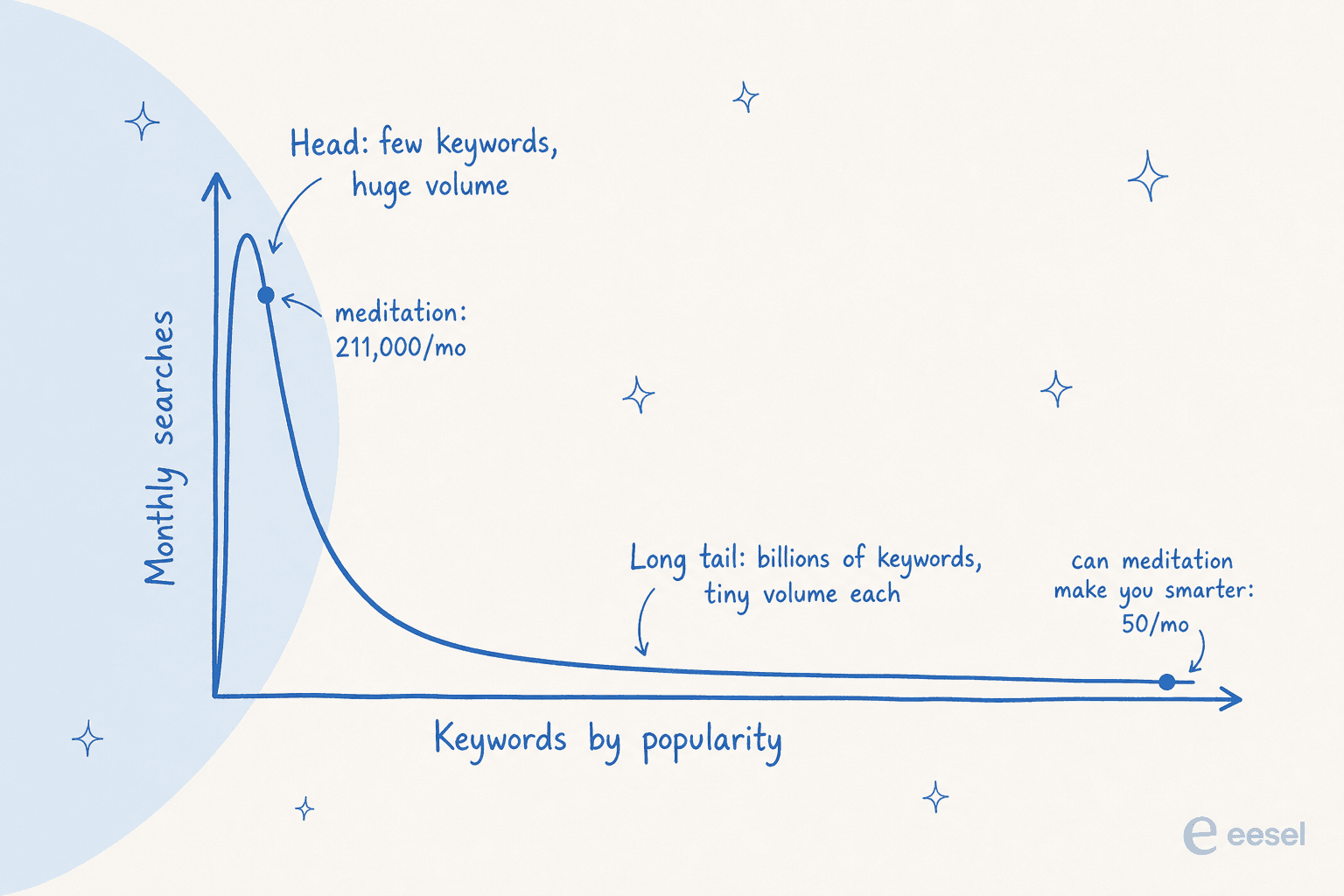
Ahrefs defines long-tail keywords as "search queries that get a small number of searches per month," which "tend to be longer and more specific" and "often have a higher conversion rate." Their worked example: "meditation" is a head keyword at 211,000 searches per month, while "can meditation make you smarter" is a long-tail keyword at just 50.
The name comes from the demand curve. Plot every search by volume and you get a tiny "head" of high-volume terms and an enormous "tail" of low-volume ones. The scale is wild: in Ahrefs' US database, just under 18,000 keywords get more than 100k searches a month, while 2.3 billion get fewer than 10.
Here's the correction most guides get wrong, straight from Ahrefs: length in words does not make a keyword long-tail, search volume does. There are one-word keywords with barely any searches and five-word phrases with hundreds of thousands. So "long-tail" is about how niche the demand is, not how many words you typed.
Why does this matter to you? Long-tail keywords are usually less competitive and more specific, so the searcher is closer to knowing exactly what they want. For a newer site, that's the whole game. As one r/bigseo commenter put it: "most of the time it is relatively easy to get ranked for the long tail than the head keywords." If you're weighing tools to surface and organize these, our keyword clustering tool roundup is a good next stop.
Search intent: the part beginners skip
Of everything on this page, this is the concept I'd tattoo on a new SEO's arm. Two people can type the same words and want completely different things, and the keyword alone won't tell you which.
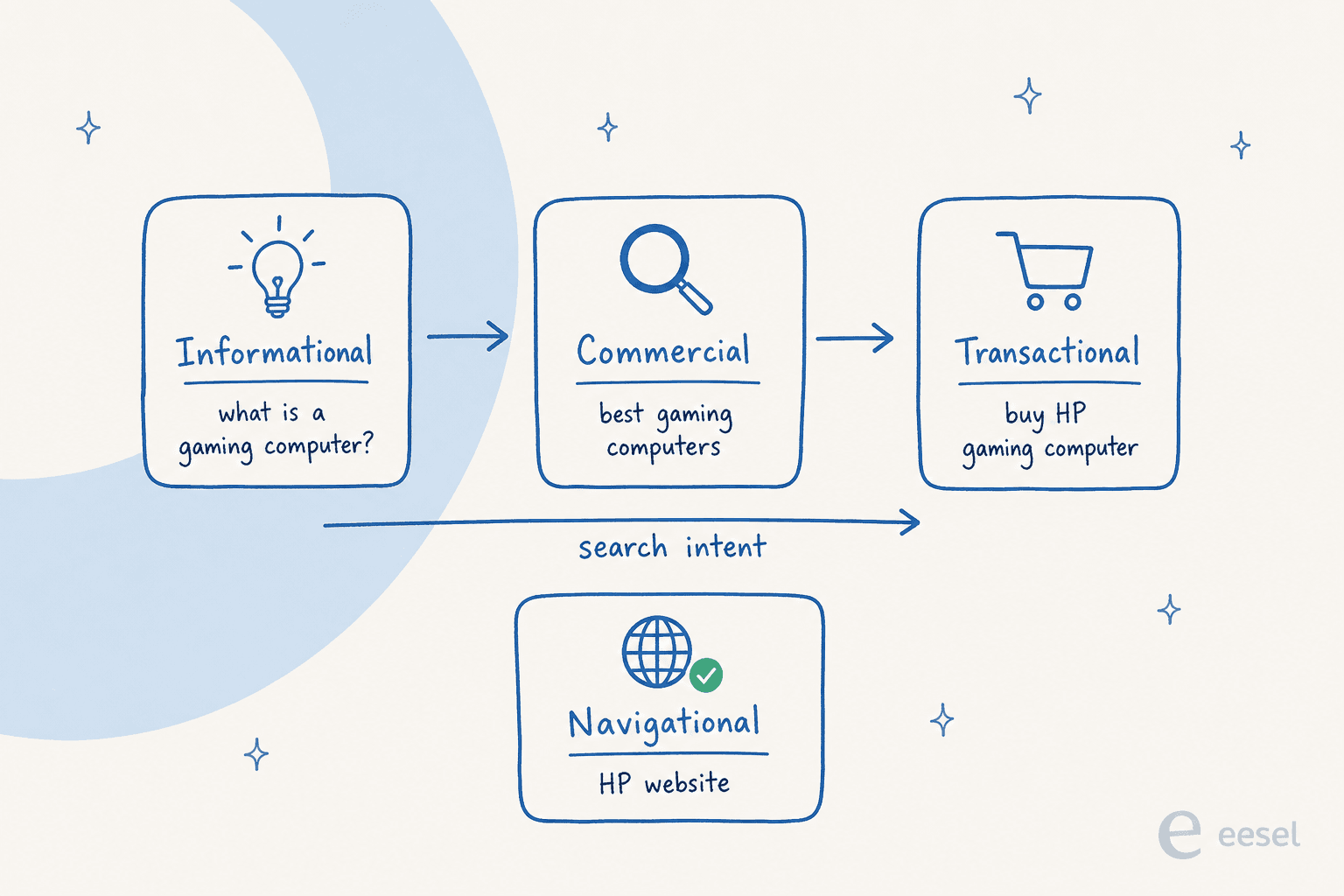
Search intent is, per Moz, "the searcher's main goal when typing a query." Most SEOs recognize four types, and Semrush categorizes keywords the same way:
- Informational: the searcher wants to learn. "What is a gaming computer?"
- Commercial: they're researching before a purchase. "Best gaming computers."
- Transactional: they're ready to buy. "Buy HP gaming computer."
- Navigational: they want a specific destination. "HP website."
Why this is the make-or-break concept: chasing volume while ignoring intent is the single most expensive beginner mistake. Here's a frontline view of it from r/AISEOforBeginners:
"Chasing keywords instead of intent. When I first started, I was obsessed with keyword difficulty scores and search volume. If it had traffic and looked 'rankable,' I'd write it... I ranked pages that brought in visitors who never converted. Tons of impressions, nice little ego boost in Search Console, zero revenue."
u/thehighesthimalaya, r/AISEOforBeginners

As Moz notes, "the closer the content you create matches the search intent, the better its chances of appearing in search results." Volume gets you the click; intent is what turns it into something that matters.
The numbers on every keyword: volume, difficulty, CPC
Open any keyword in a tool and you'll see the same few columns. Here's what each one actually means.
| Metric | What it measures | Why it matters |
|---|---|---|
| Search volume | Estimated monthly searches for the term | Confirms demand exists; Semrush calls it the starting point, not the full picture |
| Keyword difficulty (KD) | How hard it is to rank, on a relative score | Tells you how much authority and effort page one will take |
| Cost per click (CPC) | Average paid-search price per click | A handy proxy for commercial value; high CPC usually signals buyer intent |
Semrush defines search volume as "a metric that estimates how many times people search a specific keyword," and warns that "search volume alone doesn't tell you the full picture of whether a term is worth targeting." That's exactly why difficulty and intent sit right next to it. If you want to go deeper on the trickiest of the three, we have a full breakdown of keyword difficulty explained and a guide to average keyword difficulty benchmarks.
Primary vs secondary keywords, and clusters
You don't pick one keyword per page and stop. Ahrefs frames it cleanly: "Your primary keyword is the main term you're targeting, the one you'd put in your title and URL. Secondary keywords are the variations and related terms you weave throughout your content." They "share the same search intent but use different phrasing," like "best coffee machine" and "drip coffee maker" under a primary of "coffee maker."
The reason to bother: "Most pages that rank #1 for a keyword don't just rank for that one term. They rank for hundreds, sometimes thousands, of related keywords." Secondary keywords are how one page captures that extra traffic without spinning up a new article for every variation.
Group those related terms together and you get a keyword cluster, a set of keywords that share intent and can be served by a single page. That's the mechanism behind a good keyword grouping tool, and it's how you cover a topic properly instead of cannibalizing yourself with ten thin pages.
Does keyword research still matter in the AI era?
Fair question, and the one I get most often now that AI writes half the internet and AI search answers questions directly. The honest answer from people doing the work: it changed, it didn't die.
"Keyword research is still useful, just not in the old-school 'exact match' way. AI is changing search, but Google still needs keywords to understand intent. The real shift is that you have to think more about topics and search behavior instead of just stuffing in keywords... So yeah, keyword research isn't dead, it's just evolved."
u/Whole_Strawberry7279, r/SEO
That matches what named practitioners are saying too. Connor Gillivan framed it on LinkedIn as keyword research still being "the foundation of scalable SEO," but now about "intent mapping, competitive positioning, and building topic clusters." Or, as Search Engine Land put it on X, keyword research and on-page work "still matter. They're just the floor now."
So the skill shifted from collecting exact-match phrases to understanding demand and intent, then covering topics fully. If anything, that makes the humble keyword more useful, not less, because it's still the cleanest read you have on what real people want. The fundamentals haven't moved much, which is partly why a mature AI content pipeline still starts with a keyword.
The one thing not to do: keyword stuffing
Worth saying plainly because beginners still reach for it. Repeating your keyword over and over does not help. It actively hurts.
Google's spam policies define keyword stuffing as "the practice of filling a web page with keywords or numbers in an attempt to manipulate rankings," often where "keywords appear in a list or group, unnaturally, or out of context." Sites that do it "may rank lower in results or not appear in results at all." The same goes for hidden text like white-on-white keywords crammed in where readers can't see them.
Plenty of people learned this the hard way:
"My biggest mistake was obsessing over keyword density like it was 2010 lol. I would stuff keywords everywhere thinking Google would love it."
Modern search decodes meaning, not word counts. Write naturally, cover the topic, and let the engine do the matching. If you're scaling content production, that discipline matters even more, which is the whole point of our guide to scaling SEO content safely.
How to find your keywords (the long way and the shortcut)
The proper process: start from a seed keyword (the obvious term someone would search to find what you offer), feed it into a tool, and get back hundreds of related ideas with their volume, difficulty, and intent. Then narrow down to the ones that are realistic to rank for and aligned with what you actually sell. Google's Keyword Planner and Google Trends are free entry points; dedicated platforms like Ahrefs and Semrush go far deeper, and there's a whole field of AI SEO tools built to speed it up.
That's the right approach, and if SEO is your job, learn it. But if you just need a running start, there's a faster path.
Try eesel's free SEO keyword generator
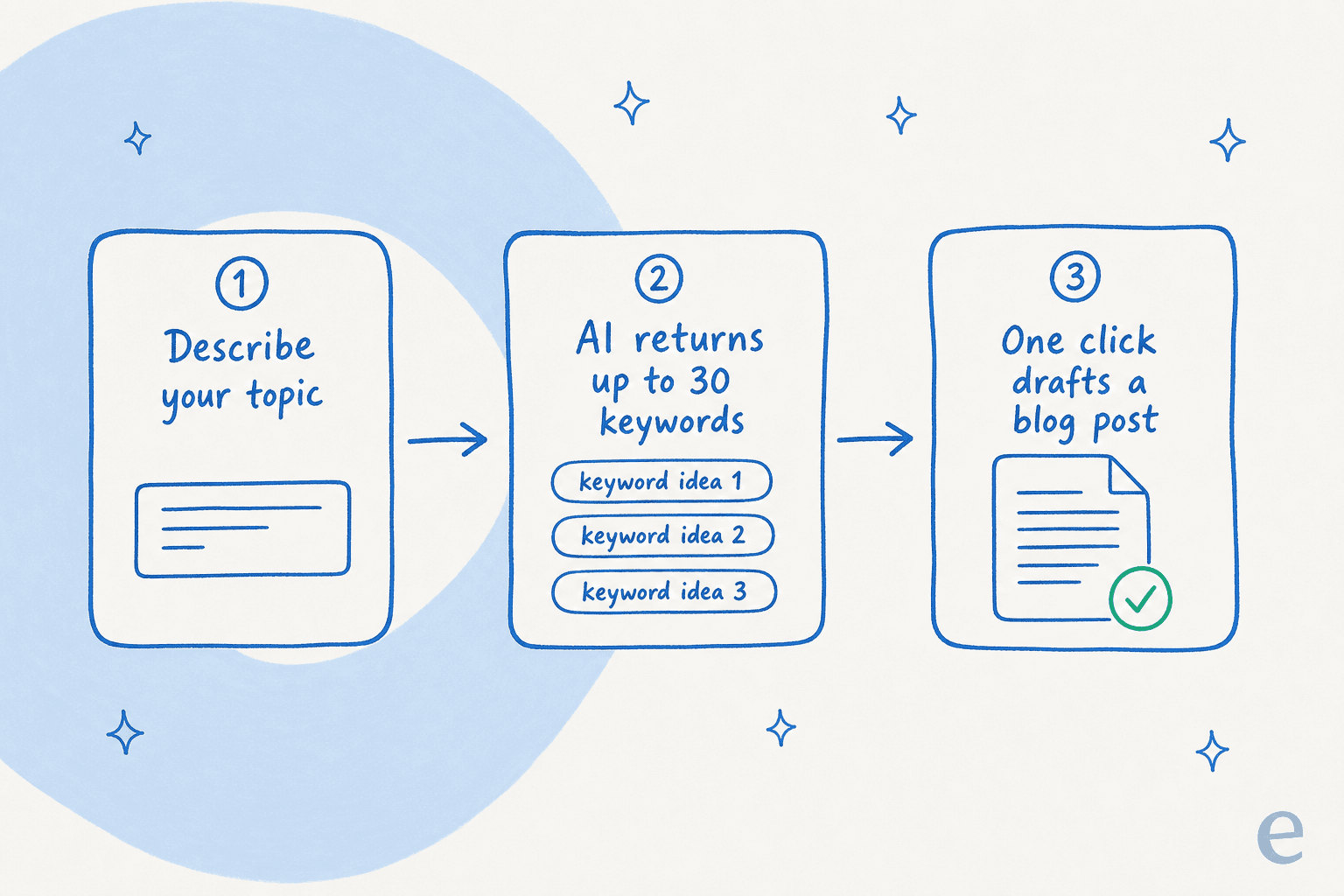
If the research process above sounds like a lot for one blog post, that's exactly the gap eesel's SEO keyword generator fills. You describe your topic in plain language, for example "healthy recipes for weight loss," and it returns up to 30 relevant SEO keywords instantly, running on Google's Gemini model. It's completely free, needs no signup, and you can generate as many lists as you want.
The part I like: every keyword it returns has a one-click "Generate Blog" button that hands off to eesel's AI blog generator and drafts a full post around that term. So the awkward gap between "I have a keyword" and "I have a page that ranks" closes in a click. It won't replace a real SEO platform for volume and difficulty data, but as a way to go from a fuzzy idea to a list of angles (and then drafts), it's a useful free starting point. Try eesel.