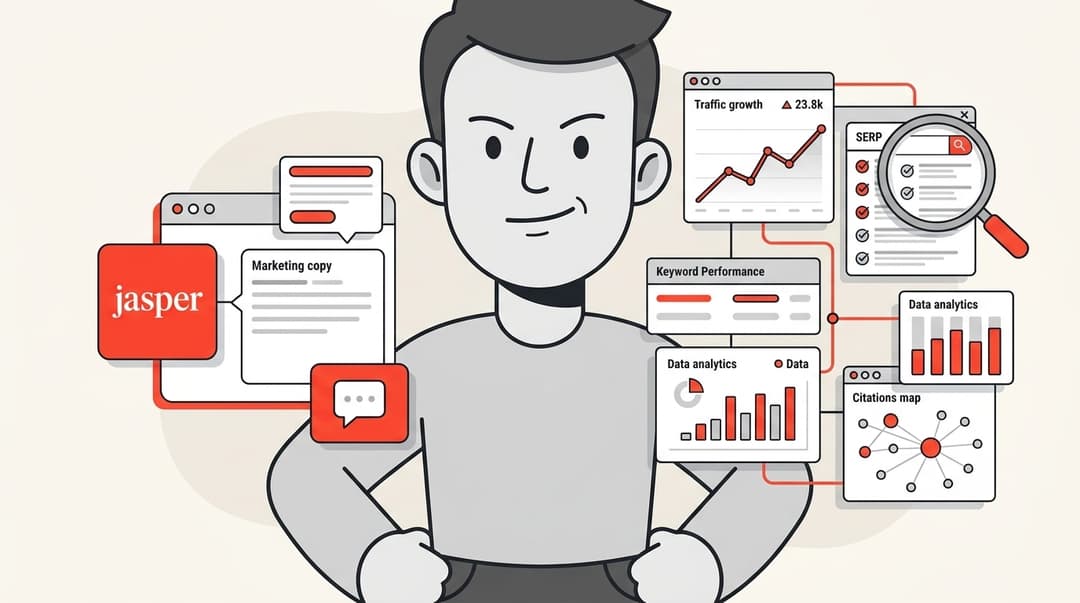

With new AI content tools emerging frequently, choosing the right one can be overwhelming. Many online reviews include affiliate links, which can make it challenging to find an unbiased perspective on which tools save time and deliver quality results.
This post aims to provide a clear comparison based on several weeks of using these platforms for marketing tasks. The focus was on key criteria: content quality, ease of use, and the ability to produce natural-sounding output.
Many leading tools offer more than text generation; they can assist with research, create visuals, and build search-engine-optimized content. These features are often part of comprehensive solutions, such as the eesel AI blog writer.
What is an AI content generation tool?
An AI content generation tool is software that uses artificial intelligence to create content, whether that’s text or visuals, based on a prompt you feed it. Think of it as a powerful assistant that can help overcome writer's block, speed up the drafting process, and automate certain content tasks on your plate.
Their main job is to make creating content smoother. This could be anything from brainstorming blog post ideas and writing the first draft to generating social media captions, whipping up ad copy, or even creating on-brand images. Over the last couple of years, these tools have evolved from simple text spinners into sophisticated platforms that can research topics, structure entire articles, and create all sorts of media to go with them.
How I picked and tested each AI content generation tool
To keep this review fair and genuinely useful, I judged every tool against the same practical checklist. This wasn't about finding the tool with the longest feature list, but about identifying the ones that delivered the most value in a real-world marketing workflow.
-
Output Quality: Does the content sound human and actually provide value? Or is it just generic AI output that you'll have to spend hours editing?
-
Ease of Use: How quickly can a new user jump in and start creating good stuff without needing a degree in prompt engineering?
-
Versatility: Can the tool handle different formats like blogs, social media posts, video scripts, and images, or is it a one-trick pony?
-
Control & Customization: Can you give the AI your brand context, tone of voice, and specific instructions to make sure the final output is actually on-brand?
-
Value for Money: Is the price tag justified by the features, quality, and time you get back?
A quick comparison of the top AI content generation tools
For those who just want the highlights before we dive into the details, here’s a quick-glance table.
| Tool | Best For | Key Feature | Starting Price (Billed Annually) |
|---|---|---|---|
| eesel AI blog writer | Generating complete, publish-ready blog posts | Context-aware research and automatic asset creation | Free to try, then $99/mo for 50 blogs |
| ChatGPT | Brainstorming, outlining, and first drafts | Conversational interface and custom instructions | Free plan available; paid plans for individuals and teams |
| Jasper | Automating marketing content pipelines | Jasper IQ for brand voice and 100+ marketing apps | Pro plan from $59/seat/month |
| Copy.ai | Go-to-market (GTM) teams and sales workflows | Pre-built workflows for sales and marketing tasks | Free plan available; paid from $24/month |
| Scenario | Creating on-brand visual content and assets | Training custom AI models for consistent visuals | From $10/month |
| Writesonic | Combined SEO and Generative Engine Optimization (GEO) | AI visibility tracking across search and AI platforms | From $39/month |
The 6 best AI content generation tools in 2026
Alright, after weeks of putting these tools through their paces, here’s my detailed breakdown of each one, including what it’s good at, where it falls short, and who it’s really for.
1. eesel AI blog writer
The eesel AI blog writer is focused on turning a keyword into a complete, SEO-optimized, and media-rich blog post. Full disclosure, this is a tool we developed and used to grow our site from 700 to 750,000 daily impressions in three months.
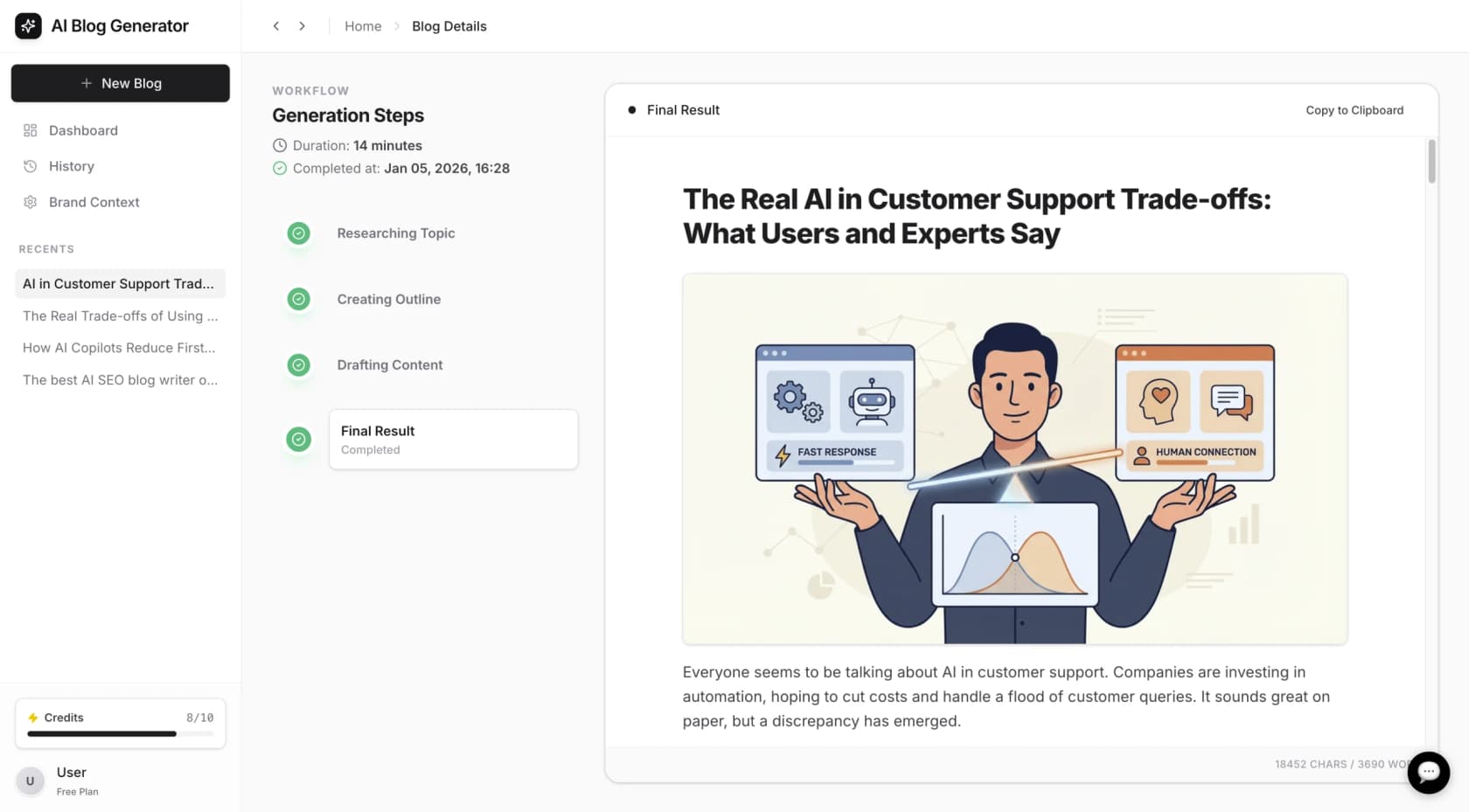
A key feature is its ability to produce a finished asset, not just a text draft. It automatically does the research and provides citations, adds internal and external links, and embeds relevant assets like AI-generated images, infographics, and YouTube videos. It even pulls in Reddit quotes to add a layer of social proof. It includes built-in AEO (Answer Engine Optimization), ensuring the content is structured to rank in both AI overviews and classic search results.
A consideration is its specialization. It’s built to create long-form articles that pull in organic traffic. While it's designed for that purpose, it's not intended for creating short social media captions or ad copy. If you need an all-in-one tool for every marketing message, you might need something else for those smaller tasks.
Pricing:
-
It's completely free to try, so you can see the results for yourself.
-
The paid plan is a simple $99/month for 50 complete blog posts.
Best for: SEO managers, content marketers, and founders who want to scale their organic traffic with high-quality articles without all the manual grunt work.
2. ChatGPT
ChatGPT is a well-known AI tool. Its chat-based interface and capable free version have made it a popular choice. It's useful for brainstorming ideas, structuring outlines, and turning a mess of notes into a clean first draft.
The biggest strength of ChatGPT is its flexibility. The Custom Instructions feature is valuable for maintaining a consistent tone without having to re-type your prompts every single time. With new models always being released, it can help with a massive range of writing tasks.
However, users still perform much of the work. It provides the raw text, but it's up to the user to conduct research, find visuals, fact-check everything, and make sure the final piece is optimized for what people are searching for. It functions as a writing assistant rather than an autonomous content generator.
Pricing:
-
A solid free plan is available for anyone to use.
-
Paid plans are available for individuals (Plus) and teams (Business, Enterprise).
Best for: Solopreneurs, students, and pretty much anyone new to AI who needs a versatile tool for brainstorming and drafting.
3. Jasper
Jasper has evolved from an AI writer into a platform for automating marketing content. It's built for bigger teams that need to produce a high volume of on-brand content across many different channels and campaigns.
The Jasper IQ feature is its standout feature. It acts like a central brain for your brand, storing your voice guidelines, product details, and audience personas to keep everything consistent. Its collaborative "Canvas" feature also allows teams to visually plan and organize entire campaigns. For large enterprise clients, Jasper Agents can even automate tasks like personalizing content at scale.
A consideration is that its long-form content may require significant human editing to perform well in search rankings. The content is based on a consensus of what's already online, so it may not always produce the unique perspective needed for thought leadership content. It is effective for scaling established marketing plays, but perhaps not for creating something entirely new from scratch.
I like a mix of free Chat GpT and Jasper. Free Chat GPT is actually still better for brainstorming , Jasper doesn’t really always understand the same prompts, the same way. I could ask it to suggest an outline for an ebook blah blah blah and sometimes it takes a lot more correction than chat GPT. But it is helpful for tightening up copy, or rather getting ideas to make it tighter, and things like various classic marketing frameworks.

Pricing:
-
The Pro plan starts at $59/seat/month when billed annually.
-
A custom-priced Business plan is available for larger teams.
Best for: Mid-to-large marketing teams and enterprises that need one central hub to automate and scale their content creation.
4. Copy.ai
Copy.ai has pivoted to become "The First AI-Native GTM Platform," targeting sales and marketing teams directly. It goes beyond just writing text and helps automate entire go-to-market workflows, from finding prospects to creating the content to reach them.
Its workflow-based approach is its key strength. You can set up multi-step automations, like having it research a prospect on LinkedIn and then draft a personalized cold email for you. It also has an "Infobase" to store company info and a "Brand Voice" feature to keep your messaging consistent. It’s really built to streamline those repetitive sales and marketing tasks.
However, since it primarily uses existing web content for its research, the output can sometimes be generic. Even with its "SEO optimized" workflow, the articles it produces often require editing to align with a specific searcher's intent and provide distinct value.
Pricing:
-
There's a limited free plan to get started.
-
The paid "Chat" plan starts at $24/month (billed annually).
Best for: Sales and marketing teams that want to automate repetitive GTM tasks like lead research, email outreach, and whipping up initial content drafts.
5. Scenario
Let's switch gears from text to visuals. Scenario is a specialized tool designed for creating consistent, on-brand images, videos, and even 3D assets. It's built for creative teams that need to produce tons of visual content without letting their brand identity slip.
Scenario's key feature is the ability to train custom AI models on your brand's unique style. This is beneficial for ensuring visual consistency. It also has a bunch of creative "apps" for specific jobs, like generating user-generated content (UGC) style product demos or creating character designs for game development.
Scenario specializes in visuals and does not write a single word of text, so you can't use it for blog posts or social media captions. It’s meant to be a powerful piece of a larger creative workflow, not an all-in-one content tool.
Pricing:
-
Starter: From $10/month (billed annually).
-
Pro: From $30/month (billed annually).
-
Max: From $50/month (billed annually).
Best for: Creative agencies, game developers, and e-commerce brands that have to produce a high volume of consistent, on-brand visuals at scale.
6. Writesonic
Writesonic positions itself as an "AI visibility platform." It focuses on helping brands perform well in both traditional search (SEO) and the new world of AI search (Generative Engine Optimization, or GEO). It’s a mix of content creation and powerful analytics.
Its main differentiator is the AI Visibility Tracking feature. It shows you how your brand is being discussed on AI platforms like ChatGPT and Perplexity, analyzes the sentiment, and even shows how you stack up against competitors. It also has an AI SEO Agent that can help with technical audits and content planning based on real-time search data.
While its analytics are comprehensive, the content generated can sometimes be formulaic, as it is designed to align with currently ranking content. Editing may be required to add originality and a unique brand voice.
Pricing:
-
Lite: Starts at $39/month (billed annually).
-
Professional (which includes the GEO features): Starts at $199/month (billed annually).
Best for: SEO-focused marketing teams who want a data-driven platform to track and improve their visibility on both Google and emerging AI search engines.
Tips for getting the most from your AI content generation tool
No matter which tool you choose, your results will only be as good as the instructions you give it. Here are a few tips to make sure you’re getting high-quality, valuable content every time.
-
Provide deep context: Don't just give the AI a keyword and hope for the best. The best tools let you provide real context, like your website URL, brand voice guidelines, your target audience, and key talking points. The more you give the AI, the more relevant and on-brand your content will be.
-
Use AI as an assistant, not an author: The best AI content generation tools out there are AI-assisted, not AI-generated. Use these tools to do 80% of the heavy lifting, the research, the drafting, the structuring. But always have a human expert come in to review, edit, and add their unique insights and personal stories. AI is a productivity tool, not a replacement for expertise.
-
Focus on the final polish: Spend your valuable time on the things AI can't do. Inject your unique brand personality, double-check any crucial facts, and add personal anecdotes. That final 20% is what will make your content stand out from the sea of generic AI noise.
Seeing these tools in action can provide a better sense of their capabilities. The video below showcases several AI tools that help creators save time, illustrating how different platforms can fit into your workflow.
Finding the right AI content generation tool
While many tools aim to save time, they are designed for different purposes and vary in their output. General-purpose tools like ChatGPT are great for brainstorming, specialized platforms like Scenario are masters of visuals, and data-driven tools like Writesonic are built for deep SEO analysis.
Many tools produce a first draft that requires additional work to become a finished piece of content. The key is to find a tool that aligns with your end goal. For example, a goal of growing organic traffic may require a tool that functions as a complete content engine.
For those looking to generate complete blog posts from a keyword, the eesel AI blog writer offers features like SEO optimization, visuals, and included research. It is available to try for free.
Frequently asked questions
What is the best AI content generation tool for beginners?
For beginners, ChatGPT is a great starting point. Its free version is powerful, and the conversational style makes it easy to brainstorm ideas and write first drafts without a steep learning curve.
Can an AI content generation tool replace human writers?
AI content generation tools are best used as powerful assistants. They can handle foundational tasks like research and drafting, but human expertise is still needed to add unique insights, personal stories, and the final polish that makes content stand out. It's a collaborative approach rather than a replacement.
How much does a typical AI content generation tool cost?
Prices vary a lot. Some tools, like ChatGPT, offer robust free plans. Others are subscription-based, ranging from around $10 to $50 per month for individual use to several hundred dollars for advanced team or enterprise plans with more features.
Is the content from an AI content generation tool SEO-friendly?
It depends on the tool. Some, like the eesel AI blog writer, are specifically designed to create SEO-optimized content from the start, including research and linking. Others might give you text that needs significant editing and optimization to rank well in search engines.
What's the main difference between a general AI content generation tool like ChatGPT and a specialized one like eesel AI?
A general tool like ChatGPT is a flexible, all-purpose writer that's great for brainstorming and drafting. A specialized tool like the eesel AI blog writer is built for a specific outcome, like creating a complete, publish-ready, and SEO-optimized blog post from just a keyword, including all the visuals and links.
How do I choose the right AI content generation tool for my business?
Think about your main goal. If you need to scale blog content for organic traffic, look at a tool like eesel AI. If you need to automate sales emails, Copy.ai might be better. If you just need help with ideas and drafts, ChatGPT is perfect. Match the tool's specialty to your specific business need.