

Creating high-quality blog content that actually ranks is a massive time commitment. It’s one of the biggest hurdles for any team trying to grow through search. You have to research topics, find keywords, build an outline, write the thing, find images, and then edit it all, and that's just for one post. Trying to scale that process can feel impossible without a huge team.
This is where an AI blog creation tool can step in. It’s built to do the heavy lifting, getting you from a single keyword to a full first draft in just a few minutes. But they’re not all the same. Some give you generic, robotic text that you have to rewrite completely, while others can deliver articles that are nearly ready to publish, complete with images and other assets.
This guide is based on my own hands-on testing of the top platforms to see which ones actually work as advertised. In fact, we use the top tool on this list here at eesel AI to scale our own content, which is how we grew our blog from 700 to 750,000 daily impressions in just three months.
What is an AI blog creation tool?
What exactly is an AI blog creation tool? It's much more than a simple text generator. Its main job is to create a complete, well-structured, and SEO-friendly blog post from just a single prompt or keyword.
What really separates these tools from basic AI writers are the features designed for performance. They often handle competitive research, weave in target keywords naturally, and even create assets like images, tables, or infographics to make the content more engaging. A growing number are also optimizing content for AI search engines, a practice known as Generative Engine Optimization (GEO). This gets your content ready to appear not just in Google search, but also in answers from platforms like ChatGPT and Google AI Overviews.
How I picked the best AI blog creation tool for this list
To figure out which tools were actually worth your time, I tested them against a few key criteria. I wanted my recommendations to be practical and based on what really matters for creating content that gets results.
- Content Quality: Is the output well-researched and readable, or is it generic AI fluff that needs heavy editing?
- SEO & AEO Features: Does the tool help you optimize for traditional search engines and the new wave of AI answer engines?
- Ease of Use: How fast can you get from a keyword to a finished draft? The process should be simple, not a 10-step headache.
- Asset Generation: Does the tool include visuals like images, tables, or video embeds to make the content more interesting and save you time?
- Value for Money: Does the price seem fair for the features and quality you get?
AI blog creation tool comparison at a glance
Before we get into the details, here’s a quick look at the tools I tested. This table gives you a high-level summary of how they stack up.
| Tool | Best For | Standout Feature | Starting Price |
|---|---|---|---|
| eesel AI blog writer | One-click, publish-ready articles with SEO and assets | Context-aware research with automatic asset generation | Free to try, then $99 for 50 blog posts |
| Jasper | Enterprise marketing teams needing content automation | Content Pipelines and Jasper IQ for brand context | Starts at $59/seat/mo (billed annually) |
| Copy.ai | GTM teams automating sales & marketing workflows | Codifies playbooks into reusable AI Workflows | Free plan; paid plans start at $24/mo (billed annually) |
| Writesonic | Marketers focused on AI search visibility (GEO) | AI Visibility Tracking across ChatGPT, Gemini, etc. | Starts at $39/mo (billed annually) |
| Koala AI | SEOs and affiliate marketers needing rank-ready articles | Deep Research with real-time SERP analysis | Starts at $9/mo |
| Rytr | Individuals and freelancers on a budget | Generous free plan and "MyVoice" custom tone feature | Free plan; paid plans start at $7.50/mo |
The 6 best AI blog creation tools in 2026
Now for the specifics. Here’s a detailed breakdown of the top tools, what they do best, and where they might not be the right fit.
1. eesel AI
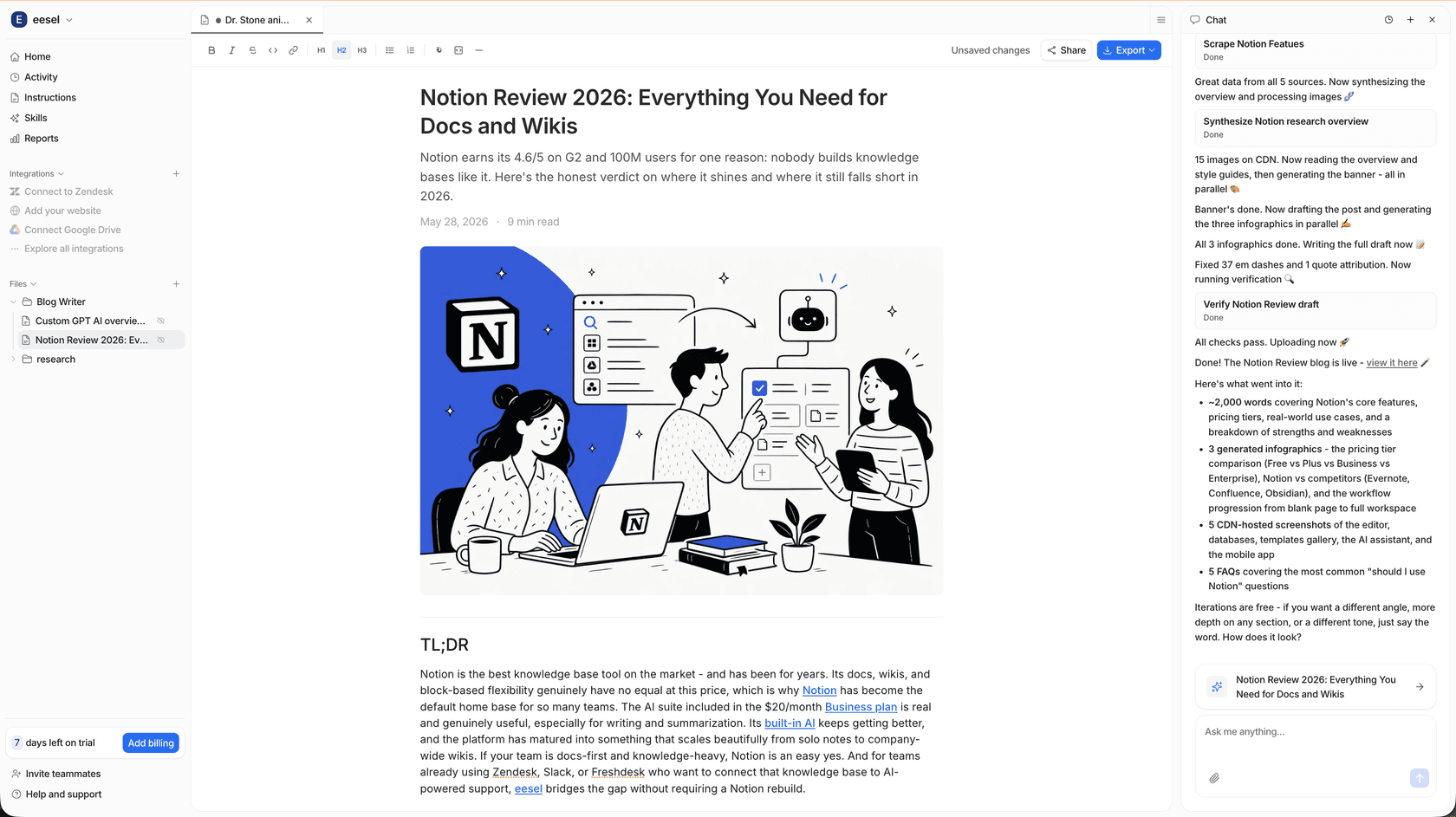
eesel AI blog writer is designed with a primary focus: turning a single keyword into a complete, SEO-optimized article that's ready to go live. Its biggest strength is how it uses your website's context to create content that sounds like your brand and naturally mentions your products without being pushy. It’s the exact tool we used to grow our own blog traffic from a humble 700 daily impressions to over 750,000.
- Pros: The one-click workflow is a huge time-saver. It handles everything from deep, context-aware research to automatically building a full post with AI-generated images, infographics, and tables. For social proof, it pulls in real Reddit quotes and finds relevant YouTube videos to embed. Most importantly, it's optimized for both traditional SEO and modern AI Answer Engines (AEO), getting your content ready for the future of search.
- Cons: Because it’s a specialized tool for creating comprehensive, long-form SEO content, it’s probably not what you need if you just want to write short copy for social media posts or ads. Its main purpose is producing high-quality blog posts from start to finish.
- Pricing:
- Free to try (your first blog post is on us)
- Early Bird plan: $99 for 50 blog posts
2. Jasper
Jasper has made a name for itself as an AI content automation platform for marketers, especially in larger enterprise teams. It’s a flexible assistant that uses features like "Content Pipelines" and "Jasper IQ" to automate the entire content process while keeping everything on-brand. It also comes with a huge library of templates for almost anything, from blog posts to full ad campaigns.
- Pros: Jasper's main draw is its flexibility. The "Canvas" feature is great for team collaboration, and its many templates make it a solid all-in-one tool for marketing teams creating a wide variety of content. The Jasper IQ feature is also pretty powerful, as it helps maintain a consistent brand voice by learning from your company’s knowledge base, including text, video, and audio files.
- Cons: While it’s effective for first drafts, the output may require specific instructions to add unique perspectives, as noted in some user reviews. For highly technical topics, users should plan to double-check for accuracy. For full optimization, it is often paired with a separate SEO tool.
- Pricing:
_ The Pro plan starts at $59 per seat, per month (billed annually).
_ Business plans are available with custom pricing.
I ran my last 10 posts through Jasper + SurferSEO — decent results, but kinda expensive if you’re not doing volume.
 Reddit
3. Copy.ai
Copy.ai positions itself as a GTM (Go-to-Market) AI Platform that aims to bring sales and marketing teams together. The core of the platform is its "Workflows" feature, which lets you turn your company's playbooks into automated, reusable processes. It's less of a pure writing tool and more of a system for automating GTM tasks, from enriching leads to creating content.
- Pros: Copy.ai is great at automating repetitive tasks and generating short-form sales copy. Its workflow builder is powerful for teams that want to streamline processes without needing a developer. The platform is also SOC 2 Type II compliant, making it a secure choice for larger companies. Users often praise how quickly it can brainstorm ideas for ad copy and email subject lines.
- Cons: The platform's strengths are in short-form copy and workflows. Long-form blog generation is available but may require manually combining different generated sections into a complete article. Its primary focus is more on sales and marketing copy than in-depth articles.
- Pricing:
- A free plan is available with some limitations.
- Paid plans start at $24 per month (billed annually) for up to 5 seats.
4. Writesonic
Writesonic has shifted from a general AI writer to a specialized AI Search Visibility Platform. Its main goal is to help brands track and improve their visibility in both traditional search engines (SEO) and AI search engines like ChatGPT and Gemini (GEO). It's built for marketers who are serious about winning at search in the age of AI.
- Pros: Writesonic's unique strength is its focus on Generative Engine Optimization (GEO). The platform gives you analytics on where your brand is being cited by AI, identifies gaps where competitors are getting mentioned instead, and gives you clear steps to improve your visibility. It also pulls data from tools like Ahrefs and Google Keyword Planner to inform its content strategy. Plus, it's compliant with SOC 2, GDPR, and HIPAA.
- Cons: The platform's extensive focus on analytics and AI search tracking is ideal for its target audience but might be more than what's needed for users seeking a simple blog writer. The data and strategic tools are comprehensive, which could be overwhelming for those only looking to generate a quick article.
- Pricing:
- A free trial is available.
- The Lite plan starts at $39 per month (billed annually).
5. Koala AI
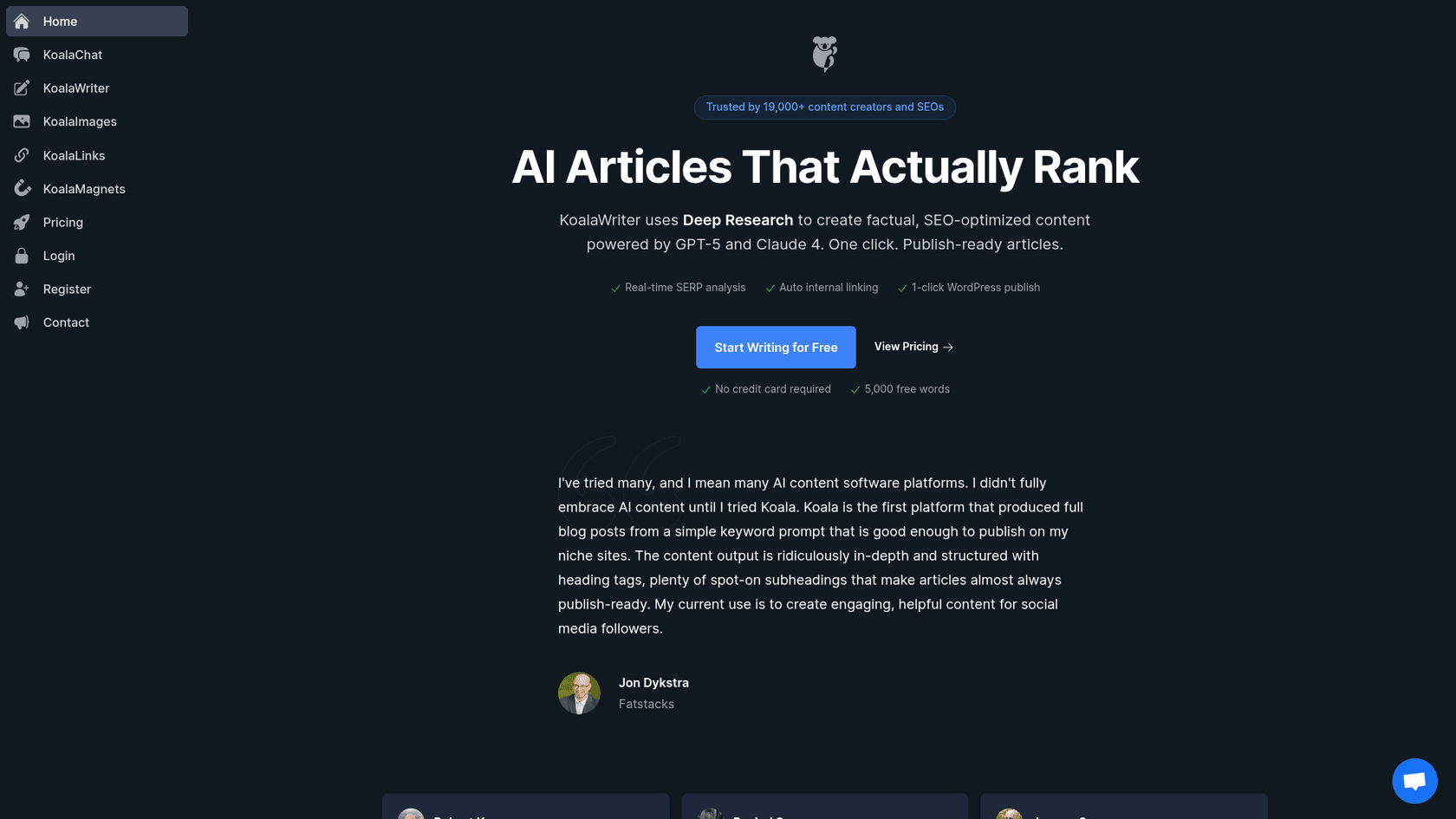
Koala AI is a specialized AI blog creation tool built for SEOs, by SEOs. Its best feature is its ability to create factual, SEO-optimized articles using real-time data from the web and SERP analysis. It has become a favorite among affiliate marketers for its impressive ability to generate product roundups using live data from Amazon.
- Pros: Koala AI is excellent at creating content that’s ready to rank. Its "Deep Research Mode" pulls from authoritative sources to create factual articles that need minimal editing. It also includes powerful SEO features like automatic internal linking and schema markup generation. The integration with Amazon's API is a huge plus for affiliate content, as it can pull real customer reviews and product specs directly into your articles.
- Cons: The interface and extensive feature set are designed specifically for SEO professionals and affiliate marketers. Users looking for a general business writing tool may find its specialized nature less intuitive, and the number of options can present a learning curve for beginners.
- Pricing:
_ A free trial is available (5,000 words).
_ The Essentials plan starts at just $9 per month.
I’ve been using KoalaWriter too. The fact that it pushes directly to WordPress is such a time-saver. Wild how far AI writing has come.
Reddit
6. Rytr
Rytr is a very accessible and affordable AI writing assistant that's perfect for individuals, freelancers, or anyone just starting with AI tools. It offers over 40 use cases, from blog writing to generating ad copy, and is known for its simple interface and generous free plan.
- Pros: Rytr's main advantage is its price. The free plan is one of the best around, and its paid plans are extremely budget-friendly. It has a unique feature called "MyVoice," which lets you train the AI on a sample of your writing to help it mimic your style. Its browser extension also makes it easy to use Rytr across different websites without breaking your workflow.
- Cons: Rytr's output is best suited for general topics. For complex or technical subjects, the content may require significant editing and fact-checking. It generates content based on existing information, so users should plan to add their own expertise. The "creativity level" setting should be used with caution, as it can impact factual accuracy.
- Pricing:
- A free plan is available with a 10,000-character limit per month.
- Paid plans start at $7.50 per month (billed annually).
How to get the most out of your AI blog creation tool
- Give it good instructions: The quality of the AI's output depends on the quality of your input. Provide clear keywords, context about your brand, and who you're writing for. For advanced tools, giving it your website URL is a great way to provide instant brand context.
- You're still the editor: AI should write the first draft, not the final version. Always review, edit, and fact-check the content to make sure it’s accurate and adds your unique perspective. Think of yourself as the editor who polishes the work of a very fast junior writer.
- Add your personal experience: The best content has personal stories, unique insights, and a clear brand voice. These are things only a human can bring to the table. Use the AI draft as a starting point and build on it with your own expertise.
- Use it to help, not replace: The right way to think about an AI blog creation tool is as a powerful assistant. It handles 80% of the grunt work (research, outlining, drafting), freeing you up for the 20% that matters most: strategy, editing, and adding real expertise.
I still write every one of my articles or posts. I refuse to use any AI-generated text, even to the point of refusing Grammarly rewrite suggestions. However, I now use ChatGPT to give me feedback on what I might have missed, or where I can make improvements. That has helped me a lot in refining my articles before publiahing.
Reddit
For a deeper dive into how to blend AI efficiency with human creativity, the video below offers some excellent step-by-step guidance on creating a blog post that stands out.
The verdict: What’s the best AI blog creation tool?
Choosing the right AI blog creation tool depends on your specific needs. For marketers integrating content into go-to-market workflows, Jasper or Copy.ai are strong options. SEOs focused on AI search analytics may find Writesonic's specialized features valuable. For those on a tight budget, Rytr provides an accessible starting point. For teams focused on scaling blog production with SEO-optimized articles that include assets, eesel AI blog writer is a dedicated solution. Its process is designed to generate a complete, asset-rich article from a single keyword, which can be a significant time-saver for content teams.
Ready to see for yourself? Generate your first blog post for free with eesel AI blog writer.