

Marketing teams today are always being asked to do more with less. The pressure to scale your outreach, personalize customer journeys, and actually prove ROI has never been higher. Automation is the clear solution, but there's a catch: it's only as good as the content it delivers. Without a steady stream of useful articles, emails, and resources, you’re just automating empty messages.
And that's the real challenge. The best marketing strategies are built on great content, but creating it is the most time-consuming part of the job. This article breaks down the best automated marketing platforms that help you scale everything from content creation to lead nurturing. We’ll cover the top seven tools, compare their features, and give you clear criteria to choose the right one for your business. We even found that a tool like the eesel AI blog writer can automate the content engine that fuels all your other marketing.
What are automated marketing platforms?
Simply put, automated marketing platforms are tools that handle repetitive marketing tasks. Think of them as a central command center for your campaigns, taking care of everything from email sequences and social media posts to lead scoring and ad management. They work using trigger-based workflows. For instance, if a user downloads an ebook from your site (the trigger), the platform can automatically send them a personalized follow-up email series (the action).
The benefits are pretty straightforward: a huge boost in efficiency and a better return on your marketing investment. You can create personalized customer journeys at a scale that would be impossible to manage by hand. According to ActiveCampaign, its platform can cut 13 hours of marketing work each week, freeing up your team to focus on strategy. These platforms act as a central hub for all your customer data, allowing for more targeted and consistent communication across every channel you use, including email, SMS, and social media.
How we chose the best automated marketing platforms
To give you a fair and practical comparison, we measured each platform against a few key criteria. We wanted to find tools that not only have powerful features but are also accessible and deliver real value for growing businesses. Here’s what we looked for:
- Automation capabilities: The platform had to automate marketing tasks across at least two channels, like email, content, or social media. We looked for solid workflow builders that could handle complex, multi-step campaigns.
- Functionality and integrations: A great automation tool doesn't work in a vacuum. We prioritized platforms that connect easily with other essential tools in your tech stack, like CRMs, e-commerce platforms, and analytics software.
- Ease of use: Powerful features are pointless if they're impossible to use. The interface needed to be intuitive enough for small and medium-sized teams to pick up quickly without needing a dedicated developer.
- Price to value: We looked for transparent pricing and plans that offer a clear return on investment. The features had to justify the cost and provide real value for businesses looking to scale their marketing.
The best automated marketing platforms at a glance
| Platform | Best For | Standout Feature | Pricing (Billed Annually) |
|---|---|---|---|
| eesel AI blog writer | Content & SEO automation | Generates publish-ready blogs with AI assets & social proof | $99/month for 50 blogs |
| HubSpot Marketing Hub | Premium all-in-one solution | Deep Smart CRM integration & AI agents | From $800/month + onboarding |
| ActiveCampaign | AI campaign building | AI Campaign Builder turns prompts into complete campaigns | From $15/month |
| Brevo | Affordable multi-channel marketing | All-in-one platform with email, SMS, WhatsApp & chat | Free plan; paid from $8.08/month |
| Mailchimp | Email marketing automation | Intuitive Customer Journey Builder with pre-built flows | Free plan; paid from $13/month |
| GetResponse | Landing pages & webinars | Built-in webinar hosting & course creation tools | From $15.58/month |
| Reteno | Small and mid-sized ecommerce businesses | One from Many block that tests message variants inside workflows and shifts traffic toward stronger performers | Free; Growth $30/month at 10,000 profiles |
The 7 best automated marketing platforms to scale your business
Let’s take a closer look at the strengths, limitations, and pricing of each platform. This breakdown should help you figure out which tool is the best fit for your specific goals and budget.
1. eesel AI blog writer
The eesel AI blog writer is foundational for any modern marketing automation strategy. It tackles the hardest part of the process: creating high-quality, SEO-optimized content at scale. Instead of just helping you distribute content, it automates its creation. You give it a single keyword, and it generates a complete, publish-ready blog post. This isn't just a rough draft; it's a fully structured article with AI-generated images, infographics, and real-time social proof like embedded Reddit quotes and relevant YouTube videos.

Why we included it: This is the tool we used to scale our own blog from 700 to 750,000 daily impressions in just three months. Its "context-aware research" goes deeper than generic AI writers, and its content is optimized for Answer Engine Optimization (AEO), ensuring it performs well in both traditional search and AI overviews.
- Pros: Creates complete, media-rich articles in a human-like tone. It automatically integrates social proof to build credibility and is optimized to rank in both search engines and AI answer engines.
- Cons: It's a specialized tool focused entirely on long-form content generation. It doesn't manage email campaigns or social media scheduling, so it's a powerful complement to the other platforms on this list rather than a replacement.
Pricing:
- You can try it entirely for free.
- The Early Bird plan is $99/month for 50 monthly blogs.
2. HubSpot Marketing Hub
HubSpot is one of the most comprehensive marketing platforms available, unifying marketing, sales, and service tools on its powerful Smart CRM. Its strength is its extensive workflow builder and its new AI toolset, Breeze, which includes agents to automate customer and lead interactions. From email marketing and chatbots to ad management and social media scheduling, HubSpot aims to be the single source of truth for all your customer data.
HubSpot can handle all of the activities you mentioned, The newsletter, track who engages with it, and opens it. CRM - connect with greater efficiency, understand lead attribution, where did the lead come from. Use the information to engage with the lead to turn them into buyers. Excel Spreadsheets only track.

Why we included it: As a market leader, HubSpot offers significant depth and a polished user experience. Despite its large feature set, the platform is surprisingly user-friendly, making it a top choice for businesses that want a mature and reliable ecosystem. The seamless integration between its different "Hubs" means your data is always consistent across your entire organization.
- Pros: Deep integration across its full suite of sales, marketing, and service tools. The workflow automation is incredibly powerful and flexible, and its reporting is best-in-class.
- Cons: Because HubSpot is a premium, enterprise-grade platform, the investment reflects its extensive capabilities. Professional plans involve an onboarding process to ensure your team is fully equipped to leverage the platform's power.
Pricing:
- A limited set of free tools is available.
- The Marketing Hub Professional plan starts at $800/month when billed annually, plus a professional onboarding fee.
3. ActiveCampaign
ActiveCampaign offers enterprise-level automation at a price point accessible for small and medium-sized businesses. It excels at creating deeply personalized customer journeys through its visual automation builder and its "Active Intelligence" AI engine. This allows you to build complex workflows based on customer behavior, engagement, and data from its built-in CRM.
Why we included it: Its standout feature is the AI Campaign Builder, which can generate a complete, multi-touch email campaign from a single text prompt. This can significantly speed up the campaign creation process. The platform also offers predictive sending to optimize email delivery times and integrates with over 1,000 other applications.
- Pros: Highly detailed automation capabilities, an integrated CRM for sales and marketing alignment, and powerful AI features that simplify campaign creation.
- Cons: The platform's feature depth may be more than required for users who only need basic email automation. Some of the best AI features, like predictive sending, are only available on the higher-priced plans.
Pricing:
- The Starter plan begins at $15/month (billed annually).
- To access more advanced automation, landing pages, and integrations, you'll need the Plus plan, which starts at $49/month.
4. Brevo
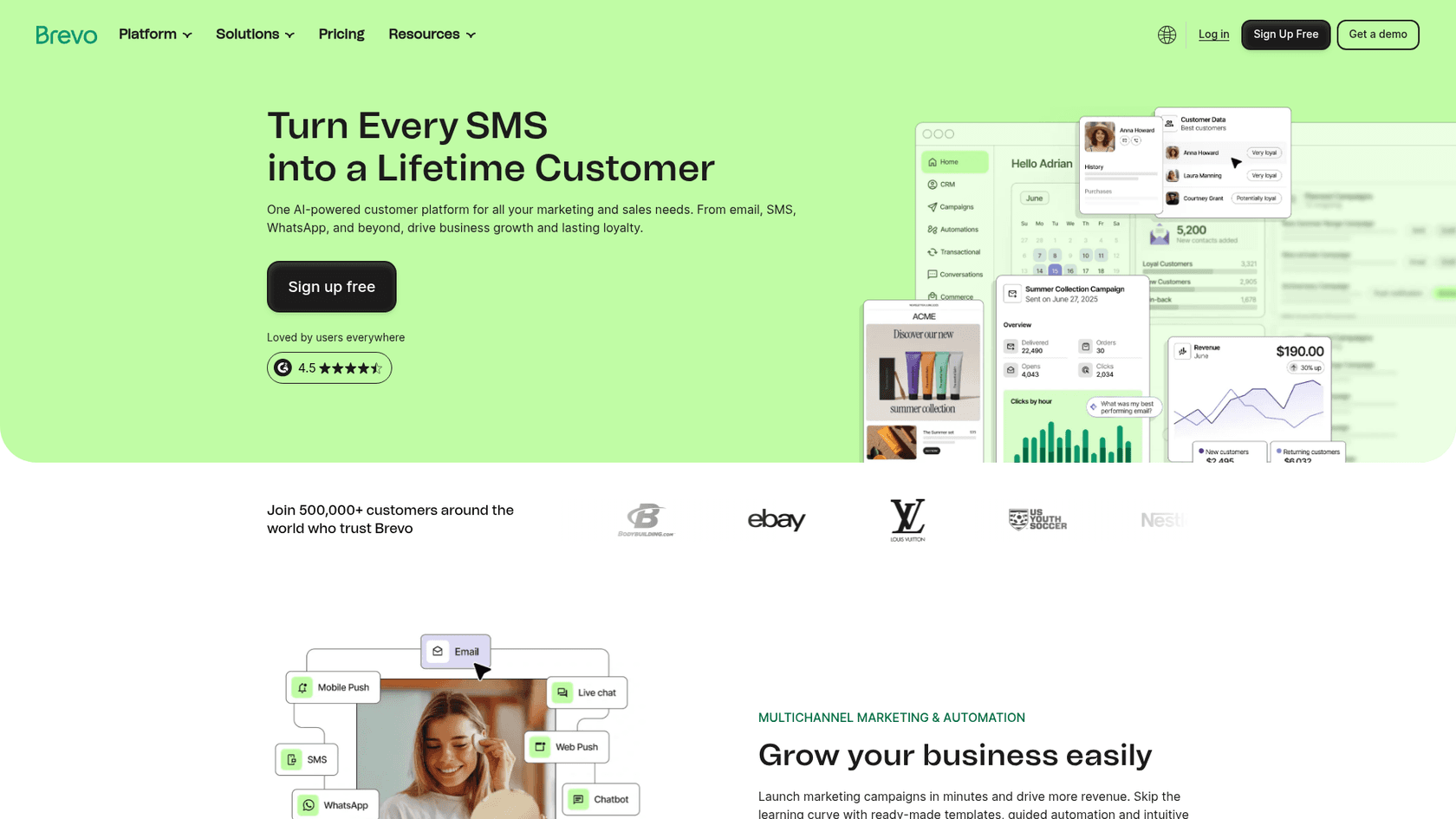
Brevo (formerly Sendinblue) is a budget-friendly, all-in-one marketing platform. It includes a wide range of tools in one package, including email, SMS, and WhatsApp campaigns, a sales CRM, live chat, landing pages, and even a meeting scheduler. It’s built for businesses that want a full toolset without the enterprise price tag.
Why we included it: Brevo provides a strong value proposition. Its workflow builder is robust for its price point, supporting complex conditions, A/B splitting, and CRM updates. The inclusion of multi-channel tools like SMS and WhatsApp makes it a strong choice for businesses looking to connect with customers on their preferred platforms, all from a single dashboard.
- Pros: Very affordable with a generous free plan. It provides a wide range of multi-channel capabilities that are often sold as separate products by competitors.
- Cons: The free plan is useful but limited to 300 emails per day and doesn't include features like landing pages or WhatsApp campaigns. More advanced features like A/B testing require a paid plan.
Pricing:
- A free plan is available for up to 300 emails per day.
- The Starter plan begins at $8.08/month when billed annually.
5. Mailchimp
Mailchimp is a prominent name in email marketing. It’s the go-to for businesses focused mainly on email automation. Its core strength is its intuitive email editor and its Customer Journey Builder, which offers a library of pre-built workflows and over 50 behavior-based triggers. This makes it easy to set up automated sequences for welcoming new subscribers, recovering abandoned carts, and re-engaging inactive contacts.
Why we included it: Mailchimp is widely considered user-friendly, making it the perfect starting point for businesses new to marketing automation. It also integrates smoothly with popular e-commerce platforms like Shopify and WooCommerce, letting you trigger campaigns based on specific purchase behaviors.
- Pros: Unmatched ease of use, excellent email design tools, and a huge library of third-party integrations.
- Cons: Its pricing scales with your contact list and can become costly as lists grow. The free plan is quite limited, capping users at 250 contacts and 500 emails per month. True multi-step automations are only available on paid plans.
Pricing:
- Free for up to 250 contacts.
- The Essentials plan starts at $13/month for 500 contacts.
6. GetResponse
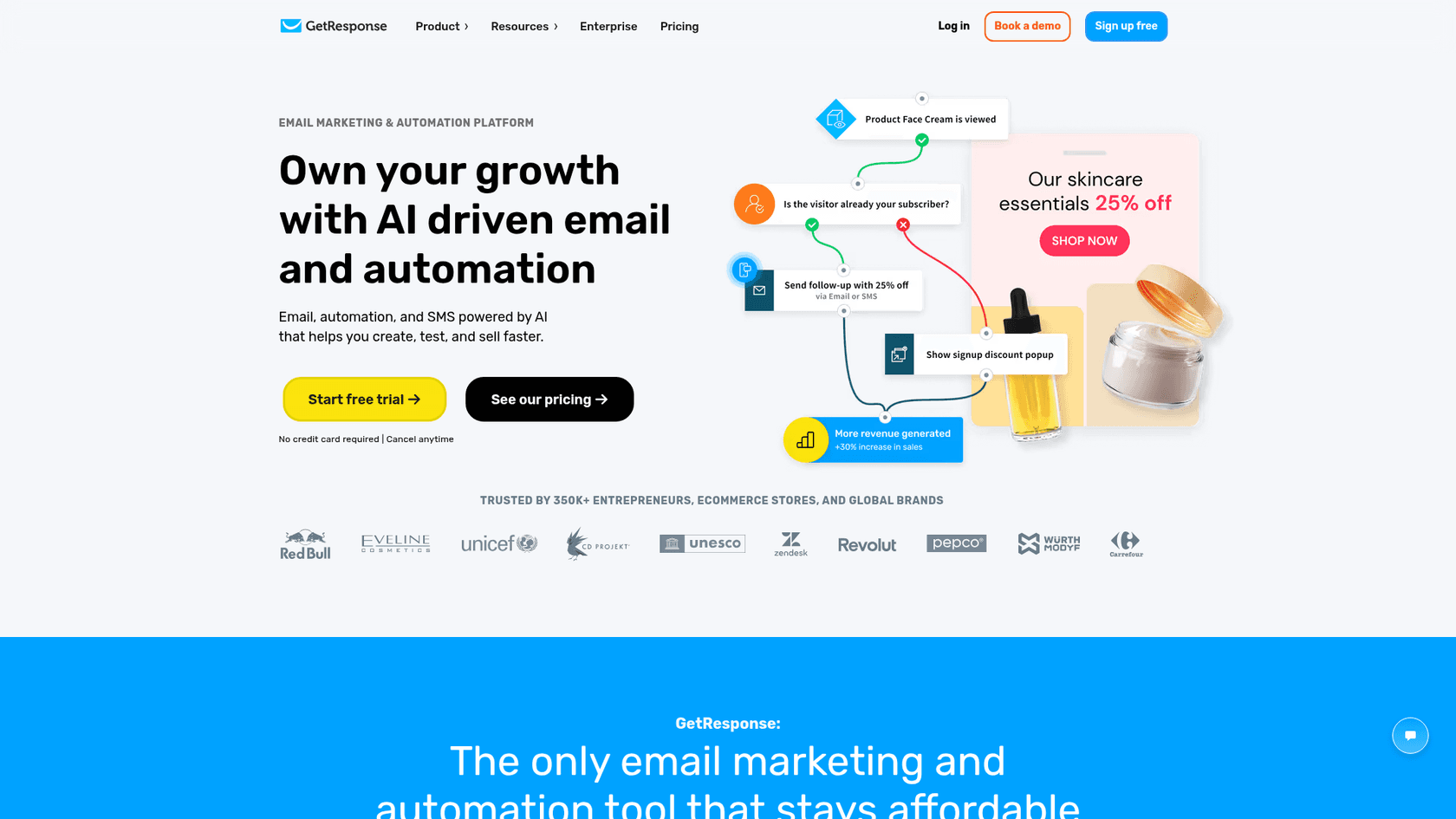
GetResponse positions itself as an all-in-one marketing platform with a strong focus on lead generation tools like landing pages and webinars. Alongside a full suite of automation tools and a website builder, it offers unique features like an AI-powered course creator, allowing you to build and market digital products within the same ecosystem.
Why we included it: The built-in webinar hosting is a key differentiator. It allows you to run live events, send automated reminders, and nurture attendees with follow-up campaigns, all from one platform. Its Conversion Funnel feature also provides pre-built templates for creating end-to-end campaigns, from the landing page to the thank you email.
- Pros: A comprehensive feature set that includes webinars, landing pages, and a course creator. It also offers powerful list management and segmentation options.
- Cons: The entry-level plan limits you to a single automation workflow. To unlock unlimited workflows, you need to upgrade to the "Marketer" plan or higher.
Pricing:
- A 14-day free trial is available.
- The Starter plan begins at $15.58/month when billed annually.
7. Reteno
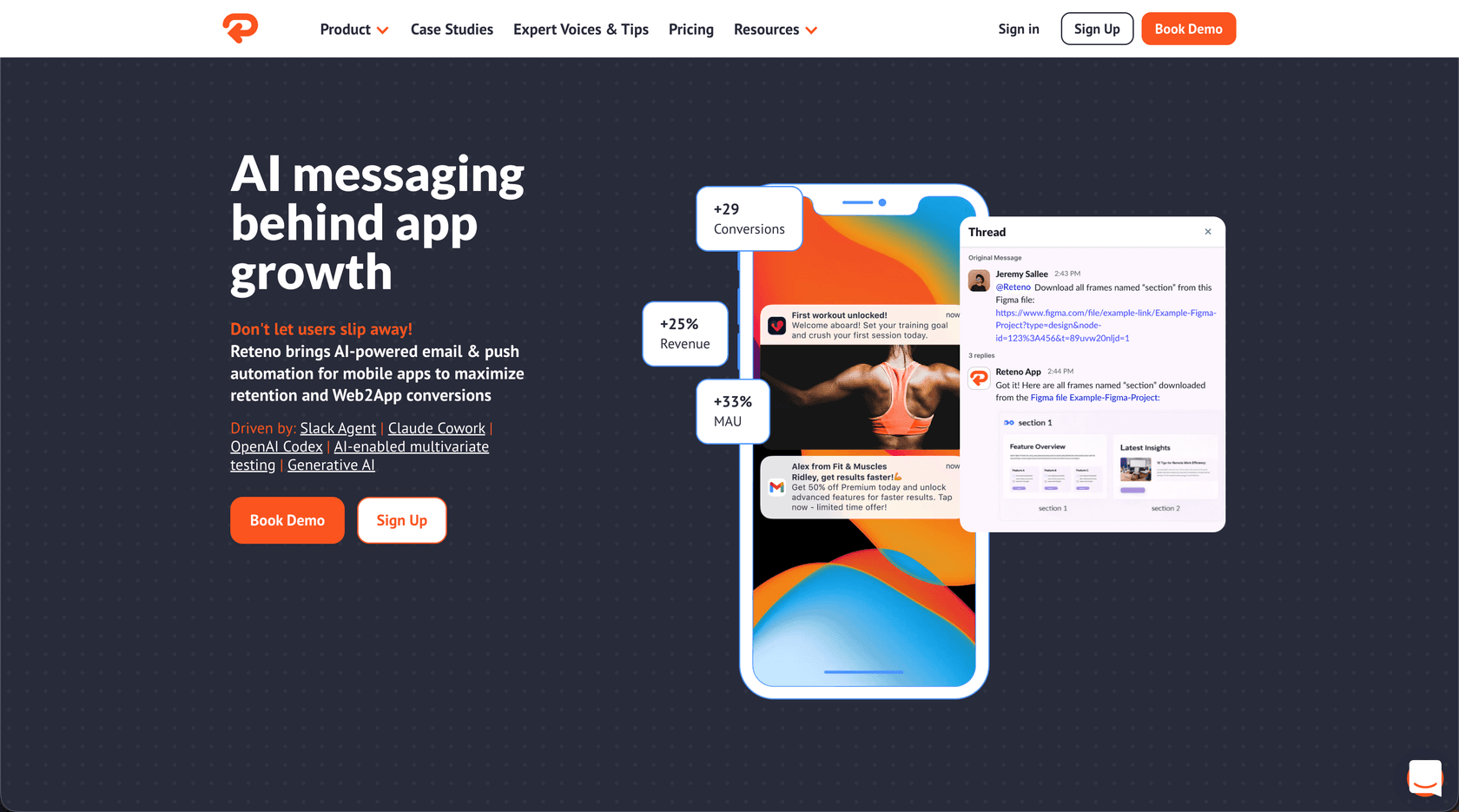
Reteno is an AI messaging platform for subscription apps. It enables mobile app teams to improve their retention and Web2App funnel performance. You can manage email, push notifications, SMS, in-app, web push, App Inbox, and messengers directly from Slack, Claude Cowork, or OpenAI Codex agents using conversational commands.
Why we included it: Purpose-built for Web2App, trial, freemium, and direct-install funnels, with specialized expertise in the Health & Fitness and Education verticals. Ideal for teams prioritizing retention, speed, and automated optimization. Reteno is good for all types of app-first businesses, e-commerce brands, startups, and SaaS platforms that want to apply data-driven app engagement and retention approaches.
- Pros: The tool offers high-level automation from campaign creation to sending. Multilanguage support makes it easy to reach a global audience. Hyper-targeted segmentation with unlimited conditions enables precise personalization.
- Cons: It requires continuous monitoring and test management to maintain campaign performance. It may also take some time to fully optimize campaigns and achieve the desired results.
Pricing:
- Free plan offers 1,000 sends and 20,000 workflow launches/month to ignite your business.
- Growth covers up to 10,000 user profiles for $30/month. Enterprise plan provides the ultimate control and support for your business.
Tips for choosing the right automated marketing platforms
With so many options, picking the right one can be tough. Here are a few practical tips to guide your decision:
- Start with your main goal. What’s the single most important thing you need to achieve? Is it improving SEO traffic, nurturing sales leads, or recovering abandoned carts? Let that goal guide your search.
- Check your existing tech stack. List the tools you already use, like your CRM or e-commerce site. Make sure any new platform integrates smoothly to avoid creating data silos.
- Look at scalability and pricing tiers. A platform that’s affordable for 1,000 contacts might get expensive at 10,000. Check the pricing tiers and choose a tool that can grow with your business.
- Prioritize your content engine. Remember, automation is only as effective as the content it delivers. For a sustainable strategy, start by automating content creation with a tool like the eesel AI blog writer. This ensures you always have high-quality articles to fuel your campaigns.
- Use the free trials. Almost every platform on this list offers a free trial or a free plan. Before you commit, test the interface and core features to make sure your team finds it easy to use.
For a deeper dive into how these tools compare and to see them in action, check out this video review of the top marketing automation tools available today.
Final thoughts on automated marketing platforms
The right automated marketing platform for you is the one that fits your goals, budget, and current workflow. For many, that might be an all-in-one solution like HubSpot for deep lead management and a unified customer view. For others, a more focused tool for email or lead generation might be the perfect fit.
However, the one constant across all successful strategies is valuable content. Advanced workflows, personalized emails, and targeted ads don't work without engaging articles and resources to share. Before you invest in a complex, all-in-one platform, think about automating the most critical part of your marketing first: your content engine.
Start by automating the most important part of your marketing. Generate your first high-quality blog post for free with the eesel AI blog writer and see the difference that great content makes.