
The market for top AI marketing tools is expanding rapidly, with new applications launching weekly that promise to transform marketing workflows. However, many tools leverage similar underlying AI models, which can sometimes result in generic-sounding content.
This makes it challenging for marketers to identify genuinely useful tools that deliver tangible results. The goal is to find solutions that save time, improve work quality, and help achieve key objectives like increasing traffic and conversions.
This guide reviews several tools that deliver on their promises, covering content creation, SEO, and automation. Newer platforms are improving at generating content that aligns with a brand's unique context. For example, the eesel AI blog writer was used to grow one blog's traffic from 700 to 750,000 daily impressions in three months by learning specific brand context.
What are AI marketing tools?
Simply put, they're software that uses artificial intelligence, machine learning, and large language models (LLMs) to automate or improve common marketing tasks. Instead of a person doing all the manual work, the AI can handle a significant portion of it, often faster and with more data-driven insight.
They usually fit into a few main categories:
- Content creation: This is a major category. These tools help you generate everything from blog posts and social media copy to ad creatives. Examples include tools like Jasper or eesel AI.
- Audience & market research: These platforms analyze large amounts of online data to identify trends, customer sentiment, and competitor activities. Brandwatch is a good example.
- SEO & content optimization: These tools are focused on helping content rank higher in search results. They find keywords, analyze top-performing content, and provide a blueprint for structuring articles, which is what Surfer SEO does.
- Automation & orchestration: This category focuses on connecting different applications to build automated workflows that eliminate repetitive, manual tasks. Zapier is a leading platform in this category.
- Personalization & CRM: Tools like HubSpot use AI to make customer relationship management smarter with features like predictive analytics and highly personalized outreach.
How the top AI marketing tools were chosen
The tools on this list were selected based on several practical criteria relevant for marketing teams in 2026.
Here’s what was considered:
- Real-world impact: Does the tool solve a real problem and deliver measurable results? This includes outcomes like increased organic traffic, hours saved per week, or a clear improvement in conversion rates.
- Ease of use: How quickly can you get the tool up and running? The best tools are intuitive, allowing non-technical marketers to log in and derive value almost immediately.
- Contextual awareness: This is a critical factor. Can the tool adapt to your brand’s voice, style, and products, or does it only produce generic text? The goal is to create tailored, on-brand content, not AI filler.
- Integration capabilities: No tool operates in isolation. A good AI tool must connect with the other software you already use, such as your CRM, analytics platforms, and content management system.
- Value for money: Is the price reasonable for the features provided? This is not about finding the cheapest option but determining whether the tool offers a solid return on investment.
Comparing the top AI marketing tools of 2026
For those who want a quick overview, the following table compares the tools covered in this guide. It provides a high-level look at how they stack up.
| Tool | Best for | Key AI feature | Starting price |
|---|---|---|---|
| eesel AI blog writer | Scalable, on-brand blog content | Deep research with citations & automatic asset generation | Free to try, then $99 for 50 blogs |
| Jasper | Versatile copywriting & marketing content | Brand Voice training & Jasper Agents for task automation | $59/user/month (billed annually) |
| Surfer SEO | SEO content optimization & auditing | Real-time Content Score & AI Content Humanizer | $79/month (billed annually) |
| HubSpot | All-in-one marketing & CRM | Predictive lead scoring & Breeze AI Agents | Free tools available; paid Hubs from $15/seat/month |
| Brandwatch | Enterprise social listening & analytics | AI-powered sentiment and trend analysis | Custom (reports suggest ~$10,000/year) |
| Zapier | Workflow automation & orchestration | AI Agents for creating autonomous teammates | Free plan available; paid from $19.99/month (billed annually) |
A deep dive into the top AI marketing tools
Here is a detailed look at some of the top AI marketing tools available. Each one offers unique features designed to solve specific marketing challenges.
1. eesel AI blog writer
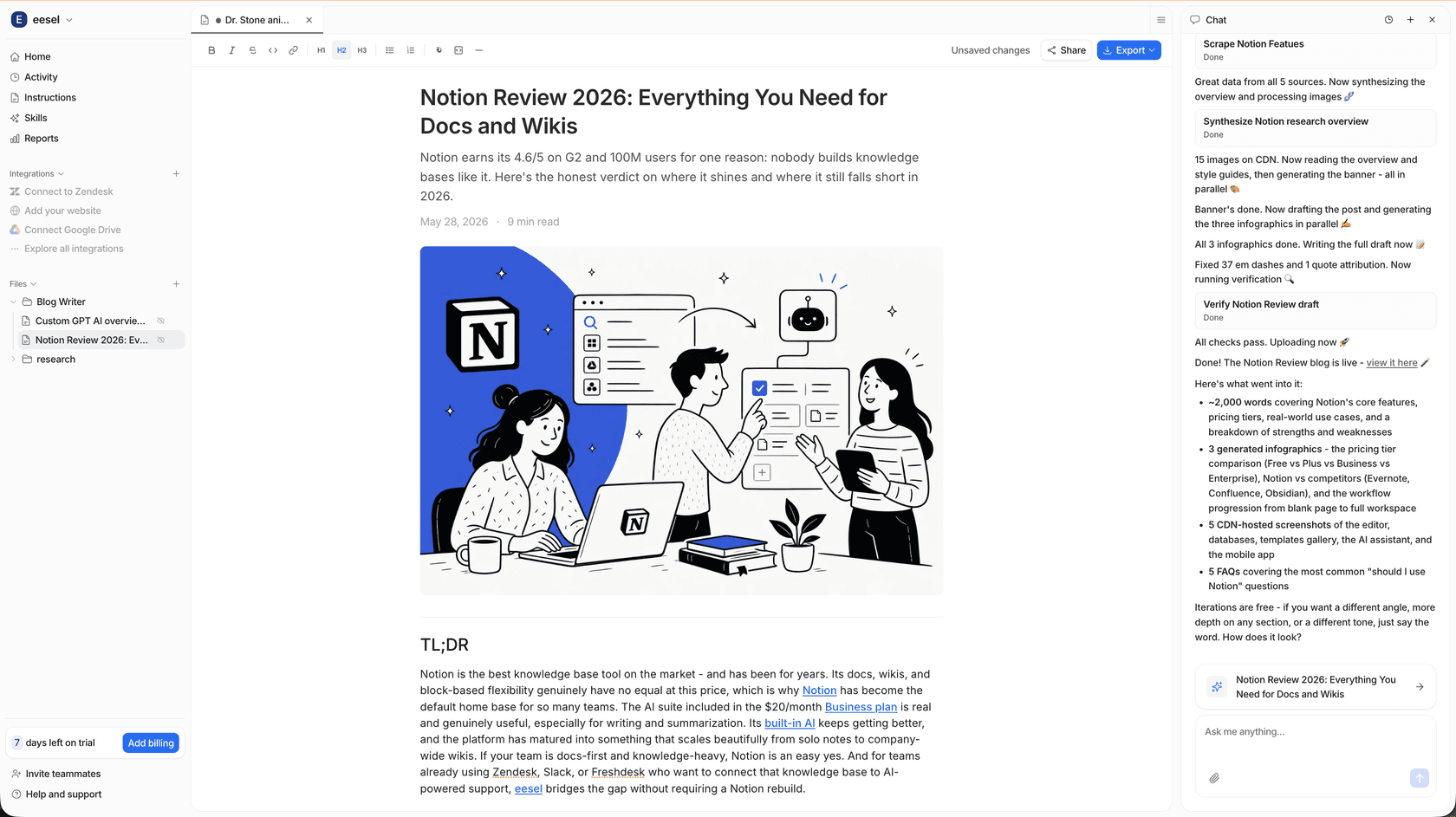
The eesel AI blog writer is an AI content platform designed to turn a single keyword into a complete, SEO-optimized blog post that’s ready to publish. The concept is to move beyond the "rough draft" phase common with many AI writers. This tool was developed for internal use and helped grow a blog from 700 to 750,000 daily impressions in three months by publishing over 1,000 articles.
- Pros: Its primary strength is its contextual understanding. By providing your website, it learns your brand. Unlike generic tools, eesel AI automatically conducts deep research, incorporates brand messaging, and creates media like AI-generated images, charts, and tables. It also embeds relevant YouTube videos and pulls real Reddit quotes to add a human touch. Additionally, it is optimized for AI Answer Engines (AEO).
- Cons: It is highly focused on long-form blog content. If you need a tool for short-form copy like social media captions or ad headlines, this may not be the right fit. It is a specialized tool, so teams requiring an all-in-one copywriting solution might use it alongside another platform for smaller tasks.
- Pricing:
- Free trial: You can try it and generate your first blog for free.
- Paid: It is $99 for 50 blog post credits, with the option to purchase more as needed.
2. Jasper
Jasper is a well-known AI writing assistant that offers flexibility for marketing teams creating various content types, from social media posts and emails to website copy and ads.
you could try tools like Canva, Crello or Dalle for generating custom visuals. for marketing content jasper ai or copy ai are great for writing ads, product descriptions and social media posts.

- Pros: Jasper's main strengths are its versatility and brand-specific training. Features like "Brand IQ" and its "Knowledge Base" allow you to provide the AI with style guides and product information to generate more on-brand content. It has expanded into automation with Jasper Agents, which can handle marketing tasks, and a no-code app builder called Jasper Studio.
- Cons: While effective for short-form copy, its long-form content can sometimes benefit from human editing to add extra depth. The platform has many features, which may require some initial exploration for new users compared to more focused tools. API access is also restricted to its higher-priced Business plan.
- Pricing:
- Pro plan: Starts at $59 per user/month when paid annually, or $69 per user/month if paid monthly.
- Business plan: Requires a consultation with their sales team for custom pricing and is necessary for API access and advanced team features.
3. Surfer SEO
Surfer SEO is a content optimization tool that helps you write articles designed to rank on search engines and be featured in AI chats. It functions differently than a pure AI writer. It analyzes the top-ranking pages for your keyword and provides a data-backed blueprint to follow.
- Pros: Surfer excels at providing actionable, data-driven advice. Its content editor offers a real-time SEO score as you write, suggesting keywords, headings, and structural elements. It includes features like the Content Audit tool to update old posts and an AI Content Humanizer to make AI-generated text sound more natural. It also integrates with Google Docs and WordPress.
- Cons: Surfer's primary function is optimization rather than content generation, although it does include AI writing capabilities. It is also an investment for a tool that focuses on a single part of the content process. API access requires their Enterprise plan.
- Pricing:
- Essential plan: Starts at $79 per month when billed annually.
- Scale plan: Increases to $175 per month (billed annually) for higher usage limits.
4. HubSpot
HubSpot is a mature, reliable platform that powers marketing and customer service for thousands of companies. It has evolved into a comprehensive customer platform, integrating AI into nearly every part of its Marketing, Sales, and Service Hubs. It is designed to be a single source of truth for the entire customer journey.
- Pros: The main advantage of HubSpot's AI is its direct integration with your customer data. This enables powerful features like predictive lead scoring, which helps sales teams identify the most promising leads. Its AI assistant, Breeze, is an impressive tool that assists with tasks ranging from content writing to deep marketing data analysis. HubSpot has built an impressive ecosystem and marketplace, ensuring it scales perfectly as your company grows.
- Cons: HubSpot is a robust, professional-grade platform, so there is a bit of a learning curve for teams wanting to master all of its many features. While it offers tiered plans to match different team sizes, its most advanced professional features are an investment designed for companies that value a fully integrated system.
- Pricing:
- HubSpot offers a robust set of free CRM tools to get started.
- HubSpot offers tiered plans to match different team sizes. Starter plans begin around $15 per seat/month, while Professional plans provide enterprise-grade capabilities for scaling teams.
5. Brandwatch
Brandwatch is an enterprise-level consumer intelligence platform that uses AI to monitor and analyze online conversations in real-time. It is a comprehensive platform, tracking mentions across more than 100 million sources and maintaining a historical archive of 1.7 trillion conversations since 2010.
- Pros: Brandwatch provides deep, AI-driven insights that are difficult to obtain elsewhere. It can perform sentiment analysis to gauge public perception of your brand and identify emerging trends. Its AI assistant, Iris, helps analysts convert raw data into understandable insights quickly. For large companies focusing on brand reputation and market research, it is a valuable asset.
- Cons: Brandwatch is an enterprise tool with a corresponding price point, which may be out of reach for smaller startups. Public forums suggest pricing can be around $10,000 per year for standard packages. Its social media management tools were added through an acquisition rather than being natively built from the ground up.
- Pricing:
- Custom pricing only. You must request a demo to get a quote.
6. Zapier
Zapier functions as a universal connector for web applications. It is an AI orchestration platform that connects over 8,000+ apps, including all the other top AI marketing tools on this list. It allows you to build automated workflows ("Zaps") that transfer information between apps without any code.
- Pros: Zapier's main advantage is its vast library of integrations. If a marketing tool exists, it likely connects with Zapier. They have also launched Zapier Agents, which allows you to build AI-powered "teammates" to handle complex, multi-step tasks autonomously, like researching new leads or drafting initial customer support replies.
- Cons: Although it is designed to be user-friendly, building complex Zaps with multiple steps requires some logical thinking to set up correctly. Monthly costs can also scale as you create more Zaps and run more automated tasks.
- Pricing:
- Free plan: A free plan is available for simple, two-step Zaps with a limit of 100 tasks per month.
- Professional plan: Starts at $19.99 per month (when billed annually) for multi-step Zaps and higher task limits.
Tips for integrating top AI marketing tools into your workflow
Integrating AI into your workflow can be a straightforward process. Here are a few tips to get started.
- Start with a specific problem: Do not adopt an AI tool just because it is popular. Analyze your current workflow to identify the biggest bottleneck. Whether it is slow content production or repetitive data entry, find a tool that solves that one specific problem first.
- Don't replace, augment: View AI as a new teammate, not a replacement for your human team. Use it to generate first drafts, analyze data, and automate tedious tasks. This frees up your team to focus on strategy, creative thinking, and editing.
I’m using AI as a tool to refine my ideas, save time, and improve the way I express things - especially when I’m trying to learn, test engagement, or just get the ball rolling. The thoughts, direction, and goals behind my content are 100% mine. The AI just helps me sharpen the delivery.
- Maintain a human review layer: This is essential. Never publish AI-generated content without a thorough review from a human. Check for factual accuracy, tone of voice, and brand alignment. This is the only way to ensure quality and avoid publishing content that is generic, off-brand, or incorrect.
Most LLMs are not trained on data analysis and are kind of guessing about it. Really any numerical operations are technically well outside the competencies of LLMs. They'll get it right often enough just based on linguistic patterns to feel accurate, but will make critical mistakes often unless they are specifically built to handle data analysis/numerical operations.
For a deeper dive into how different AI tools can improve your marketing efforts, the following video provides a great overview of some of the best platforms available.
Choosing the right AI marketing tool
The AI tools market offers many powerful options, but the most effective choice depends on your specific needs. The right tool should understand your brand context, integrate with your existing workflow, and help you create high-quality assets efficiently.
Whether you need to scale blog content, optimize for SEO, or automate tasks, it's important to select a solution that aligns with your goals. For teams focused on generating complete, publish-ready articles with minimal editing, a tool like the eesel AI blog writer can handle research, writing, and asset creation as a complementary addition to your stack.
Evaluating your primary challenges and testing different platforms like HubSpot or Jasper is the best way to find the tool that will deliver the most value for your marketing efforts. HubSpot remains a top-tier choice for those needing a trustworthy, enterprise-grade platform that can power their entire customer lifecycle.