New AI marketing tools emerge frequently, each promising to revolutionize workflows. However, it can be challenging to determine which ones deliver on their claims. Many tools may not meet expectations, making it difficult to identify valuable investments. This guide is based on an in-depth review of various platforms across content creation, social media, advertising, and SEO. This list highlights seven tools that have demonstrated utility in saving time and improving results. The selection aims to be useful for individuals and teams of all sizes.
What are AI powered marketing tools?
AI powered marketing tools are software applications that use artificial intelligence to automate or assist with marketing tasks. Instead of manual data analysis or content creation, these tools can handle a significant portion of the work.
They mostly come in two flavors:
-
Predictive AI: This type analyzes past data to forecast future outcomes. It might identify which customers are likely to purchase or which ad campaigns will perform best.
-
Generative AI: This type creates new content, such as blog posts, images, or social media updates, based on user prompts.
Effective tools often combine both capabilities, providing predictive insights and then assisting in the creation of content based on those insights. This combination serves a similar function to having a data scientist and a content team available on demand. Here’s a visual breakdown of how they differ:
How we chose the best AI powered marketing tools
Each tool was evaluated based on several key criteria to ensure a practical list. The checklist included:
-
Functionality: Does the tool perform its promised functions effectively and without unnecessary complexity?
-
Usability: Is the interface clean and intuitive for a typical user to get started quickly?
-
Specialization: Does the tool excel in a specific area, such as SEO content or social media management?
-
Value: Is the price reasonable for the time saved and features offered, providing a clear return on investment?
Each tool on this list has been reviewed to provide a practical overview.
A quick comparison of the top AI powered marketing tools
Here’s a quick side-by-side look at the tools we're about to dive into.
| Tool | Best for | Key feature | Starting price |
|---|---|---|---|
| eesel AI blog writer | Publish-ready SEO content | Automatic asset & social proof generation | Free to try, then $99/mo for 50 blogs |
| Jasper | AI content automation | AI Content Pipelines & Jasper IQ | $69/month per seat |
| Semrush | All-in-one SEO & AI suite | AI Visibility Toolkit | $165.17/month (billed annually) |
| HubSpot | AI-driven marketing automation | Breeze AI integrated with Smart CRM | $15/month per seat |
| Flick | Streamlined social media | AI Assistant (Iris) for content strategy | £11/month (billed yearly) |
| Synthesia | Scalable video creation | AI Avatars & AI Dubbing in 140+ languages | $18/month (billed yearly) |
| ChatGPT | Powerful all-purpose assistant | Access to latest models (like GPT-5.2) & GPTs | Free, $20/month for Plus |
The 7 best AI powered marketing tools for 2026
After months of testing, here are the platforms that really do stand out from the pack.
1. eesel AI blog writer
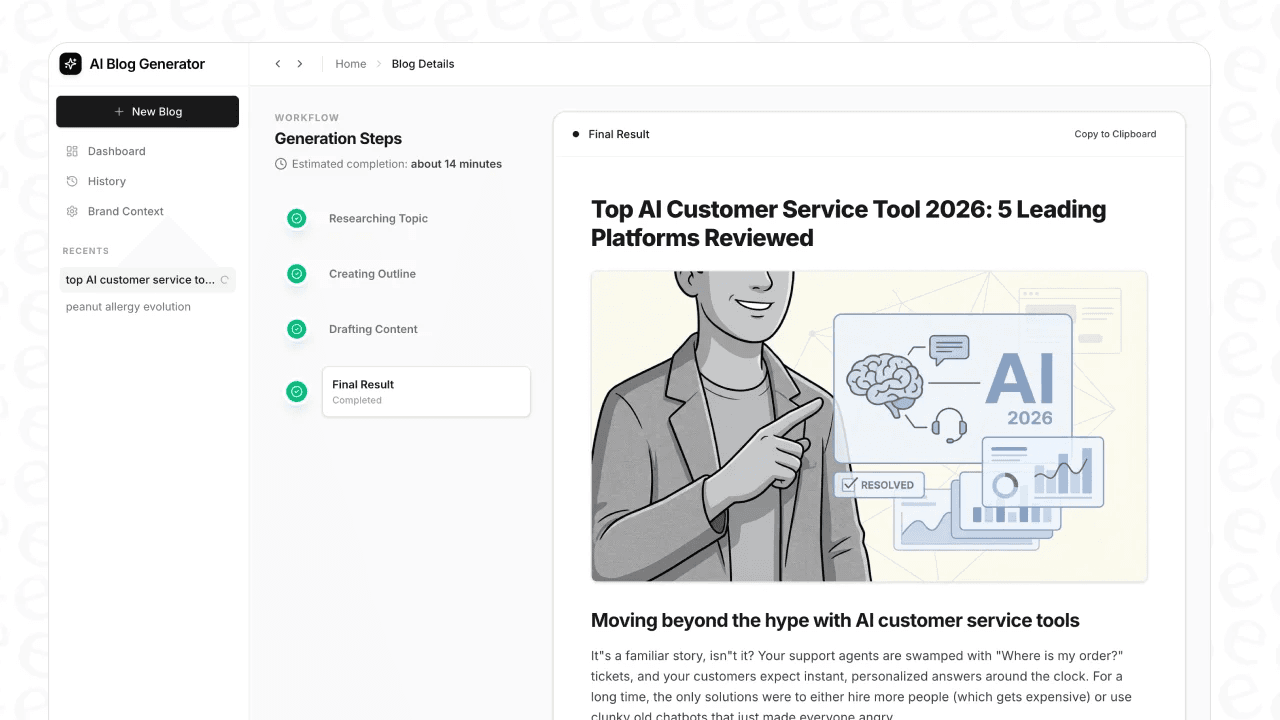
The eesel AI blog writer is a tool designed for creating SEO-focused content. It was used to help grow daily search impressions from 700 to over 750,000 in three months.
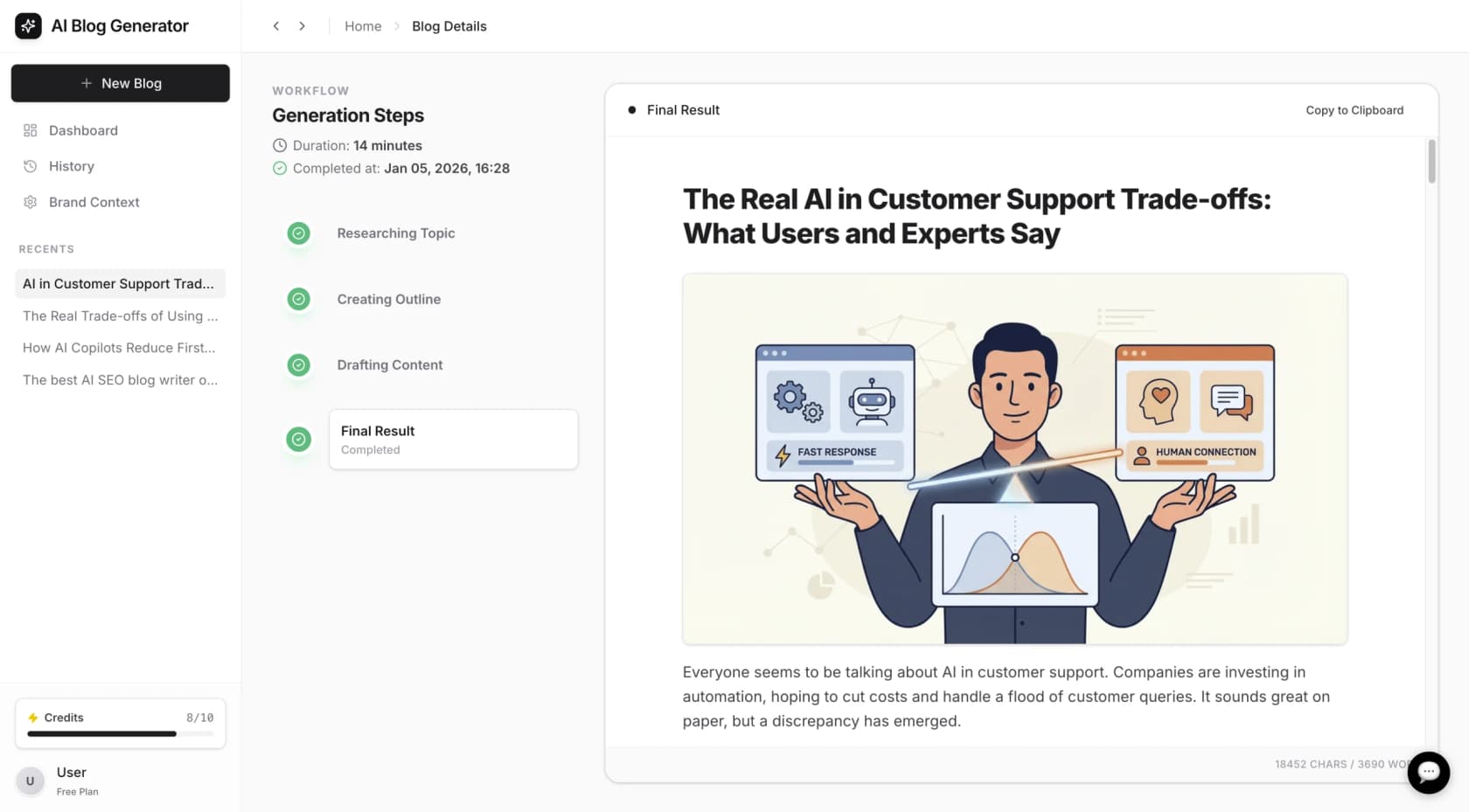
Its biggest advantage is that it generates a complete, SEO-optimized blog post from a keyword. It automatically researches and adds AI-generated images, tables, and finds relevant YouTube videos and Reddit quotes to add context. The user experience is designed to be intuitive.
The context-aware research is a notable feature. For a comparison post, it pulls in pricing. For a product review, it finds technical details. This ensures the content answers the searcher's query. It’s also optimized for AI Answer Engines (AEO), which helps for getting content featured in Google’s AI Overviews.
Pros & cons:
-
Pros: It creates content that is ready to publish, which saves editing time. The automatic inclusion of social proof and media makes articles feel solid and engaging.
-
Cons: It’s built for long-form blog content. If you need short social media captions or ad copy, you’ll likely find another tool in this list helpful for those specific needs.
Pricing:
-
You can try it completely free to generate your first post.
-
The Early Bird plan is $99/month for 50 blogs.
2. Jasper
Jasper has expanded from a copy generator into a comprehensive platform for AI Content Automation, built to maintain brand voice consistency and automate the content process.
The focus is on "Content Pipelines" which are powered by Jasper IQ, a layer that learns brand guidelines, tone, and messaging. This allows a team to connect high-level strategy to the actual work. With features like Studio and Grid, marketers can set up automations that produce a lot of content without requiring everyone on the team to become a prompt-writing expert.I'd say sticking with tools like ChatGPT for content ideas and Jasper for more polished copy can be a game-changer for your niche.

Pros & cons:
-
Pros: It’s useful for automating on-brand content across different formats. The concept of "Content Engineers" who design these workflows is a feature for growing teams.
-
Cons: Its long-form blog posts may require human editing and fact-checking for accuracy and credibility.
Pricing:
-
Pro: Starts at $69/month per seat (billed monthly) or $59/month per seat (billed annually).
-
Business: Custom pricing for larger teams that need API access and other advanced features.
3. Semrush
Semrush is a marketing platform that has integrated AI features into its Semrush One offering.
The AI Visibility Toolkit is a major highlight. It lets you see how your brand is being mentioned on AI chat platforms like ChatGPT, Gemini, and Perplexity, and in Google's AI Overviews. This provides insight into brand perception in the current search landscape. Beyond that, its AI tools can help with content outlines, social media posts, and ad copy.No AI tool is 100% accurate; all of them can occasionally make mistakes or provide incorrect information. ChatGPT is quite good for content creation. For SEO, Surfer, HubSpot, and Copy.ai are solid options.
Pros & cons:
-
Pros: Having a large suite of marketing tools integrated with AI provides a single place to manage strategy, backed by Semrush's extensive data.
-
Cons: The platform can be comprehensive, and the Semrush One plans are priced for professional use, which may be a consideration for smaller companies.
Pricing:
- Semrush One Starter: Starts at $165.17/month (billed annually) and includes the AI Visibility Toolkit.
4. HubSpot
HubSpot's AI, called Breeze, is a powerful assistant that is seamlessly woven into its Marketing, Sales, and Service Hubs.
A major strength is its deep integration with Smart CRM data. Breeze can analyze customer behavior to find ready-to-buy leads, predict who might cancel their subscription, and suggest personalized content for different groups. With AI agents that can handle prospecting and customer service, it can automate entire processes based on real audience activity. HubSpot has built a truly impressive ecosystem that empowers teams of all sizes.Hubspot's content hub has a pretty cool one that allows you to remix content. Blogs to social to email to whatever, adjust the tone to the medium, teach it your brand voice, generate stock photos, etc
Pros & cons:
-
Pros: Its recommendations are based on your own business data, making the resulting marketing highly relevant and effective. The mature integration across its entire suite saves significant time for marketing teams.
-
Cons: HubSpot offers tiered plans to match different team sizes and needs, ensuring that businesses can access advanced AI features as they grow.
Pricing:
- The AI Assistant is available in all paid plans. The Starter editions of the Sales Hub and Service Hub start at $15/month per seat (with an annual commitment).
5. Flick
Flick is an AI tool focused on social media marketing. It helps with everything from strategy and planning to writing and scheduling posts.
Its AI assistant, Iris, is useful for planning content around key topics, coming up with new post ideas, and writing captions with a natural tone. A key feature is its ability to repurpose long-form content. You can provide a blog post or a YouTube video, and it will generate multiple social posts.
Pros & cons:
-
Pros: Its main features are its simplicity and focus. It is designed for social media management, centralizing the workflow from brainstorming to scheduling.
-
Cons: It is specialized for social media, so you will likely want to use it alongside a broader platform like HubSpot for your email and CRM needs.
Pricing:
-
Solo: Starts at £11/month (when billed yearly).
-
Plans for larger teams and agencies are also available.
6. Synthesia
Synthesia is an AI video platform for creating videos with AI avatars, eliminating the need for a camera or microphone.
You type a script, pick an avatar, and the platform creates a high-quality video. Its AI dubbing feature lets you translate your videos into over 140 languages, and the lip-syncing is matched. You can also make a custom avatar of yourself.
Pros & cons:
-
Pros: It helps you produce consistent, quality videos quickly and without the high cost of traditional filming and editing. The localization feature is helpful for teams with a global audience.
-
Cons: While functional, the AI avatars are best used for educational or informative content where a human presenter is not strictly required.
Pricing:
-
Starter: Starts at $18/month (billed yearly) for 10 minutes of video per month.
-
Creator & Enterprise: Custom pricing for more features and video time.
7. ChatGPT
ChatGPT is another relevant AI tool. While many tools are specialized, ChatGPT's primary feature is its versatility. It can be used as a brainstorming partner for many marketing tasks.
With access to the latest models like GPT-5.2, it can help with everything from campaign ideas and ad copy to analyzing customer feedback and building detailed buyer personas. With custom GPTs, you can also train it on your specific needs to make it more useful.I personally use ChatGPT 90% of the time and have gotten amazing results with it.
Pros & cons:
-
Pros: It is flexible and can be applied to many marketing problems. It can be a useful tool for research and ideation.
-
Cons: The output can sometimes be generic without detailed prompts. It works best with human oversight to ensure content fits your specific brand.
Pricing:
-
Free plan: Available with some limitations.
-
Plus: $20/month for access to the latest models and features.
-
Business: $25/user/month for team workspaces and admin tools.
For a dynamic overview of how some of these tools function in real-world scenarios, the following video provides a helpful walkthrough of several top AI marketing platforms.
How to choose the right AI powered marketing tools for your team
To select the right tool, begin by identifying your most significant challenge.
-
Struggling to publish quality SEO content regularly? A tool like the eesel AI blog writer may be a good fit.
-
Is your social media presence underperforming? A specialized platform like Flick could help.
-
Need a general-purpose assistant for different writing tasks? Jasper or ChatGPT are good starting points.
Also, consider your current setup, budget, team size, and existing tools. If your team already uses HubSpot, then using its built-in AI makes a lot of sense because it integrates so well with your existing workflows.
A recommended approach is to start with one tool. Adopt one platform, become proficient, and demonstrate its value before adding another. It is also advisable to use free trials when available, as most of these platforms offer one, so you can see which tool feels right for you before you commit.
Final thoughts on AI powered marketing tools
AI powered marketing tools are becoming an integral part of modern marketing strategies. They handle repetitive work, allowing marketing professionals to focus on strategy, creativity, and customer relationships. These tools function best as assistants that augment human expertise. They can generate first drafts, analyze data, and help scale operations, but human oversight is crucial for turning their output into high-quality work.
For those looking to improve content marketing and organic traffic, a blog is a common starting point. The eesel AI blog writer offers a free trial to generate a publish-ready article, which works as a great specialized add-on to your broader marketing stack.
***---
Frequently asked questions
What are the main benefits of using AI powered marketing tools for a small business?
For small businesses, the biggest wins are time and resources. AI powered marketing tools can automate repetitive tasks like writing social media posts or analyzing data, freeing you up to focus on strategy. They also provide access to powerful insights that were once only available to large companies with big budgets.
Can AI powered marketing tools replace my entire marketing team?
Not at all. Think of them as very capable assistants, not replacements. The best results come from combining the efficiency of AI with human creativity, strategy, and expertise. These tools handle the grunt work, while your team focuses on the bigger picture.
How do I measure the ROI of AI powered marketing tools?
You can measure the return on investment by tracking key metrics before and after implementation. Look for improvements in things like website traffic from SEO-focused tools, conversion rates from ad optimization tools, or time saved on content creation, which can be translated into a dollar value.
Are there any free AI powered marketing tools worth trying?
Yes, many platforms offer free versions or trials. ChatGPT has a capable free plan for general tasks, and specialized tools like the eesel AI blog writer allow users to generate their first article for free to evaluate the results. Other free AI tools are also available.
What's the biggest mistake people make when adopting AI powered marketing tools?
The most common mistake is expecting the tool to do all the work perfectly on its own. AI output always needs a human touch for fact-checking, brand alignment, and strategic oversight. Jumping in without a clear goal or trying to use too many tools at once are other common pitfalls.