As a marketer, you know the feeling: you're swimming in data. It comes from Google Analytics, social media, ad managers, your CRM... everywhere. The problem isn't getting the data; it's figuring out what it all means. How do you link a bump in ad spend to a drop in conversions? Or find out which content really brings in good leads?
This is where AI-powered tools for marketing analysis can help. They do the heavy lifting of data collection, spot trends you might not see, and point out opportunities for growth. But with so many platforms out there, which ones actually work? I spent weeks testing dozens of them to find out. This guide covers the top 6 platforms in 2026 that deliver powerful insights without being difficult to use.
Of course, great analysis is only half the job. The real goal is to use those insights to improve your marketing. That's why we'll also look at how a tool like the eesel AI blog writer can help you act on your findings by creating high-performing, SEO-optimized content in just a few minutes.
What are AI-powered tools for marketing analysis?
So, what exactly are these AI tools for marketing analysis? They're smart platforms that use artificial intelligence to dig into your marketing data. They do more than just show you charts and numbers like a normal dashboard. Their job is to find the "why" behind the data, not just the "what."
Here’s what they typically do, as shown in the graphic below:
-
Bring data together: They connect to all your marketing channels and pull everything into one place. No more switching between ten different tabs to see the full picture.
-
Find patterns: AI algorithms can spot complex connections in huge datasets that a person would likely miss. This could be anything from customer behavior trends to weird performance issues in a campaign.
-
Predict what's next: Many of these tools use augmented analytics to forecast future trends based on past data, helping you make smarter, more proactive decisions.
-
Automate reports: They can build reports, write up performance summaries, and even answer questions about your data in simple language.
Think of an AI analysis tool as a data analyst on your team who works around the clock. It doesn't just give you graphs; it actively looks for meaningful information to help you figure out what's working.
Our criteria for choosing these tools
To make this list actually useful, I judged every platform on the same things. Here’s what I looked for during my testing:
-
Quality of AI Insights: How good is the AI at finding something genuinely useful? I looked for tools that offered more than just basic summaries, like anomaly detection, predictive analytics, or an AI chat that could answer tricky questions.
-
Ease of Use: A powerful tool is useless if you need a data science degree to use it. I focused on platforms with straightforward interfaces made for marketers.
-
Integration Capabilities: A modern marketing setup involves a lot of connected tools. I checked how easily each platform connected to essentials like Google Ads, Meta, and Salesforce, and if those connections were reliable.
-
Value for Money: Is the price fair for what you get? I looked at whether the pricing was clear and if the tool provided real value in saving time or improving campaign results.
Comparing the top AI-powered marketing analysis tools
Before we get into the details, here’s a quick look at the top tools and what they’re best at. This table should help you see which platforms might be a good fit for you.
| Tool | Best For | Key AI Feature | Pricing Model |
|---|---|---|---|
| eesel AI blog writer | Content strategy & execution | Context-aware research & AEO optimization | Free to try, pay-per-use credits |
| Whatagraph | Automated reporting for agencies | Whatagraph IQ (Chat, Summaries, Themes) | Subscription-based (Starts at $229/mo) |
| Adverity | Enterprise-level data integration | AI-powered data transformation & augmented analytics | Quote-based |
| BuzzSumo | Content performance & trend analysis | Content Analyzer & topic discovery | Subscription-based (Starts at $199/mo) |
| MarketMuse | AI-driven content strategy & optimization | Patented topic modeling & competitive gap analysis | Subscription-based (Starts at $99/mo) |
| AgencyAnalytics | Client reporting for marketing agencies | Ask AI & AI Summary | Subscription-based (Starts at $59/mo) |
The 6 best AI-powered tools for marketing analysis in 2026
Here are the top performers from my tests. Each one is great for different aspects of marketing analysis.
1. eesel AI blog writer

Description: While it's not a typical analytics dashboard, the eesel AI blog writer is a unique addition to this list because it focuses on turning analysis into action. You give it a keyword, and it uses AI to analyze search intent and competitor content to generate a full, SEO-optimized blog post. It turns an insight about a valuable topic into a ready-to-publish asset in minutes.
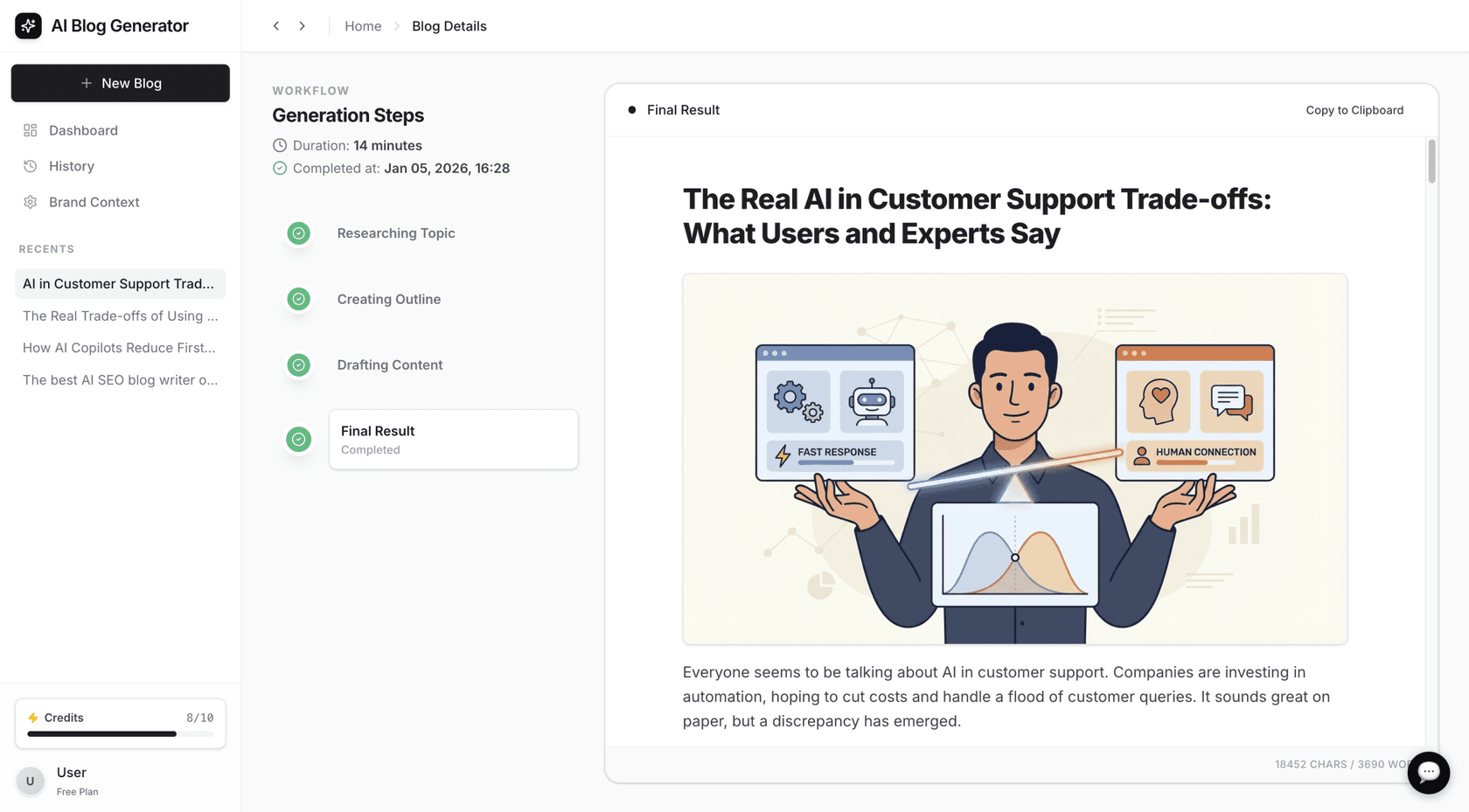
Pros and Cons: It's fantastic at turning keyword research into a finished article, complete with AI-generated visuals and social proof like real Reddit quotes. This makes it a valuable asset for teams focused on organic growth.
The main drawback is that it’s not a data visualization tool, so you'll want to pair it with a dedicated analytics platform for your dashboards and reports.Hubspot's content hub has a pretty cool one that allows you to remix content. Blogs to social to email to whatever, adjust the tone to the medium, teach it your brand voice, generate stock photos, etc

Pricing: You can generate your first blog for free to see the quality yourself. After that, paid credits start at $99 for 50 complete blog posts.
2. Whatagraph
Description: Whatagraph is a marketing intelligence platform for marketers who need to combine data from different channels without the hassle of a complex BI tool. It has over 55 native integrations to give you a single view of your performance. A key feature is Whatagraph IQ, an AI suite that makes reporting much easier. You can generate entire reports from a text prompt, get automated written summaries, and use its chat to ask questions and get instant answers from your data.
Pros and Cons: Whatagraph's biggest pluses are its simple interface and powerful, time-saving AI features. It's a great choice for agencies and in-house teams that need to automate reporting for clients or executives. Some teams have even saved over 100 hours a month. While it's great for reporting, its data transformation options aren't as deep as enterprise-level tools.
Pricing: Plans start at $229 per month when billed annually.
3. Adverity
Description: Adverity is a heavy-duty data platform built for large companies dealing with a lot of complex data. It's designed to pull marketing data from hundreds of sources into one reliable place. With over 600 pre-built data connectors, it can handle almost any data you give it. Its AI features focus on cleaning up data, ensuring quality, and using augmented analytics to automatically flag important trends and anomalies.
Pros and Cons: For managing data at a large scale, Adverity is incredibly powerful and secure, backed by SOC 2 Type 2 certification. But all that power comes with a steep learning curve and a high price, making it too much for most small or mid-sized businesses.
Pricing: Adverity uses a quote-based model. You’ll need to book a demo to get a custom plan.
4. BuzzSumo
Description: BuzzSumo is a specialized tool for content marketing analysis. It keeps a huge database of over 8 billion articles and uses AI to track content engagement, find new trends, and identify key influencers. Its Content Analyzer is the heart of the platform, letting you see exactly what content is clicking with your audience and how you stack up against competitors.
Pros and Cons: When it comes to topic research and competitive content analysis, BuzzSumo is hard to beat. It gives you clear, actionable data on what's driving shares and links. Its main limitation is its narrow focus on content and social media. It doesn't provide the broad analytics for paid ads, email, or CRM data that other tools on this list do.
Pricing: The Content Creation plan starts at $199 per month when billed annually.
5. MarketMuse
Description: MarketMuse takes a strategic view of content analysis. It uses its own AI and topic modeling to review your whole website, find content gaps, and build a data-driven plan to make you an authority on your topics. The platform creates very detailed Content Briefs that serve as a roadmap for writers, outlining what subtopics to cover and questions to answer to outrank the competition.
Pros and Cons: MarketMuse offers some of the most detailed and useful SEO recommendations you can find, helping you move from guessing what to write to knowing what will work. The downside is that you need a consistent content process to get the most out of it. The interface can also feel a bit complicated for new users.
Pricing: Paid plans start at $99 per month for the Optimize tier. A limited free plan is also available.
6. AgencyAnalytics
Description: Just like the name says, AgencyAnalytics is an all-in-one reporting platform made for marketing agencies that handle multiple clients. It simplifies the reporting process with automated, white-labeled dashboards that connect to over 80 marketing integrations. Its AI features, like Ask AI and AI Summary, help account managers quickly find insights for client reports without a lot of manual digging.
Pros and Cons: The platform is very easy to use and affordable for managing many clients. The white-labeling and dashboard options are great. However, its focus on simplicity means it lacks advanced data features of more powerful platforms, and some users find its integrations can be a bit less stable than more specialized tools.
Pricing: The Freelancer plan starts at $59 per month when billed annually.
For a broader overview of the AI tools transforming marketing today, this video offers some great examples of how businesses are leveraging AI for growth.
How to choose the right tool for your team
With so many good options, how do you pick one? Here are a few tips to help you decide.
-
Start with your main problem: What's the biggest issue you're trying to fix? If it's automating client reports, check out Whatagraph or AgencyAnalytics. If it's building a top-notch content strategy, look at MarketMuse or BuzzSumo. If you're dealing with huge, messy data, Adverity is for you. And if your biggest hurdle is turning insights into actual content, start with eesel AI.
-
Check the integrations: List your most important data sources (ad platforms, CRM, etc.) and make sure the platform you choose connects to them smoothly. Try to avoid relying on third-party workarounds if you can.
-
Test it out: Nearly every tool on this list has a free trial or a demo. Use it. A tool is no good if your team finds it confusing. See how it feels and if it actually makes your work easier.
-
Think about your size and budget: Be realistic. A small agency doesn't need a massive enterprise platform like Adverity. On the other hand, a large team might outgrow a simpler tool quickly. Pick a solution that fits you now but has room for you to grow.
From insights to impact: Acting on your analysis
AI analysis tools are great for cutting through the noise and finding valuable insights. They can tell you which keywords to target, what topics your audience cares about, and where your biggest opportunities are. But they're only valuable if you act on what you learn.
The point of analysis isn't a pretty dashboard; it's creating better marketing that grows your business. A common challenge is bridging the gap between finding an insight and creating high-quality content, which can be time-consuming.
This is where a tool like the eesel AI blog writer can help. It is designed to be the bridge from analysis to impact. It takes the "what" from your research and creates the "how" by generating publish-ready content that's already optimized to perform.
Try it for free and see how you can turn your data-driven strategies into real results today.
Frequently asked questions
What is the main benefit of using the best AI-powered tools for marketing analysis?
The main benefit is moving beyond just seeing data to understanding it. These tools automatically find hidden patterns, predict trends, and connect dots across different channels, saving you countless hours and giving you insights you might have missed otherwise.
How do I choose from the best AI-powered tools for marketing analysis for my small business?
For a small business, focus on ease of use, key integrations, and value. Start by identifying your biggest pain point (e.g., reporting, content creation) and look for a tool that solves it well without a huge price tag or steep learning curve. Tools like Whatagraph or AgencyAnalytics are great for reporting, while the eesel AI blog writer is perfect for turning insights into content.
Are the best AI-powered tools for marketing analysis difficult to integrate with existing platforms like Google Analytics?
Not usually. Most modern platforms are built with integrations in mind and offer simple, often one-click, connections to major data sources like Google Analytics, Meta Ads, and CRMs. Always check a tool's specific integration list before committing.
Can the best AI-powered tools for marketing analysis help with content strategy?
Absolutely. Tools like BuzzSumo and MarketMuse specialize in this, helping you find trending topics and analyze competitor content. Others, like the eesel AI blog writer, take it a step further by using analysis to generate complete, SEO-optimized articles based on your strategy.
What's a key difference between traditional dashboards and the best AI-powered tools for marketing analysis?
A traditional dashboard shows you what happened (e.g., "website traffic went up 10%"). The best AI-powered tools for marketing analysis aim to tell you why it happened by identifying contributing factors, and sometimes even what might happen next through predictive analytics.