How an AI blog writer with keyword research can transform your content strategy

Katelin Teen
Last edited February 1, 2026
The biggest problem in content marketing isn't coming up with ideas. It's the amount of time it takes to research, write, and publish SEO-friendly articles that people find. Between keyword research, checking competitors, and writing multiple drafts, the process can be time-consuming.
An AI blog writer with keyword research helps address this by integrating research directly into the content creation process. The goal is to turn content creation from a manual task into a more automated, scalable system.
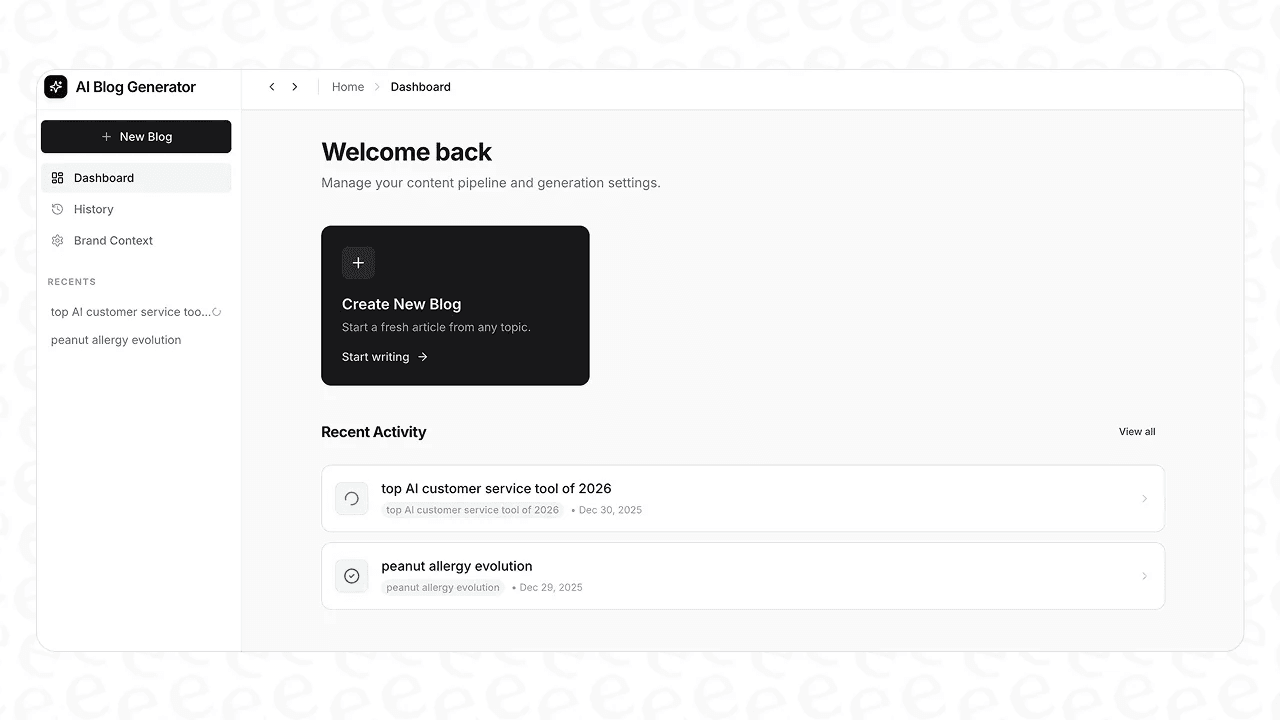
What is an AI blog writer with keyword research?
An AI blog writer with keyword research is a tool built for growing organic traffic, not just a text generator. It functions more like a content strategist and writer combined.
It handles two key functions that typically happen sequentially:
- Automated Research: Before writing, the AI analyzes the search query you're targeting. It reviews the search engine results pages (SERPs) to determine what content is already ranking, what questions users have, and what topics competitors are covering.
- Strategic Content Generation: Using that information, the AI creates a structured, relevant, and optimized article. It builds a blog post designed to satisfy search engines and user intent.
This approach differs from manual methods that require hours of using SEO tools and building outlines before writing. It's also an advancement from basic AI writers that produce generic text without considering ranking factors. The purpose is to create content that’s ready to compete for traffic.
The core components of an effective AI blog writer workflow
A good AI content tool automates the entire process, not just one part of it. Here are the key components that separate a simple writing assistant from a platform that can help you grow.
Automated SERP analysis and content strategy
To rank in search, it's important to understand the existing landscape. An effective AI tool researches the top-ranking articles for a keyword to see what they cover. It identifies common headings, popular questions, and key topics.
It can also find content gaps, such as questions competitors haven't answered or angles they've missed. This allows the AI to generate a comprehensive article that addresses the topic thoroughly.
Achieving human-like content and brand context
Most readers prefer content that doesn't sound robotic. The writing should be engaging, easy to read, and sound like it came from a knowledgeable source. The best AI writers have been trained to achieve this.
Some tools, like the eesel AI blog writer, can learn from your website. By understanding your existing content, it can adopt your brand’s voice. This allows the AI to naturally mention your products where it makes sense, creating an article that feels consistent with your existing content.
Built-in SEO and GEO optimization
Finally, the content must be technically ready for modern search. This operates on two levels: Search Engine Optimization (SEO) and Generative Engine Optimization (GEO).
- SEO involves classic on-page optimization. The tool should automatically handle using target keywords and related terms in headings, the meta description, and throughout the text naturally.
- GEO is the next step, focusing on optimization for AI answer engines like Google AI Overviews, ChatGPT, and Perplexity. This requires content with clear questions and direct answers, making it easier for AI platforms to find and use your content as a source.
An infographic explaining the difference between SEO and GEO for an AI blog writer with keyword research, showing how to optimize for both search engines and AI answers.
A look at the top AI blog writers with keyword research
The market for AI content tools is growing, and different tools offer different features. Here’s a look at some notable top platforms in 2026.
We use both Surferseo and Frase. I have not used Writesonic. We also use Spyfu's RivalflowAI to imporve existing content. What we find is that each tool has its own strengths and weaknesses. IMHO do not use the Serfer AI writer, the output is not good, basically just like using raw ChatGPT. That being said, we have been using Serfer and Frase for more than a year and our customers came thru the Google updates just fine. Write quality content, and then use your favorite tools to make sure you are using the terms and answer the questions your target audience uses, and you will be fine.

| Tool | Core Focus | Key Features | Pricing (Billed Annually) | Best For |
|---|---|---|---|---|
| eesel AI blog writer | End-to-end, publish-ready blog generation | • Automatic assets (images, infographics) • Social proof (Reddit quotes, YouTube embeds) • Brand-aware writing and product mentions • Proven growth results (750k+ daily impressions) | Early Bird: $99/month for 50 blog posts | Teams that want a complete, media-rich blog post from a single keyword with minimal editing. |
| Frase | All-in-one SEO & Generative Engine Optimization (GEO) | • AI research agent • AI visibility tracking on 8 platforms • Real-time SEO and GEO scoring • SERP and competitor analysis | Starter: $39/month for 10 articles Professional: $103/month for 40 articles | SEO teams who need a full suite of tools for research, optimization, and tracking AI visibility. |
| Surfer SEO | On-page content optimization | • Detailed content score based on 500+ signals • Content audit feature • Strong integrations with WordPress & Google Docs • Auto-Optimize and Auto Internal Linking | Discovery: $49/month for 120 documents/year Standard: $99/month for 360 documents/year | Writers and teams who want to optimize new or existing drafts against detailed, data-driven SEO guidelines. |
| Junia AI | Automated content scheduling and publishing | • AutoBlogging feature • 30-day content calendar planning • Direct publishing to CMS platforms • Bulk content generation | Basic: $19/month for 5 articles Growth: $34/month for 10 articles | Users focused on maintaining a high-volume, consistent publishing schedule with a hands-off approach. |
Key features to look for (and pitfalls to avoid)
When evaluating these tools, the feature lists can be long. Here are a few key features to consider and common pitfalls to avoid.
Beyond text: The importance of assets and media
A modern blog post often includes more than just text. Visuals like infographics, charts, and tables are useful for reader engagement and simplifying complex information. Manual creation of these assets can be time-consuming.
Look for tools that automatically create these assets. Some platforms can also pull in media from other sites to add credibility. The eesel AI blog writer, for example, can embed relevant YouTube videos and find real discussions on Reddit to use as quotes. This can add a layer of authenticity to the content.
Context is king: Why your brand voice matters
A common challenge with AI content is producing generic or unengaging text. If the content doesn't align with your brand or product, it may not connect with your audience.
That’s why you should look for tools that can learn from your existing website. By analyzing your content, the AI can adopt your specific tone and style. This lets it include natural mentions of your products without sounding like a sales pitch. The result is content that feels more authentic and consistent with your brand.
True automation: From keyword to publish-ready post
Some tools marketed as "AI writers" may only provide a rough first draft. If you still need to conduct SERP research, find statistics, create an outline, optimize for SEO, format the text, and create visuals, the time savings may be limited.
For a deeper dive into how these keyword research and writing strategies work in practice, the following video provides a full tutorial on finding the right keywords and structuring blog posts to rank effectively.
Final thoughts
An AI blog writer with keyword research can be a valuable asset for content teams focused on growth. Many tools have evolved beyond simple text generation. They offer a complete workflow that includes deep research, brand alignment, asset creation, and optimization for both traditional and AI-powered search.
These platforms can help create competitive articles designed to rank. By automating the most time-consuming parts of the process, they allow you to focus on growing your audience and business.
To see an example of a publish-ready blog post generated from a keyword, you can try eesel AI blog writer free.

Frequently Asked Questions
Share this article

Article by
Katelin Teen
Katelin is an operations specialist at eesel where she uses her psychology training and education experience to optimize B2B SaaS processes. Outside of work, she unwinds with story-driven games, writing, and keeping up with latest tech innovations.