


Traditional keyword research can be a time-consuming process, involving detailed analysis of spreadsheets to identify potential traffic-driving keywords. This often manual work can feel more operational than strategic.
AI has emerged as a a potential solution, with tools designed to automate the process of sifting through data to find valuable keywords more efficiently. These tools are also adapting to new search paradigms like AI answer engines.
However, the capabilities of "AI" tools can vary significantly. Some offer more advanced features than others. To clarify these differences, this article examines several popular tools on the market to evaluate which ones save time and deliver measurable results.
I'll sometimes use ChatGPT to help me brainstorm new keyword *ideas*, but it's usually a total crap shoot whether what it comes out with is any good.

Finding a keyword is only the first step. The next is creating content that meets user needs and ranks in search engines. A tool like the eesel AI blog writer can assist in this stage, helping to turn keyword research into a published article.
What are AI tools for SEO keyword research?
In simple terms, these tools use artificial intelligence and machine learning to go beyond just generating a list of related words. They are designed to understand context, determine search intent, and see how different topics connect.
Traditional tools provide raw numbers like search volume and keyword difficulty, but they often miss the nuance. AI-powered tools can do things like group keywords into logical clusters, identify semantically related terms, and provide a much better grasp of the searcher's journey. This infographic highlights the key differences between the two approaches.
The search landscape is also changing. It's not just about ranking on Google anymore. Many of these tools are now built for "Answer Engine Optimization" (AEO), which means they help you get your content featured in AI-powered search results from platforms like ChatGPT and Google's AI Overviews. You can see this evolution in advanced platforms like Semrush and Ahrefs.
The real benefit here is moving beyond basic metrics. It’s about understanding why people are searching for something so you can create content that actually answers their questions and solves their problems.
How these AI tools were selected and tested
The tools were selected and compared based on a few key criteria to ensure a practical evaluation.
-
Real AI capabilities: The evaluation focused on tools that offered more than a basic keyword generator, such as AI-powered topic clustering, genuine intent analysis, and personalized recommendations.
-
Data accuracy and freshness: The reliability of information was considered, with preference given to tools with frequently updated databases and clear data sources.
-
Usability and workflow: A powerful tool should also be easy to use. Platforms with an intuitive design that fits into a content creator's daily routine without a steep learning curve were prioritized.
-
Value for money: The price tag was weighed against the features offered, looking for transparent pricing models and a clear path to getting a return on investment.
Quick comparison: The best AI tools for SEO keyword research
Here’s a quick-glance table to help you see how these tools stack up. It's a high-level overview to help you find the right fit based on what you need most.
| Tool | Best For | Key AI Feature | Starting Price (Monthly) |
|---|---|---|---|
| eesel AI blog writer | Turning a keyword into a publish-ready article | Context-aware content & asset generation | $99 for 50 blogs |
| Semrush | All-in-one SEO, PPC & marketing campaigns | Personalized Keyword Difficulty (PKD%) & AI visibility tracking | From $165.17 (billed annually) |
| Ahrefs | Deep competitor & backlink analysis | AI keyword suggestions & brand tracking in AI search | From $129 |
| Surfer SEO | On-page optimization while you write | Real-time SEO scoring & AI content humanizer | From $99 |
| Moz Pro | Building foundational SEO & domain authority | AI-powered search intent analysis & Domain Search Themes | From $49 |
| LowFruits | Finding low-competition, "easy win" keywords | SERP analysis to identify weak spots & low-DA competitors | From $29.90 |
The 6 best AI tools for SEO keyword research
Here’s a deeper look at each tool, including their features, pros and cons, and their ideal use cases.
1. eesel AI blog writer
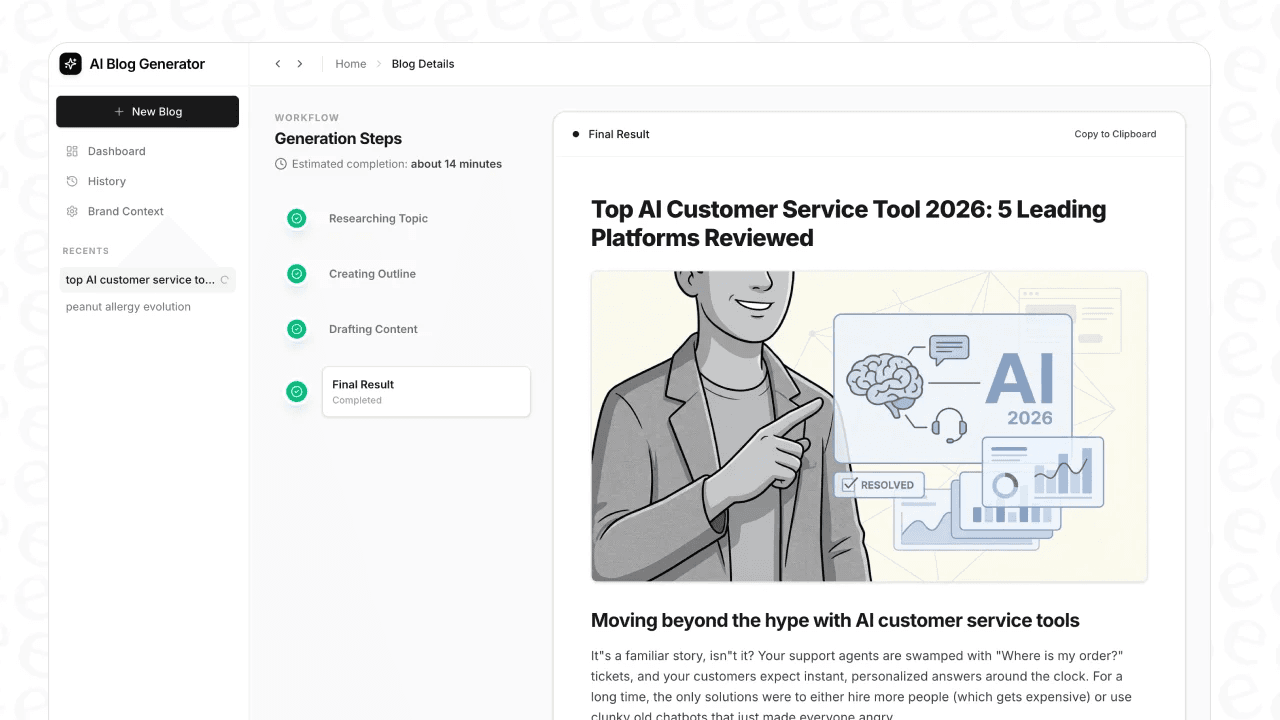
While most tools on this list help you find the perfect keyword, the eesel AI blog writer is designed to help you rank for it. You provide a single keyword, and it generates a complete, SEO-optimized blog post that’s ready to publish. Its context-aware research is a huge time-saver, automatically pulling in relevant data like pricing for comparison posts or technical specs for product reviews. It even optimizes the content for AI answer engines (AEO) right out of the box.
Our Experience: This tool is used by the team at eesel AI. For example, after publishing over 1,000 blogs with the tool, eesel AI was able to grow organic traffic in just three months.
Pros: Its primary benefit is its efficiency and completeness. You don't just get a wall of text; you get a fully structured article with AI-generated images, relevant YouTube videos, and even real Reddit quotes to add authenticity. This can save dozens of hours per post. Cons: It’s not a traditional research tool for discovering brand-new keywords from scratch. It is best used once you have a target keyword.
Pricing: The pricing is $99 for 50 blogs, and you can buy more credits when you need them. It is completely free to try, so you can see the quality of the articles for yourself.
2. Semrush
Semrush is a comprehensive marketing suite that has integrated AI into many areas of its platform. Their Semrush One platform brings together traditional SEO tools with AI search tracking and geo-targeting features, making it a capable tool for anyone managing both organic search and Google Ads campaigns.
Our Experience: A notable feature of Semrush is its personalized metrics. Its AI can analyze your website to calculate a Personal Keyword Difficulty (PKD%), which tells you which keywords you have a better-than-average chance of ranking for based on your site's authority. Their AI Visibility Toolkit is also useful for keeping tabs on how your brand is being mentioned in AI search results.
Keyword Magic Tool shows search intent. They have a cluster tool. The only thing it doesn’t do is prioritize keywords, but I would never trust any tool to do that. You can organize the data however you want to do that yourself.
Pros: The main advantage of Semrush is the breadth of its features. It offers a wide range of marketing tools in a single subscription. Cons: The price can be a significant investment, particularly for freelancers or smaller businesses, and some AI features may be locked behind higher-tier plans or sold as separate add-ons.
Pricing: The "Starter" plan for Semrush One starts at $165.17 per month if you pay annually.
3. Ahrefs
Ahrefs is a popular tool among SEO professionals, known for its massive backlink index and robust keyword data. They have added AI-powered tools like Brand Radar, which is designed to track your brand's mentions across various AI chatbots.
Our Experience: Ahrefs is known for its deep competitive intelligence. The Keywords Explorer uses AI to generate smart keyword suggestions and analyze search intent with impressive accuracy. It’s all powered by a database of over 28.7 billion keywords.
Ahrefs has intent 2 different ways. The classic INCT and a more intelligent look at it that's pretty specific. There's also 2 different grouping options. Parent topic which is a SERP clustering method and by terms which is an n-gram method.
Pros: Ahrefs delivers deep data, and their free Ahrefs Webmaster Tools is a valuable resource for website owners. Cons: Their credit-based system on paid plans can be a limitation. The 500 monthly credits you get on the Lite plan can be used up quickly, requiring the purchase of more credits to continue working.
Pricing: The "Lite" plan starts at $129 per month.
4. Surfer SEO
Surfer SEO is built to bridge the gap between keyword research and content writing. It gives you real-time optimization feedback directly in its Content Editor. The tool analyzes the top-ranking pages using natural language processing (NLP) and over 500 different web signals to create a data-driven roadmap for your article.
Our Experience: The workflow is a key feature. Instead of switching between a keyword list and a document, Surfer tells you which terms to include, how many times, and where, all while you're writing. Its AI Tracker also monitors your brand's visibility in AI chats like ChatGPT and Perplexity, which shows they're thinking about the future of search.
Pros: Its biggest advantage is convenience. It gamifies the optimization process with a "Content Score" that keeps you motivated. They also offer a free AI Humanizer tool to make AI-generated text sound more natural. Cons: Its keyword discovery features aren't as broad as what you'd find in dedicated tools like Ahrefs or Semrush.
Pricing: The "Essential" plan starts at $99 per month.
5. Moz Pro
Moz Pro is one of the original players in the SEO space, and they have enhanced their platform with AI. It’s especially good at giving you high-level insights into your site's topical authority and is the creator of the industry-standard Domain Authority (DA) metric.
Our Experience: Moz's AI can analyze your website to identify Domain Search Themes, which is useful for planning out content hubs and building authority. It’s also very user-friendly, making it a great starting point for anyone new to SEO. Plus, their educational resources, like The Beginner's Guide to SEO, are top-notch.
Pros: Moz makes complex SEO concepts easy to understand, and its AI-powered search intent analysis is solid. Cons: Its keyword and backlink databases are smaller than what you'll find with Semrush and Ahrefs, so you might miss out on some niche opportunities.
Pricing: The "Starter" plan is very accessible, beginning at $49 per month.
6. LowFruits
LowFruits is a specialized tool with a clear mission: find the "low-hanging fruit" keywords that larger, more complex tools might overlook. It takes a different approach to keyword difficulty by analyzing SERPs directly to find weaknesses you can exploit.
Our Experience: This unique approach can be effective. LowFruits scans the SERPs to find keywords where forums like Reddit or websites with low Domain Authority are ranking on the first page. That can be a signal that a well-written, optimized article can potentially claim a top spot. It’s a helpful tool for new websites trying to gain traction.
If you're on a budget, here are some great keyword research tools under $50/month: 1. Keysearch... 2. KWFinder... 3. LowFruits.io , Perfect for finding low-competition keywords.
Pros: It is effective at its primary function: finding easy-to-rank keywords quickly and affordably. It’s a brilliant way to build initial momentum for a site. Cons: It isn't an all-in-one SEO platform. You'll still need other tools for things like in-depth competitor analysis or tracking your backlink profile.
Pricing: The "Standard" plan starts at an affordable $29.90 per month, and they also offer pay-as-you-go credits.
How to choose the right AI tool for SEO keyword research
With many options available, the best tool for you depends on your specific needs and workflow. Here’s a quick guide to help you decide.
-
For the all-in-one strategist: If you need a single platform to manage everything from keywords and backlinks to PPC campaigns and market research, you might consider Semrush or Ahrefs.
-
For the content creator: If your primary job is to write and optimize articles, Surfer SEO can be a helpful tool. It keeps you focused and efficient by integrating optimization directly into your writing process.
-
For the budget-conscious beginner: If you're just starting out and need to find some achievable wins without a large budget, Moz Pro and LowFruits are both excellent and affordable entry points.
-
For turning keywords into publish-ready content: If your goal isn't just to find keywords but to quickly turn them into high-quality, fully-formatted, and SEO-optimized blog posts, then the eesel AI blog writer is a tool to complete your stack and get content live.
From research to results: Applying keyword insights
AI has made keyword research faster and more insightful. However, a list of keywords is only the first step. The ultimate goal is to create valuable, in-depth content that truly satisfies what people are looking for.
To see how these AI-driven strategies work in practice, the video below offers a practical hack for modern keyword research, showing how to move beyond traditional methods to find opportunities in the AI era.
Research is just the starting line; execution is what matters for results. You need to take those keywords and turn them into articles that people will love to read and share.
Beyond standard blog posts, repurposing keyword data into interactive assets with a web-based digital presentation maker lets you share cloud-based, multimedia lead magnets via direct links or site embeds while tracking reader engagement through built-in analytics.
Ready to turn your best keywords into content that ranks? You can Try the eesel AI blog writer and generate your first complete, SEO-optimized article.
Frequently asked questions
What are the main benefits of using AI tools for SEO keyword research compared to traditional methods?
They save a ton of time by automating data analysis. Instead of just giving you search volumes, they can group keywords into topic clusters, analyze search intent, and uncover related terms you might have missed, giving you a much clearer picture of what your audience is looking for.
Can AI tools for SEO keyword research help me understand search intent better?
Absolutely. This is one of their biggest strengths. AI algorithms analyze the top-ranking pages for a keyword to figure out *why* people are searching for it. They can tell you if users are looking to buy something, find information, or compare options, which helps you create content that actually meets their needs.
Are free AI tools for SEO keyword research good enough for beginners?
Some free tools can be a decent starting point to get your feet wet. However, they usually come with significant limitations on data and features. For serious content strategy, paid tools like the ones mentioned in this post offer more accurate data, deeper insights, and features that are well worth the investment.
How do AI tools for SEO keyword research help with Answer Engine Optimization (AEO)?
Many modern tools are now designed to help you rank in AI-powered search results, like Google's AI Overviews. They do this by identifying the specific questions people ask and helping you structure your content to provide direct, authoritative answers. Some can even track your brand's visibility within AI chat platforms.
Do I still need SEO knowledge if I use AI tools for SEO keyword research?
Yes, you do. These tools are incredibly powerful assistants, but they're not a replacement for strategy. You still need to understand foundational SEO principles to interpret the data correctly, make smart decisions about which keywords to target, and build a cohesive content plan. The tool provides the data; you provide the strategy.
Which AI tools for SEO keyword research are best for finding low-competition keywords?
For finding those "easy wins," a specialized tool like LowFruits is fantastic. It's built specifically to scan search results for weaknesses, like pages with low domain authority or forum discussions ranking high. This approach helps you find keywords you can realistically rank for, especially if your site is new.