SEO isn't dead, but it’s definitely not the same game it was a couple of years ago. We're not just trying to rank on Google's list of blue links anymore. Now, we're also fighting for a spot in AI-generated answers from tools like ChatGPT, Perplexity, and Google's own AI Overviews. This big change has unleashed a flood of AI SEO tools, all claiming they're the solution you need.
But how many of them actually work? I've been doing SEO for a long time, and many tools can be full of hype. To cut through the noise, I tested dozens of them, from massive all-in-one platforms to tiny, specialized optimizers. This isn't just another listicle. It's a real-world review of the 6 best AI SEO tools that can save you time and help you rank in this new world of search.
What are AI SEO tools?
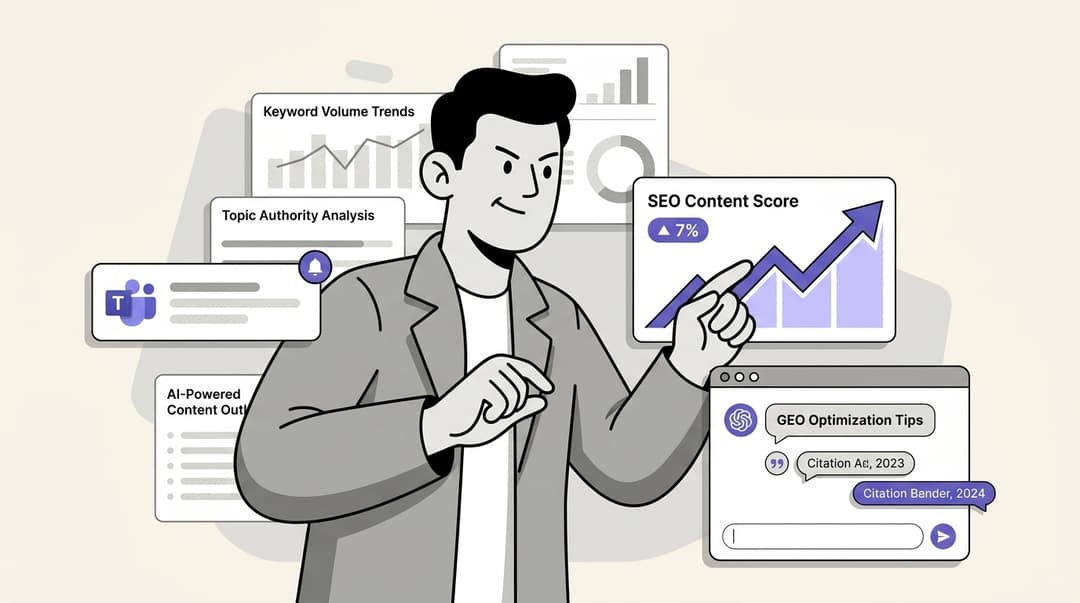
At their core, AI SEO tools are software that uses artificial intelligence to help with search engine optimization. But that's a pretty broad definition. It's not just about writing content anymore. Today's tools can help with tricky keyword research, cluster topics automatically, run technical site audits, and even track if your brand gets mentioned in AI-generated search results.
The biggest shift is this idea of Generative Engine Optimization (GEO). It’s all about optimizing your content so that Large Language Models (LLMs) like ChatGPT want to cite it. As the team at Frase points out, GEO is about creating content that has authority, is super clear, and is structured in a way that’s easy for LLMs to digest. These AI engines pull info straight from the web to answer questions, which means the old-school SEO fundamentals are more important than ever. The top AI SEO tools help you nail both, making sure you're visible to people on Google and useful to the AI.
How I chose the AI SEO tools for this list
I wanted this list to be genuinely useful, so I focused on tools that SEOs and content folks are actually using day-to-day. I avoided platforms that function primarily as simple content spinners. My criteria were pretty simple.
I’ve tested quite a few. The ones that actually made a difference weren’t the shiny “all-in-one SEO AI” platforms but the ones that fit neatly into existing workflows. Keyword clustering tools help surface opportunities we’d otherwise miss, and AI content optimizers are good at tightening drafts so they hit intent better.

-
Does it solve a real problem? I looked for tools that fit into an actual workflow and didn't just create more work.
-
Can it track AI visibility? A huge part of modern SEO is knowing if you're showing up in places like ChatGPT and Perplexity.
-
Is it easy to use? I didn't want anything that required a PhD to figure out.
-
Does it give actionable advice? The tool had to provide clear recommendations, not just a bunch of vague data.
With that in mind, I tested each tool myself to see if it was the real deal. Here are the ones that stood out.
A comparison of top AI SEO tools
Before we get into the details, here’s a quick look at the tools that made the cut. Each one has its own specialty, from creating entire blog posts to tracking your visibility in AI answers.
| Tool | Best For | Key AI Feature | Pricing Model |
|---|---|---|---|
| eesel AI blog writer | Generating complete, publish-ready blog posts from a single keyword | Automatic assets, social proof, and Answer Engine Optimization (AEO) | Subscription |
| Search Atlas | All-in-one SEO management with automated fixes | OTTO SEO, an AI assistant for deploying SEO changes | Subscription |
| Surfer SEO | On-page content optimization and SERP analysis | AI Tracker for monitoring brand visibility in AI answers | Subscription |
| Semrush | Comprehensive SEO and market research | AI Visibility Toolkit for tracking brand presence in AI answers | Subscription |
| Rankscale.ai | Granular AI search visibility tracking | Tracking across 10+ AI engines including ChatGPT, Perplexity, and Gemini | Subscription with credits |
| Frase | Content optimization for both SEO and GEO | Dual optimization engine for Google and AI search platforms | Subscription |
The 6 top AI SEO tools tested
Here’s a closer look at each tool, what it's good for, its best features, and who should consider using it.
1. eesel AI blog writer
Best for: Generating complete, publish-ready blog posts from a single keyword.
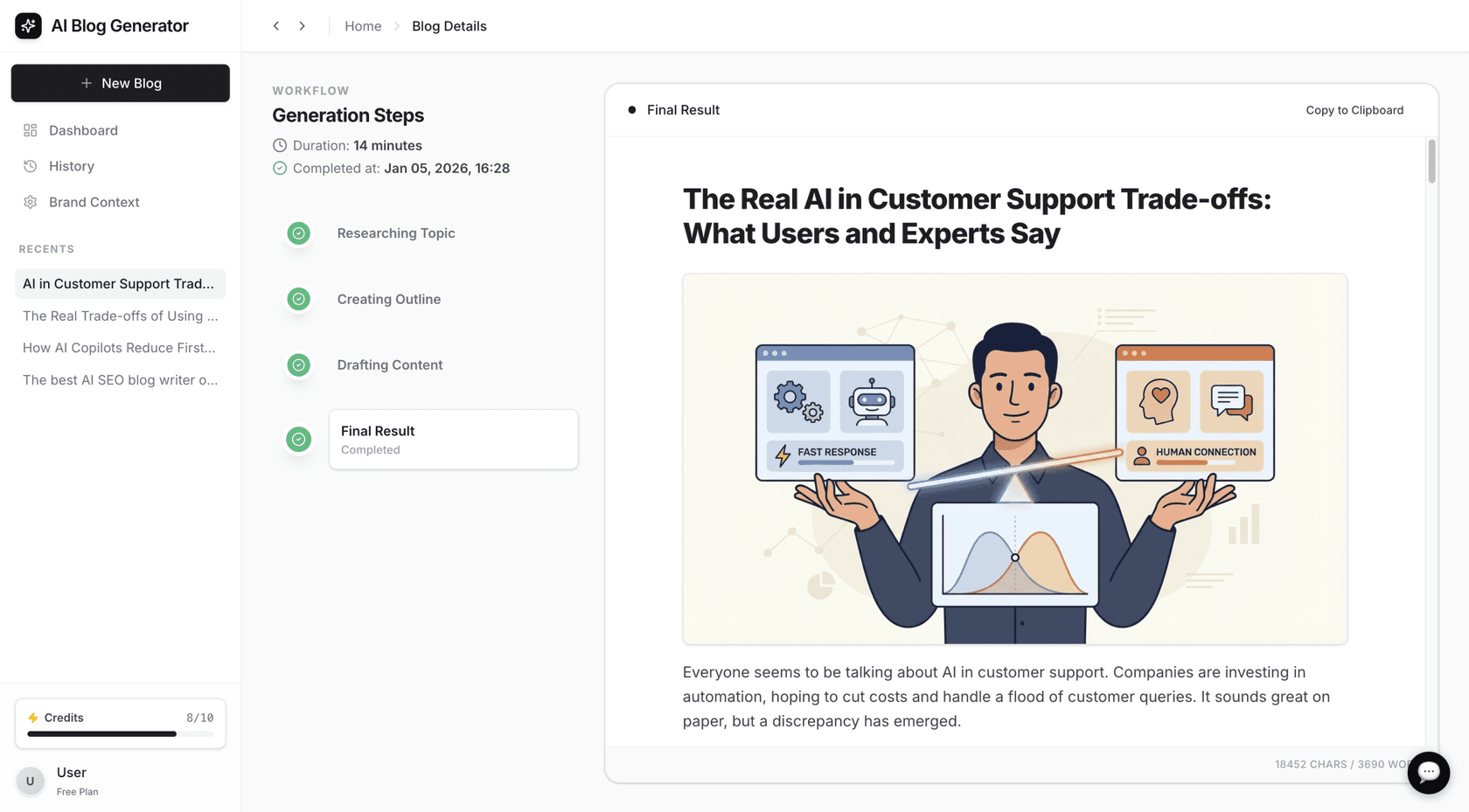
Many AI writers produce a rough draft that requires significant editing and research. The eesel AI blog writer is designed to address this. It takes a keyword and generates a comprehensive, SEO-optimized article that includes images and other media. This tool was developed for internal use and helped our blog grow from 700 to 750,000 impressions a day in just three months.
A key feature is its ability to perform context-aware research and generate assets automatically. The articles it creates come with AI-generated images, tables, and infographics. It also finds and embeds relevant YouTube videos and pulls real quotes from Reddit, which adds a layer of social proof. It's all designed around Answer Engine Optimization (AEO), making sure the content is structured for AI platforms like Google AI Overview and ChatGPT to find and use. It can also translate the final post into any language, letting you expand your reach instantly.
The main benefit is significant time savings. The tone is designed to be natural, based on extensive refinement to avoid common AI-generated content issues. As with any AI tool, a final human review is recommended to add a unique brand voice, though the tool aims to complete most of the work.
- The Early Bird plan is $99/month for 100 blog posts, and you can try it for free to see if you like the quality.
2. Search Atlas
Best for: All-in-one SEO management with automated fixes.
Search Atlas is a contender in the all-in-one SEO space, bundling keyword research, site audits, and content creation into one platform. If you're looking to consolidate tools, this could be a good option.
Its most interesting feature is OTTO SEO, an AI assistant that scans your site and gives you a to-do list of technical fixes and content tweaks. You can approve its suggestions, and OTTO will make the changes on your site for you, no CMS login required. It also has an LLM Visibility™ tool to track brand visibility in AI answers from ChatGPT, Gemini, and Perplexity. The platform also has its own metrics like Domain Power™ and Topical Dominance™ to give you a sense of your site's authority.
A major benefit of Search Atlas is its comprehensive feature set for the price, potentially replacing other subscriptions. On the flip side, because it does so much, it can take a little while to get the hang of everything.
- Pricing starts at $99/month for the Starter plan, and there's a 7-day free trial.
3. Surfer SEO
Best for: On-page content optimization and SERP analysis.
Surfer SEO has been a go-to tool for creating optimized content. Its Content Editor looks at the top-ranking pages for your keyword and gives you a live checklist of terms to include, what your word count should be, and how to structure your article.
Where Surfer is keeping up is with its AI Tracker. This feature keeps an eye on your brand's visibility in AI-generated results. It gives you a visibility score and tells you how often you're being mentioned. Surfer has also added an AI Content Detector and AI Humanizer to help make sure your content feels authentic. One catch is that some of the more powerful features, like the API, are only on Enterprise plans.
Surfer's main strength is its content editor. The downside is that to get the most out of its AI features, you'll likely need to be on a more expensive plan or buy add-ons.
- The Essential plan starts at $99/month (or $79/month if you pay for the year). For more details, check our Surfer SEO review or Surfer SEO pricing guide.
4. Semrush
Best for: Comprehensive SEO and competitive market research.
Semrush is a well-known platform with over 55 tools for everything from keyword research to ad campaigns. Semrush has been adding AI features, especially within its Semrush One plans.
Some of the key AI additions include the AI Visibility Toolkit, which tracks how you're doing in AI search results, and Semrush Copilot, an AI assistant with tips. For content planning, its Keyword Strategy Builder uses AI to suggest topic clusters. Semrush also recently started tracking AI search on Microsoft Copilot.
The best thing about Semrush is the incredible amount of data you get and the sheer number of tools at your disposal. The main drawback is the price. It's one of the more expensive options out there, and you'll need to subscribe to their higher-tier plans to get all the new AI features.
- The Semrush One Starter plan is $165.17/month (billed annually), which comes with the AI Visibility Toolkit.
5. Rankscale.ai
Best for: Specialized, granular tracking of AI search visibility.
While the big all-in-one platforms are adding AI tracking, Rankscale.ai is a tool built from the ground up just for Generative Engine Optimization (GEO). It lets you track your brand’s visibility across a long list of AI engines, including OpenAI ChatGPT, Perplexity AI, Google AI Overviews, Gemini, DeepSeek AI, Mistral AI, Anthropic Claude, xAI Grok, and Microsoft Copilot.
This tool solves a big headache with AI search: the results change all the time and are different for everyone. Rankscale.ai gives you a more stable, accurate view of how you're performing. It calculates an overall AI visibility score, shows you how you stack up against competitors, and even analyzes whether your brand is being mentioned in a positive or negative light.
Its strength is its laser focus on GEO tracking. The drawback is that it's a specialized tool, so you'll need something else for content creation. It also has no public API yet, but they say one is coming.
- Rankscale uses a subscription model with credits, and the Essentials plan starts at $20/month for 120 credits.
6. Frase
Best for: Content optimization for both traditional SEO and AI search engines (GEO).
Frase was one of the first tools to really lean into optimizing content for both Google and AI engines. Much like Surfer, it analyzes what's already ranking to give you data-driven advice, but its whole system is tuned for both SEO and GEO.
Frase helps you build out comprehensive, well-organized content that AI platforms tend to like. Its AI Search Tracking covers ChatGPT, Claude, Gemini, Perplexity, and Google AI. One cool feature is Content Opportunities, which sends daily alerts on rankings so you can update them before you lose traffic.
Its primary advantage is its dual-optimization focus. A potential downside is that its AI writer is good for creating outlines but isn't as powerful as dedicated generators when it comes to writing a full first draft.
- The Starter plan is $38/month when paid annually, and you can get a free trial. For a detailed breakdown, see our Frase AI pricing guide or explore Frase AI alternatives.
How to use AI SEO tools effectively
Using AI for SEO isn't about letting a robot take over your job; it's about making your job easier. Google has been pretty clear about this: using AI just to spam search results is against their rules, but using it to help you create great content is totally fine. The key is to treat AI as a smart assistant, not as a substitute for your own expertise.
AI works best when used for research, outlining, and speeding up drafts while the real ranking power still comes from expertise, strategy, and links.
Here are a few ground rules to follow:
-
Always start with search intent. Before you write anything, figure out why someone is searching for that keyword. Are they looking for information, a product comparison, or something to buy? AI tools are great at analyzing the search results to give you clues, but you still need to make the final call.
-
Make E-E-A-T your mantra. Google’s guidelines on Experience, Expertise, Authoritativeness, and Trust (E-E-A-T) are more critical than ever. An AI can't fake real-world experience. Let the AI handle the grunt work of research and drafting, but always add your own unique insights, case studies, and personal stories. That’s what makes content genuinely helpful.
-
Use AI for the boring stuff. AI is fantastic at summarizing articles, writing simple definitions, creating outlines, and drafting meta descriptions. Offloading these repetitive tasks frees you up to think about the bigger picture, like building your brand's authority and making sure your content actually solves a problem for the reader.
The future of AI in SEO
The SEO world is changing fast, and AI search is rewriting a lot of the rules. But the core idea is still the same: create helpful, authoritative content that answers someone's question better than anyone else. The tools on this list aren't going to do the work for you, but they can provide a significant advantage. They automate the tedious parts of SEO, the hours of research, the fear of the blank page, the endless tracking, so you can focus on what really matters: strategy, expertise, and creating content that both people and AI engines can trust.
To see how experts are evaluating today's top platforms, check out this tier list of AI SEO tools that breaks down which ones are delivering real results and which ones are just hype.
Instead of worrying about AI, the smartest SEOs are figuring out how to use it. The right tool can help you create better content in less time, find opportunities you might have missed, and stay visible in a world where answers are increasingly coming from algorithms.
For those focused on automating content creation, the eesel AI blog writer offers a solution designed for this purpose. A free trial is available to test its capabilities for scaling content production.
Looking for more SEO tool comparisons? Check out our reviews of Anyword and SEO.ai. You can also explore Anyword pricing, Anyword alternatives, and browse our list of AI SEO tools.
Explore more SEO resources: AI SEO software, AI SEO services, AI SEO content writer, AI SEO content generator, AI software for SEO, AI-driven SEO tools, AI-powered SEO tools, AI mode SEO tools, best AI mode SEO checking tools, AI tools for SEO free, free AI SEO tools, best free SEO AI tools, SEO monitoring, SEO tracking, types of SEO, SEO automation platform, automated SEO, and AI SEO optimization.
Frequently asked questions
What makes AI SEO tools different from traditional SEO software?
The biggest difference is how they use artificial intelligence to automate complex tasks. While traditional tools are great for data analysis, AI SEO tools can also generate content, automate technical fixes, and track your visibility in new places like ChatGPT and Google's AI Overviews, which is part of a new focus called Generative Engine Optimization (GEO).
Can AI SEO tools replace human SEO experts?
Not at all. Think of them as powerful assistants, not replacements. They are excellent for handling time-consuming tasks like research, drafting, and data analysis. However, they can't replicate the strategic thinking, creativity, and firsthand experience (a key part of Google's E-E-A-T guidelines) that a human expert brings to the table.
How much do AI SEO tools typically cost?
Prices can vary quite a bit. Some specialized tools, like Rankscale.ai, have plans starting around $20 per month. More comprehensive, all-in-one platforms like Semrush or Search Atlas usually start in the $100-$170 per month range. Many tools offer different tiers, free trials, or credit-based systems, so you can often find a plan that fits your budget.
Are AI SEO tools safe to use according to Google's guidelines?
Yes, as long as you use them correctly. Google's official stance is that using AI to create helpful, high-quality, people-first content is perfectly fine. Where you get into trouble is using AI purely to generate spammy content designed to manipulate search rankings. The key is to use AI to assist your content creation process, not to replace human oversight and quality control.
Which AI SEO tool is most effective for tracking visibility in AI search results like ChatGPT?
Several tools are now offering this feature. For the most detailed and specialized tracking across the widest range of AI engines (like ChatGPT, Perplexity, Gemini, and more), a dedicated tool like Rankscale.ai is your best bet. However, all-in-one platforms like Surfer SEO, Search Atlas, and Semrush have also integrated robust AI visibility tracking into their toolkits.
How can a small business choose an AI SEO tool on a limited budget?
Start by identifying your biggest SEO bottleneck. Is it content creation? Technical audits? Tracking new AI search engines? Instead of buying an expensive all-in-one suite, pick a more affordable, specialized tool that solves that one problem well. Take advantage of free trials, like those offered by the eesel AI blog writer or Search Atlas, to test the tools before committing. This lets you see the value firsthand without a big upfront investment.