The best free AI SEO tools to scale your traffic in 2026

Kenneth Pangan

Katelin Teen
Last edited January 7, 2026

SEO is evolving beyond traditional search rankings to include visibility in AI-powered answers from tools like ChatGPT, Perplexity, and Google's AI Overviews. This shift introduces new challenges for content creators and marketers. Free AI SEO tools can help by automating tasks, identifying new opportunities, and improving content creation speed and quality. This guide will walk you through free and free-to-try tools for every part of your SEO workflow, from creating articles to addressing technical issues.
What are free AI SEO tools?
AI SEO tools are software that use artificial intelligence to assist with search engine optimization tasks. This includes keyword research, topic brainstorming, and content writing and optimization. As SEO evolves toward "Answer Engine Optimization" (AEO), which focuses on visibility in AI-generated search results, AI tools are now required for creating high-performing content. To better illustrate this evolution, see the graphic below.
These tools can analyze large amounts of data, automate repetitive work like writing meta descriptions or grouping keywords, and generate outlines or full drafts. This allows users to focus more on strategy and creativity.
The best free AI SEO tools for content creation and optimization
Content is still the heart of SEO, but the standard for what's considered "good" is higher than ever. AI can help you research, write and polish content that both people and search algorithms will appreciate. Here are the top tools to get it done.
eesel AI blog writer
The eesel AI blog writer is designed as a comprehensive solution that handles the entire content creation process. You provide it with a keyword and your website URL, and it produces an SEO-optimized blog post.
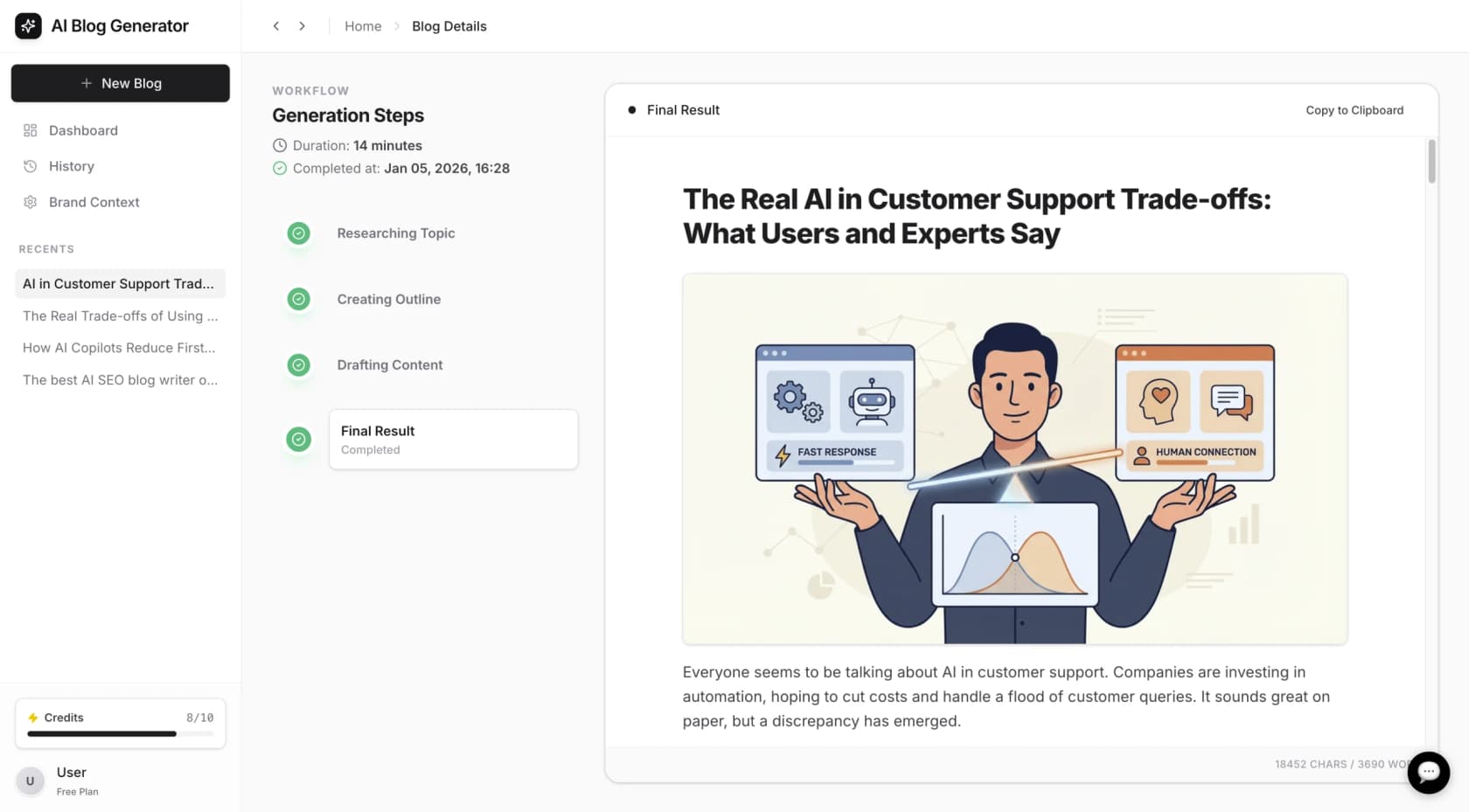
Here’s what it includes:
-
Automated assets: It creates and inserts AI-generated images, infographics, and tables directly into the post.
-
Social proof integration: The tool finds and embeds relevant Reddit quotes and YouTube videos to add real-world context.
-
Research-based content: It conducts research to create nuanced, human-sounding content.
-
Translation capabilities: A finished post can be translated into any language with a single click, which aids in reaching a global audience.
We used this tool to grow our own traffic from 700 to 750,000 impressions per day in three months. It’s free to try, so you can generate a full blog post to evaluate its quality.
Surfer SEO
Surfer SEO is a well-known name in content optimization. It works by analyzing the top-ranking pages for your target keyword and then giving you a data-driven checklist of what to do.
It’ll suggest keywords to add, an ideal word count, and how to structure your article to be competitive.Still one of the best for optimizing on page content. I usually run my drafts through Surfer to adjust structure, keyword use, and SERP relevance.

It does offer a couple of truly free tools, like an AI Content Detector and Humanizer, which can be useful for quick spot-checks.
The core features, such as the Content Editor and SERP Analyzer, are part of its paid subscription. There’s no free-forever plan for the main tools, and subscriptions start at $79/month (if billed annually). This makes it a choice for tweaking content you've already written, but it may not be suitable for creating new articles on a limited budget.
Clearscope
Clearscope is another premium content optimization tool that helps you improve your topic coverage. It assigns your content a letter grade and provides a list of relevant terms to include, all based on what's already ranking at the top of Google.
It's a very powerful platform for ensuring your content is thorough and covers a topic from every important angle, which helps signal your expertise to search engines.
Its biggest consideration is the price. Clearscope is designed for larger content teams and does not have a free plan for its main features. Its plans start at $129/month, making it a significant investment compared to other tools on this list.
Top free AI SEO tools for keyword research
Keyword research is the foundation of any solid SEO strategy. These AI-powered tools help you figure out what your audience is searching for, understand their intent, and find low-competition opportunities, all without opening your wallet.
Google's free suite
You can't talk about free SEO tools without bringing up Google's own lineup. They’re essential for any marketer.
-
Google Keyword Planner: Although it was built for paid ad campaigns, it’s still an incredible free tool for getting search volume estimates and discovering new keyword ideas.
-
Google Autocomplete: This gives you a real-time look at what people are actually typing into the search bar. It’s perfect for uncovering long-tail keywords you might have otherwise missed.
-
Google Trends: This is great for comparing the popularity of different keywords over time and spotting seasonal topics before they blow up.
The only real drawback is that these tools just provide raw data. It's on you to manually connect the dots and turn that information into a coherent content strategy.Google Search Console, Google Trends
AnswerThePublic
AnswerThePublic is great for digging into Google's autocomplete data at scale to find the exact questions your audience is asking.
You give it a keyword, and it visualizes all the related questions, prepositions, and comparisons people are searching for.
This is incredibly valuable for brainstorming H2s, building out FAQ sections, and creating content that directly addresses user needs.Other than Google Search console and Google Trends, I like 'answer the people' for keyword research. If you’re looking at technical SEO I like to use the chrome extension WooRank. I find it helpful.
The free version, however, is quite limited. You only get three free searches per day. After that, you'll need a paid subscription, which starts at around $13.33/month.
Keywordly
Keywordly is a handy tool that uses AI to group related keywords into topic clusters. This is a smart way to approach content creation, as it helps you build topical authority by writing a series of articles that cover a subject from all sides.
A unique feature is its ability to research keywords on platforms like Reddit and Quora, giving you a direct line into real user conversations.
Free access is credit-based. You get 20 credits to try it out before you have to upgrade to a plan starting at $14/month. This makes it a limited trial rather than a long-term free tool.
Must-have free AI SEO tools for technical site audits
You can have the best content in the world, but if your site has technical problems, search engines won't be able to crawl and index it correctly. These free tools help you find and fix the hidden issues that might be hurting your rankings.
Screaming Frog
Screaming Frog is the industry-standard desktop tool for conducting deep, detailed technical SEO audits. If you want to see your site the way a search engine does, this is the tool to use.
Its free version lets you crawl up to 500 URLs, which is usually plenty for small websites or for a quick health check on a larger one.
It can find all sorts of problems, like broken links (404s), redirect chains, duplicate content, and issues with page titles and meta descriptions.Screaming Frog is pretty good if your site is less than 500 pages.
The main downsides are that the user interface is quite complex and can be intimidating for newcomers, and the 500 URL cap can be a problem for larger sites.
AIOSEO
If you use WordPress, the All in One SEO (AIOSEO) plugin is a very user-friendly tool for running a quick SEO audit on any page.
Its SEO Audit Checklist feature even on the free plan. It creates a simple report that points out on-page SEO issues and gives you clear recommendations on how to fix them.
The free version gives you a great high-level overview, but more advanced features like a Redirection Manager or advanced schema markup are part of the paid plan starts at $49.50/year.
Indexly
Publishing great content is only half the battle; you also need search engines to find and index it before it can rank.
Indexly is a tool that helps automate submitting unindexed pages to search engines to speed up the process.
But the free plan has a major limitation. It only offers automated indexing for Yandex, the Russian search engine. Automatic submission to Google and Bing, which are the primary search engines for many users, is reserved for paid plans starting at $14/month.
How to choose the right free AI SEO tools
With so many options, how do you pick the right one? Here are a few things to keep in mind:
-
Start with your main goal. Are you trying to write a new blog post, optimize an old one, or fix a technical problem? Pick a tool that's designed for that specific task.
-
Read the fine print. "Free" often means limited searches, credits, or features. Pay close attention to daily limits or other restrictions to see if the free tier is actually viable for you long-term.
-
Consider the learning curve. Tools like Google Trends are simple to use, while something like Screaming Frog requires a bit more technical knowledge. Pick something you'll actually use.
-
Look for complete solutions. Using five different free tools to accomplish one task can be inefficient. An all-in-one generator may save time by handling an entire process from start to finish.
| Tool | Best For | Key Free Plan Limitation |
|---|---|---|
| eesel AI blog writer | Generating complete, publish-ready articles | Free to try (generates full articles) |
| Surfer SEO | Optimizing existing content | Core features are paid; free tools are limited |
| Google Suite | Foundational keyword and trend research | Requires manual analysis to build a strategy |
| AnswerThePublic | Finding user questions and content ideas | Limited to 3 searches per day |
| AIOSEO | On-page analysis and technical audits (WordPress) | Advanced features require paid plans |
| Indexly | Forcing content indexing | Free plan only submits to Yandex |
For those who prefer a video walkthrough, the following guide offers a great overview of some of the top free AI tools available for SEO and content creation, providing practical examples of how to use them.
Using free AI SEO tools to augment your strategy
There are many capable free AI SEO tools available for every part of the SEO workflow, from brainstorming to publishing and technical audits.
But remember that these tools are best used as assistants. They can automate tasks and provide valuable data, but they don't replace an SEO strategy or human expertise.
Your experience, brand voice, and customer understanding are what will ultimately help your content stand out.
If creating high-quality, SEO-optimized content is a primary goal, a comprehensive tool can be a useful starting point. You can generating a free blog post with the eesel AI blog writer to evaluate its output.

Frequently asked questions
The main catch with most free AI SEO tools is their limitations. You'll often run into daily usage caps, restricted features, or credit-based systems. For example, a tool might only let you perform three searches a day or analyze a limited number of URLs. The core, most powerful features are almost always reserved for paid subscribers.
Not at all. Think of free AI SEO tools as powerful assistants. They're fantastic for automating repetitive tasks like keyword clustering, generating content outlines, or [running technical checks](https://aioseo.com/seo-analyzer/). However, they can't replace the strategic thinking, creativity, and deep audience understanding that a human expert brings to the table.
You can use them across the entire content workflow. Start with tools like AnswerThePublic to find questions your audience is asking. Then, use a generator like the [eesel AI blog writer](https://blog-generator.eesel.ai/) to create a full, publish-ready draft complete with images and social proof. Finally, you can use a tool like AIOSEO's free checker to do a final on-page optimization pass.
The most important factor is how well the tool solves your specific problem. If your biggest bottleneck is writing content, an all-in-one generator is more valuable than a simple keyword tool. Also, consider the learning curve and the free plan's limitations. Choose a tool that you'll actually use and that provides enough value on its free tier to be useful for your workflow.
[Reputable free AI SEO tools](https://whatagraph.com/blog/articles/ai-seo-tools) from well-known companies are generally safe. Tools that crawl your site, like Screaming Frog or AIOSEO, are just reading your public-facing code, much like Google does. For content generators, the main "risk" is producing low-quality content, so it's important to choose a tool that creates well-researched, human-like articles.
Share this article

Article by
Kenneth Pangan
Writer and marketer for over ten years, Kenneth Pangan splits his time between history, politics, and art with plenty of interruptions from his dogs demanding attention.
