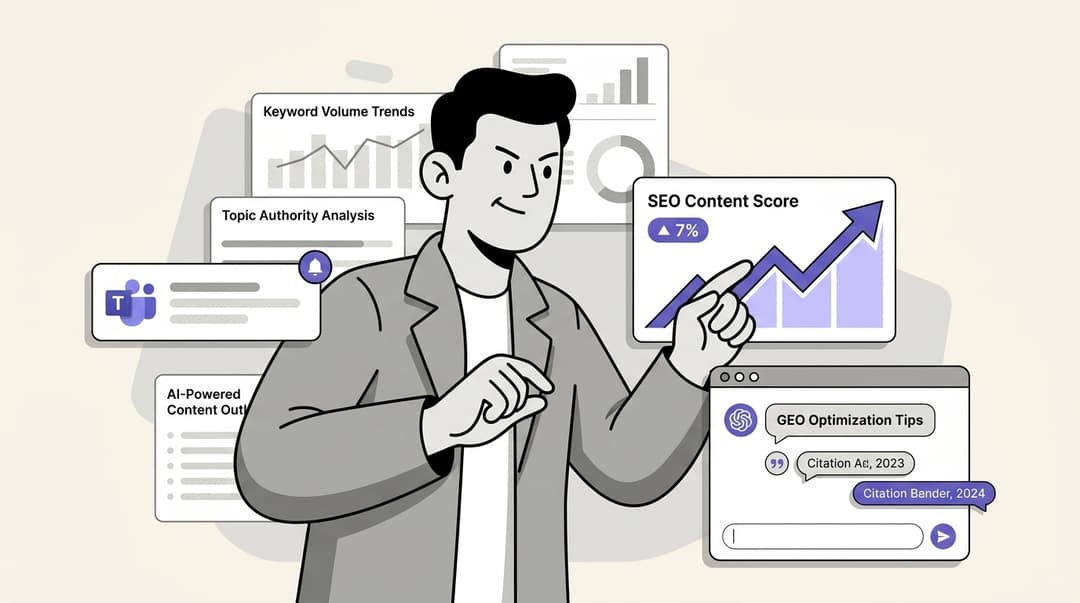

The SEO landscape has evolved. It is no longer just about ranking in Google's classic ten blue links. The focus has expanded to include appearing in AI Overviews, being cited in ChatGPT answers, and serving as a source for Perplexity. This new approach is often called Answer Engine Optimization (AEO) or Generative Engine Optimization (GEO).
This shift has led to a surge in "AI SEO tools," with many platforms promising to improve rankings. This makes it challenging for marketing teams to differentiate between tools and identify what is genuinely useful.
This guide will break down the main types of AI SEO tools, their functions, and their practical limitations. The goal is to help you find the right tool for your team's specific needs.
What are AI SEO alternatives?
"AI SEO tool" is a catch-all term for any software that uses artificial intelligence to help with search engine optimization. However, they are not all the same, and it’s important to understand the different types.
They generally fall into three buckets:
-
Content Generation & Optimization Platforms: These are tools designed to help write and polish content so it performs well in both traditional search results and new AI answers.
-
All-in-One SEO Suites: These are established platforms like Semrush or Ahrefs that have added AI features to their existing platforms to help with research, analysis, and tracking.
-
AI Visibility & GEO Trackers: These are newer, specialized tools that focus on monitoring a brand's presence in AI-generated search results.
Knowing which category a tool belongs to is the first step in deciding if it is the right fit. The focus is shifting from pure rankings to becoming a citable authority that AI engines trust and reference.
Category 1: Content generation platforms
This is one of the most populated categories of AI SEO tools. These platforms focus on helping users create content faster, whether that means generating an outline, writing a full draft, or scoring an article against the current top-ranking pages.
What they do well
These tools are effective for several tasks:
-
Speeding up the first draft: Tools like Jasper and Writesonic can produce blog posts and marketing copy quickly, helping teams overcome "blank page" paralysis.
-
On-page optimization guidance: Platforms like Surfer SEO and Clearscope analyze top-ranking pages for a given keyword. They provide real-time suggestions on keywords to add, questions to answer, and topics to cover to help you build more comprehensive content.
-
Content brief creation: Frase can quickly generate detailed content briefs. It pulls headings, questions, and stats from the top 20 search results, which can reduce research time.
Common limitations
While these tools are useful, they have some limitations to consider:
-
Over-optimized content: A common concern is that following suggestions too closely can lead to content that sounds robotic or keyword-stuffed. For example, some users feel Surfer SEO’s recommendations can push you toward using an unnatural number of keywords, which is contrary to Google’s push for helpful, human-first content.
-
Generic tone and heavy editing: AI-generated content can be fast, but the output often lacks a unique brand voice. Users may spend significant time editing the text to align with their brand and audience expectations.
Oh, don't get me wrong. I like AI generated content. I just don't think the 'SEO tools' that generate content do a very good job of it or are worth the added cost.
-
Complex pricing and costly add-ons: Pricing models can be complicated. For instance, Surfer SEO's AI articles are a key feature available on higher-tier plans, with the Scale plan starting at $175/month when billed annually. Clearscope is also a premium choice, starting at $129 per month for 20 content reports.

A focused alternative for content creation
A limitation with some platforms is that they may function as either a text generator or an optimization editor, requiring multiple steps to create a finished asset. Some tools, like the eesel AI Blog Writer, are designed to produce a complete blog post from a single keyword. This process can include research, outlining, writing, and generating assets like images, infographics, and relevant quotes.
Category 2: All-in-one suites
Next are the established platforms in the SEO industry, like Semrush and Ahrefs. They have been adding AI features to their toolkits to assist with deeper analysis, research, and tracking visibility in AI-powered search.
How they use AI
These platforms are integrating AI into their core offerings in several ways:
-
Unified SEO and AI visibility analysis: Semrush One now bundles its traditional SEO tools with an AI Visibility Toolkit. This allows users to track both classic keyword rankings and performance in AI answers from one dashboard.
-
Smarter keyword and content research: Ahrefs uses AI to generate more nuanced keyword ideas and better identify search intent, moving beyond simple phrase matching to understand the reasoning behind a search query.
-
Brand mention tracking in AI: Both platforms have introduced features to monitor how often a brand is mentioned in Google's AI Overviews and other large language models. Ahrefs' Brand Radar, for example, is an add-on that tracks mentions across Google AI Overviews, ChatGPT, Perplexity, and more.
Common limitations
These platforms are powerful, but that comes with certain considerations.
-
Complexity and cost: These tools can be comprehensive, which may translate to a steeper learning curve and a higher price tag. Ahrefs' Lite plan starts at $129/month, and Semrush One's Starter plan is $165.17/month (when billed annually). This may be more than required for teams primarily focused on content creation.
SEO content optimization tools are overrated and overpriced. Most are relatively the same as they were two years ago (excluding a UI update).
-
AI as an add-on: In some cases, AI features are offered as add-ons and are not included in the base price. Ahrefs' Brand Radar AI tracking, for example, starts at an additional $199/month.
-
Focused on analysis, not creation: These tools are primarily built for research and monitoring. They provide insights on what to write about but typically require a separate process to turn those insights into published content.
Considerations for focused tools
If the main goal is producing content at scale, a comprehensive suite may offer more features than necessary. For teams prioritizing a direct path from insight to publication, a tool that consolidates the research, writing, and optimization steps into one workflow can be more efficient. This approach allows users to generate a published article without requiring a separate subscription for analysis.
Category 3: GEO trackers
This is a newer and growing category of AI SEO tools. These tools are focused on tracking performance in AI-driven search.
What they do
Tools like SE Ranking’s AI Overviews Tracker and Surfer’s AI Tracker are designed to monitor how often a brand is mentioned or cited in AI-generated answers on platforms like Google, ChatGPT, and Perplexity.
Frase’s AI Search Tracking monitors visibility across ChatGPT, Claude, Gemini, and Perplexity, and provides metrics like share of voice and sentiment analysis. The purpose is to help measure the impact of Generative Engine Optimization (GEO) efforts.
Common limitations
While the data is useful, these tools have some practical limitations.
-
Reactive, not proactive: These tools are for monitoring. They report if you are being cited by an AI but do not assist in creating the type of content that gets cited.
-
Directional data: AI outputs can be variable. As some users have noted, trackers may use a fixed set of prompts, making the results more of a statistical estimate than a definitive fact.
-
Niche subscription: For teams looking to consolidate tools, adding another specialized subscription solely for tracking may be a consideration. Surfer's AI Tracker is a $95/month add-on, and Frase typically bundles its tracking into its more expensive plans.
Proactive content creation for AI
An alternative to tracking results after the fact is to create content designed for AI from the start. Tools built for Answer Engine Optimization (AEO) structure content with clear headings, concise answers, and factual data that language models can more easily understand and use as a source. This offers a proactive way to improve visibility in AI answers, as opposed to only measuring it.
A pricing comparison of AI SEO alternatives
Cost is a significant factor, so here’s a rundown of how some of the popular AI SEO tools compare, based on their entry-level plans with annual billing.
| Tool | Starting Price (Annually) | Key Focus |
|---|---|---|
| Surfer SEO | $79/month | On-page & AI search optimization |
| Semrush | $165.17/month | All-in-One SEO & AI Visibility Suite |
| Ahrefs | $129/month | All-in-One SEO (Backlinks & Competitor Research) |
| Clearscope | $129/month | Premium Content Optimization & Discoverability |
| Frase | $38/month | SEO + GEO Content Optimization & Briefs |
| SE Ranking | $52/month | All-in-One SEO & Rank Tracking |
| eesel AI | $4 per blog post | SEO/AEO Blog Generation |
For a deeper dive into how different AI SEO tools stack up and which ones might be worth your investment, the following video offers a helpful breakdown of some of the top contenders in 2026.
Choosing the right AI SEO alternative
The landscape of AI SEO tools is large and constantly changing. There is no single "best" tool, only the tool that best fits a team's workflow, budget, and objectives.
If the main job is deep technical analysis and competitor research, an all-in-one suite like Semrush or Ahrefs might be suitable. If the process revolves around polishing human-written drafts, a content optimization editor like Clearscope or Frase could be a good fit.
However, if the primary challenge is scaling the creation of high-quality, optimized blog content without managing multiple tools, a solution designed for that specific purpose may be more suitable.
Many tools in this space offer free trials to evaluate their capabilities. You can try the eesel AI Blog Writer to generate a fully-optimized post and see if it fits your workflow.
Frequently asked questions
What are the main types of AI SEO alternatives available?
They generally fall into three categories: content generation tools that help you write and optimize articles, all-in-one SEO suites like Semrush that have added AI features, and specialized trackers that monitor your visibility in AI-generated search results.
Are free AI SEO alternatives effective for content creation?
Some free tools can be useful for brainstorming or generating a rough first draft. For creating high-quality, fully optimized content, specialized tools often yield better results. Many paid tools offer free trials to allow users to test the quality.
How do I choose the right AI SEO alternatives for my business?
The best choice depends on your main goal. If you need deep data analysis, an all-in-one suite is great. If you want to improve human-written drafts, a content optimizer works well. If your goal is to scale content production from scratch, a dedicated AI blog writer is a more direct solution.
Can using AI SEO alternatives replace my entire SEO team?
Not really. These tools are designed to augment your team's efforts, not replace them. They speed up research and content creation, freeing up your human experts to focus on strategy, analysis, and creative oversight. Think of them as powerful assistants.
What is the biggest limitation of most AI SEO alternatives?
A common issue is that they often focus on just one part of the process. For example, analysis tools don't create content, and content generators often produce generic text that needs heavy editing. The challenge is finding a tool that handles the entire workflow from keyword to publish-ready article.
Do AI SEO alternatives help with Generative Engine Optimization (GEO)?
Yes, many of them do. Some tools are specifically designed to track your brand's visibility in AI answers (GEO trackers). Others, particularly content generators, are built to structure articles in a way that AI models can easily understand and cite, which is a proactive approach to GEO.