Anyword Review: Features, Pricing, and Use Cases

Kenneth Pangan

Katelin Teen
Last edited January 5, 2026

The world of AI content tools is growing. Many of them promise to generate articles in seconds, but marketers are beginning to ask a different question: "Is this content actually doing anything for my business?" Speed has limited value if the output is generic, disconnected from business goals, and isn't improving traffic or sales. This is the problem Anyword aims to solve. It positions itself as a performance platform that uses data from A/B tests to predict which copy will convert before it's published.
They are great when I have writers block or need different title ideas. For full articles... Nah.

In this review, we’ll examine what Anyword offers. We'll look at its main features, current pricing, and its capabilities. We’ll explore whether its data-first approach leads to better results and how it fits into a team's content marketing strategy.
What is Anyword?
Anyword is an AI copywriting platform designed for marketing and go-to-market (GTM) teams focused on measurable results. Unlike more general AI writers, its primary purpose is to create content that contributes to the bottom line. It's designed to help marketers write copy for ads, emails, landing pages, and social media to increase clicks, sign-ups, and sales. The company states it can achieve a 30% lift in business outcomes compared to standard AI models.
The platform's core feature is its proprietary Predictive Performance Score. Anyword says this score is based on analyzing millions of real-world marketing assets. This focus on ROI clarifies its target audience: performance marketers, demand generation teams, and ad agencies. With a large user base and adoption by some major enterprise GTM teams, it has established credibility in the market.
Key features
Anyword provides a set of features centered on optimizing copy for performance. These features are useful for short-form copy and also indicate the platform's scope for teams that need to produce complete, ready-to-publish blog posts.
Predictive performance scoring
The core of Anyword is its Predictive Performance Score. For every headline, call to action, or ad variation it creates, the platform provides a score that predicts how well it will perform. Anyword states its model has 82% accuracy in predicting which of two options will perform better, compared to the 52% accuracy it attributes to generic models like GPT-4o. This score can be a valuable tool for A/B testing ad copy or email subject lines, giving marketers a data-backed starting point, as shown in the visual below.
A high-performing headline is one component of a successful article, which also includes structure, visuals, and social proof. The score optimizes for a specific element, while modern content marketing involves optimizing the entire content package.
Copy intelligence and brand voice
AI-generated content can sometimes sound generic. Anyword addresses this with its Copy Intelligence Platform. It connects to your marketing channels (like Google Ads or Meta) to analyze past performance. It identifies your best-performing messages and styles to build a custom AI model for your brand.
The platform's Brand Voice feature allows you to maintain consistency in messaging, tone, target audiences, and brand rules. This helps ensure consistent text output. A comprehensive brand voice also includes data presentation, visuals, and expert sources. This text-based analysis differs from platforms like the eesel AI blog writer, which create complete, media-rich posts by including elements like custom infographics and relevant Reddit discussions.
Content and blog generation
Anyword has a "Blog Wizard" for creating long-form content. The process is structured, guiding users from a brief to an outline and then to a full draft. It includes tools like a built-in SEO score, a research panel to pull in facts, and a plagiarism checker. The ability to edit the outline before text generation offers a good level of control.
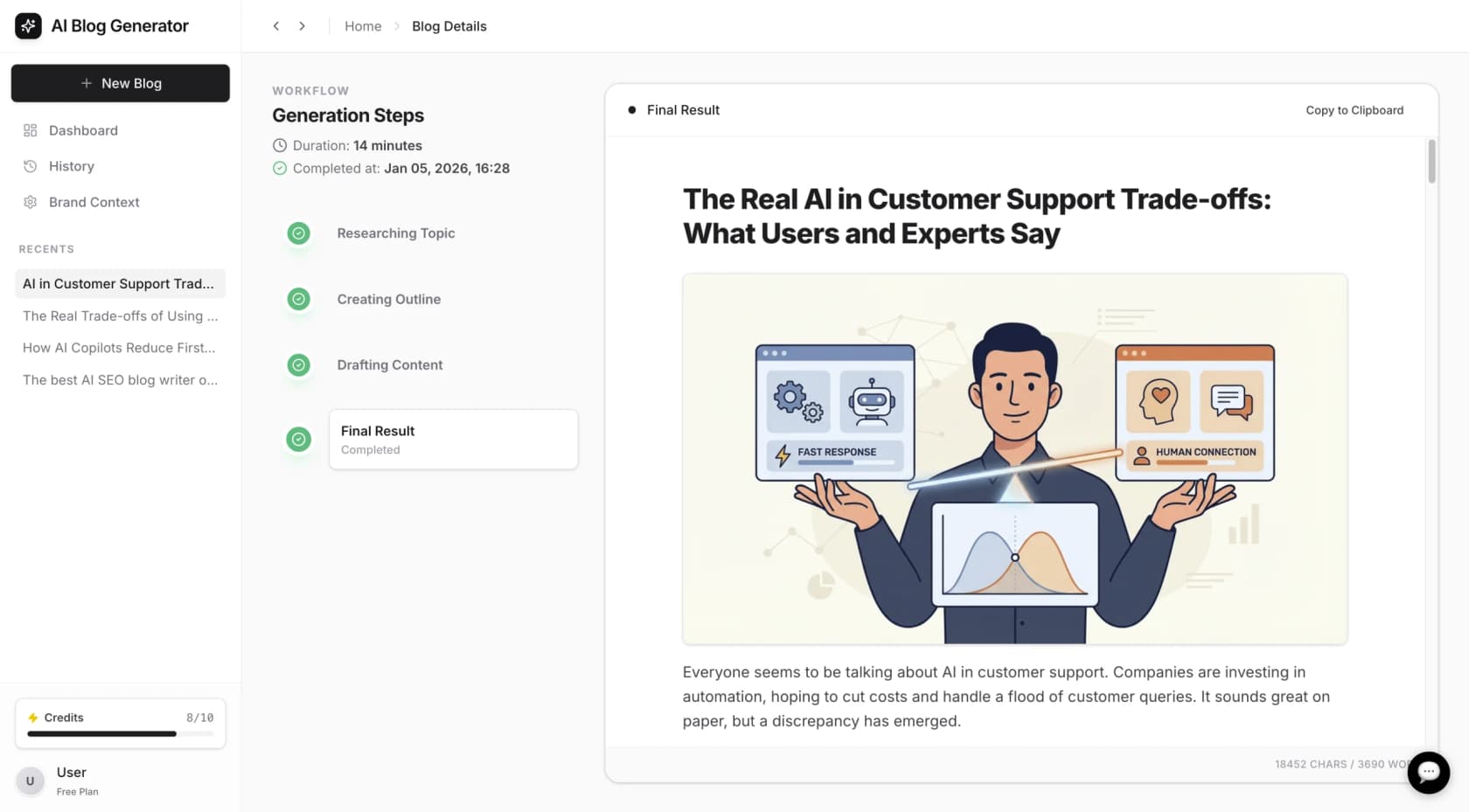
While the output provides a solid first draft, it typically requires further editing and asset creation before it is ready to publish. It can be a useful tool for overcoming writer's block, but users should expect to perform additional work. This workflow differs from tools designed to deliver a more finished product. For example, some tools generate articles that include text, media, and formatting, aiming to reduce post-generation work.
Anyword pricing plans
Anyword’s pricing is tiered, with performance-focused features like custom AI models and channel integrations available in the higher-tier plans. A 7-day free trial is available, but most marketing teams will need a paid plan for full functionality.
| Plan | Price (Monthly) | Key Features | Best For |
|---|---|---|---|
| Starter | $49/month | Unlimited copy generation, 1 brand voice, Blog Wizard, 50 performance predictions/month. | Solopreneurs or freelancers. |
| Data-Driven | $99/month | Includes 3 seats, real-time performance predictions, 100 performance predictions/month. | Small teams needing basic performance metrics. |
| Business | Custom | Adds Copy Intelligence (connects marketing channels), custom AI models, 5 brand voices. | Larger marketing teams and agencies. |
| Enterprise | Custom | Adds a private LLM option, full API access, enterprise-grade security, and a dedicated success manager. | Large organizations with complex security needs. |
Anyword’s advanced features, such as connecting marketing channels with Copy Intelligence to train the AI, are available only on the custom-priced Business plan. This can be a consideration for smaller teams. For comparison, other tools like the eesel AI blog writer offer different pricing models, such as a flat rate of $99 for 50 complete, SEO-optimized blog posts, making high-quality content generation more accessible for some users.
Limitations of the text-first approach
Anyword is a capable AI copywriting tool, and its focus on text is a key characteristic of the platform.
Draft generation capabilities
Even with a high performance score, the output from Anyword's Blog Wizard is a text document. After generation, the marketer's work continues. You still need to:
-
Find or create relevant images and infographics.
-
Format the post for readability and engagement.
-
Search for and embed relevant videos.
-
Find social proof like quotes or forum discussions to build credibility.
This process requires additional time and effort, which is a factor to consider when evaluating AI tools for efficiency.
Lack of integrated assets
A modern blog post often includes a mix of media, not just text. It may need visuals to break up content, videos for explanations, and social proof to build trust. An alternative approach is seen in tools like the eesel AI blog writer, which generates a full content package that can include:
-
AI-generated images and infographics.
-
Relevant YouTube video embeds.
-
Quotes from Reddit threads to add a human element.
This approach can save manual work and result in a more engaging final product from a single keyword.
A focus on SEO over AEO
In addition to traditional SEO, Answer Engine Optimization (AEO) has become important for visibility in platforms like Google’s AI Overviews and Perplexity. This means structuring content so AI can easily extract it for direct answers. Anyword's focus is on creative copy, which differs from tools like the eesel AI blog writer that are built with AEO in mind, automatically creating structured elements like FAQs designed to be picked up by answer engines.
Who should use Anyword?
Is Anyword a worthwhile investment? The answer depends on your specific goals.
Anyword is a strong choice for performance marketers, PPC managers, and email marketers whose primary role involves creating and testing high volumes of short-form, conversion-focused copy. For writing Facebook ad variations, Google headlines, or email subject lines, the Predictive Performance Score provides a clear, data-driven advantage that can save time and improve results.
Anyword may be less suitable for content marketing teams, SEO managers, and businesses that need to scale the production of complete, ready-to-publish blog posts. While its Blog Wizard can produce a first draft, it still requires users to handle asset sourcing, formatting, and media integration to compete in today's search landscape.
For a deeper dive into Anyword's features and user experience, you can watch a detailed video review. These visual walkthroughs often provide valuable insights into how the platform operates in real-world scenarios.
The future is more than words
Anyword effectively addresses a key challenge in AI content: connecting copy to performance. Its predictive scoring is a useful feature for conversion-focused tasks. A different approach in AI content marketing focuses on automating the creation of the entire content asset, from the text and SEO structure to images, videos, and social proof.
If you're looking for an AI tool to help write better ad copy, Anyword is a solid option. For teams whose goal is to generate a complete, SEO-optimized blog post from a single keyword, an alternative solution like the eesel AI blog writer might be a consideration.
Want to compare Anyword with other tools? Check out Anyword vs SEO.ai, explore Anyword alternatives, or see our detailed Anyword pricing breakdown.

Frequently asked questions
The main takeaway is that Anyword is well-suited for short-form, conversion-focused copy like ads and email subject lines, thanks to its Predictive Performance Score. It helps you test and optimize text before it goes live.
While Anyword has a "Blog Wizard," it primarily generates a text draft. You'll still need to manually source images, videos, and other media. For teams looking to scale complete, publish-ready articles, tools that generate complete articles may be more suitable.
A key characteristic of the tool is its text-first approach. Modern content marketing often requires a mix of text, visuals, and social proof to rank and engage readers. Anyword focuses on the text, leaving the other aspects of content creation to the marketer.
The most powerful features, like connecting your marketing channels with Copy Intelligence, are part of the custom-priced [Business and Enterprise plans](https://www.anyword.com/blog/ai-writing-without-limits-anywords-new-pricing). This may make the tool's full potential a significant investment for smaller teams on a budget.
Anyword's Predictive Performance Score analyzes your copy and gives it a score based on a model trained on [millions of real-world marketing assets](https://www.anyword.com/blog/you-assume-your-ai-gets-smarter-over-time-it-doesnt). It predicts how well your text will perform in terms of conversions, stating it has 82% accuracy in A/B test predictions.
The ideal user is a PPC manager, email marketer, or anyone on a [GTM team](https://www.contentellect.com/anyword-review/) who needs to generate and test high volumes of short-form copy for ads, landing pages, and social media.
Share this article

Article by
Kenneth Pangan
Writer and marketer for over ten years, Kenneth Pangan splits his time between history, politics, and art with plenty of interruptions from his dogs demanding attention.
