


The SEO world has completely changed. Not long ago, everyone was fighting for the top spot in Google's ten blue links. Now, with AI Overviews and ChatGPT dishing out direct answers, the game is different. The new "top rank" isn't a position, it's getting your brand mentioned or cited as a source in an AI-generated response.
This has kicked off a wave of new software called "AI mode SEO checking tools." But like any trend, it's hard to tell what's genuinely useful and what's just hype.
I spent the last few months testing the most popular options to see what actually delivers. This is a straightforward review of the five best tools I found. We'll cover how to track your brand mentions, but we'll also get into how to create content that AI engines are more likely to cite. That's where a tool like the eesel AI blog writer comes in, helping you build a solid foundation for your AI search strategy from the start.I’ve tried a few and honestly, most of them feel like rebranded SERP parsers with AI slapped on.

What are AI mode SEO checking tools?
What's different about these "AI mode" checkers compared to the Ahrefs or Moz you're used to?
Traditional SEO tools track your rank on a search results page. You put in a keyword, and it tells you if you're #3 or #53. These new tools, often called Generative Engine Optimization (GEO) or Answer Engine Optimization (AEO) tools, do something else. They watch how your brand shows up inside AI-generated answers on platforms like Google AI Overviews, ChatGPT, and Perplexity.
They don't just track a position number. They focus on new metrics like mentions, citations, sentiment, and share of voice. The following graphic breaks down the key differences between these two approaches.
The main idea is to stop chasing clicks and start becoming a trusted authority that AI models rely on. It’s about building a reputation, not just a ranking.
My criteria for selecting the best tools
To cut through the hype, I set up some ground rules. To make it onto this list, a tool had to deliver real, usable value. I judged them based on four main things:
-
Comprehensive platform coverage: It’s not just about Google. A great tool has to track your visibility across the major AI players, including Google AI Overviews, ChatGPT, and Perplexity.
-
Actionable insights: Data is useless without context. The best tools don't just show you a number; they help you understand why you were mentioned (or why your competitor was) and suggest what to do next, like pointing out content gaps.
-
Accuracy and transparency: The data needs to be reliable. I looked for tools that provide consistent tracking and, ideally, show you a snapshot of the AI answer they analyzed so you can verify the context yourself.
-
Ease of use and reporting: Nobody has time for a clunky interface. The platform needs to be intuitive, and it should be easy to pull reports to show your team or clients the progress you’re making.
A comparison of top AI mode SEO checking tools in 2026
Here’s a quick rundown of the tools that made the cut, so you can see how they stack up at a glance.
| Tool | Best For | Standout Feature | Pricing (Starts From) |
|---|---|---|---|
| eesel AI blog writer | Proactively creating AEO-optimized content that gets cited | Generates publish-ready blogs with automatic assets & social proof | Free to try, then $99 for 50 blogs |
| SE Ranking | All-in-one traditional SEO and AI visibility tracking | Integrated AI Search Toolkit within a full SEO platform | $95.20/month (Pro plan, annual) |
| Peec AI | Startups and SMBs needing an accessible starting point | Simple UI focused on Visibility, Position, and Sentiment metrics | €89/month |
| Semrush | Teams already in the Semrush ecosystem needing strategy | "AI Strategic Opportunities" framework for an action plan | $99/month add-on or from $165.17/mo with Semrush One |
| Otterly.AI | Affordability and automating prompt discovery | Converts SEO keywords into trackable prompts; includes GEO audit | $29/month |
The 5 best AI mode SEO checking tools in 2026
Alright, let's get into the details. Here’s my hands-on take on each tool, who it’s for, and what it does best.
1. eesel AI blog writer: Building a content foundation
Okay, this one is a bit different. The eesel AI blog writer isn't a "checking" tool in the usual sense. It's a foundational content creation tool that addresses a key first step. You have to create the kind of content that AI wants to cite in the first place.
The eesel AI blog writer takes a single keyword and turns it into a complete, AEO-optimized blog post that AI models see as a trustworthy source. It is designed to generate a complete, AEO-optimized blog post with features tailored for AI consumption.
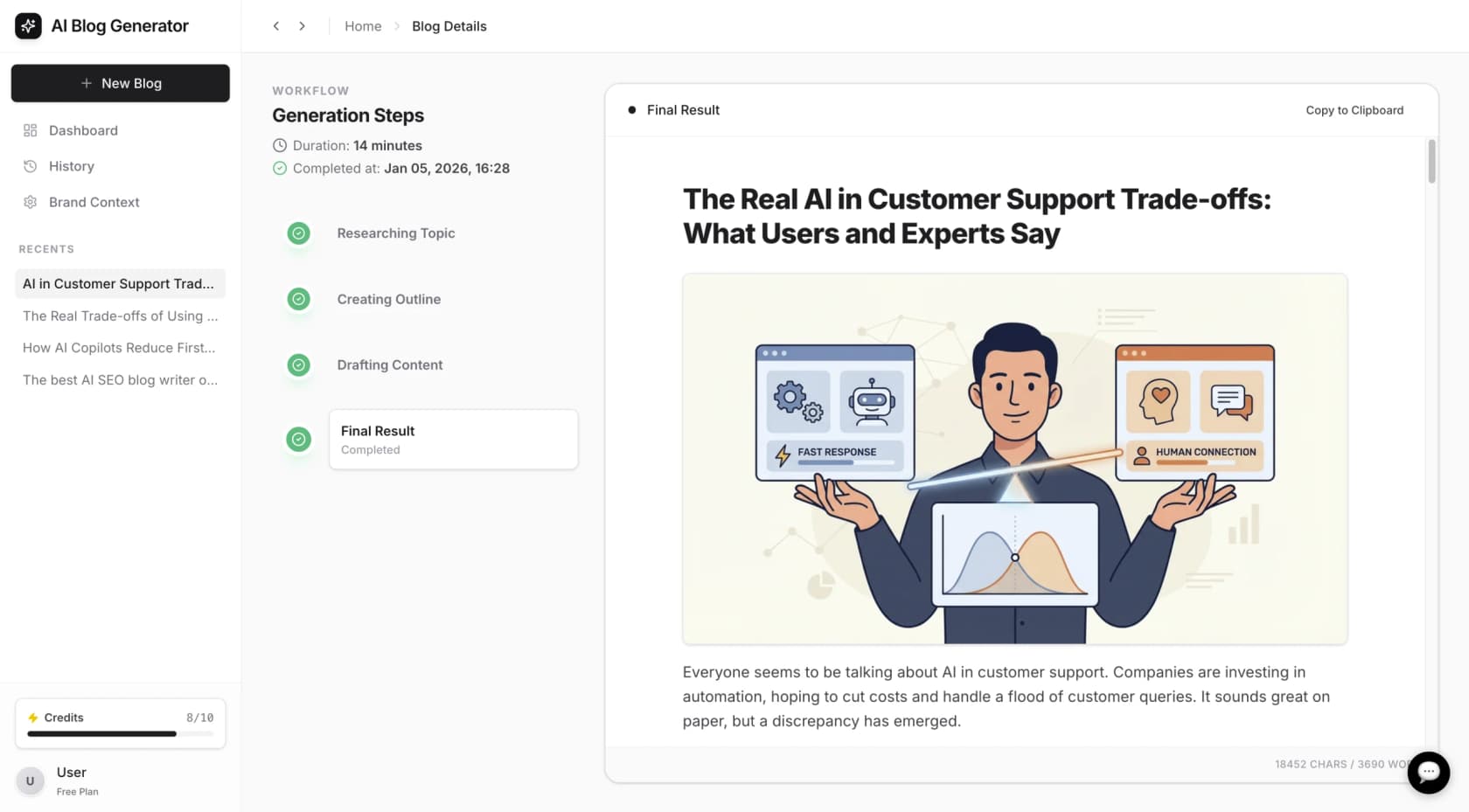
Here’s what makes it so effective for AEO:
-
Automatic Assets: It doesn't just write text. It generates AI images, infographics, and tables to create rich, comprehensive content that answers a topic from multiple angles.
-
Authentic Social Proof: It pulls in real, relevant quotes from Reddit and embeds YouTube videos. This adds a layer of human experience and authority that AI models are designed to value.
-
Deep Research: The content isn't shallow. It's researched to satisfy both traditional search engines and Large Language Models (LLMs) like those powering ChatGPT and Perplexity.
This is the exact tool we used to grow our own daily impressions to 750,000 in just three months. It's about being proactive, not just reactive.
-
Pros: Proactively builds the high-quality content that actually gets you cited and mentioned, saving a massive amount of time.
-
Cons: It's a content creation platform, not a monitoring dashboard. For the best results, you'll want to pair it with one of the other tracking tools on this list.
-
Pricing: It's completely free to try, so you can see the quality for yourself. Paid plans start at $99 for 50 blog generations.
2. SE Ranking: An all-in-one solution
For teams that want to keep everything under one roof, SE Ranking’s AI Search Toolkit is a solid option. It neatly integrates AI visibility tracking into their already robust traditional SEO platform, which can simplify your workflow.
SE Ranking covers the big players, tracking your presence across Google AI Overviews, AI Mode, ChatGPT, Gemini, and Perplexity.
SE Ranking is probably the most well-rounded AI SEO checking tool I’ve used so far. It doesn’t just track if you’re mentioned in AI Overviews, but also breaks down how often, in what format (inline vs block), and what type of content Google is pulling. Super useful if you're trying to figure out how to optimize content for LLM visibility.
Its key features include:
-
Daily tracking of brand mentions and source citations.
-
An analysis that shows you the overlap between your organic rankings and your AI mentions, which is super helpful for strategy.
-
A clean view of how you stack up against your competitors in AI search.
-
Pros: Having all your SEO and AEO data in one place is a major time-saver. The integration is seamless and makes reporting much easier.
-
Cons: The AI platform coverage isn't quite as extensive as some of the hyper-focused tools, and you'll need to be on their higher-tier plans to get all the features.
-
Pricing: The Pro plan, which gives you access to the AI Search Toolkit, starts at $95.20 per month if you pay annually.
3. Peec AI: An accessible and intuitive option
If you're an SMB or just dipping your toes into AEO, Peec AI is a suitable starting point. Its biggest strength is its simplicity. The interface is clean, uncluttered, and focuses on the metrics that matter most without overwhelming you.
On their starter plan, Peec AI tracks ChatGPT, Perplexity, and Google's AIO. If you need more, their enterprise plan adds models like Gemini and Claude.
Here’s what I liked:
-
It boils everything down to three core metrics: Visibility, Position, and Sentiment. It's easy to see at a glance how you're doing.
-
The "citation gap" feature is useful. It shows you which third-party sites are getting cited for your target topics when you aren't, giving you a clear roadmap for content creation.
-
For agencies, the "Pitch Workspaces" feature is a helpful addition, letting you share AI visibility reports with potential clients.
-
Pros: It makes AEO monitoring incredibly easy to understand and act on, all at a reasonable price point.
-
Cons: It doesn't have some of the deep strategic planning features you'll find in enterprise-level tools, and the number of prompts you can track is tied to your plan.
-
Pricing: The Starter plan begins at €89 per month and includes tracking for 25 prompts.
4. Semrush: Integrated strategy for existing users
For teams already living and breathing in the Semrush ecosystem, their AI Visibility Toolkit is a logical choice. What makes it stand out is how it frames the data. Instead of just giving you numbers, it organizes insights into actionable "AI Strategic Opportunities," basically telling you what to do next.
It monitors your brand across ChatGPT, Google AI, Gemini, and Microsoft Copilot.
Key features include:
-
An "AI Visibility Score" and brand sentiment analysis give you a high-level view of your performance.
-
The prompt research feature provides data on AI volume and intent, helping you find new topics to target.
-
It includes an "AI Search Site Audit" that flags technical issues on your site that might be preventing AI crawlers from accessing your content.
-
Pros: The strategic framework is excellent for helping teams prioritize their AEO efforts. The integration for existing Semrush users is seamless.
-
Cons: As of now, it doesn't track Perplexity, which is a bit of a gap compared to some of its competitors.
-
Pricing: It’s available as a $99 per month add-on to an existing subscription, or it's included in their Semrush One plans, which start from $165.17/month (billed annually).
5. Otterly.AI: An affordable automation tool
Otterly.AI is a suitable pick for freelancers, solo-preneurs, and small teams who need an affordable and efficient way to get started. Its smart automation features save a lot of time during the initial setup.
It boasts wide coverage, including Google AI Overviews, ChatGPT, Perplexity, Gemini, Copilot, and AI Mode.
Here are its standout features:
-
It can automatically take a list of your target SEO keywords and convert them into relevant, conversational prompts to track. This saves a ton of manual work.
-
It includes a GEO audit feature that analyzes your content against key on-page factors and suggests specific improvements to make it more AEO-friendly.
-
Pros: It’s one of the most affordable and straightforward ways to start tracking AI visibility, and its automation features are a huge help.
-
Cons: It doesn't have the deep trend analysis or advanced competitor intelligence that you'll find in the more expensive, enterprise-focused tools.
-
Pricing: The Lite plan is very accessible, starting at just $29 per month.
How to choose the right tool
So, which one is right for you? It really boils down to your team's needs and budget.
-
If you're an agency or a data-heavy team already using Semrush: Sticking with Semrush makes the most sense. The integrated workflow and strategic guidance are perfectly tailored for you.
-
If you want a single platform for both traditional SEO and AEO: SE Ranking is a strong choice. It offers a powerful, blended toolkit that makes analysis and reporting a breeze.
-
If you're a small business or just getting started with AEO: You need something affordable and easy to use. Peec AI and Otterly.AI are both excellent, user-friendly starting points.
-
If your main goal is to actually create the content that gets cited: Then you need to start with the content itself. The eesel AI blog writer is designed to proactively build that foundation of high-quality, AEO-optimized content, making it an essential part of any serious AI search strategy.
Choosing the right tool is the first step, but understanding the underlying strategy is what will truly set you apart. To get a deeper dive into the practical steps of optimizing for AI search, check out this video. It breaks down how to create content that not only ranks but also becomes a trusted source for AI engines like ChatGPT.
Beyond checking: A proactive content strategy
Here’s the bottom line: tracking your AI visibility is important, but it's only one piece of the puzzle. The data you get from these tools is a roadmap, not the engine that will drive you forward.
The brands that succeed in this new era are the ones that actively shape their own presence. They're the ones consistently publishing authoritative, helpful, and deeply researched content that is specifically designed for AI consumption.
Reactive monitoring shows you where you stand. A proactive content strategy ensures you're always leading the conversation.
This is exactly why a tool like the eesel AI blog writer can be effective. It helps you put points on the board by scaling the creation of media-rich articles that AI models are built to find, trust, and reward with citations.
Ready to stop just tracking and start creating? Generate your first blog post for free with eesel AI and see for yourself what a difference a proactive content strategy can make.
Frequently asked questions
What features should I look for in the best ai mode seo checking tools?
Look for tools that cover major AI platforms like Google AI Overviews, ChatGPT, and Perplexity. Key features include tracking brand mentions, source citations, sentiment analysis, and competitor comparisons. Actionable insights that suggest content gaps are also incredibly valuable.
How much do the best ai mode seo checking tools typically cost?
Pricing varies a lot. Some tools, like Otterly.AI, start around $29/month, making them accessible for small businesses. More comprehensive platforms like SE Ranking or add-ons for Semrush can range from about $90 to over $160 per month, often bundled with other SEO features.
Can the best ai mode seo checking tools guarantee my brand will be mentioned by AI?
No, these tools are for monitoring and analysis, not direct influence. They show you where you stand and what opportunities exist. To get mentioned, you need to create high-quality, authoritative content that AI models find trustworthy. That's why pairing a checking tool with a content creator like the eesel AI blog writer is so effective.
How often should I use the best ai mode seo checking tools to monitor my brand?
For active campaigns or in competitive industries, checking your visibility weekly is a good practice. Many tools offer daily tracking, which can be useful for spotting trends or the impact of new content quickly. For general monitoring, checking in a couple of times a month should be sufficient.
Why is it important to use the best ai mode seo checking tools alongside a content creation strategy?
These tools provide the "what" and "where"-what topics are getting AI attention and where your competitors are showing up. A content creation strategy provides the "how." You use the data from the tools to inform a proactive plan for creating articles, like those from the eesel AI blog writer, that are designed to be cited by AI engines. One without the other is an incomplete strategy.
Are there any free options among the best ai mode seo checking tools?
While most dedicated monitoring platforms are paid, some offer limited free trials or free-tier plans that let you track a small number of prompts. For content creation, which is the first step to getting cited, the eesel AI blog writer is completely free to try.