

Let's be honest, ranking on Google is a different beast these days. With AI-powered search becoming the norm and algorithms that seem to shift constantly, having the right SEO tools isn't just a nice-to-have, it's a must. These platforms provide the data you need to understand what your market is searching for, see what your competitors are doing, and create content that actually resonates.
But when you start looking around, the number of options can be dizzying. You have huge all-in-one suites, specialized content tools, and a handful of free basics. This guide will walk you through the main types of SEO tools, help you decide which ones fit your needs, and show you how to build a modern tech stack that delivers results.
What are seo tools and how do they work?
Simply put, an SEO tool is any software that helps you improve your visibility in search engines like Google and Bing. They can do everything from analyzing competitor strategies and finding keywords to checking your site for technical issues and helping you refine your content. By gathering and interpreting a massive amount of data from across the web, they give you clear steps to improve your rankings and bring in more organic traffic. The diagram below illustrates how these core functions work together.
To make sense of all the choices, it helps to group them into a few categories:
-
All-in-One Suites: Think of these as the Swiss Army knives of SEO. They aim to cover all the bases: keyword research, rank tracking, competitor analysis, and site audits. Increasingly, they're also adding features to track your visibility in AI search results.
-
Content Optimization & Creation Tools: These tools are focused on helping you write and polish content that aligns with search intent. Some of the newer ones can even generate the content for you.
-
Technical SEO Tools: This category includes crawlers and analytics platforms that help you identify and fix technical problems like broken links, slow page speeds, and indexing errors.
-
Foundational First-Party Tools: These are typically free tools offered by the search engines themselves. They provide the most accurate data on your own site’s performance and are an essential part of any toolkit.
Understanding these categories makes it much easier to assemble an SEO workflow that works for you.
All-in-one platforms for deep competitor and market analysis
All-in-one platforms often serve as the command center for SEO campaigns. They offer a wide array of features that let you manage almost everything, from initial research to long-term performance tracking, all in one dashboard. They're incredibly powerful, but they usually come with a significant price tag and a bit of a learning curve. Still, for digging into competitor strategies and understanding the market, they are hard to beat.
yeah solid breakdown. tbh the deciding factor for me is team workflow and content ops. If you’re running PPC or need social scheduling, SEMrush makes sense. If you’re doing heavy link building and SERP gap hunting, Ahrefs feels faster and cleaner. One thing I’ve done on smaller budgets is pair Ahrefs with a content engine like Supawrite for the blog lift. Ahrefs finds the gaps and Supawrite cranks out researched, on-brand posts with WordPress push for like 10 bucks a post, so you still cover keyword targeting without paying for SEMrush’s full content suite. If you’ve got a lean team, that combo is pretty efficient.

Semrush: A focus on AI search visibility
Semrush is a massive platform, used by over 35% of Fortune 500 companies, and for good reason. It's known for its huge database of 27 billion keywords. Recently, they've invested heavily in their AI Visibility Toolkit, which helps you see how your brand is performing in new AI-driven search platforms like ChatGPT and Google's AI Overviews.
-
Pros: It has a feature for nearly every SEO task imaginable, a growing focus on AI search visibility, and excellent free learning resources like the Semrush Academy.
-
Cons: The cost can be a hurdle for smaller businesses, and the sheer number of features can feel overwhelming when you're just getting started.
| Plan | Price (Monthly, Billed Annually) | Key Features |
|---|---|---|
| Starter | $165.17 | 5 websites, 500 keywords tracked, AI Visibility Toolkit. |
| Pro+ | $248.17 | 15 websites, 1,500 keywords tracked, historical data, content optimization. |
| Advanced | $455.67 | 40 websites, 5,000 keywords tracked, API access, share of voice. |
Ahrefs: Specializing in backlink analysis
Ahrefs is the other major player in the space, known for its comprehensive backlink index, with over 35 trillion live backlinks. According to Cloudflare, it operates the #1 most active SEO crawler on the web, second only to Google's own bot. Its main strength lies in competitor research and finding link-building opportunities. Features like its Content Gap tool are invaluable for strategic planning.
-
Pros: The backlink data is among the most comprehensive you'll find. The user interface is clean and intuitive, and they've integrated some useful AI features for understanding search intent.
-
Cons: The pricing is a serious commitment. Their $29/month Starter plan is quite limited, with the next tier jumping to $129. Also, remember that their traffic metrics are estimates from third-party data, so they may not perfectly match your own analytics.
| Plan | Price (Monthly) | Key Features |
|---|---|---|
| Lite | $129 | 5 projects, 750 tracked keywords, 100,000 crawl credits. |
| Standard | $249 | 20 projects, 2,000 tracked keywords, 2 years of historical data. |
| Advanced | $449 | 50 projects, 5,000 tracked keywords, 5 years of historical data. |
Key considerations for all-in-one platforms
While these platforms are powerful, they aren't flawless. The biggest barrier for many is the cost, which can be difficult for smaller teams or freelancers to justify. Additionally, because they rely on third-party data, you should always view their traffic and ranking figures as educated estimates rather than absolute facts. It's always wise to cross-reference their numbers with your own first-party data from a tool like Google Search Console.
Content optimization vs. content creation: A modern comparison
In today's SEO landscape, simply stuffing keywords onto a page doesn't work. Search engines have gotten much better at rewarding content that is genuinely helpful, thorough, and provides a good user experience. This has led to a new generation of tools built not just to find keywords, but to help you create excellent content that satisfies searcher intent. This distinction between optimizing and creating is key, as shown in the comparison below:
Surfer and Clearscope: Tools for optimizing written content
Tools like Surfer and Clearscope are staples for many content teams. They operate by analyzing the top-ranking pages for a target keyword and providing a data-driven brief. This typically includes a list of related terms to include, a recommended word count, and a readability target. As you write in their editor, you get a live "content score" that grades your draft against the competition.
-
Key Features: They excel at SERP analysis, provide a useful content score, and integrate with Google Docs and WordPress. Surfer's Scale plan includes an "AI Tracker" for visibility, while Clearscope offers a similar feature for Google and AI chatbots.
-
Limitations: It's important to remember these are content optimizers, not creators. You still have to do the writing. They can also become expensive quickly. Clearscope's Essentials plan starts at $129 per month for only 20 reports, and Surfer's Essential plan is $79/month (billed annually) for 30 articles.
Pricing (Surfer, Billed Annually):
| Plan | Price (Monthly) | Key Features |
|---|---|---|
| Essential | $79 | 30 articles/month, 5 AI articles/month, 1 Custom Voice. |
| Scale | $175 | 100 articles/month, 20 AI articles/month, 5 AI Tracker prompts included. |
| Enterprise | From $999 | Custom limits, SSO, Whitelabeling & API access. |
eesel AI: A tool for scaling content creation
While optimizers are designed for refining a draft, AI content creation tools can assist with the initial writing process. The eesel AI Blog Writer is designed to handle the entire workflow, transforming a single keyword into a complete, well-researched, and SEO-friendly article.
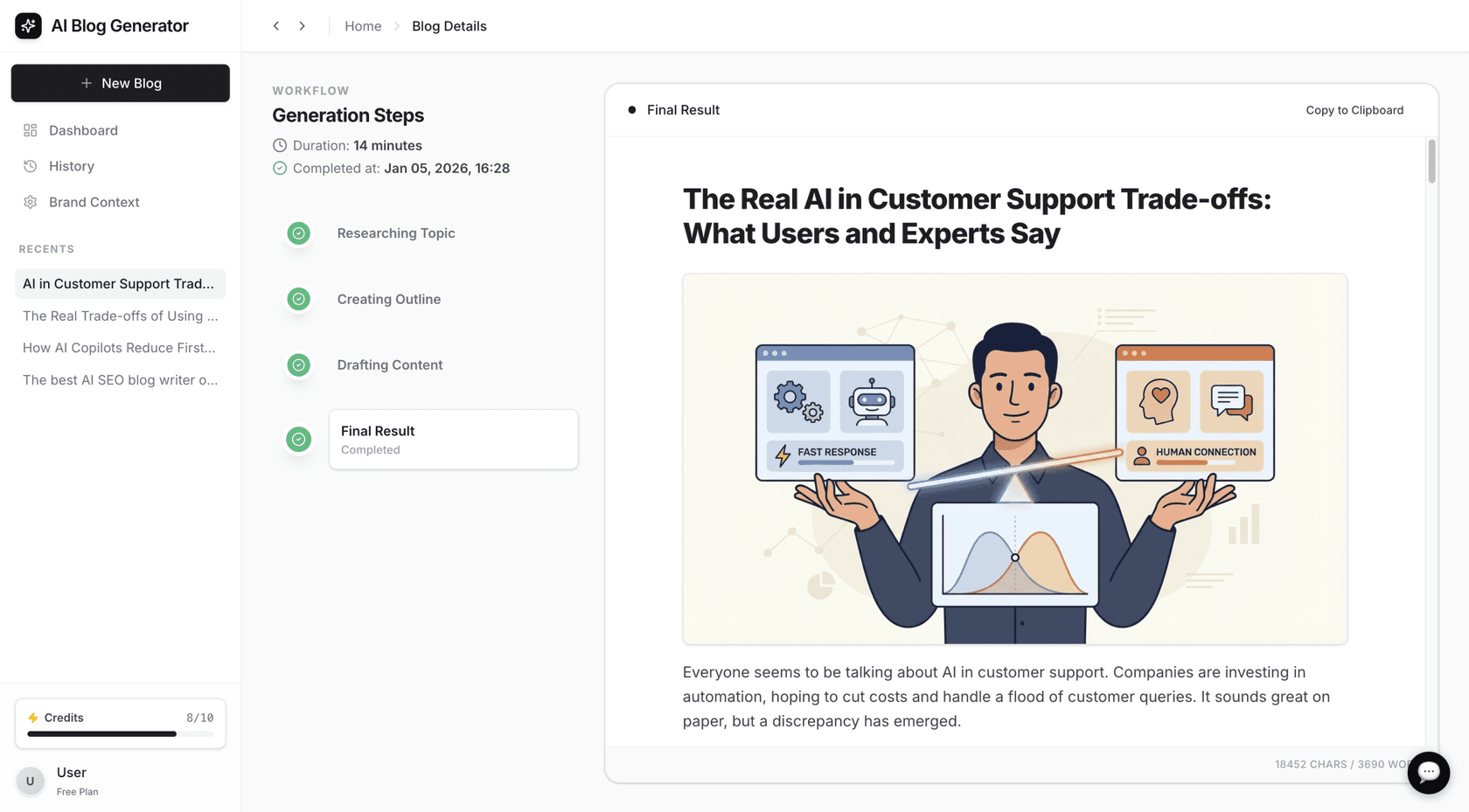
It doesn't just suggest terms to include; it generates the entire post, including:
-
Deep Research: It finds relevant data and statistics to incorporate into the content.
-
AEO Optimization: The content is designed for performance in AI answer engines.
-
Asset Creation: It can automatically create images, tables, and embed media like YouTube videos and quotes.
-
Product Integration: It can integrate product mentions based on a provided website URL.
eesel AI offers a credit-based model where users can purchase blog posts, for example, 50 posts for $99. You can even try it for free to see the quality firsthand.
Pro tip
Your SEO strategy relies heavily on your content. Tools designed to scale the production of high-quality articles can be a component of this process.
Foundational free tools for first-party data
Regardless of your budget, some of the most powerful SEO tools are completely free. These platforms, particularly those from Google, give you the definitive truth about how your website is performing. They are a non-negotiable part of any SEO toolkit.
Google Search Console (GSC)
If you use only one SEO tool, make it Google Search Console. It’s a free service from Google that lets you monitor your site's health and performance in their search results. You can see the exact search queries that bring people to your site, submit sitemaps to help Google discover new content, and identify technical issues that might be holding you back.
-
Value: It provides 100% accurate data directly from the source. It’s not an estimate; it's reality.
-
Limitation: It only shows data for your own website, so you can't use it for competitor research.
Google Keyword Planner
Although it was designed for Google Ads users, the Keyword Planner is a very useful free tool for SEO. You can use it to discover new keywords, get an idea of their monthly search volume, and gauge their competitiveness by looking at the cost-per-click (CPC) data.
-
Value: The data comes straight from Google, making it one of the most reliable sources for search volume information.
-
Limitation: It's primarily built for advertisers. If you aren't running an active ad campaign, the search volume data is often presented in broad ranges (e.g., "1K-10K"), which is less precise.
Screaming Frog SEO Spider
Screaming Frog is a desktop program that crawls your website in the same way a search engine bot does. It thoroughly checks your site for common technical SEO issues, such as broken links, redirect chains, duplicate content, and problems with page titles or meta descriptions.
-
Value: It is one of the most powerful tools available for conducting an in-depth technical SEO audit.
-
Limitation: The free version is limited to crawling 500 URLs, which may not be sufficient for larger sites. The interface is also data-heavy and can be intimidating for those new to technical SEO.
While text-based guides are helpful, seeing these platforms in action can provide a clearer understanding of their capabilities. The video below offers a practical look at how several top SEO tools are used to build a comprehensive strategy.
Building your modern SEO toolkit
The reality is that no single "best" SEO tool does everything perfectly. The most effective approach is to build a custom stack that leverages the strengths of different platforms. A common workflow involves using an all-in-one suite like Semrush for initial competitor research, relying on Google Search Console for accurate performance data, and then using a specialized tool for content. A balanced SEO stack might look something like this:
At the end of the day, all of your SEO efforts rely on great content. Before you can analyze data, track rankings, or optimize a page, you need to have something valuable to offer both search engines and users. As search technology advances, the ability to produce genuinely helpful content at scale is what will set you apart.
A key part of an SEO strategy is content creation. Tools like eesel AI's Blog Writer are designed to take keywords and generate researched, SEO-optimized blog posts. These tools aim to streamline the content creation process, allowing teams to focus on strategy. You can try it for free to see how it works.
Frequently asked questions
What are the most important features to look for in seo tools?
It really depends on your needs, but key features usually include keyword research, rank tracking, backlink analysis, site auditing, and competitor analysis. For modern strategies, look for features that also address AI search visibility and content creation.
Can I do SEO without using any paid seo tools?
You can definitely get started without paid tools. Free seo tools like Google Search Console and Google Keyword Planner give you essential, accurate data about your own site. However, as you scale, paid tools offer deeper competitive insights and efficiency that are hard to replicate for free.
How many seo tools do I really need?
There's no magic number. Many people build a "stack" that includes a free foundational tool (like Google Search Console), an all-in-one platform for deep analysis (like Semrush or Ahrefs), and a specialized content tool. The goal is to cover your bases without paying for redundant features.
Are all-in-one seo tools better than specialized ones?
Not necessarily. All-in-one seo tools are powerful because they bundle many functions together, but they can be expensive and complex. Specialized tools, like a dedicated AI content writer or a technical crawler, often do one specific job exceptionally well. The best approach is often a mix of both.
How do AI-powered seo tools differ from traditional ones?
Traditional seo tools focus on analyzing data like keywords and backlinks. AI-powered seo tools go a step further by using artificial intelligence to help with tasks like generating entire blog posts (like eesel AI), predicting search trends, or optimizing content for AI answer engines like Google's AI Overviews.
What are the best free seo tools for a beginner?
For anyone starting out, the best free seo tools are Google Search Console and Google Analytics. They provide accurate, first-party data directly from Google about your site's performance and traffic. Screaming Frog's free version is also great for learning the ropes of technical site audits.


Article by
Kurnia Kharisma
Kurnia is a software engineer and writer at eesel AI with two years of SEO experience, writing about AI tools, helpdesk software, and customer support. He pairs a developer's understanding of how these products are built with search-driven research into what actually ranks and resonates with the people searching for them.