SEO Metadata Generator
Generate optimized title tags, meta descriptions, and keywords for your web pages. Improve your SEO with AI-powered metadata that follows best practices and drives traffic.
Frequently Asked Questions
An SEO Metadata Generator is a powerful AI-powered tool that creates optimized title tags, meta descriptions, and keywords for web pages to improve search engine rankings. Our SEO metadata generator analyzes your page content, page type, and target keywords to generate SEO-optimized metadata that follows best practices including proper length limits (title: 50-60 characters, description: 150-160 characters). The tool supports 12 different page types from blog posts to e-commerce pages and creates compelling metadata that drives traffic and improves website metadata performance.
Our SEO Metadata Generator creates three essential components for comprehensive SEO optimization: optimized title tags that include primary keywords and stay within the 50-60 character limit, compelling meta descriptions (150-160 characters) that summarize content and include calls-to-action, and targeted keywords lists focusing on primary and secondary terms. The title tag generator, meta description generator, and keywords generator work together to create complete website metadata packages that improve search visibility across 12 page types including blog posts, product pages, landing pages, and e-commerce pages.
Yes! Our SEO Metadata Generator is completely free to use for generating unlimited optimized title tags, meta descriptions, and keywords for your web pages. Create comprehensive website metadata for all your pages without any subscription fees or usage limits. Whether you need SEO optimization for blog content, product pages, or any other page type, simply input your content, select your page type, and instantly get professionally optimized metadata ready to copy to clipboard and implement on your website.
Our SEO Metadata Generator creates complete, SEO-optimized metadata instantly in just seconds. Once you provide your page content, select the page type, and specify any target keywords, our AI-powered tool immediately generates optimized title tags, compelling meta descriptions, and relevant keywords that follow SEO best practices. This speed makes it an essential SEO optimization tool for digital marketers, content creators, and website owners who need to quickly generate professional metadata for multiple pages while maintaining consistent quality and search engine optimization standards.
Absolutely! Our SEO Metadata Generator supports 12 different page types including blog posts, product pages, service pages, landing pages, e-commerce pages, news articles, tutorials, and more. You can customize the generated metadata by selecting from 14 different tones (Professional, Friendly, Formal, Persuasive, etc.) and 12 languages to match your brand voice and target audience. The tool adapts the title tag generator, meta description generator, and keywords generator output based on your specific page type and requirements, ensuring your website metadata is perfectly optimized for your content type and SEO optimization goals across all supported languages and page formats.
Have more questions? Contact our support team
The complete guide
SEO metadata: what actually matters in 2026 (and what to skip)
A plain-English guide to SEO metadata in 2026: which title, description, robots, and structured data tags move the needle, and which ones Google quietly ignores.
11 min read
What SEO metadata actually is
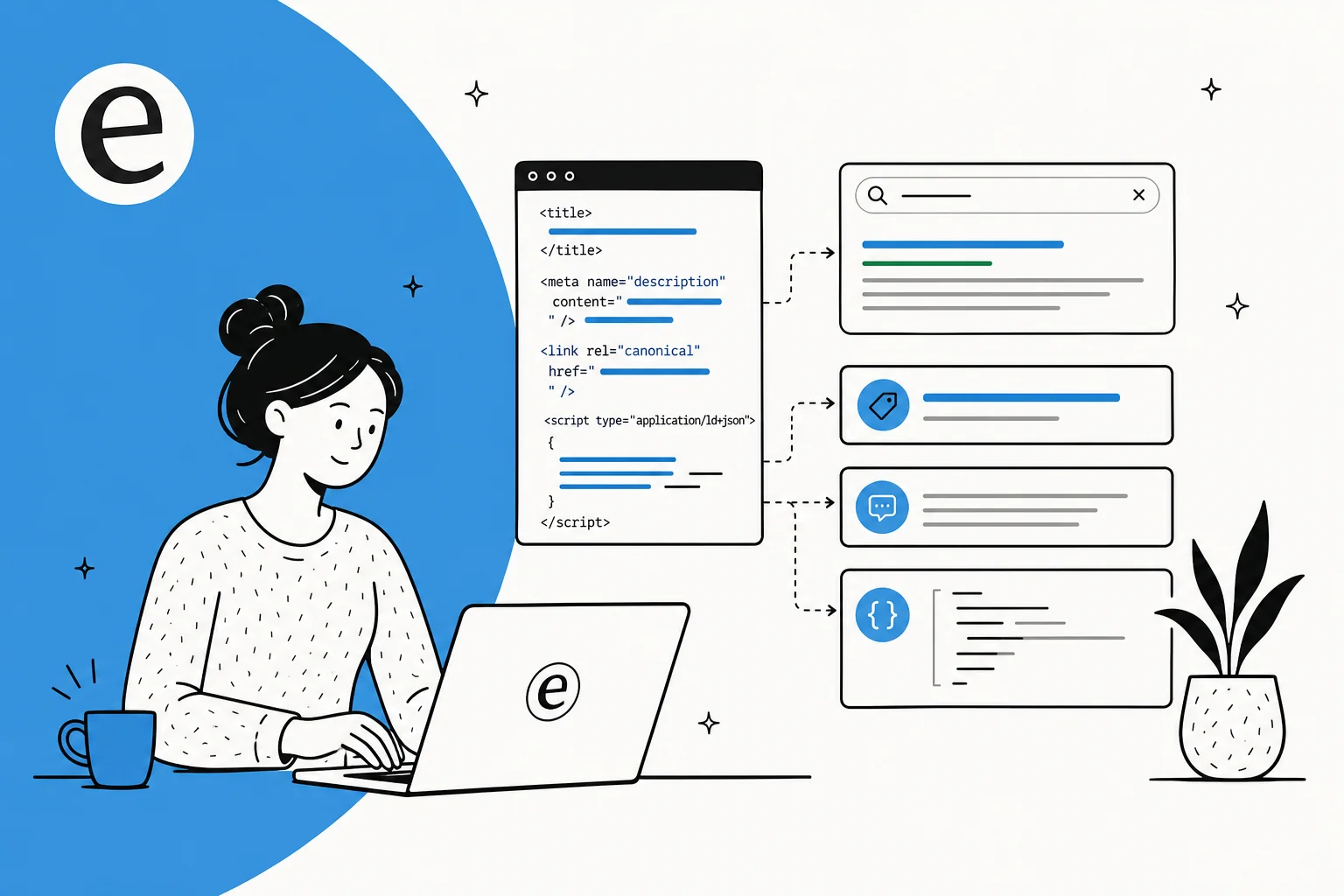
Open the source of almost any web page and the first thing you'll hit, before any visible content, is the <head>. That's where most SEO metadata lives. It's structured information about the page rather than the page content itself, written for two audiences that never read your prose: search engine crawlers and the link-preview bots on social platforms.
I've spent the last couple of years working on SEO, and I write for eesel's own blog, where we publish a lot. When you're shipping content at volume, metadata stops being an abstract best-practice and becomes a real, repetitive decision on every single page: what's the title, what's the description, should this be indexed, what shows up when someone shares it. Getting a mental model of which tags matter saves you from polishing things that don't.
At a high level, the metadata on a page feeds three destinations:
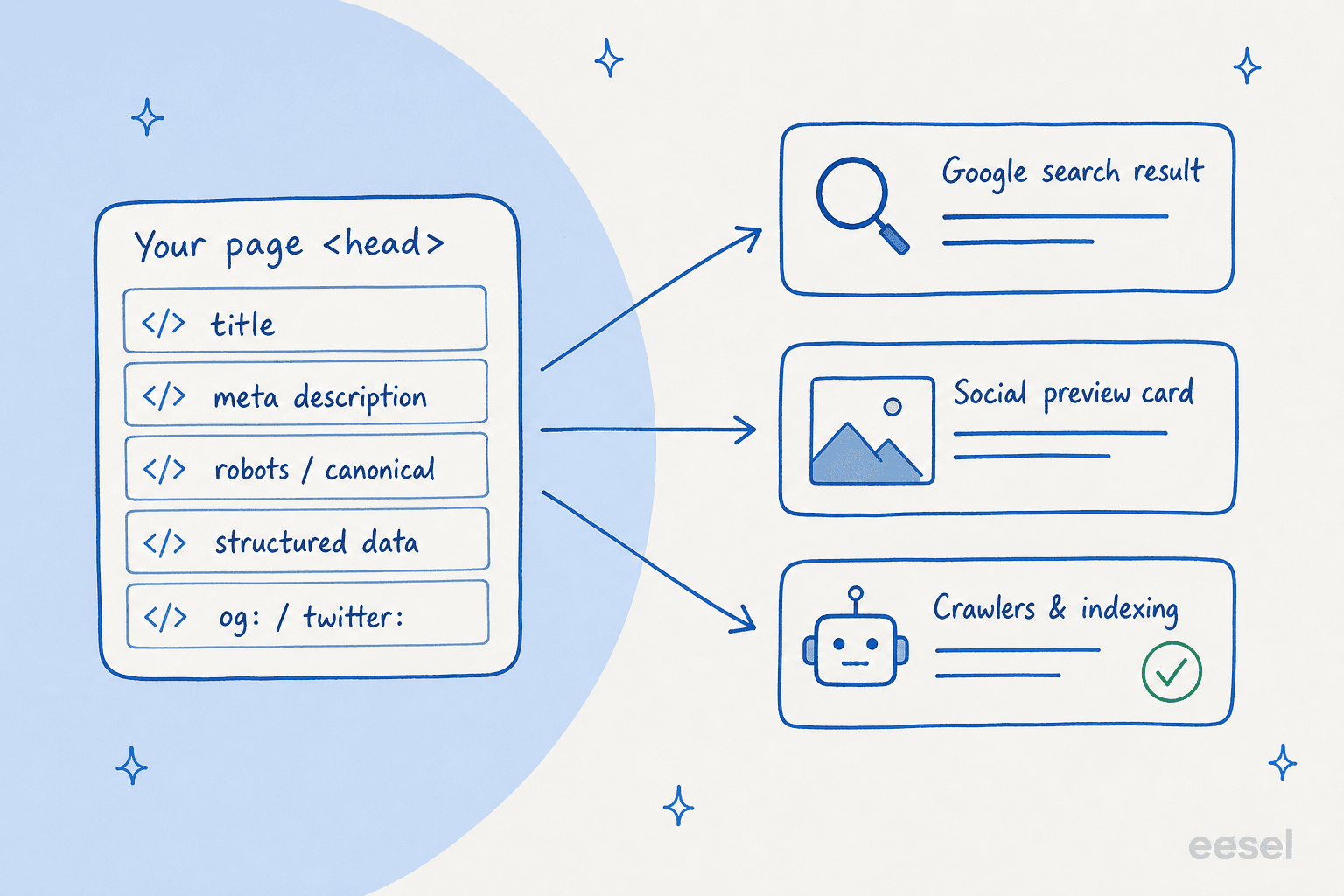
The pieces almost every page needs to think about:
- Title tag (
<title>) - the clickable headline in search results. - Meta description (
<meta name="description">) - the candidate snippet under that headline. - Robots and canonical tags - rules for whether and how the page gets indexed.
- Structured data - machine-readable markup that can unlock rich results.
- Open Graph and Twitter/X tags - what shows up when the link is shared.
The underlying HTML element doing most of this work is the humble <meta> element. As MDN describes the meta element, it's a void element whose entire meaning comes from its attributes, usually a name paired with content. The <title> element is its own tag, and Open Graph uses property instead of name, but the pattern is the same: small tags in the head, big consequences for how your page is treated.
The metadata that actually matters (and the stuff that doesn't)
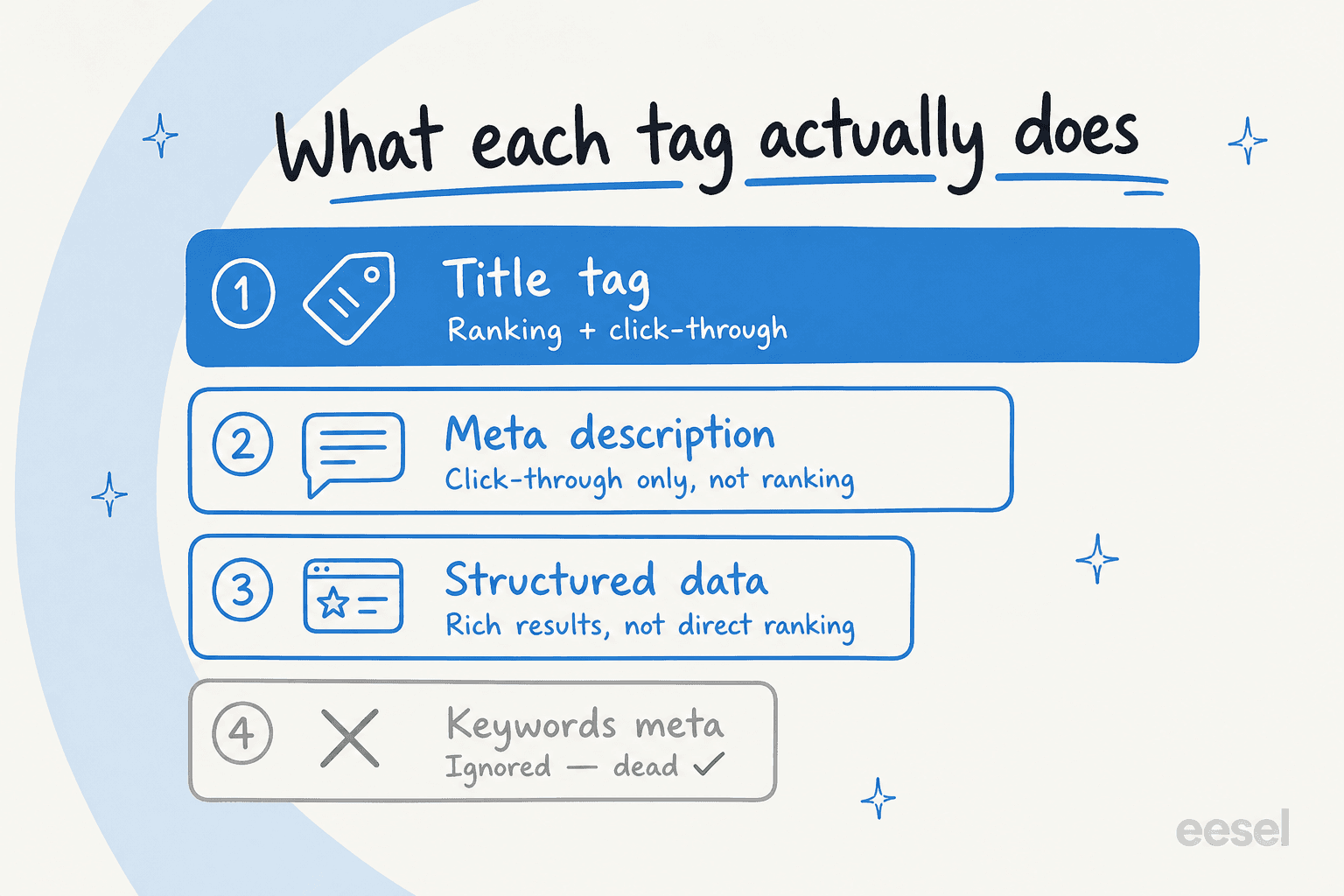
This is where most guides go soft and tell you "it all matters." It doesn't. After reading both Google's own documentation and what working SEOs actually say, here's how I'd rank the impact:
Title tags: your highest-leverage tag
The <title> element is the one piece of metadata I'd never skip. Google uses it as a primary input to the "title link," the blue headline people click in search results, and Google's guidance on title links lists the <title> as the main source it pulls from. It influences both how the page is understood and whether anyone clicks.
Practitioners are blunt about this. One widely-shared take on r/SEO put it about as starkly as you can:
"Meta Title tags are 100% important in SEO, extremely, whereas meta descriptions have ZERO importance, and no relevance at all."

The practical rules: make each title descriptive and unique, lead with the thing the page is actually about, keep your brand to a short suffix rather than the opening words, and don't stuff keywords. Those are straight out of Google's title-link best practices, and they line up with everything in our own SEO blog playbook. A quick pass with SERP analysis tools before you write the title tells you what already ranks for the query.
Meta descriptions: a click lever, not a ranking lever
Here's where the old advice fails people. The meta description is not a ranking factor. What it can do is nudge click-through rate when Google decides to show it. And "when Google decides" is the catch: Google generates snippets per query, using your meta description only when it judges that more accurate than text pulled from the page itself.
How often does it override you? More than you'd think. As Peter Rota noted in a widely-circulated LinkedIn post:
"Google rewrites meta descriptions for pages over 70% of the time. Yet, I still see SEOs giving advice to manually create them on here!"
Peter Rota, LinkedIn

So the honest move is to write strong descriptions for the pages that earn you money and let the rest auto-generate. There's still a case for filling them: Bing leans on the description more than Google does, and a good one raises the odds Google keeps yours. But hand-crafting a unique description for 800 blog posts is a poor use of anyone's afternoon, which is one reason teams reach for AI SEO content optimization and an AI content writer to draft them in bulk.
The keywords tag is dead
If you still see <meta name="keywords"> in a template, you can delete it. Google stated outright that it does not use the keywords meta tag back in 2009, and nothing has changed since. Listing your target terms there does nothing but hand your keyword strategy to competitors who view source. Put that energy into your title and your content, the way the AI SEO guide lays out.
Why Google rewrites your titles and descriptions
It throws people off the first time they see it: you write a careful title, then watch Google display something else entirely in the results. This isn't a bug. Google rewrites the displayed title link when it thinks it can do better for a given query.
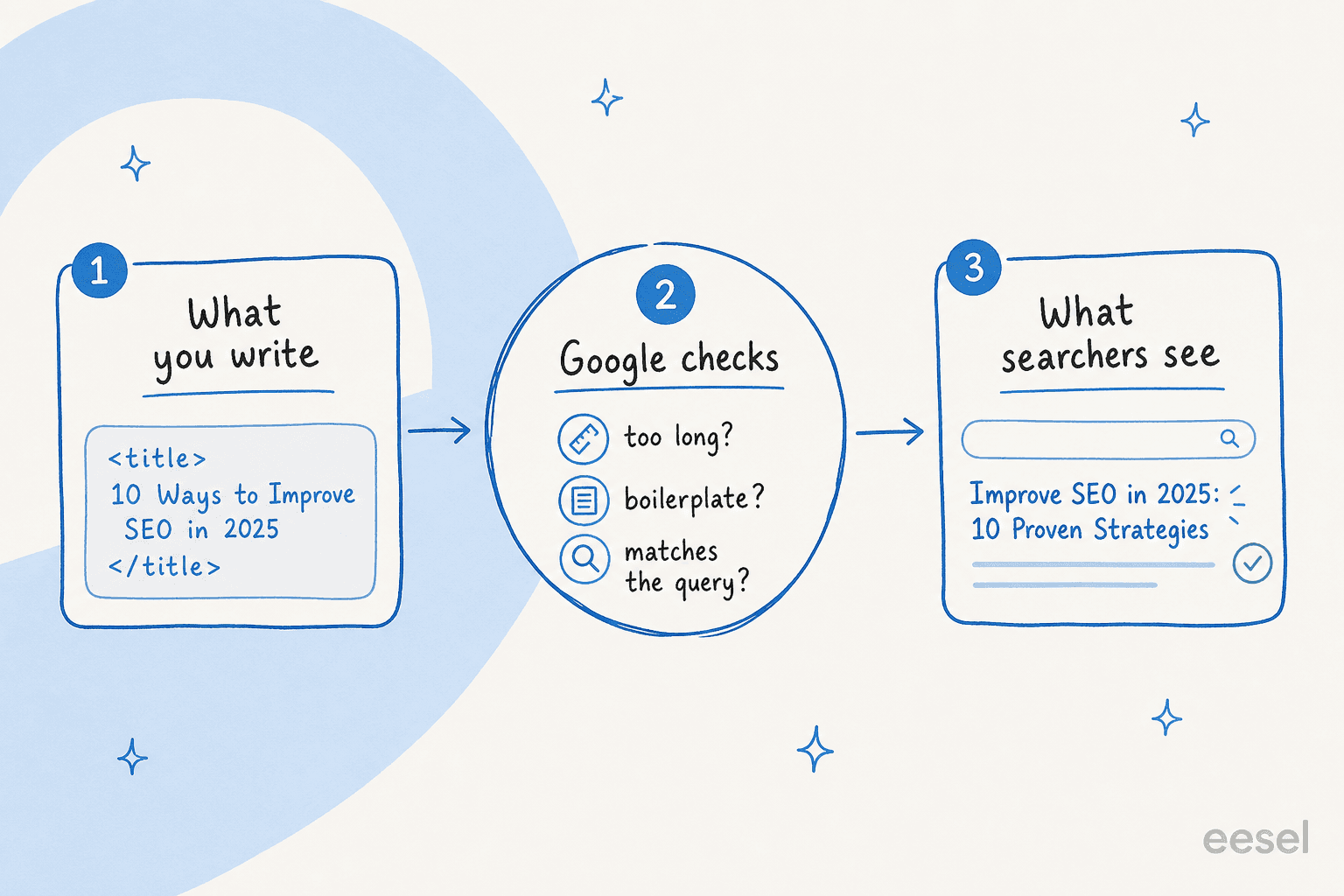
Per Google's documentation on title-link issues, the usual triggers are titles that are half-empty, stale, inaccurate, or boilerplate (the same Home | Site Name repeated across every page). The fix is upstream: write titles that are accurate and specific, and Google has less reason to overrule you.
Some SEOs even play this deliberately. A thread on r/SEO about adding localities to titles described the tactic of packing extra terms into a title knowing Google will clean it up for display:
"The goal is to get Google to rewrite the tag. Reap the ranking benefits of the extra keywords in the title, and then Google rewrites it to look clean."
I wouldn't lead with that as a strategy, but it tells you something important: the title text is still parsed even when it isn't shown. That's the whole reason the tag stays your highest-leverage lever. The same logic applies to descriptions; one r/SEO commenter summed it up well: "absolutely worth doing to have a better chance of getting your keywords in there."
Structured data: metadata for machines
Structured data is the part of metadata that doesn't live in the <head> at all. It's markup, usually JSON-LD that Google recommends, placed in your page that describes its meaning in a shared vocabulary from schema.org: this is a Recipe, this is a Product, this is an FAQ, here's the author and the rating.
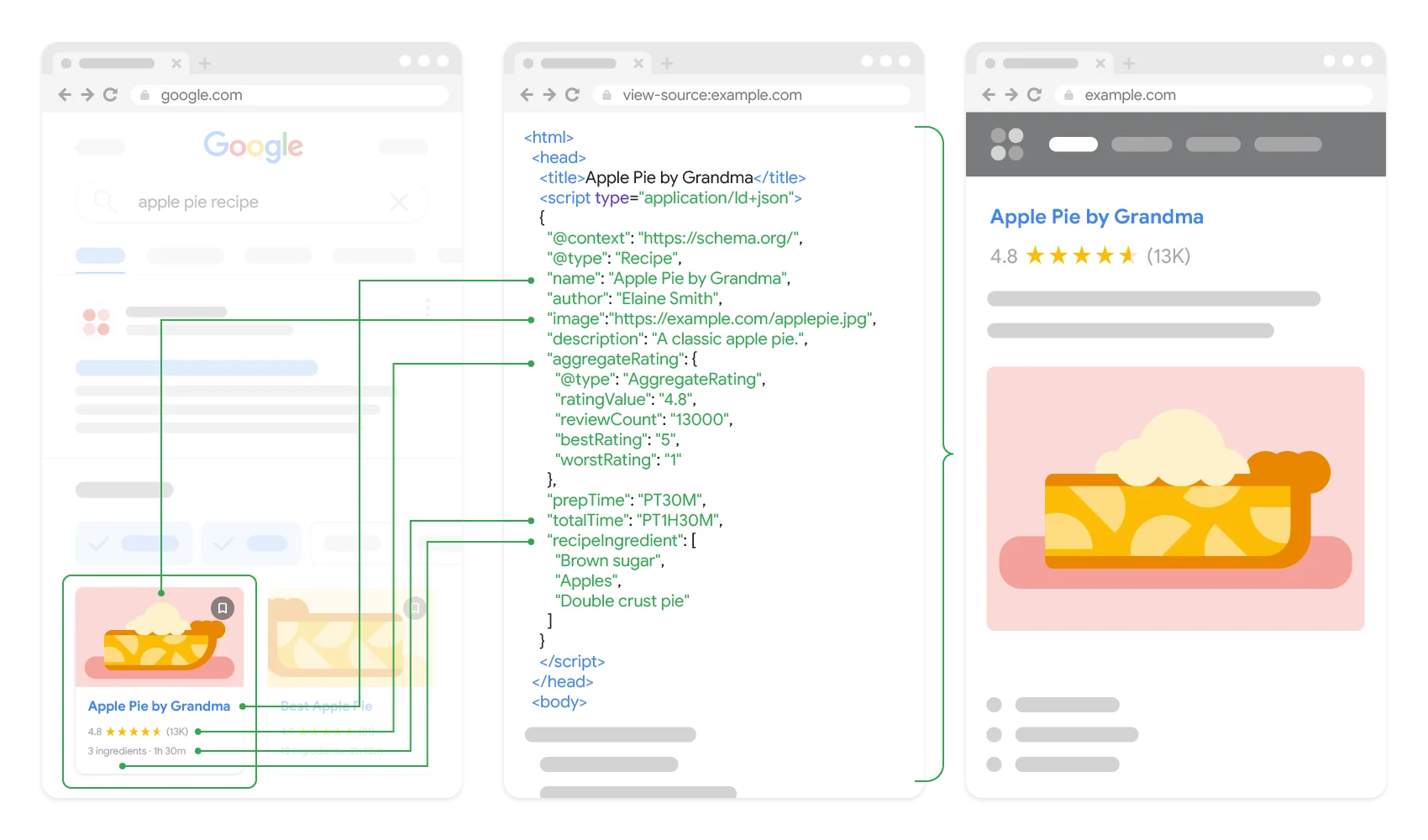
The thing to be clear-eyed about: structured data does not raise your ranking. Google's John Mueller said so directly, as captured in a r/TechSEO thread:
"Structured data won't make your site rank better. So if someone tells you that you can expect your page's ranking to go up after you add some schema markup, that is false."
John Mueller, via r/TechSEO
What it does do is make your page eligible for rich results, and those can lift clicks meaningfully. Google's own structured data case studies cite a 25% higher click-through rate for Rotten Tomatoes pages with structured data and an 82% higher rate for Nestlé pages that appeared as rich results. For some SERP features it's effectively mandatory, as one practitioner in that thread put it: "You ain't going to be ranking in the job search section without schema."
The guideline that trips people up: your structured data must represent content that's actually visible on the page. No marking up a 4.8 rating that doesn't exist, no hidden FAQ schema. Validate it with Google's Rich Results Test before you ship.
Robots, canonical, and the tags that control crawling
This is the boring metadata that quietly causes the worst SEO disasters. The robots meta tag and the X-Robots-Tag HTTP header carry indexing and serving rules: noindex (keep this page out of search), nofollow (don't pass link signals), nosnippet, max-snippet, and more, all documented in Google's robots meta tag spec.
The single most common mistake: blocking a page in robots.txt and adding a noindex tag, expecting it to drop out of the index. It won't reliably, because if robots.txt blocks the crawler, Google never reads the page and never sees the noindex. If you want a page out of the index, let Google crawl it and serve the noindex.
The companion is the canonical tag (<link rel="canonical">), which tells Google which URL is the "real" version when you have duplicates or near-duplicates. Get robots and canonical wrong and it doesn't matter how good your titles are; the page either won't show or will compete with itself. This is the metadata I'd audit first on any site, and it's worth mapping into a repeatable SEO process flowchart so it gets checked on every launch.
Open Graph and Twitter cards: metadata for sharing
This metadata doesn't touch your Google ranking at all, but it controls something just as important: what your link looks like when a human shares it in Slack, on LinkedIn, or on X. A bare link with no image gets ignored; a rich card with a title, description, and image gets clicks.
The Open Graph protocol is the standard here, originally from Facebook. It uses <meta property="og:..."> tags, and four are required: og:title, og:type, og:image, and og:url. Add og:description and a properly-sized og:image and you've covered most platforms. X/Twitter has its own twitter: tags (the summary_large_image card is the usual choice for a blog post), and helpfully, X falls back to your Open Graph tags when the twitter: equivalents are missing, so you don't have to duplicate everything.
If you're producing content with AI content generation tools or scaling a content pipeline, make sure social tags are part of your template. They're cheap to set once and they directly affect how much traffic your distribution actually drives.
How SEO metadata is changing in the AI-search era
Here's the shift worth internalising. The visible meta description matters a little less every year, as zero-click results and AI answers pull attention away from the classic snippet. But metadata as a whole matters more, because there's a second machine reading it now: the AI search engines and assistants that summarise the web.
Chris Long made this point well in a LinkedIn post on AI search:
"Title and meta descriptions will always remain important because they save a lot of processing time and resources for search engines."
Chris Long, LinkedIn
Clean titles, accurate descriptions, and rich structured data give a language model a fast, reliable read on what your page is and whether to cite it. That's why structured data keeps showing up in advice for AI mode SEO tools, AI search optimization tools, and generative engine optimization, even though it's still "not a ranking factor." The metadata you write for crawlers is increasingly the metadata you're writing for AI, and it's worth folding into your AI SEO content strategy rather than treating it as an afterthought.
A practical SEO metadata checklist
If you do nothing else, do these, roughly in priority order:
- Unique, specific title tag on every page. Lead with the topic, brand at the end, no boilerplate. This is the one that moves rankings and clicks.
- Meta descriptions on your money pages. Skip or auto-generate them on low-value pages; Google rewrites most anyway.
- Robots and canonical set correctly. Confirm important pages are indexable and duplicates point to a canonical. Don't
noindexandrobots.txt-block the same page. - Structured data where you want rich results. Match it to visible content, validate with the Rich Results Test.
- Open Graph and Twitter tags in your template. Title, description, image, set once at the template level.
- Drop the keywords tag. It does nothing.
None of this is hard on a ten-page site. It gets painful at a hundred or a thousand pages, which is where the work shifts from "write good metadata" to "produce good metadata at scale without it becoming a full-time job." That's the gap the right AI SEO tools, AI writing tools, and AI content tools for SEO are meant to close.
Try eesel for content (and the metadata that comes with it)
We feel the metadata-at-scale problem directly: eesel's blog is run largely by our own AI blog writer, one of the AI teammates the platform ships. It drafts full SEO posts (titles and descriptions included) from your existing knowledge and a target keyword, so the metadata is part of the draft instead of a separate chore you do 800 times. You edit the pieces that matter rather than writing every tag from a blank page.
You can start with $50 in free usage and two free blog generations, no credit card, and see what a drafted post (metadata and all) looks like for your own topics. If support content is more your world, the same platform runs an AI helpdesk agent on the side. Either way, Try eesel and judge the output on your own keywords.