
It feels like we're all swimming in a sea of AI content generation tools, right? They all promise to save you a mountain of time, but a lot of them just spit out generic, bland content that you have to spend hours editing anyway.
Feels like every tool promises the world and delivers like 60% of it.

The goal isn't just to write things faster. It's to create better content that actually resonates with your audience and gets noticed by Google. Most tools, frankly, aren't quite there yet.
This guide is meant to be a practical look at the AI content world. We’ll walk through the different kinds of tools out there, see how they've evolved, and give you some real tips for getting high-quality, on-brand results that don't sound like they were written by a robot.
Understanding the landscape of AI content generation tools
"AI content generation tools" is a pretty huge umbrella term. To find the right one, you have to know what you need it for. Are you looking for a brainstorming partner or something that can handle the whole process from start to finish? To help clarify, we can break them down into four main groups, as this chart shows.
The brainstormers: Foundational AI content generation tools
These are the big-name AI assistants you’ve probably used, like ChatGPT and Claude. They’re the foundational models that many other specialized tools are built upon.
They are great for getting started. You can use them for outlining a post, kicking around some ideas, summarizing research, or creating a very rough first draft. They have easy-to-use conversational interfaces and are incredibly flexible. For example, Claude's Pro plan has a massive context window, which means you can feed it a huge document or a bunch of code, and it can actually remember the beginning of the conversation by the end.
But they do have their weaknesses. These general-purpose tools can sometimes produce generic text or inaccuracies, so their output quality is highly dependent on the context you provide. There’s also a difference in how they handle large files. ChatGPT Plus uses a technique called RAG, which sometimes skims over key details if your prompt isn't precise. Claude, by contrast, reads the entire document (within its limit), which usually gives you a more accurate analysis.
The polishers: Specialized AI content generation tools for marketing copy
Next are the platforms designed for specific marketing jobs, like Jasper and Copy.ai. You’d turn to these when you need to whip up some short-form copy and make it shine.
I like a mix of free Chat GpT and Jasper. Free Chat GPT is actually still better for brainstorming , Jasper doesn’t really always understand the same prompts, the same way. I could ask it to suggest an outline for an ebook blah blah blah and sometimes it takes a lot more correction than chat GPT.
They're at their best for quick, targeted tasks like writing ad copy, social media captions, email subject lines, or product descriptions. They usually come packed with templates and features to help you stick to your brand voice. For instance, Jasper's Business plan offers Brand Voices and a "Knowledge Base" you can load with company info to keep the AI on track. Copy.ai markets itself as a GTM AI Platform, offering "Workflows" and an "Infobase" for a similar purpose.
They are primarily designed for shorter copy, so creating cohesive long-form content may require stitching together multiple generated pieces. At the end of the day, you're still the one responsible for guiding the AI to create a cohesive article or landing page.
The strategists: AI content generation tools for SEO
This group includes tools like Surfer SEO and Clearscope, which are all about one thing: helping your content rank higher in search results.
These are what you use to make sure your content is aligned with what people are searching for. They analyze top-ranking pages and give you a clear set of recommendations for improving drafts written by you or another AI. You'll get things like a content score, keyword suggestions, and outline builders based on what's already performing well. Surfer SEO's "Content Score" offers real-time feedback as you write, and Clearscope gives you content grades while also tracking your content's performance in Google search and AI chatbots.
The main thing to remember is that these are optimization guides, not writers. You still need to create the content separately. And while a high content score is a good sign, it's no guarantee of a top spot on Google. A study by Surfer SEO found their Content Score has a 0.28 correlation with Google rankings. That shows that other factors like site authority and backlinks are still incredibly important.
The publishers: End-to-end AI content generation tools
This leads us to a newer type of tool that does more than just write. These platforms are designed to produce complete, publish-ready articles, not just outlines or bits of copy.
An example in this category is the eesel AI blog writer. It aims to generate a complete, media-rich, and SEO-optimized article from a single keyword.
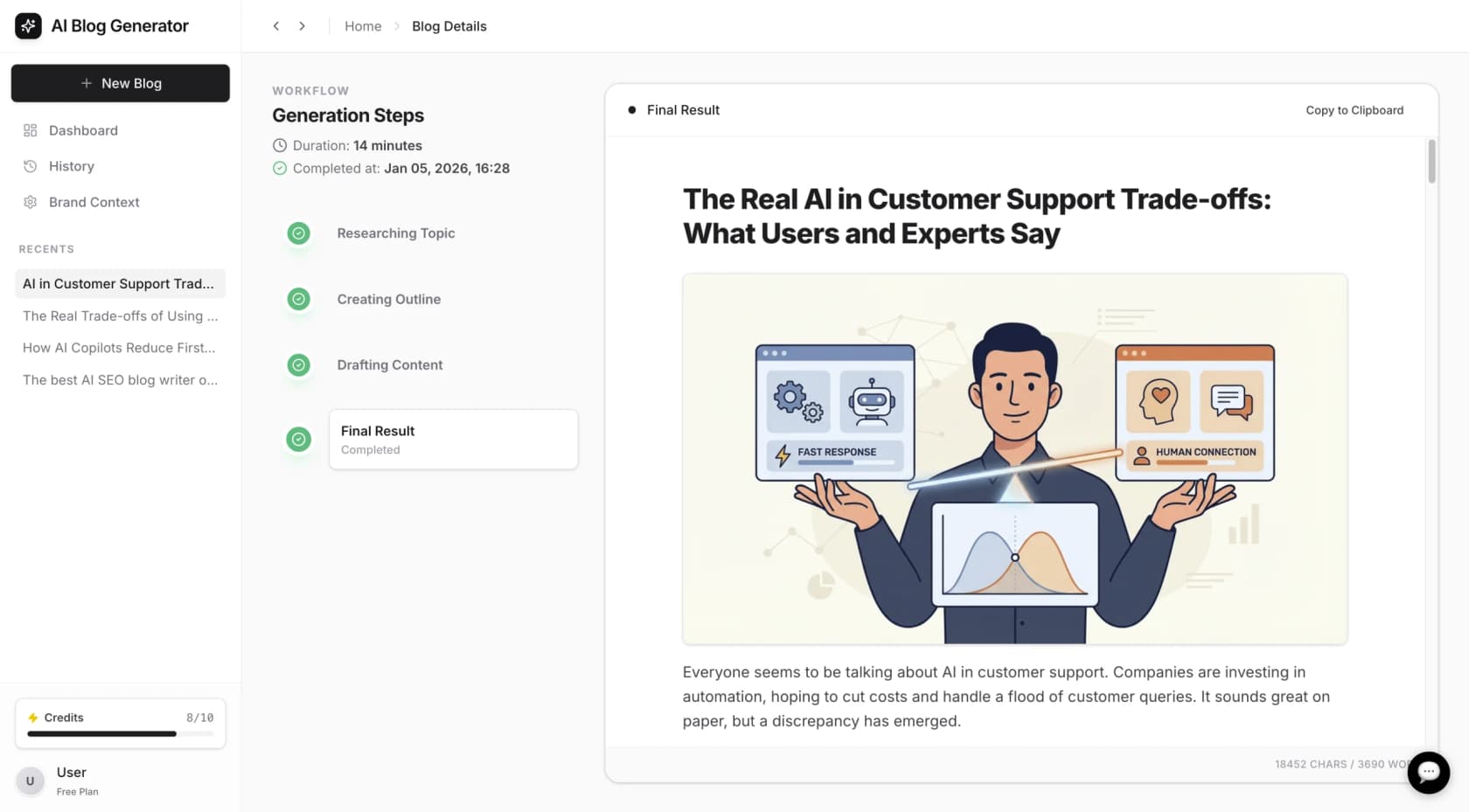
These tools are often designed to handle the entire content workflow with features such as:
-
Automatic Asset Generation: It doesn't just produce a wall of text. It creates relevant images, tables, and infographics to make the content more engaging and visually appealing.
-
Social and Media Integration: It finds and embeds relevant Reddit quotes and YouTube videos, adding authentic voices and diverse perspectives to your articles.
-
Context-Aware Research: It automatically scans your website to understand your brand's context, allowing it to add natural product mentions that don't feel shoehorned in.
-
AEO (Answer Engine Optimization): It structures content to be easily understood and cited by modern search experiences like Google AI Overviews.
The evolution of AI content generation tools
The AI content scene is changing incredibly fast. Knowing how we got here can help you understand the current landscape and choose a tool that will still be relevant next year.
The past: From basic text spinners to prompt-based assistants
Remember the early days of AI writing, before 2022? It was a bit of a mess, full of sketchy text spinners that produced low-quality, often plagiarized content. Then ChatGPT arrived and changed everything. It introduced a powerful, prompt-based model that made AI feel accessible and actually useful for just about everyone.
The present: Specialization and the problem of "AI slop"
Today, the market is overflowing with specialized tools for every possible niche. But this boom has had an unfortunate side effect: a huge wave of low-effort, generic "AI slop" that is cluttering the internet. It's not just on spam sites anymore; it's becoming a problem on platforms meant for human connection.
I can totally relate, I’ve gone through the same cycle of trying every 'AI-powered' tool out there, only to end up juggling five tabs and editing everything manually anyway.
Reddit moderators are dealing with an influx of AI-generated stories. One moderator guessed that up to half of all content on the platform might be created or touched by AI. This trend really underscores the need for tools that focus on quality and authenticity, not just churning out more content.
The future: Autonomous, context-aware content creation
The future of AI content is about more than just writing text. It's about creating a complete content asset that has a deep understanding of context, your brand, and what your audience is looking for.
This change is giving rise to Answer Engine Optimization (AEO). As defined by industry experts, AEO is about optimizing your content to be used as a source in AI-generated answers, not just to be ranked in a list of links. This means focusing on clear, structured information and building authority.
Platforms such as the eesel AI blog writer are part of this shift. These tools function less as simple command-based writers and more as systems that manage the entire process, from research and writing to asset creation, delivering a final piece that’s ready for both human readers and answer engines.
How to get the best output from your AI content generation tools
The quality of what you get from an AI tool is a direct reflection of what you put in. Just typing a simple prompt and hoping for the best won't get you very far. To get great results, you need to provide plenty of context and clear instructions.
Why deep context matters for AI content generation tools
A one-sentence prompt will give you a one-dimensional result. If you want detailed and accurate output, you have to give the AI enough material to work with.
A Reddit experiment demonstrated this perfectly. Someone gave a 30,000-word version of "Alice in Wonderland" with hidden mistakes to both ChatGPT and Claude. The prompt was simple: "list all the wrong things." ChatGPT's RAG system missed the mistakes because it couldn't retrieve the right information. Claude, on the other hand, found every single one because its huge context window allowed it to process the entire document. It’s a great illustration: the more context an AI has, the more accurate it can be.
Leveraging brand guidelines and negative constraints
One of the most effective things you can do is give the AI your brand's style guide, tone of voice, key terms, and, most importantly, what not to say. These negative constraints are just as valuable as the positive ones.
Many specialized tools are starting to build this in. Surfer SEO has a "Brand Knowledge" feature, and Jasper lets you create a "Brand Voice" by uploading a document or linking to a URL.
Some tools, like the eesel AI blog writer, can simplify this by automatically analyzing your website to learn your brand's context. This ensures that any product mentions and the overall tone feel natural right from the start, without you needing to configure style guides for every article.
The human in the loop: Editing for expertise and voice
This is probably the most important step. No matter how good the AI-generated content is, it should always be reviewed by a human expert.
Why? Because a human review is where you add your unique insights, personal anecdotes, and double-check that all the facts are correct. That final polish is what builds trust with your audience and helps your content align with Google's E-E-A-T (Experience, Expertise, Authoritativeness, and Trust) guidelines. AI is an amazing assistant, but it’s not a substitute for real human experience.
For a deeper look into which tools content creators are actually using and how they fit into their workflows, check out this video review of some of the top options available.
Final thoughts and next steps
So, what's the bottom line? The world of AI content generation tools is vast and varied. You have brainstormers like ChatGPT, copy polishers like Jasper, SEO strategists like Surfer SEO, and now, end-to-end publishing engines. The future seems to belong to the tools that can work with deep context and create high-quality, complete assets, not just text.
The ultimate goal is to shift your role from being an AI operator to a content strategist. Picking the right tool is the first, and most critical, step in that journey.
To find the right tool for your needs, consider trying different types of platforms to see which best fits your workflow and quality standards. For example, you can explore the output of an end-to-end tool like the eesel AI blog writer.
Frequently asked questions
What are the main types of AI content generation tools?
They generally fall into four categories: foundational generators like ChatGPT for brainstorming, specialized copywriters like Jasper for marketing copy, SEO platforms like Surfer SEO for optimization, and end-to-end engines like the eesel AI blog writer that create complete, publish-ready articles.
How can I get better results from AI content generation tools?
The key is context. Instead of simple prompts, provide detailed information, brand guidelines, style guides, and examples of what you want (and what you don't). The more the tool knows about your goals, the better the output will be.
Are AI content generation tools good for SEO?
They can be, but it depends on the tool and how you use it. Some are specifically designed for SEO, helping with keyword research and on-page optimization. However, you always need a human to review the content to ensure it meets Google's E-E-A-T guidelines for expertise and trustworthiness.
What is the biggest mistake people make when using AI content generation tools?
The biggest mistake is treating them as a replacement for human expertise. Hitting "generate" and publishing the raw output often leads to generic, inaccurate, or off-brand content. Always use them as an assistant and have a human expert edit and refine the final piece.
Will using AI content generation tools get my site penalized by Google?
Google's stance is that high-quality content is what matters, regardless of how it's produced. As long as you're using AI to create helpful, original, and people-first content (and not to spam search results), you won't be penalized. The focus should be on quality, not just quantity.
How do I choose the right AI content generation tools for my business?
Start by identifying your primary need. Do you need help with brainstorming (foundational tools), short-form copy (specialized copywriters), ranking on Google (SEO platforms), or producing full articles efficiently (end-to-end engines)? Test a few free trials to see which one fits your workflow and quality standards best.