

The old SEO playbook is gathering dust on a shelf somewhere. For years, the focus was on keywords, backlinks, and climbing up a list of blue links. But AI is no longer just a buzzword; it is now the engine driving how search platforms like Google understand and present information, especially with the new AI Overviews appearing at the top of the page.
So, what is the plan now? It is all about AI SEO. Think of it as a two-part mission: first, you are tweaking your website to be a trusted source for AI-powered search engines. Second, you are using clever AI tools to make your own SEO work faster and more efficient.
This guide is here to cut through the noise. We will provide a practical AI SEO guide that focuses on what actually moves the needle today. The lines between old-school SEO, Answer Engine Optimization (AEO), and Generative Engine Optimization (GEO) are becoming blurry, and we will show you how to tie it all together into a single strategy that works.
What is AI SEO?
At its core, AI SEO is about making your content incredibly easy for AI-powered search experiences to find, understand, and trust. We are talking about Google's AI Overviews, Perplexity, ChatGPT, or any place where an AI summarizes the web to give someone an answer.
This is a significant leap from traditional SEO. For the longest time, the objective was simple: get your page to rank high in a list. AI SEO has a bigger goal. The new aim is to get your content featured inside the AI-generated summaries, which often means a user gets their answer without ever clicking through to your site.
It is basically a two-part job:
-
Optimizing for AI algorithms: This means structuring your content so that AI systems can easily digest it, pull out the key facts, and cite you as a reliable source. You want to be the "expert in the room" that the AI turns to.
-
Using AI tools for SEO: This is about using AI to automate and improve the tedious parts of the job, like keyword research, content creation, and technical audits. It frees you from the grunt work so you can focus on the high-level strategy that makes a real difference.
However, the most important thing to remember is that AI SEO builds on the fundamentals; it does not throw them out. A technically sound website, genuinely useful content, and real authority are more important than ever. AI just raised the stakes.
Key components of modern search
AI did not just tweak the search algorithm; it completely redesigned the search engine results page (SERP). It is no longer a simple list of links. This new terrain is defined by three major shifts that you need to understand to stay in the game.
Generative Engine Optimization (GEO)
Generative Engine Optimization (GEO) is all about prepping your content to be picked and featured in AI-generated summaries, like Google AI Overviews or Bing Copilot responses.
The goal here is not just to be #1 anymore. It is to become the primary source that the AI uses to build its answer. You want your facts, your data, and your explanations woven directly into the summary users see first. As one SEO expert on Reddit noted, GEO is about being "cite-worthy for LLMs."
To do GEO well, you need to be obsessed with factual accuracy, write incredibly clear and concise explanations, define key terms, and use structured formats like lists and tables. Anything that makes your content easier for a machine to read and process is a win for GEO.
Answer Engine Optimization (AEO)
Next is Answer Engine Optimization (AEO). This strategy is all about providing direct, easy-to-grab answers to very specific questions. You might already be doing this if you have ever optimized for featured snippets or voice search. Now, AEO is a top priority for AI chatbots and search summaries.
So, what is the difference between GEO and AEO? While GEO is about being one of several sources that contribute to a broader answer, AEO is about having your content lifted directly as the single best answer. Think of a question like "how to reset a router." AEO is when the AI grabs your step-by-step instructions and presents them word-for-word.
In practice, many people in the industry see GEO and AEO as two sides of the same coin. They share a ton of overlapping optimization principles, and the main idea for both is to create answer-first content that gets right to the point.
Understanding zero-click searches
This brings us to one of the most discussed (and feared) changes in search: zero-click searches. This is what happens when a user's question gets a full answer right on the search results page, giving them no reason to click through to a website.
And it is happening more and more. A 2024 study by SparkToro found that nearly 60% of all Google searches now end without a click, a fundamental shift in user behavior as illustrated below.
Why is this a big deal? It means we can't just measure success by website traffic anymore. In this new world, brand mentions and being cited as a source in AI answers are the new KPIs. The good news is that it is not all bad. Google has mentioned that the clicks you do get from AI Overviews tend to be from higher quality, more engaged users. So, earning that citation is still incredibly valuable; it just looks a bit different.
Three pillars for AI SEO success
GEO and AEO might sound a little abstract. The good news is that optimizing for them really just means beefing up three core pillars of SEO that you are probably already working on. You just need to look at them through a new, AI-first lens.
Pillar 1: Create clear, structured, and expert content
In an AI world, content quality is king. Generic, fluffy articles are less effective. Here is how to make your content stand out to both people and machines.
-
Focus on Topical Authority: You need to go deep, not just wide. AI systems are built to favor websites that show they know a specific subject inside and out. Instead of writing random articles, start building topic clusters. These are groups of interlinked articles that cover a single topic from every possible angle. This tells search engines that you are the go-to expert on that subject.
-
Structure for Extraction: Think like a robot. Use clear, logical headings (H1, H2s, H3s) that ask and answer specific questions. Write short paragraphs, and use bullet points, numbered lists, and tables to break down information. This makes it super easy for an AI to "lift" your content for its summaries. SEO pros call this optimizing for "chunk-level retrieval," and it is a huge deal.
-
Emphasize Real Experience: Google has said that E-E-A-T (Experience, Expertise, Authoritativeness, Trustworthiness) is not a direct ranking factor, but it is pretty obvious what they like. Showing first-hand experience is a massive advantage. Include original data, unique insights from your own work, customer stories, and clear author bios. This is your best defense against the flood of generic, AI-written content.
Pillar 2: Build a strong technical foundation
Your amazing content is useless if AI crawlers cannot find, understand, and trust your site. Your technical SEO has to be flawless.
-
Schema Markup is a Must-Have: Think of schema markup as a special language you use to give search engines extra context about your content. It is like putting helpful labels on everything. As many SEOs on Reddit have mentioned, using specific types like "FAQPage", "QAPage", or "HowTo" schema to mark up your Q&A sections makes it incredibly simple for AI systems to parse them correctly.
-
Core Web Vitals Still Matter: Do not forget the basics. A fast, stable, and mobile-friendly website is still essential. A good page experience is a fundamental part of Google's core ranking systems, and that is just as true for AI search as it is for the classic blue links.
-
Ensure Crawlability and Accessibility: This one is straightforward: AI can't rank what it can't find. Make sure you have a clean XML sitemap, a logical internal linking structure, and that you are not accidentally blocking important pages from crawlers in your robots.txt file.
Pillar 3: Establish citation-worthiness and trust
Finally, you need to prove that your content is not only helpful but also trustworthy enough to be cited in an AI summary.
-
Target Conversational Queries: People do not type keywords into AI chatbots; they ask questions. Start optimizing for full-sentence questions and natural language. Your content should directly answer the "who, what, where, when, why, and how" that your audience is asking.
-
Become Citation-Worthy: You want to be the source everyone else links to. The best way to do that is to make your content a reliable hub of information. Include original research, first-party data from your business, and always link out to authoritative studies or primary sources. This shows AI that your information is well-researched and trustworthy.
-
Build a Multi-Modal Presence: Search is not just about text anymore. It is multi-modal, involving text, images, videos, and more. Back up your expertise by supporting your articles with high-quality images, engaging videos, and helpful infographics. As Google's own guidance suggests, this helps provide a more complete and useful experience for everyone.
Using AI to scale your SEO efforts
So far, we have talked about optimizing your content for AI. Now let's flip that and talk about using AI to do your SEO. The strategies discussed require a significant time investment. AI can automate the most time-consuming parts, freeing you and your team up to focus on the big-picture stuff.
Automating keyword research and content strategy
AI tools can streamline the process of sifting through keyword spreadsheets. Modern AI tools can analyze thousands of keywords in seconds, automatically group them by search intent, and spot content gaps you might have missed.
On top of that, AI can help generate detailed, data-driven content briefs. These briefs can outline the ideal heading structure, list all the target keywords and related terms you need to include, and even pull in common user questions your article should answer. This makes sure every piece of content is built on a solid SEO foundation right from the start.
Scaling high-quality content that ranks
A significant challenge is consistently creating expert-level, well-structured, and multi-modal content, which can be resource-intensive. This is where AI content generation platforms can help, but it requires careful selection.
IMO opinion, AI is like most tools. Garbage in, garbage out. You can’t throw a Kw at it and expect a week written article. You still need to research proper KWs. You need to study the SERPs. You still need to perfect a great outline. Once all that is done, AI is a crutch, it can assist you.

Some AI writing tools may produce generic drafts that lack the unique insights, data, and structure for optimal performance in AI-first search environments.
One approach is to use AI tools with broader capabilities. For example, the eesel AI blog writer is a tool designed to create publish-ready blog posts from a keyword, addressing content scaling while maintaining quality.
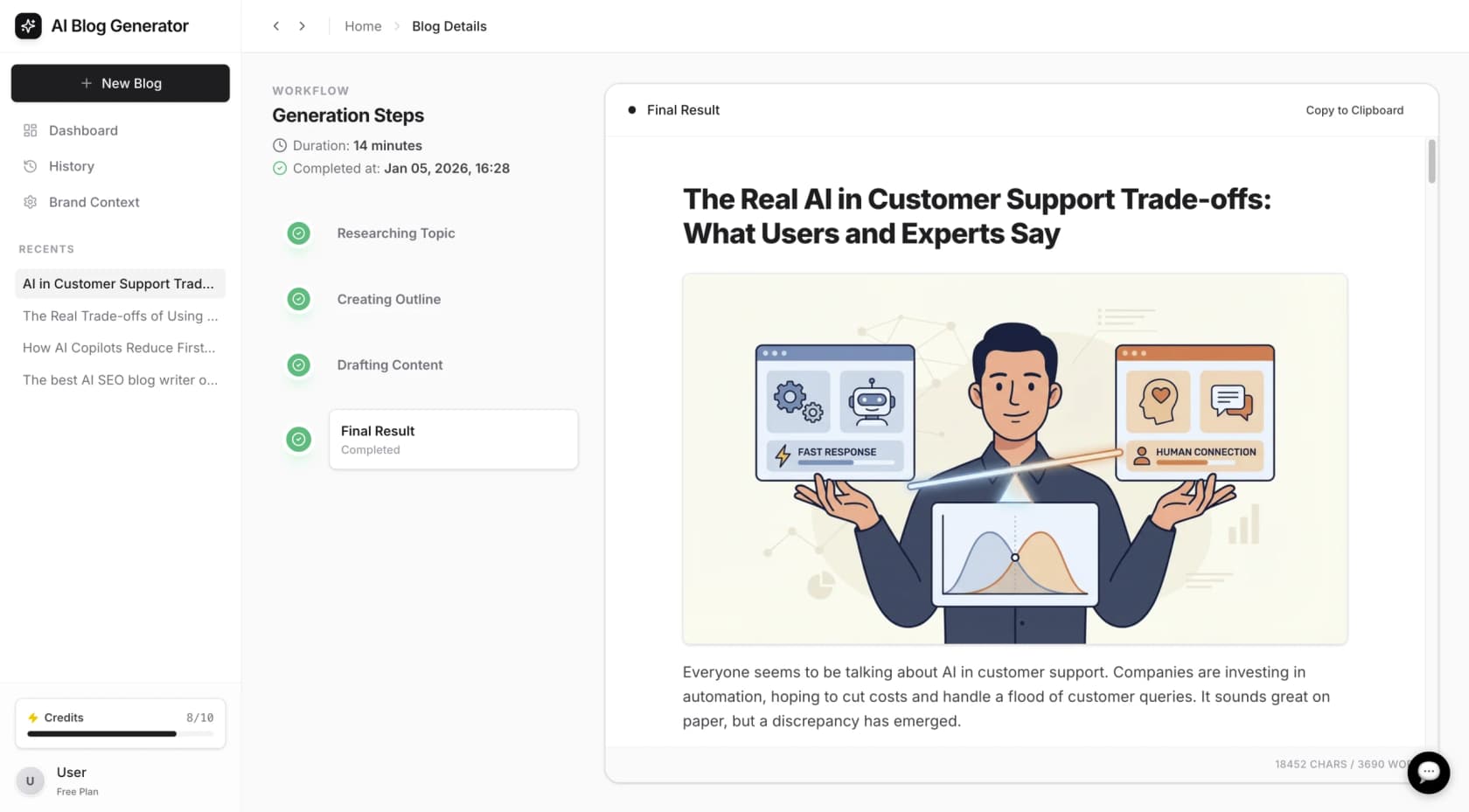
Key features include:
-
It generates and adds AI-powered images, tables, and infographics to create multi-modal content.
-
It integrates social proof by finding and embedding relevant YouTube videos and Reddit quotes, adding an element of human experience and authority.
-
The output is structured for SEO and optimized for AEO and GEO.
As a case study, this tool was used to grow organic impressions from 700 to 750,000 per day over three months.
Pricing plans are available, such as an option to generate 50 blog posts for $99. A free trial is also offered for users to test the content quality.
To see these strategies in action, it can be helpful to watch a walkthrough of a modern AI SEO workflow. The video below provides a complete guide on how to approach AI search and rank effectively in 2026.
Making AI your advantage
In summary, AI SEO is not about finding new "hacks." It is about getting back to basics and doubling down on quality, structure, and authority. The game has changed, but the rules of good marketing have not.
The path forward is a two-pronged attack:
-
Adapt your content strategy for an AI-first search world. That means focusing on GEO and AEO, creating answer-first content, and proving your real-world expertise in everything you publish.
-
Use intelligent AI tools to scale your work without sacrificing the quality that both users and algorithms want. Automate the boring stuff so you can focus on strategy.
The brands that will win in this new era are the ones that pair human expertise with AI efficiency. It is about using technology to consistently produce citation-worthy content that actually helps people.
To explore how AI can assist in content production, you can generate a free blog post with a tool like the eesel AI blog writer.
Frequently asked questions
What is the most important takeaway from this AI SEO guide for 2026?
The biggest takeaway is that AI SEO isn't about new tricks; it's about doubling down on quality. You need to create clear, structured, expert content that's easy for AI to understand and cite, while also using AI tools to scale your production without losing that human touch of expertise.
How does Generative Engine Optimization (GEO), as mentioned in this AI SEO guide, differ from traditional SEO?
Traditional SEO focuses on ranking your page in a list of blue links. GEO, on the other hand, aims to get your content featured directly within AI-generated summaries (like Google's AI Overviews). The goal shifts from just getting a click to becoming a primary source of information for the AI itself.
Does this AI SEO guide suggest that keywords are no longer important?
Not at all. Keywords are still crucial, but the focus has shifted. Instead of just targeting short-tail keywords, you should optimize for conversational, long-tail questions that people actually ask AI assistants. The context and intent behind the keywords are more important than ever.
According to this AI SEO guide, how can I make my content "citation-worthy"?
To become citation-worthy, focus on E-E-A-T (Experience, Expertise, Authoritativeness, Trustworthiness). Include original data, first-hand experiences, unique insights, and link to credible primary sources. This signals to AI that your information is reliable and deserves to be referenced.
What's the best way to get started with the strategies in this AI SEO guide if I have limited resources?
Start with Pillar 1: content. Focus on one core topic where you have real expertise and build a topic cluster around it. Use clear headings and structured data (like schema markup) to make your best content easily digestible for AI. This provides a solid foundation before you tackle more technical aspects.
Can I use AI to write content and still follow this AI SEO guide?
Yes, but you have to be smart about it. Avoid generic AI writers that produce shallow content. Use a tool like the eesel AI blog writer that's designed to create structured, multi-modal posts with built-in social proof and visuals. The key is to use AI to scale quality, not just to produce more text.