

The buzz around AI in content marketing is constant. It's no longer a sci-fi concept but a real, practical tool that marketers are using every day. We're all trying to solve the same puzzle: how do you create great content consistently without completely draining your team or your budget?
The usual content headaches are probably familiar to you: that blinking cursor on a blank page, the pressure of a demanding publishing schedule, and the sticker shock from outsourcing quotes. An AI copilot can help take the edge off these problems. An AI content writer is a piece of software built to tackle these exact issues. Think of it less like a robot taking over your job and more like a creative assistant.
What is an AI content writer?
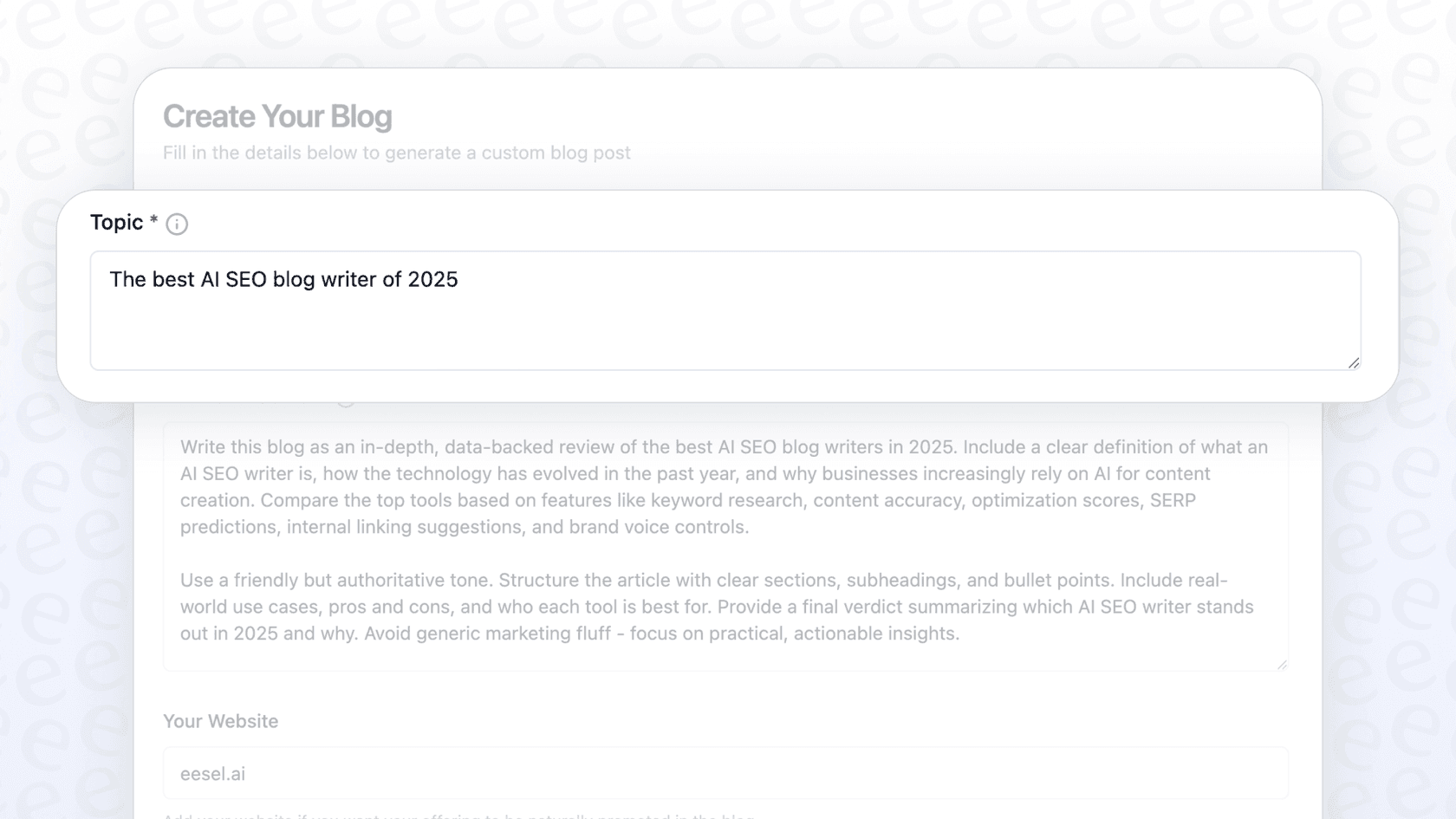
An AI content writer is a tool that uses artificial intelligence to automatically generate text that sounds like a person wrote it. The technology behind it is called large language models (LLMs), which you’ve probably heard about.
This is why the quality of the output depends so much on the quality of the input. The old saying "garbage in, garbage out" has never been more relevant. A vague prompt will get you a vague, generic article. A detailed prompt with plenty of context will get you something much closer to what you were hoping for.
These tools are useful for all kinds of tasks: whipping up blog posts, drafting product descriptions, creating ad copy, or generating social media captions. It's important to note that specialized tools, built for a specific purpose like writing long-form blog posts, often yield more refined results.
The evolution of AI content writers
Not all AI writers are created equal, and the technology has improved dramatically in just a few years. Knowing this history helps explain why some people are still skeptical about AI content, while others are using it to significantly scale their traffic.
There is one major flaw with all 'AI' writers however. The semantic linking profile that it uses is the same across most 'AI' articles. Google can determine this by looking at the top results for your search query and look at how each article is written... Right know 'AI' text ranks. It won't in the next year unless you do significant editing, and I mean nearly rewrite the entire thing.

The early days: From article spinners to AI slop
If you tried an AI writer a few years back and walked away unimpressed, you're not the only one. The common complaint was that early tools were just "fancy article spinners." They would scrape the top-ranking articles for a keyword, shuffle the sentences, swap out a few words, and call it a new piece. The result was often clunky, keyword-stuffed content that felt lifeless and unoriginal.
This wave of low-effort content led to the term "AI slop," which describes text that's technically readable but has no real substance, originality, or human touch. It’s the kind of stuff that feels unpleasant to read and was, thankfully, pretty easy for both search engines and people to identify.
The modern era: The impact of LLMs
Everything shifted with the introduction of advanced LLMs like the GPT and Claude series. These models have a much deeper, more nuanced grasp of language, context, grammar, and tone. Suddenly, AI could generate content that was not just grammatically correct, but actually read naturally and could handle complex instructions.
This leap has opened up a new world for AI content tools. The best platforms today do much more than just generate text. They act as strategic partners, doing deep research, structuring content for readability and SEO, and even creating multimedia assets to accompany the text. The eesel AI blog writer, for example, is built to create a finished asset: a complete, publish-ready blog post, not just a text draft that requires hours of editing.
Key features of modern AI content writers
With so many AI writing tools on the market, it can be hard to figure out which one is right for you. To cut through the marketing noise, it helps to focus on the features that really make a difference in creating content that performs.
Deep context and brand alignment
A good AI writer doesn't just string words together; it understands your intent. The basics are fine, but you should look for tools that can adapt their style and tone to fit your needs. Your brand voice is what makes your content unique, so this is an important factor.
SEO and AEO features
Many AI writers offer basic SEO features, like keyword assistance. The real differentiator is what comes next: Answer Engine Optimization (AEO).
AEO is about optimizing your content to show up in AI-powered search results, like Google's AI Overviews or platforms like Perplexity. With Gartner predicting that 25% of organic search traffic will shift to AI chatbots by 2026, AEO isn't just a nice-to-have feature; it's critical for the future of your content strategy. It involves structuring content with clear, direct answers and a conversational tone so that AI answer engines are more likely to use it and cite you as a source.
Long-form content generation capabilities
While many tools can generate short paragraphs, a key capability of more powerful tools is the ability to create a complete, well-structured, long-form article (think 1,500 words or more) from just a single keyword.
But great content is more than just text. A wall of words can be off-putting. That's why the best tools now automatically generate assets like AI images, custom infographics, and data tables to make the content more engaging and easier to read. Another valuable feature is the ability to pull in real-world context. For instance, the eesel AI blog writer can automatically find and embed relevant YouTube videos and pull real quotes from Reddit threads on your topic. This adds a layer of authenticity and social proof that makes the content feel much more human and credible.
The pros and cons of using an AI content writer
Like any powerful tool, AI content writers have their upsides and downsides. It's important to have a balanced perspective to get the most out of them while steering clear of the common traps.
Benefits: Speed, scale, and efficiency
- Save time: This is the most obvious benefit. You can go from a blank page to a full first draft in minutes, not hours or days.
- Increase productivity: You can scale your content output dramatically without having to scale your team. As a real-world example, our team at eesel AI used our own tool to grow our blog impressions from 700 to over 750,000 in just three months. That would have been impossible with manual writing alone.
- Save money: For many businesses, using an AI writer is much more cost-effective than hiring freelance writers or a large in-house content team.
- Overcome writer's block: AI can be a fantastic brainstorming partner. If you're stuck, you can use it to generate outlines, ideas, or different angles on a topic to get things moving again.
Drawbacks: Generic and inaccurate content
- Lack of original perspective: AI models learn from existing data online. This means they're great at summarizing what's already out there, but they can't create truly original ideas or share personal experiences. This is significant, especially with Google's E-E-A-T guidelines, which place a high value on firsthand Experience, something an AI simply can't have.
- Factual inaccuracy: AI models can "hallucinate," which is a nice way of saying they can make things up and present them as facts with total confidence. This means that rigorous fact-checking by a human is an absolute must.
- Generic "AI voice": Without careful prompting and editing, AI-generated text can feel flat, repetitive, and bland. It can lack a distinct personality, leading to that generic "AI slop" that doesn't connect with readers.
An infographic showing the pros and cons of what is an AI content writer, covering benefits like speed and drawbacks like generic content.
How modern tools address common pitfalls
While these drawbacks are valid for many AI writers, more advanced tools are being built to address these problems.
The eesel AI blog writer, for instance, was designed with these challenges in mind.
- It performs context-aware research: Instead of just pulling from its general knowledge, it does deep research based on your specific topic. For a comparison post, it will find pricing data. For a product review, it will look for technical specs. This greatly reduces the risk of factual errors.
- It has a genuinely human tone: The model has been refined over a year to create content that sounds natural, engaging, and conversational, not robotic.
- It integrates with the real world: By embedding relevant YouTube videos and pulling real quotes and discussions from Reddit, it adds that crucial layer of human experience and authenticity that most AI-generated content is missing.
Will AI replace human content writers?
The short answer is no. The definitive answer from experts, agencies, and even Google itself is that AI is a tool to help human writers, not replace them.
A good content writer will use AI to develop exceptional content for you, and will generate more of it. Unless you’re ready to carefully proof and edit AI content, you need a human content writer. I asked ChatGPT to make my resume 'more convincing' once and it added in a bunch of completely fake stats. AI is helpful, but it’s also a wild card. It needs a human to operate it effectively.
Google's official stance is that it rewards high-quality, people-first content, regardless of how it's produced. Their focus is on the quality of the final product, not the process. This means a poorly written, unhelpful article will perform badly whether a human or an AI wrote it.
For a more in-depth look at how to use AI writers effectively without sacrificing quality, this video provides some excellent rules and best practices.
Your next step in AI-powered content creation
So, what is an AI content writer? It's a tool that has quickly evolved from a simple text generator into a strategic content partner. It offers significant benefits in speed and efficiency, but it's not a magic button. The best results come from a "copilot" approach that combines AI's power with human creativity and oversight.
The future of content creation is this collaboration. It's about using technology to handle the tedious parts so you can focus on what matters most: creating valuable, insightful content that truly connects with your audience.
If you're ready to see what this new wave of content creation looks like, the eesel AI blog writer is the perfect place to start. It’s completely free to try, and you'll get to see firsthand how it can turn a single keyword into a complete, publish-ready blog post with all the assets included, not just a rough text draft.