A practical guide to AI content generation

Stevia Putri

Stanley Nicholas
Last edited January 5, 2026
Expert Verified

It feels like AI content generation has popped up everywhere overnight. Every marketing team seems to be talking about how it can speed up workflows, scale content, and maybe even fetch their coffee. And yeah, some of that is true. The promise of getting more done, faster, is definitely real.
But here’s the tricky part: how do you use these tools without churning out generic, robotic "AI slop"? We've all seen it, the kind of content that looks fine from a distance but has zero personality and doesn't actually help anyone.
That's what we're digging into here. We’ll pull back the curtain on AI content generation, covering how it works, the real pros and cons you should know about, and a straightforward comparison of the most popular tools so you can figure out what’s right for your team.
What is AI content generation?
At its heart, AI content generation is just using artificial intelligence to create new things, like text or images, based on a prompt you feed it. The technology behind it relies on Large Language Models (LLMs), which have been trained on an unbelievable amount of data from across the internet. By sifting through all that info, they learn to spot patterns, grammar, and different writing styles.
A concept that's making AI content much more useful is called Retrieval-Augmented Generation (RAG). It sounds technical, but the idea is pretty simple. Instead of just using its general internet knowledge, you can give the AI a specific set of documents to pull from, like your company’s help articles. This makes the final output way more accurate and relevant to your business. Think of it as the difference between asking a random tourist for directions and asking a local who actually knows the area.
This brings up a key distinction: there's AI-assisted content, where AI gives a human writer a hand, and then there's fully AI-generated content. As one Reddit user put it, the best tools are collaborative.
How does AI content generation actually work?
You don't need a degree in computer science to get the gist of what’s happening behind the scenes. Here’s a quick, non-nerdy breakdown.
The building blocks: Machine learning and deep learning
It all begins with machine learning, which is a way for computers to learn from data without someone having to program every single rule. AI content tools use these algorithms as a starting point.
Deep learning is the next level up, using complex structures called neural networks. You can picture these as a digital brain that can pick up on really complicated patterns like grammar, sentence structure, and even stylistic habits. This is what helps AI-generated text sound less like a machine and more like a person.
The engine: Transformer networks and LLMs
The real engine driving modern AI is the Large Language Model (LLM), like the GPT models from OpenAI. An LLM is basically a super-sophisticated predictive text engine. It works by constantly guessing the next most likely word in a sentence, based on all the data it's learned from.
The secret ingredient is something called a "transformer architecture." This lets the model look at an entire piece of text to understand the context, not just the last few words. It’s the reason an AI can write a long, coherent article instead of just a jumble of random sentences.
The specialization: Fine-tuning on your data
A general LLM knows a little bit about everything, but it doesn't know the specifics of your business. That’s where fine-tuning comes into play. By training a model on your own content, like your blog or knowledge base, you can teach it to adopt your brand voice and use your specific lingo. This is how you get content that’s not just well-written, but also sounds like it came from you.
The different types of AI content generation
While text is the most common use, AI's creative talents are growing fast. Here’s a peek at what these tools can whip up.
Text content: From blogs to social media
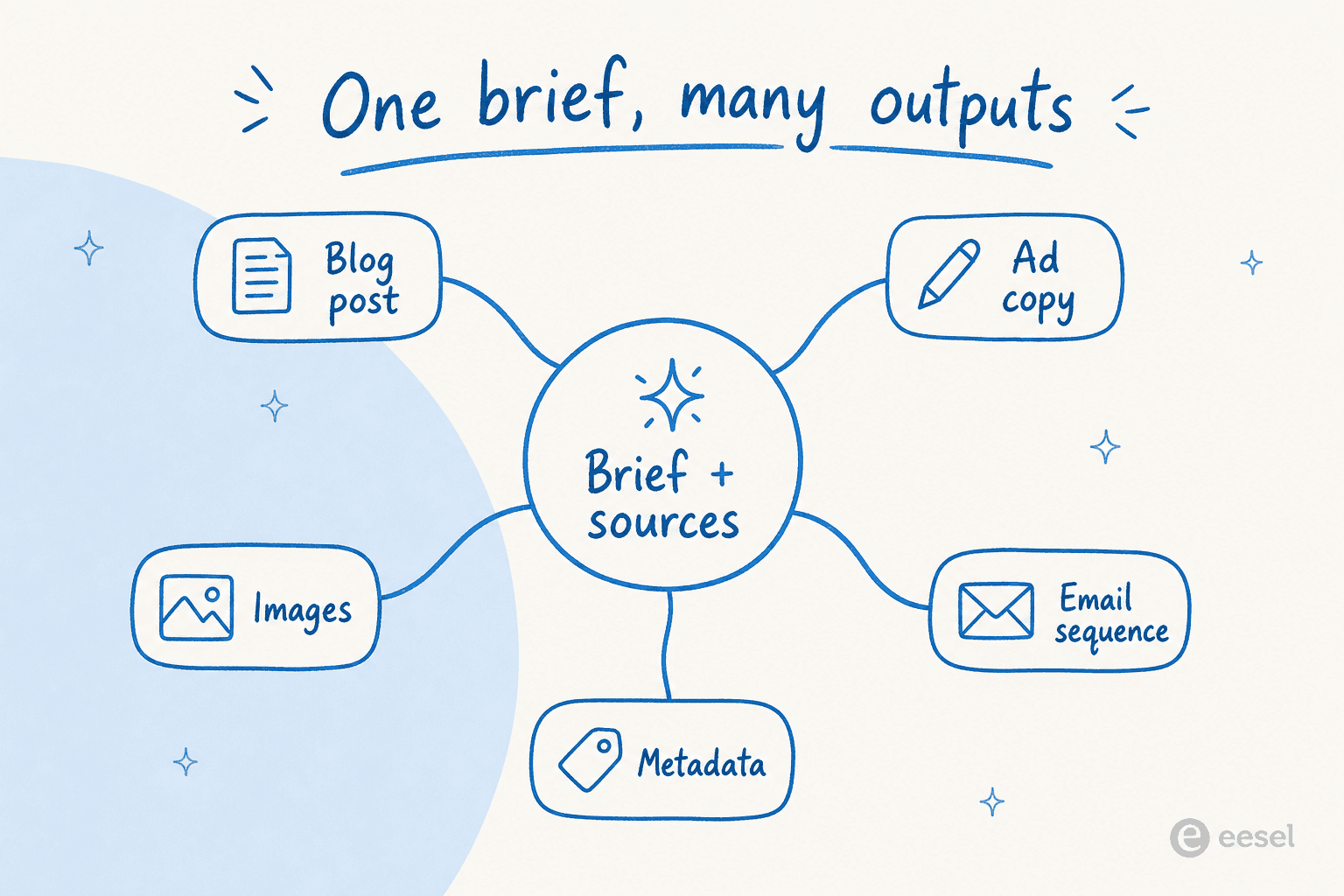
This is the main event for AI content generation. It covers just about any written format you can imagine:
-
Blog posts and articles
-
Social media captions
-
Ad copy and landing page text
-
Product descriptions
-
Emails and newsletters
Visual content: Images and video clips
AI is getting surprisingly good at making visuals. Tools like DALL-E and Midjourney can produce incredible images from a simple text prompt. This is great for creating custom blog headers or social media graphics without needing to hire a designer. We're also starting to see text-to-video tools that can create short clips, which are perfect for spicing up your written content.
Audio content: Voice-overs and podcasts
Need a voice-over for a video but don't have a good microphone (or just can't stand the sound of your own voice)? AI can handle that. Voice synthesis tools can generate realistic-sounding audio in different languages and accents. Some tools can even create entire podcast scripts, opening up new avenues for audio content.
The benefits and challenges of AI content generation
AI can be a fantastic asset, but it's not a silver bullet. It’s smart to have a realistic view of what it can and can't do.
The upsides: Speed, scale, and idea generation
-
Speed & Efficiency: This is the big one. An AI can produce a first draft in seconds, saving you hours of staring at a blank screen.
-
Scalability: Want to publish five blog posts a week instead of just one? AI makes it possible to create content at a volume that would be tough for a human team to match.
-
Beating Writer's Block: We've all been there. AI is an amazing brainstorming partner. You can ask it for outlines, topic ideas, or different takes on a subject to get things moving.
The downsides: Generic output, factual errors, and lack of originality
-
The "AI Slop" Problem: The biggest risk is creating bland, soulless content. Many tools churn out repetitive text that lacks a unique voice. As one marketer on Reddit wisely advises, you always need to clean up the output.
Above all though I always clean up the cringe at the end, rewrite some, and take out all the damn emojis. -
Accuracy and Hallucinations: AI models can, and often do, just make things up. They might present completely false information as a hard fact. This means a human absolutely must review and fact-check everything the AI produces.
-
Google's Stance: A lot of people worry that using AI will get them penalized by Google. The reality is, Google cares more about whether the content is helpful than how it was made. Their official stance is that quality matters more than the creation method. As one content writer put it when asking for advice:
So, high-quality content made with AI is fine. Low-quality "AI slop" will tank your rankings.
Comparing popular AI content generation tools
Not all AI tools are the same. They usually fit into a few categories, each with its own pros and cons.
The conversational generalists: ChatGPT and Gemini
These are the big names everyone knows. They're powerful, flexible conversational AIs that are great for brainstorming, outlining, or rewriting a paragraph.
They're best for marketers who need a creative sidekick for ideas or for generating short copy like a social media post or a quick email.
But they have their limits. They're basically "blank slates" that require a lot of prompting and back-and-forth to get what you really want. The free version of ChatGPT has internet usage caps, which can be a limitation for researching current events. More importantly, the output is just a wall of text. It's up to you to handle all the formatting, fact-checking, and adding images.
The marketing copy assistants: Jasper and Copy.ai
Platforms like Jasper and Copy.ai are designed specifically for marketing teams. They come with templates and guided workflows for different content types, which can help speed things up.
These are good for teams that need to produce a lot of different marketing copy regularly. Jasper generally markets itself for long-form and SEO content, while Copy.ai leans more into short-form content and sales outreach.
Still, the output can sometimes be generic and often needs a lot of human editing to add personality and original insights. According to some reviews, Copy.ai lacks strong SEO features. And while Jasper works with Surfer SEO, both tools mostly just give you a text draft. You're still responsible for finding or creating all the other assets to make a post publishable.
| Feature | Jasper | Copy.ai |
|---|---|---|
| Primary Focus | Long-form, SEO-focused content | Short-form, Go-to-Market (GTM) copy |
| SEO Tools | Surfer SEO integration | No direct SEO integrations mentioned |
| Brand Voice | Advanced (Brand IQ, voice uploads) | Basic (Infobase for brand facts) |
| Pricing (Annual) | Pro plan from $59/month per seat | Chat plan from $24/month for 5 seats |
| Output Type | Primarily text-based drafts | Primarily text-based drafts and workflows |
Comprehensive content generation platforms
This next group of tools aims to address challenges like heavy editing requirements and the need for separate asset creation. The idea here isn't just to hand you a text draft, but to deliver a complete content package that's ready to publish.
The eesel AI blog writer is an example of this approach. It's designed to turn a single keyword into a complete, SEO-optimized blog post that you can use.

Here’s what sets this kind of tool apart:
-
Goes Beyond the Draft: Instead of just spitting out a block of text, eesel AI generates a fully structured post with an introduction, headings, a conclusion, internal links, and external citations.
-
Automatic Asset Generation: It automatically creates and inserts relevant, AI-generated images, infographics, and data tables directly into the article, making the content more visually engaging and easier to digest.
-
Authentic Social Proof: To add authenticity, it can embed relevant YouTube videos and pull real quotes from Reddit forums. This adds a layer of authenticity that purely AI-generated text often lacks.
-
AEO Optimization: It’s optimized for both traditional search engines (SEO) and Answer Engine Optimization (AEO). This means the content is structured to show up in newer formats like Google's AI Overviews and Perplexity.
We actually built this tool for our own use, and the results have been pretty wild. We used it to go from 700 to 750,000 impressions per day in just 3 months by publishing over 1,000 optimized blogs. It's completely free to try, so you can see the quality for yourself.
Best practices for using AI content generation effectively
No matter which tool you pick, your success really comes down to how you use it. Here are a few tips to keep in mind.
-
Always Start with Strategy: An AI is a tool, not a strategist. You still need to do the important thinking upfront. Your content goals, target audience, and keyword strategy should always lead the way.
-
Keep a Human in the Loop: Never just copy and paste. Treat the AI's output as a solid first draft. A human editor needs to review, fact-check, and polish everything to add your brand's unique voice, personal stories, and expert insights.
-
Provide Good Context: The quality of what you get out is directly tied to the quality of what you put in. Use tools that let you provide specific brand context, details about your audience, and clear style guidelines. The more you give the AI, the better the result.
-
Focus on Value, Not Just Volume: It’s easy to get caught up in churning out tons of content with AI, but that's a losing strategy. As Google's guidelines state, your focus should always be on quality and helpfulness, no matter how the content gets made.
To see how these concepts come together in a practical workflow, check out this video from HubSpot. It provides a great overview of how to integrate AI tools into your content creation process from start to finish, ensuring you're generating revenue-generating assets, not just text.
A video from HubSpot Marketing explaining a complete AI-powered content creation workflow, from idea to revenue-generating asset.
Making AI content generation work for your content strategy
AI content generation is here to stay, and it’s an incredibly powerful technology. As we've seen, different tools offer varying levels of functionality. Some provide a text draft, while others deliver a more complete post with visuals and links.
The goal isn't to replace human writers but to augment their capabilities. It’s about freeing up your team from the more tedious parts of content creation so they can focus on what really moves the needle: strategy, promotion, and building a real connection with your audience.
Ready to see what a complete, SEO-optimized blog post generated from a single keyword actually looks like? Generate your first blog for free with the eesel AI blog writer and experience the difference.
Frequently asked questions
Not if you do it right. Google's main concern is the quality and helpfulness of the content, not how it was made. As long as your AI content generation produces original, high-quality, and helpful articles, you're in the clear. Low-effort, spammy AI content, however, will definitely hurt your rankings.
The biggest mistake is treating the AI's output as the final product. You should always use it as a first draft. A human needs to review, fact-check, and add unique insights, brand voice, and personal anecdotes to make the content truly valuable.
The key is to provide the AI with as much context as possible. Use tools that allow you to define your brand voice, target audience, and specific style. Also, fine-tuning the model on your own existing content can teach it to write more like you. And, of course, a final human edit is crucial.
Not at all! While it's great for blogs, you can use AI content generation for almost any type of content, including social media captions, ad copy, product descriptions, emails, and even scripts for videos and podcasts. AI can also generate images, infographics, and audio.
It's unlikely. The goal of these tools isn't to replace writers but to make them more efficient. AI is fantastic for handling the initial research, outlining, and drafting, which frees up human writers to focus on higher-level tasks like strategy, editing, and adding the creative spark that AI can't replicate.
General tools like Gemini are like a blank canvas-powerful but require a lot of guidance to produce marketing content. Specialized tools, like the eesel AI blog writer, are built specifically for content creation. They often include SEO features, templates, and even generate assets like images and tables, giving you a more complete, publish-ready article.
Share this post

Article by
Stevia Putri
Stevia Putri is a marketing generalist at eesel AI, where she helps turn powerful AI tools into stories that resonate. She’s driven by curiosity, clarity, and the human side of technology.