

Many content creators face the challenge of consistently producing high-quality material. The cycle of researching, writing, and editing can be demanding, creating a constant need to publish quality content to stay relevant.
AI has evolved significantly beyond basic writing assistance, now offering capabilities for comprehensive content automation. The focus has shifted from merely increasing writing speed to producing a higher volume of quality, engaging content.
This guide explores what it means to automate content creation with AI. We will review several popular platforms and identify the key features that enable comprehensive content automation beyond simple text generation.
What does it mean to automate content creation with AI?
AI content automation refers to using software to generate complete, publish-ready articles with minimal manual intervention. This process covers everything from the initial idea to the final draft.
The objective is not to replace human creators but to augment their capabilities. AI can handle repetitive tasks, allowing teams to focus on strategy, creativity, and audience engagement.
Key benefits include:
-
Saving time: Automation can significantly reduce the hours spent on research, drafting, and creating visual assets like images or charts.
-
More content: It allows for an increase in content output without a proportional increase in team size or budget.
-
Staying on-brand: AI can be trained to adhere to a specific brand voice and style, ensuring consistency across all content.
Popular platforms to automate content creation with AI
The choice of tool depends on a team's specific needs and technical preferences. Some platforms excel at text generation, while others provide comprehensive frameworks for building custom content workflows. Let's look at a few of the best generative AI tools.
Jasper: The AI marketing co-pilot
Jasper is a well-known name in the AI space, primarily focused on marketing teams. It began as a simple copywriting tool and has expanded into a system for building "Content Pipelines" to automate various marketing tasks.
Jasper provides a "Canvas" for long-form writing, "Jasper IQ" to teach the AI a brand's voice and knowledge, and "Agents" to handle tasks like research. The platform is designed for what they term "Content Engineers", individuals who build and manage automated marketing systems.
Sometimes Jasper and Writesonic feel a bit too 'default' for me, like, all the outputs got the same voice. You run into that? I do like Scalenut’s Cruise Mode though for bulk content.

The Pro plan starts at $59 per month with an annual subscription. Larger teams that require more control and API access can opt for a custom Business plan.
While Jasper is effective for automating marketing workflows, it requires users to assemble the different components, such as text and visuals, to create a finished article. While it produces on-brand copy, the process of creating a complete blog post involves manual steps.
ContentBot: Automation through AI workflows
ContentBot takes a similar approach, using customizable workflows it calls "Flows" for content automation. It is designed for marketers and agencies that need repeatable systems for generating content, including full blog posts.
Its main features include a visual "AI Flow" builder, an "AI Blog Writer," and an "Importer" for bulk content creation from a spreadsheet. It also has a "Humanizer" feature, intended to make the AI text sound more natural.
ContentBot’s pricing is flexible, making it easy to get started.
| Plan | Price (Monthly) | Words/Month | AI Workflows |
|---|---|---|---|
| Prepaid | $0.50 per 1,000 words | Pay-as-you-go | Included |
| Starter | $9 | 50,000 | Included |
| Premium | $29 | 150,000 | 3 |
| Premium+ | $49 | 400,000 | Unlimited |
Building "Flows" may require a time investment for users who prefer a more straightforward article generation process. The platform includes a "Humanizer" feature, which can be used to refine the AI-generated text to ensure a more natural tone, potentially adding an extra editing step.
An AI writing detector can provide another signal during review, but its score should not replace checks for accuracy, clarity and originality.
Make and n8n: The DIY automation engines
Tools like Make and n8n are also available. It is important to note that these are not dedicated content creation tools. They are integration platforms that allow users to connect different applications (like OpenAI, Google Sheets, and WordPress) to build custom content automation pipelines from scratch.
You could use a workflow automation platform like N8N or Make. Nevertheless, the most robust way to create this system would be with coding (e.g., Python script). For this use case, you do not need an agent. The process looks sequential, and the next step to take is clear.
Both offer visual workflow builders, connect to thousands of apps, and provide users with control over the automation logic. n8n is a "fair-code licensed" tool that can be hosted for free, which is a benefit for technically proficient users. Make is often considered to have a more user-friendly interface.
Both platforms have free tiers for smaller tasks. Make's paid plans start at $9 per month for its Core plan, and n8n's cloud-hosted Starter plan begins at $20 per month.
These platforms have a significant learning curve and are best suited for developers or technical marketers with experience in building automated workflows. They may not be the ideal solution for content teams seeking a simple way to generate articles. Tutorials for these systems show users how to manually set up steps, modules, and error checks.
Key features for true content automation
When evaluating tools for content automation, it's useful to look beyond basic text generation. A comprehensive automation system manages the entire content lifecycle, from topic ideation to a finished piece, without requiring complex systems integration.
Beyond text generation: Complete asset creation
Many AI writers primarily generate text, which requires users to spend additional time sourcing images, creating infographics, and formatting tables to complete a post.
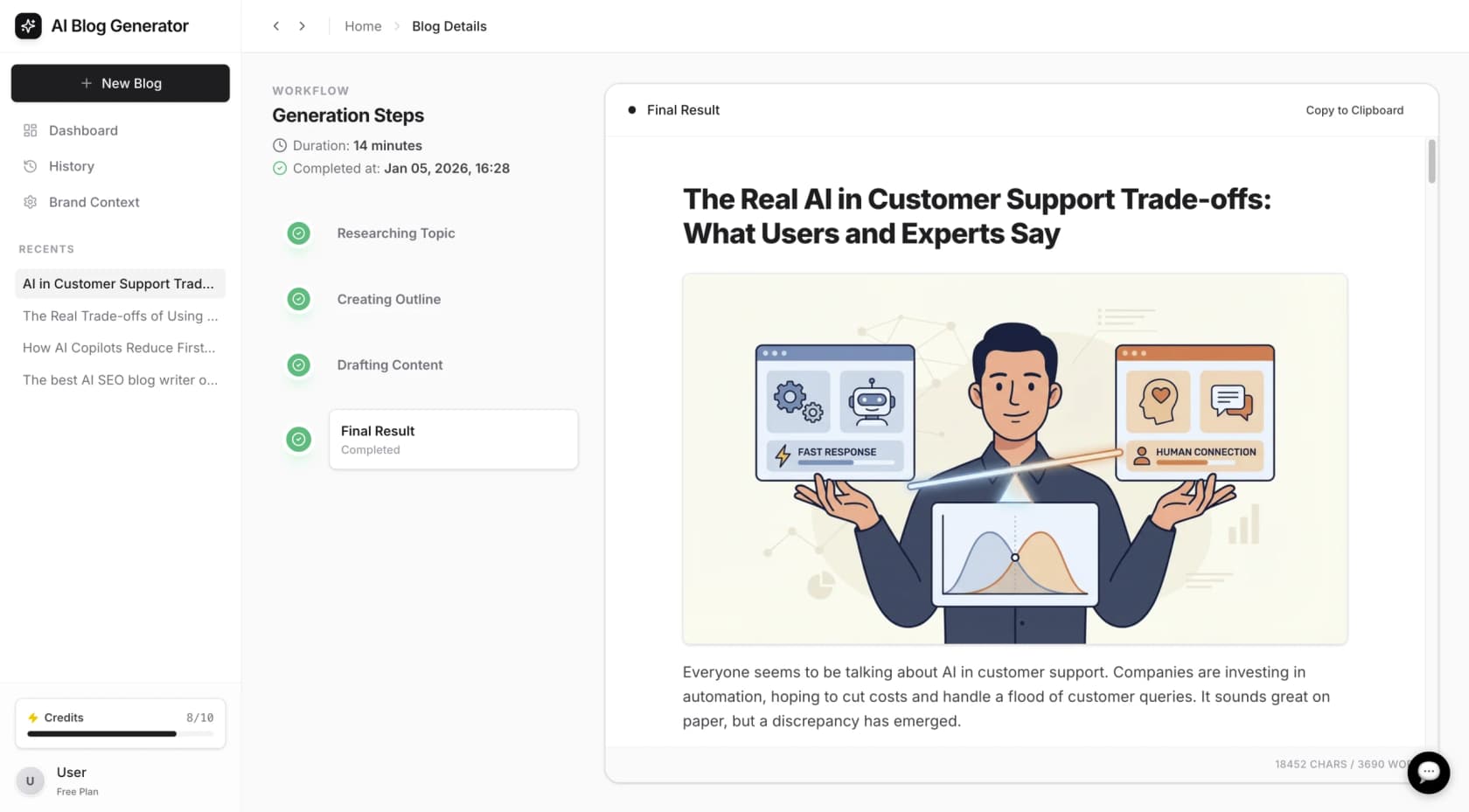
An alternative approach is a tool that generates the entire article, including assets. This provides a publish-ready post with visuals automatically created and placed within the content. For example, the eesel AI blog writer creates AI images, charts, and tables directly inside the article, reducing the need for multiple tools.
Social proof and real-world context
Content that is entirely AI-generated can sometimes lack the authenticity of human perspectives.
Adding social proof (the concept that people trust the actions and opinions of others) is an effective way to build credibility. Displaying user opinions or endorsements can build trust. Manually searching for relevant user comments on platforms like Reddit can be time-consuming. That's why the eesel AI blog writer automatically finds and embeds relevant Reddit quotes, grounding the content in real-world experiences.
Context-aware research and AEO
Generic AI-generated content may not always align with specific search intent, such as a user looking for a product comparison, a how-to guide, or a general overview.
A smart tool needs to conduct context-aware research, incorporating specific details like pricing for a comparison post or technical specifications for a review. It should also be optimized for Answer Engine Optimization (AEO), meaning the content is structured to be featured in Google's AI Overviews and other answer engines.
How eesel AI automates content creation
At eesel AI, our approach was to develop a tool to address common challenges in our own content strategy. Using our AI blog writer, our daily search impressions increased from 700 to 750,000 in three months by publishing over 1,000 optimized posts.
The process involves providing a keyword to receive a complete, SEO-optimized blog post. This is designed for content teams that need to produce high-quality content efficiently.
Here’s what makes our articles finished products, not just first drafts:
| Feature | How it works |
|---|---|
| Complete Assets | Automatically makes and inserts AI images, infographics, and tables. |
| Social Media Integration | Embeds relevant YouTube videos and real Reddit quotes for a dose of reality. |
| Context-Aware Research | Grabs the right info based on the blog type (like pricing for comparisons). |
| AEO Optimization | Structures content to show up in AI answer engines like Google AI Overviews. |
| Natural Product Mentions | Learns your brand from your website to drop in subtle, natural product mentions. |
Visualizing how these automation workflows come together can be helpful. Many creators share their step-by-step processes for using different AI tools to build a content engine.
Moving from drafts to publish-ready content
To effectively automate your content creation, a tool should offer more than text generation. It should function as a content strategist, managing research, drafting, asset creation, social proof integration, and formatting.
While some tools offer powerful automation capabilities, they may require users to build and manage complex systems. The objective extends beyond writing speed to publishing high-quality, engaging content that achieves results. Effective tools simplify the entire process.
For those looking to streamline the process of combining drafts and visuals from multiple sources, exploring a tool that produces publish-ready articles can be beneficial. Generate your first blog post for free to see a fully automated approach.
Frequently asked questions
What is the main benefit of automating content creation with AI?
The biggest benefit is saving a massive amount of time. Instead of spending hours on research, writing, and finding visuals, you can generate a complete, publish-ready article in minutes. This lets you scale your content production without burning out your team.
Can I still maintain my brand voice if I automate content creation with AI?
Yes. Many advanced AI tools can be trained on your existing content to learn your specific brand voice, style, and key messaging. For instance, platforms like Jasper have features for this, and tools like eesel AI can learn from your website to include natural product mentions that sound like you.
What is the difference between an AI writer and a full content automation tool?
An AI writer typically just gives you text. A true automation tool handles the entire process. It does the research, writes the draft, creates and embeds visuals (like images and charts), integrates social proof (like Reddit comments), and formats everything into a publish-ready post.
Is it expensive to automate content creation with AI?
It varies. Some platforms have entry-level plans starting around $9-$50 per month, while more advanced or enterprise solutions can be more expensive. The key is to look at the return on investment. If a tool saves your team dozens of hours a month, it often pays for itself very quickly.
Will the content be SEO-friendly if I automate content creation with AI?
Yes, many tools are built with SEO in mind. They perform context-aware research to match search intent and structure the content for things like Google's AI Overviews (AEO). Our tool at eesel AI, for example, is designed to create posts that are optimized right out of the box, based on a single keyword.
Do I need technical skills to automate content creation with AI?
Not necessarily. While DIY platforms like Make or n8n require technical know-how, many tools are designed for content creators and marketers. Platforms like the eesel AI blog writer are built to be incredibly simple: you just provide a keyword, and it handles the rest.