

You know that feeling, right? You peek at your analytics, and that one blog post, the one you spent ages perfecting last year, is starting to fade. The rankings seem fine, but the traffic is just trickling away. It's a frustrating little problem called "content decay," and it can quietly sabotage even the sharpest SEO strategies.
Sure, you could manually update every post, but who has the time for that? It's a huge chore. As a guide from Search Engine Land on content decay notes, keeping content fresh is vital, but doing it all by hand just doesn't scale. So, how do you stop your entire content library from going stale without hiring an army of writers?
The answer is to automate the refresh process with AI. Modern tools like the eesel AI blog writer are completely changing how this works. Instead of just tweaking a few sentences, you can take your original keyword and generate a brand new, fully optimized article that’s ready for 2026. It’s all about working smarter, not harder, to keep that traffic you worked so hard for.
Understanding content decay and the need for content refreshes
Content decay is just the natural, gradual decline of a piece of content’s organic traffic and search rankings over time. Think of it like a new car: it starts losing value the second you drive it off the lot. Your content works the same way. The moment you hit publish, the clock starts ticking on its relevance.
But why does it happen? It's not just about your content getting "old." A few things are usually going on behind the scenes:
- The sneaky traffic thief: Hidden content decay. This one’s a real pain. You look at Google Search Console, and it says you're still ranking on page one. Great! But your clicks are tanking. What gives? The search results page itself has evolved. As SERPs add more features like Google's AI Overviews, "People Also Ask" boxes, and video carousels, they pull clicks away from the classic blue links. Your content is still there, but fewer people are actually clicking on it.
- Google loves fresh content. For a lot of topics, Google just plain prefers new information. If you’re writing about social media trends, SEO tactics, or the best software of the year, a post from 2026 won’t be very helpful in 2026. Google knows this and gives a little boost to content that has been recently updated.
- Search intent is always changing. What people are looking for when they type in a keyword changes over time. A year ago, someone searching for "AI content tools" might have wanted a simple text generator. Today, they probably expect a tool that also creates images, does research, and optimizes for SEO. If your content doesn't match what people are looking for right now, Google will favor competitors who do.
Fixing content decay isn’t just about damage control; it’s a huge opportunity. A good content refresh strategy lets you:What you need to do is look at the pages rank position - if its not ranking - then you didnt target properly or well.

- Get back the organic traffic you lost and climb back up the rankings.
- Give your readers a better experience with current, accurate, and genuinely helpful information.
- See a much higher ROI than creating new content from scratch. You already did the hard work of getting the page to rank once; now you’re just giving it a tune-up.
Manual vs. automated content refreshing
When it comes to fighting content decay, you have two main options: the old-school manual approach or the new, automated workflow.
The traditional manual process
The old way of refreshing content is detailed, but it can be time-consuming. It usually involves a bunch of steps that can take hours, if not days, for a single blog post.
- Content audit: First, you have to dig into Google Search Console. You set date comparisons, usually looking at the last three months versus the three months before that, and export everything to a spreadsheet to find pages with falling traffic.
- SERP analysis: Once you find a decaying post, you have to manually Google its main keyword. Then you open the top 5-10 competing articles and start picking them apart, looking for new subtopics, different angles, and updated info that you’re missing.
- Rewriting and updating: Now for the actual writing. You have to hunt for new stats, find and replace broken links, update screenshots, and often rewrite whole sections to match the new search intent you found.
- On-page SEO checks: After all that, you still need to go back and manually tweak your meta title, description, headers, and internal links to reflect the new content.
Doing this for one post is a project. Doing it for ten or twenty is basically a full-time job, which makes it impossible to manage your whole content library.
The modern automated approach
The new way flips the whole process on its head by using AI to do the heavy lifting. Instead of treating a content refresh as a manual editing job, you treat it as a content generation job.
With an automated workflow, AI platforms can analyze the current SERP for your target keyword and generate a completely new, fully optimized draft in minutes. This isn't about making small changes; it's about creating the best possible version of that article for today's search landscape.
A modern workflow for automated content refreshing
Ready to try this out? Here’s a simple, step-by-step workflow for setting up an automated refresh process. We’ll use the eesel AI blog writer as our main tool because it’s built for exactly this kind of work.
Step 1: Identify high-potential pages
First stop: Google Search Console. You need to find the articles that will benefit most from a refresh.
Open the "Performance" report and set the date range to compare the last 3 months to the previous 3 months. This will quickly show you which pages are losing clicks and impressions. You're looking for two types of opportunities:
- Pages with a big click decline: Look for content that has dropped by 25% or more. These are the posts that need attention right away.
- "Quick win" pages: Find articles ranking at the bottom of page one or the top of page two (positions 11-20). These pages are so close to driving real traffic, and a refresh is often all they need to jump into the top spots.
Step 2: Generate a new version with eesel AI
Once you've picked a post to refresh, don't even bother opening the old draft. The best way to do this now is to generate a completely new, perfectly optimized version from scratch using the original keyword.
The process couldn't be simpler:
- Grab the primary keyword from your underperforming post.
- Head over to the eesel AI blog writer and plug in that keyword.
- Add your website URL. This is an important step because it lets the AI understand your brand’s context, tone, and products, so it can weave in natural mentions.
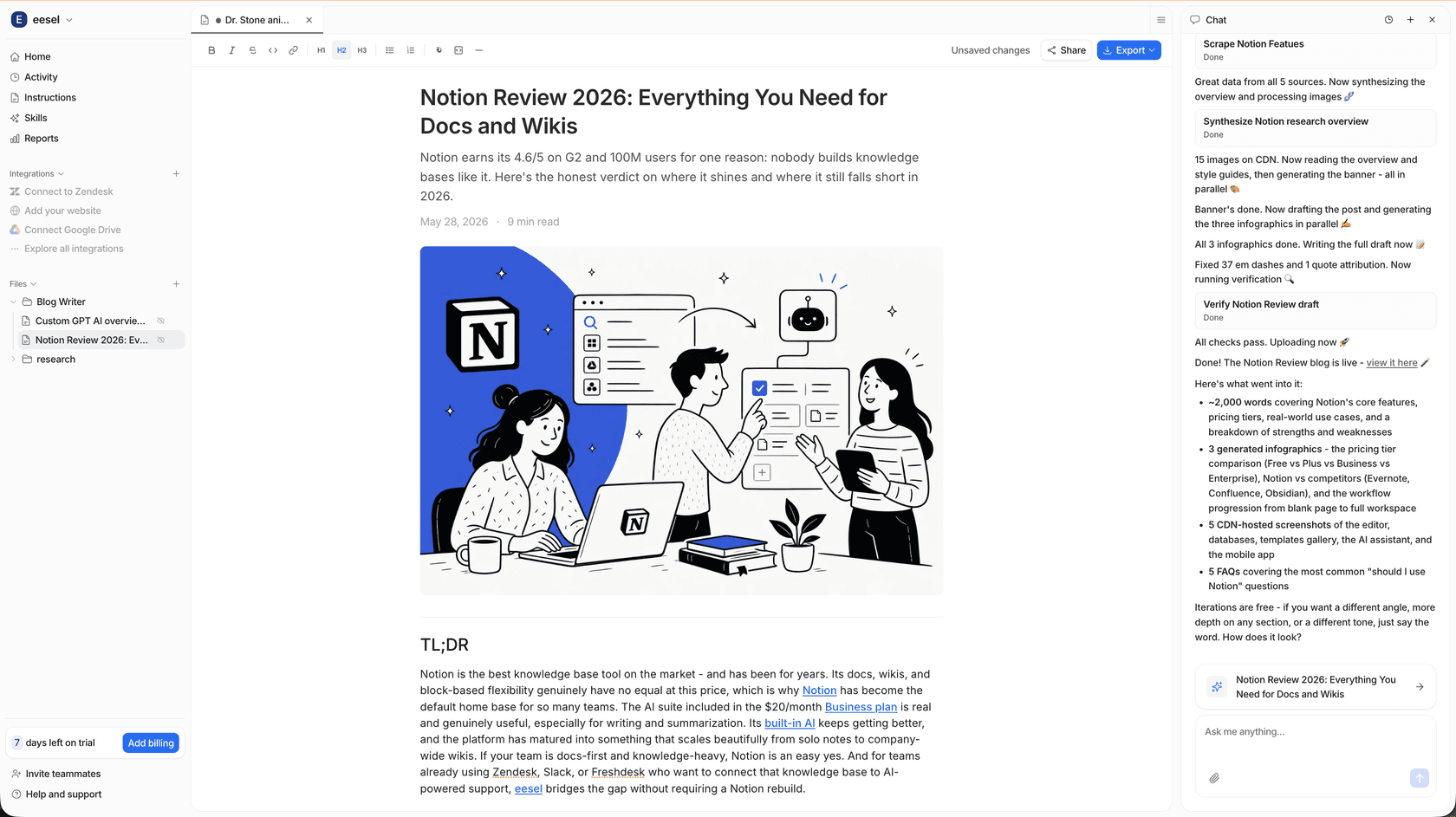
eesel AI then gets to work, automatically doing the SERP analysis and deep research you used to do by hand. In just a few minutes, it gives you a complete, publish-ready blog post that is perfectly aligned with current search intent and filled with rich media assets.
Step 3: Review, merge, and publish
The AI has done most of the work, and now it’s your turn to add the final strategic touches. Go through the new AI-generated draft. It will be about 90% of the way there, but you can add your unique human perspective.
If your original article had any unique insights, customer quotes, or internal data, just merge them into the new version. The great thing is that the new draft from eesel AI will already include updated assets like AI-generated images, tables, relevant YouTube videos, internal links, and external citations, saving you even more time.
Once you’re happy with it, publish the updated content on the same URL. Don’t create a new page! Finally, pop into Google Search Console and request re-indexing to let Google know your content is fresh and ready for a rankings boost.
Key features to look for in an automated refresh tool
As you start looking at tools to automate your content refreshes, you’ll find they aren't all the same. Here are the key features to look for to make sure you’re getting a platform that will actually get you results.
Full content generation vs. in-place optimization
First, you need to understand the two main approaches. Some tools, like Surfer SEO's Auto-Optimize feature, work by adding to your existing content. They analyze your text and suggest relevant keywords and terms to add to boost a "Content Score." This can be useful for small tweaks or when you’re just trying to optimize a piece that’s already doing pretty well.
However, for a real content refresh where search intent has shifted, that may not be enough. The whole structure of your original article might be outdated. This is where a platform like the eesel AI blog writer really stands out. It doesn't just edit your old post; it generates an entirely new, perfectly structured article from just the keyword. This ensures your content is built from the ground up to match what’s currently ranking.
Integrated asset and media creation
A good content refresh is about more than just text. Modern blog posts need to be visually engaging with images, charts, and videos to keep people reading. Manually creating or finding these assets is another huge time sink.
A key feature to look for is a tool’s ability to automatically create and embed these assets for you. The best platforms will generate custom images and infographics, build helpful tables, and even find and embed relevant YouTube videos right into the draft. This is a core feature of the eesel AI blog writer, turning what used to be a multi-hour task into something that requires zero effort.
SEO and AEO optimization
In 2026, you can't just optimize for traditional search engines; you also need to optimize for AI Answer Engines like Google AI Overviews, Perplexity, and ChatGPT. This new field is called Answer Engine Optimization (AEO), and it's all about structuring your content so AI models can easily find, understand, and cite it in their answers. This is a big deal, as Gartner predicts that by 2026, 25% of organic traffic will shift to these AI chatbots.
A forward-thinking tool should be built for both SEO and AEO. This means structuring content with clear headings, scannable sections, and dedicated FAQ areas that give direct answers to common questions. The eesel AI blog writer is designed for this, even integrating real Reddit quotes to capture the community consensus that answer engines really value.
User interaction data is fed into ML systems. Said ML system(s) then identify any patterns within the data that allows them to 'reliably' ascertain what a satisfactory interaction with a page looks like for the query.
Contextual brand understanding
Finally, one of the biggest headaches with AI content tools is getting them to sound like you and talk intelligently about your own products. Generic AI content is easy to spot and rarely leads to conversions.
Look for tools that can absorb your website’s context to learn your brand voice, understand your positioning, and subtly weave in product mentions where they make sense. This is a unique strength of eesel AI. By simply providing your URL, it learns your business and creates content that feels like a natural part of your brand, not something churned out by a robot.
Scaling content freshness with automation
Content decay is going to happen, but losing traffic doesn't have to. While the manual refresh process is too slow and expensive to be a real solution, AI-powered automation has completely changed the game. Refreshing your existing content is one of the highest-ROI things you can do in content marketing, and now it’s faster and easier than ever.
For a visual walkthrough of how a content refresh can be approached, the video below demonstrates some key principles for updating old posts to regain their SEO traction.
You understand the problem and you have the workflow. The only thing left to do is try it for yourself.
The eesel AI blog writer is the perfect tool to get started with because it handles the entire process, from research and SERP analysis all the way to a publish-ready draft complete with assets. We used this exact tool to take our own blog from 700 to 750,000 daily impressions in just three months by refreshing and publishing over 1,000 posts.
It's completely free to try. Generate your first refreshed post today and see the difference for yourself.