

You’ve probably seen the promises of AI: churning out hundreds of blog posts in a flash. But you've also heard the horror stories, sites getting slapped by Google for "scaled content abuse." Let's be real, scaling content is a high-stakes game. Get it wrong, and your rankings could tank. Get it right, and you're looking at some serious growth. The secret isn't just about speed, it's about building a smart, sustainable system.
This guide will show you the difference between reckless AI spam and strategic, safe content scaling. We'll walk you through a framework that prioritizes quality, authority, and results that actually last. We’ll also show you how tools like the eesel AI blog writer can help you build a content engine that works with you, not against you. It's the same approach we used to grow our own impressions from 700 to over 750,000 in just three months.
Understanding scaled content in Google's eyes
Before we get into the "how-to," it's important to understand what "scaled content" really means. Google's March 2026 core update and new spam policies drew a clear line in the sand, and crossing it can get you into trouble.
The risky approach: Scaled content abuse
Google’s policy on "scaled content abuse" is pretty blunt: generating tons of pages just to manipulate search rankings, without actually helping users. This applies whether you're using AI, an army of human writers, or both. This kind of content is usually easy to spot, it's low-quality, unoriginal, and published without any real review or thought for the reader. This approach carries the risk of manual penalties that can drag down your entire site.
The strategic approach: Programmatic SEO
The safe and effective way to scale is through a strategy often called programmatic SEO. This isn't about spamming. It's about using data and templates to create high-quality, valuable content in a structured way. This method focuses on building topic clusters, which are deep networks of interconnected content that establish your site as an authority on a subject. According to Moz, sites with high topical authority see a 25% increase in organic traffic. The goal is to systematically cover a topic from every angle, creating a go-to resource for users and signaling your expertise to search engines.
The foundations for scaling SEO content safely
To scale content without getting penalized, you need a solid foundation. Just hitting "publish" a hundred times a week on a shaky website is a recipe for disaster. Here are the core pillars you need to have in place first.
Build authority with topic clusters
Instead of writing random articles, organize your content using the hub-and-spoke model. It’s simple: a "pillar page" (the hub) covers a broad topic, while "cluster content" (the spokes) dives into specific sub-topics in more detail. All the spokes link back to the hub and to each other.
This structure does two really powerful things:
- For Users: It creates a logical, easy-to-navigate library that keeps them on your site longer.
- For SEO: It builds a dense web of internal links that tells Google you're an authority on the topic, which helps your entire cluster rank better. BrightEdge reports that sites with strong internal linking structures rank 40 percent higher in search.
Ensure your technical SEO is ready for scaling
Your website's technical health is the engine that powers your content. If your site is slow, poorly structured, or hard for Google to crawl, scaling your content will only make those problems worse. Before you ramp up production, make sure you’ve addressed these key areas:
- Crawl Budget: For large sites, Google allocates a finite "crawl budget." You need to make sure it’s not being wasted on low-value pages. Use
robots.txtand canonical tags to guide crawlers to your most important content. - Site Speed: Page load speed is a huge ranking factor. As you add more content, keep your site zippy by using a CDN, compressing images, and enabling lazy loading. A slow site frustrates users and hurts rankings.
- Site Architecture: A flat and logical site structure is key. A user or a search crawler should be able to get to any page on your site within three to four clicks from the homepage. A clear hierarchy helps spread authority and makes your content much more discoverable.
Prioritize E-E-A-T
Google’s E-E-A-T framework (Experience, Expertise, Authoritativeness, Trust) should be your north star for quality. Google added the extra E for Experience back in December 2022 to emphasize the value of first-hand knowledge. Unreviewed, generic AI content fails this test miserably. To scale safely, your content must be factually accurate, cite credible sources, and show real-world experience, answering what Google calls the "Who, How, and Why" of content creation.
A practical framework for scaling content safely
With a solid foundation in place, you can start building a repeatable system for creating high-quality content at scale. This framework is about creating efficient workflows that maintain quality, not just cranking up the quantity.
Step 1: Create a content playbook
You can't have consistency without clear guidelines. A content playbook is a central document that standardizes your entire content operation. It should include things like:
- Content Templates: Pre-defined structures for different types of content (like listicles, how-to guides, or comparison posts).
- Brand Style and Tone Guide: This ensures every piece of content, no matter who creates it, sounds like it came from your brand.
- SEO Checklist: A simple list of on-page SEO requirements for every post, including internal linking standards, header usage, and image optimization.
Step 2: Use AI as a content accelerator, not a generic writer
Many teams use general-purpose AI tools like ChatGPT or Jasper for content creation. ChatGPT is a versatile chatbot suited for a wide range of writing tasks. Jasper is designed for marketing teams and offers various content templates, often integrating with tools like Surfer SEO for enhanced optimization. While these tools can effectively produce drafts, the process often still requires a significant human editing and optimization phase to ensure the content is ready to publish.
Scaling SEO content with the eesel AI blog writer
The eesel AI blog writer was built to solve this exact problem. Instead of spitting out a rough text draft, it creates a complete, SEO-optimized blog post from a single keyword. It’s the tool we used to grow our own daily impressions from 700 to 750,000 in just three months by publishing over 1,000 optimized blogs.
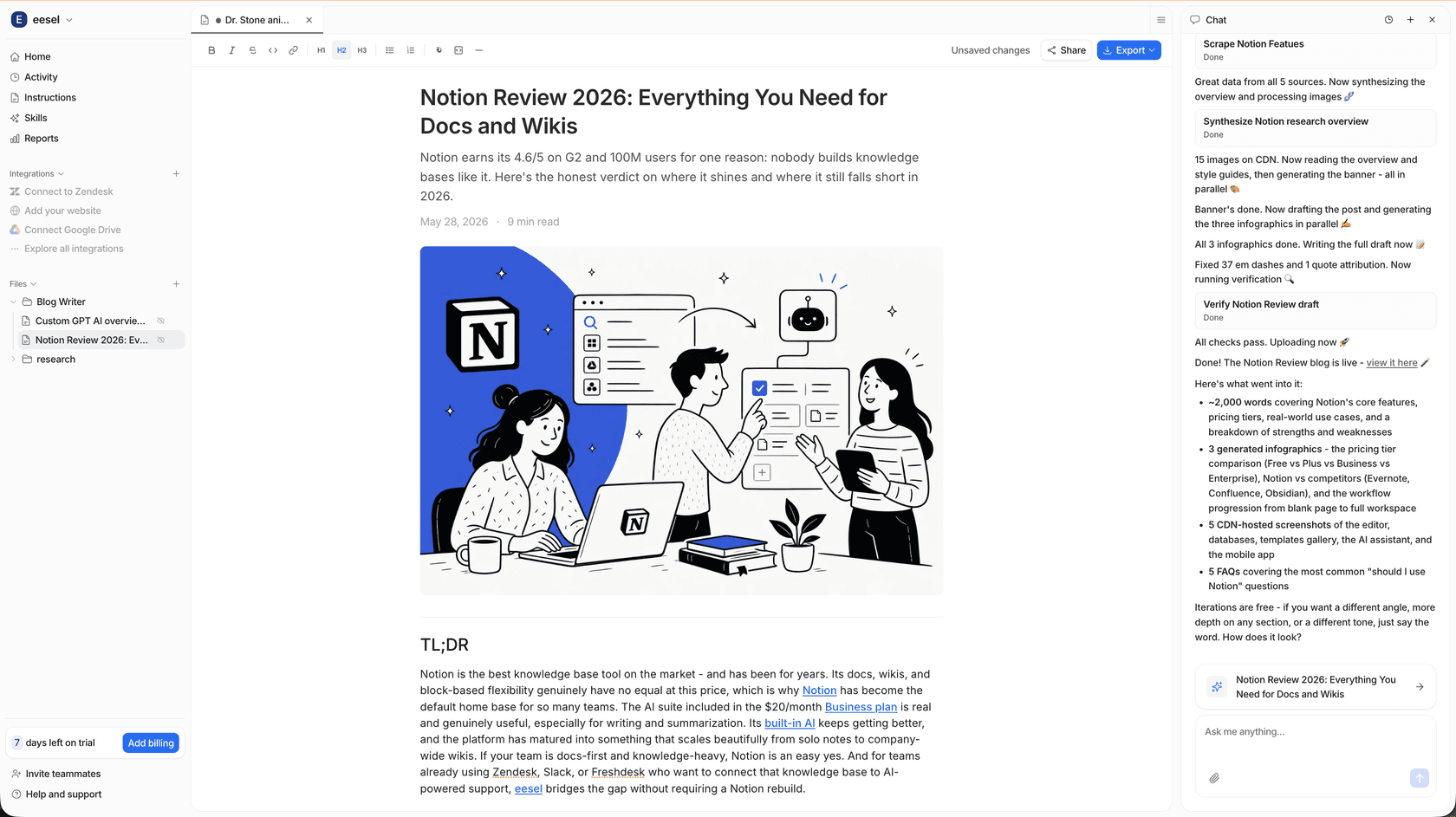
Here’s why it’s different:
- It creates complete assets, not just text: Every post comes ready to publish with AI-generated images, infographics, tables, and even relevant YouTube video embeds.
- It integrates real social proof: It automatically finds and embeds relevant Reddit quotes and discussions, adding a layer of authenticity and E-E-A-T that generic AI can't fake.
- It’s context-aware: Just provide your website URL, and it learns your brand to include natural product mentions that don't sound forced or salesy.
- It’s built for SEO and AEO: The content is structured for search engines and optimized for AI Answer Engines like Google AI Overviews.
By automating the most time-consuming parts of content creation (research, drafting, asset creation, and formatting), you can focus your valuable time on strategy and final review.
Implement quality control
Scaling safely requires a robust feedback loop. You can't just publish and hope for the best. You need systems to make sure quality stays high and to measure what's actually working.
Keep a human in the loop
No AI is perfect. Even with a powerful tool like the eesel AI blog writer, a final human review is non-negotiable. This last check ensures factual accuracy, protects your brand voice, and adds any unique insights that only a human expert can provide. The goal of AI should be to get you 95% of the way there, with a human providing that final 5% of polish and strategic approval.
Schedule regular content audits
Scaling isn't just about creating new stuff; it's also about maintaining the value of what you already have. A winning strategy involves regularly auditing your content to find pages that are losing traffic or rankings. Refreshing this content with updated information, new stats, and better internal links is often one of the quickest ways to get an SEO boost.
Track metrics that matter
Vanity metrics can be seriously misleading. High traffic numbers don't mean much if they don't contribute to your business goals. Focus on tracking metrics that show the real impact of your content scaling efforts.
| Vanity Metric (What to track cautiously) | Business Impact Metric (What to focus on) |
|---|---|
| Total Organic Traffic | Organic Traffic to High-Intent Pages |
| Keyword Rankings for broad terms | Keyword Portfolio Expansion (total number of keywords you rank for) |
| Impressions | Click-Through Rate (CTR) by page |
| Bounce Rate | Time on Page & Scroll Depth |
| Number of Articles Published | Conversion Rate from Organic Traffic (e.g., sign-ups, demos) |
Scale systems, not just output
Learning how to scale SEO content safely comes down to one core principle: focus on building a sustainable system, not just chasing a higher word count. Reckless, low-quality scaling will always be a short-term game with long-term risks.
I have to say bravo for providing great content in one location for free. This is the kinda stuff someone would build 40 slides that are 5 minutes each of rambling and make a $150 udemy course out of. Thank you 🙏

Strategic scaling, on the other hand, is about creating a repeatable process that combines smart strategy (like topic clusters), powerful technology, and rigorous quality control. By leveraging tools like the eesel AI blog writer to handle the heavy lifting, your team can focus on what truly matters: creating valuable content that builds authority, drives meaningful traffic, and stands the test of time.
Ready to see how it works? Generate your first blog post for free.