
What an AI comparison page writer actually does
I've spent the last couple of years mapping keywords to what people actually search for, and at eesel I've watched our AI blog writer draft comparison content across live customer sites. The pattern that stuck with me is how unforgiving comparison queries are: the reader already knows the category and is one decision away from buying, so a page that reads like a brochure gets closed in seconds.
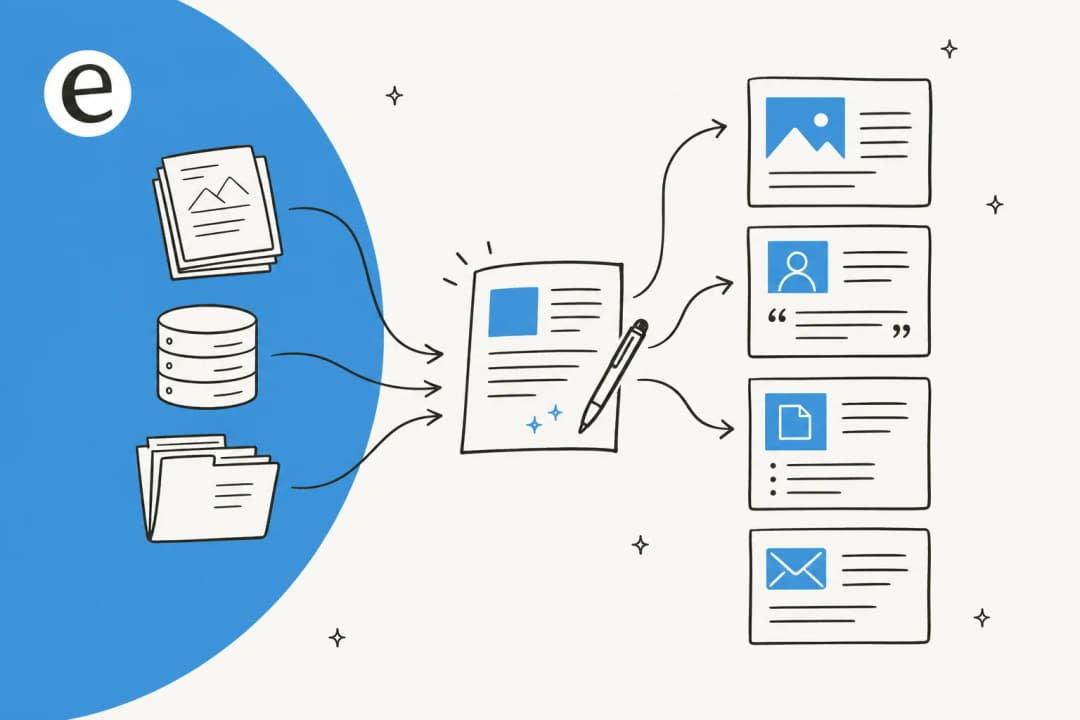
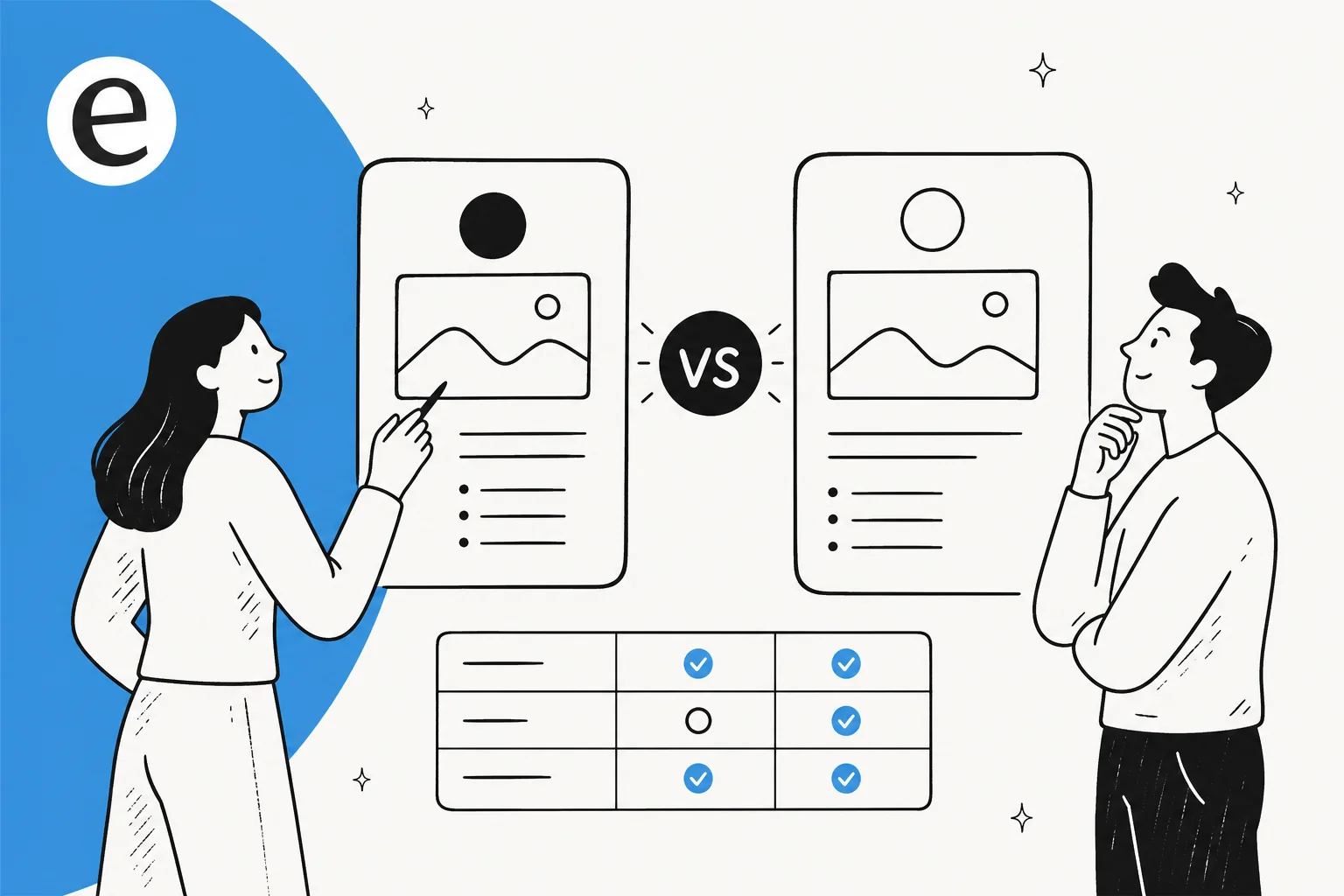
A comparison page writer is an AI content writer pointed at exactly that moment. Instead of one isolated article, you hand it a matchup and it returns the parts a buyer scans for: a feature comparison table, a few "who should pick this" lines, a pricing comparison, and a verdict. It's doing three jobs at once, and the third is the one cheap tools skip:
- Research both tools so the table is accurate, not invented.
- Build the comparison table and the "who it's for" framing.
- Write a fair verdict that takes a position without trashing the loser.
Those map to the three shapes of comparison content worth writing: a head-to-head ("Notion AI vs Anyword"), a "best alternatives" list with your product near the top (Outranking alternatives is the pattern), and the underused three-way ("A vs B vs C") that lets a low-awareness brand insert itself into a matchup it has no search demand for. If you want the strategic version of this, my guide on comparison blog writing goes deeper on choosing the matchup.
Why comparison pages are worth doing properly
Most content converts in the low single digits. Comparison pages don't, and the data on this is unusually clean. Grow and Convert measures conversions on every client post, and their study of 95 articles (123,000+ organic pageviews, 4,687 conversions) breaks the rate down by keyword type.
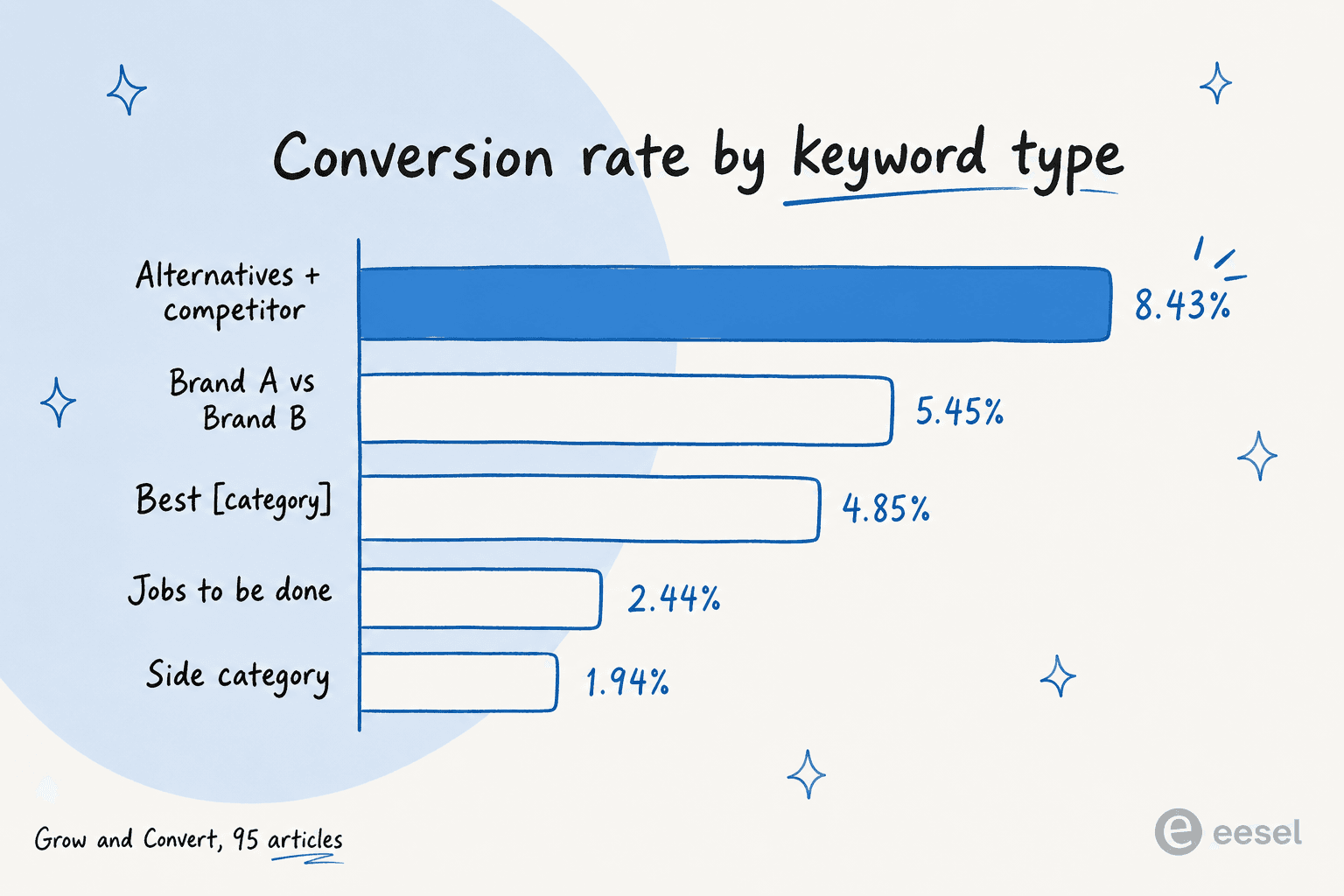
The headline: alternatives and competitor keywords convert at 8.43%, "vs" keywords at 5.45%. Both beat the "best [category]" terms (4.85%) that everyone fights over, and crush jobs-to-be-done (2.44%) and side-category (1.94%) content. Two quieter findings make these pages even better than the rate suggests. They rank fast even for low-authority sites: for a client at domain rating 28, comparison keywords hit page one "within weeks" and five of five landed in the top three, because competitors hadn't bothered. And they convert at real volume despite tiny reported search volume, six pages each under 20 monthly searches drove 149 signups.
Operators who've run the play say the same thing. One SaaS founder shared 12 months of data on building comparison pages for their top competitors:
"Conversion rate: 8.2% (vs 3.4% for general traffic). Why comparison pages convert well: Visitors are already in buying mode. They know the category, they're evaluating options... Closer to purchase decision."
u/Bulky-Economy-6746 on r/SaaS, reporting ~2,400 visits/month across 5 pages ranking #2 to #4 for "[competitor] alternative."

There's a newer reason to care, and it's the one I'd lead with in 2026: comparison content is what AI search engines pull from. As one practitioner put it on LinkedIn, "the sites that get cited in AI answers are disproportionately comparison/review content, not the brands being compared." Winning the "X vs Y" query increasingly means winning the citation, which is the whole bet behind AI-vs-traditional-SEO thinking.
The catch: the same writer builds a spam farm
Here's where most "AI comparison page writer" pitches go quiet. The tool that drafts a great matchup in a minute is exactly the tool that drafts a worthless one in the same minute, and Google has a specific name for the worthless version.
Google's spam policy is blunt: "Scaled content abuse is when many pages are generated for the primary purpose of manipulating search rankings and not helping users... no matter how it's created." The first example it lists is "using generative AI tools or other similar tools to generate many pages without adding value for users." A set of programmatically spun "X vs Y" pages with a templated table and no original analysis is the textbook trigger.
The nuance that matters: AI authorship isn't the violation, mass-producing low-value pages is. Google's helpful content guidance asks whether your content "provide[s] original information, reporting, research, or analysis" and whether it leaves readers "feeling like they need to search again to get better information." A comparison page that just tabulates spec-sheet rows fails both. I dug into whether Google penalizes AI content separately; the short version is it doesn't penalize AI, it penalizes value-less mass production.
This isn't theoretical. One operator ran a statistically-tested experiment publishing AI-generated app and comparison pages, and the result is the most useful thing I read all month:
"Ranking turned out to be the easy part. The click is where everything dies... 28 articles, 215 impressions, 0 clicks. Zero. App pages converted at 0.6%."
The diagnosis from the SEO crowd is consistent: the AI isn't the problem, the by-products of bulk publishing are. As one r/SEO commenter laid it out:
"What kills sites is the by-products of bulk AI publishing, not the AI itself... thin topical coverage, no entity grounding (no quotes, no proprietary data, no first-person experience), templated structure... if the AI drafts go through a real editor who adds something the model couldn't have written, you're usually fine."
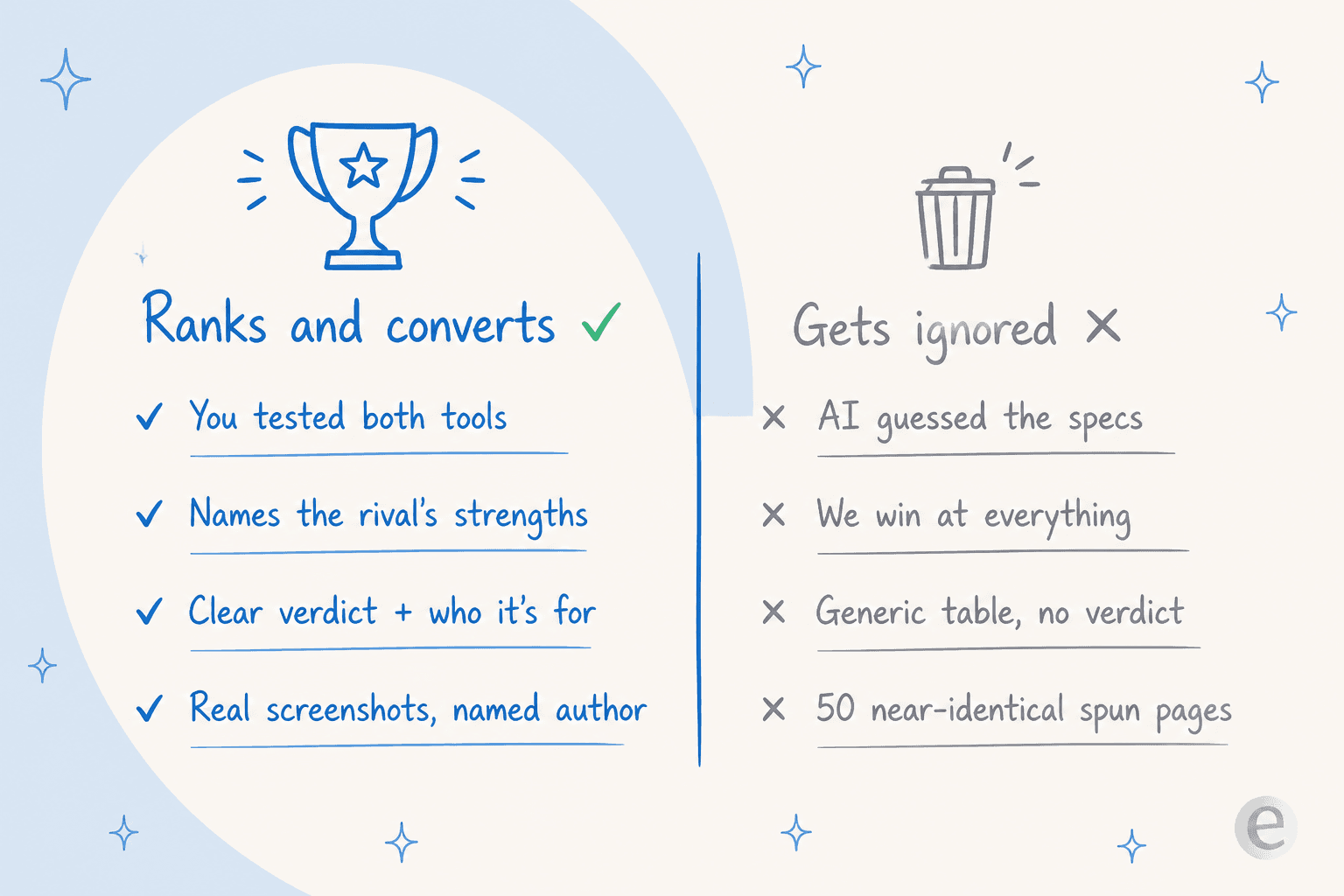
That editor-adds-something line is the whole game. It's also why AI posts that don't rank almost always share the same tells, and why AI content that ends up sounding generic is really about grounding it in something only you know.
What makes a comparison page actually rank
Once you've decided to do it properly, the structure is fairly settled. Ahrefs' SEO director maps out the anatomy of a ranking page, and it lines up with what Grow and Convert sees convert. Here's the working checklist.
| Element | Why it earns its place |
|---|---|
| Keyword-bearing title and H1 | Tells the reader and the engine exactly what's compared; the title is a real ranking signal. |
| Feature comparison table | The artefact buyers actually screenshot and skim; the core of the page. |
| "Who it's for" lines | Advanced prospects need the true differences spelled out, not a generic table. |
| Pricing comparison | Omitting pricing makes users bounce, which hurts rankings. |
| Honest verdict | A position the reader can act on; the thing a fair comparison is for. |
| FAQ section | Answers pre-purchase questions and ranks for related queries. |
| Schema markup | Product and breadcrumb schema lifts CTR via rich snippets. |
| Real screenshots | Proof you opened the products; ranks in image search too. |
| Named author byline | The trust signal a self-comparison needs most. |
One structural surprise worth flagging: the classic short, conversion-optimized comparison landing page is often the wrong format. Grow and Convert uses blog posts instead, because thin landing pages are "often too basic to be compelling to advanced prospects" and harder to rank. When the top results for a "vs" query are blog posts, that's Google telling you the searcher wants depth. That depth is also where your internal links and topical authority come from, so the page does double duty.
How to write one with AI, step by step
Here's the workflow I'd use. The order matters, and the human checkpoint at the end is not optional.
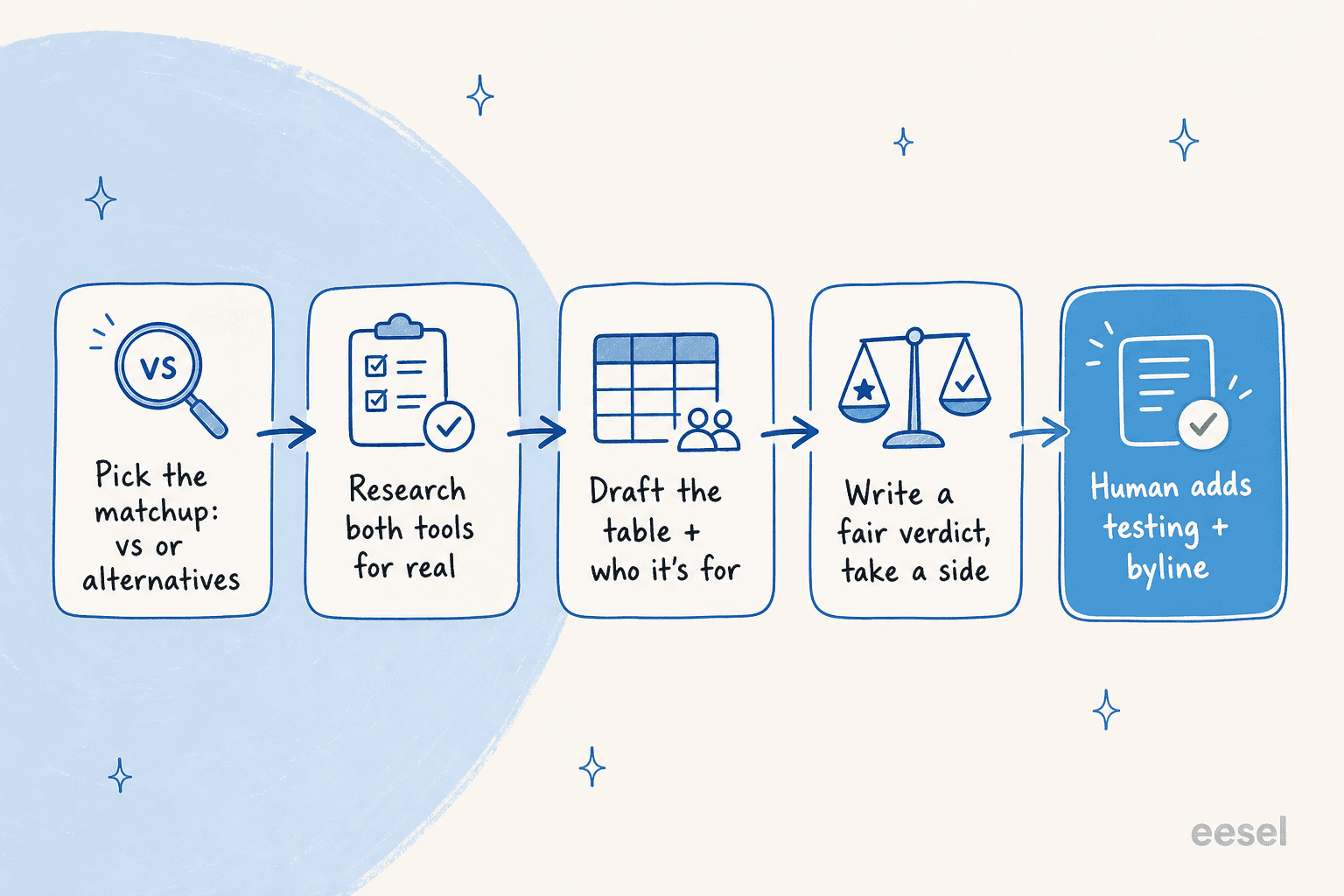
1. Pick the matchup. Decide whether you're writing a head-to-head, a "best alternatives" list, or a three-way. Start from real demand: a keyword clustering tool or eesel's free keyword generator surfaces which "vs" and "alternative" terms people actually search, so you're not guessing the matchup.
2. Research both tools for real. This is the step that separates a page that ranks from one that gets ignored. If the writer drafts the table from a generic prompt, it will confidently invent a pricing tier or a feature. Feed it the actual pricing pages, docs, and your own notes. An AI writer that drafts from a knowledge base instead of the open web is what keeps the specifics honest.
3. Draft the table and the "who it's for." Let the AI build the comparison table and the first pass of the framing. This is genuinely the part it's good at: structure, parallel phrasing, covering every dimension a buyer weighs. A content brief per page keeps the scope tight so it doesn't wander.
4. Write a fair verdict, and take a side. Acknowledge what the other tool is genuinely good at, then say who should pick what. A verdict that hedges is worse than no verdict, more on that in the next section.
5. Put a human on the publish button. Add the one thing the model couldn't have known: a screenshot from your own testing, a real number, a line about where each tool annoyed you. Where a reader would reasonably wonder how the page was made, Google's guidance recommends disclosing the use of AI. Build this gate into your AI content pipeline as a requirement, not a nice-to-have, and your editing process becomes the thing that adds value.
Be fair, then take a side
This is the part an AI writer can't decide for you, and it's where most vendor comparison pages quietly fail. There's a real tension here. Readers searching "X vs Y" don't want a neutral shrug, they came for a verdict. But the second a page reads like a sales pitch, they stop believing any of it.
The SaaS founder from earlier put the failure mode and the fix in one breath:
"Honest comparisons. Don't trash competitors. Acknowledge their strengths... What doesn't work: Overly biased content. Readers can tell when you're not being fair. Generic comparisons. 'We're better at everything' isn't credible."
The resolution practitioners land on is simple to say and hard to fake: do a genuinely fair, detailed comparison, then introduce your product as the better fit for a specific kind of buyer. Not "we win at everything," but "if you need X, pick them; if you need Y, pick us." That's the opposite of the templated AI table, and it's exactly the gap a comparison page writer should be built to fill responsibly: AI for the structure and the draft, a human and a real E-E-A-T byline for the take. Trust is, in Google's own words, the most important part of the quality bar, and a fair verdict from a named author is how you earn it.
Try eesel for comparison pages
If you want to draft comparison pages at volume without landing on the wrong side of Google's scaled-content line, the deciding factor is where the draft comes from. eesel's AI blog writer is an AI teammate that finds the matchups worth writing, researches both products, and drafts in your voice, then you just tell it what to change in chat.
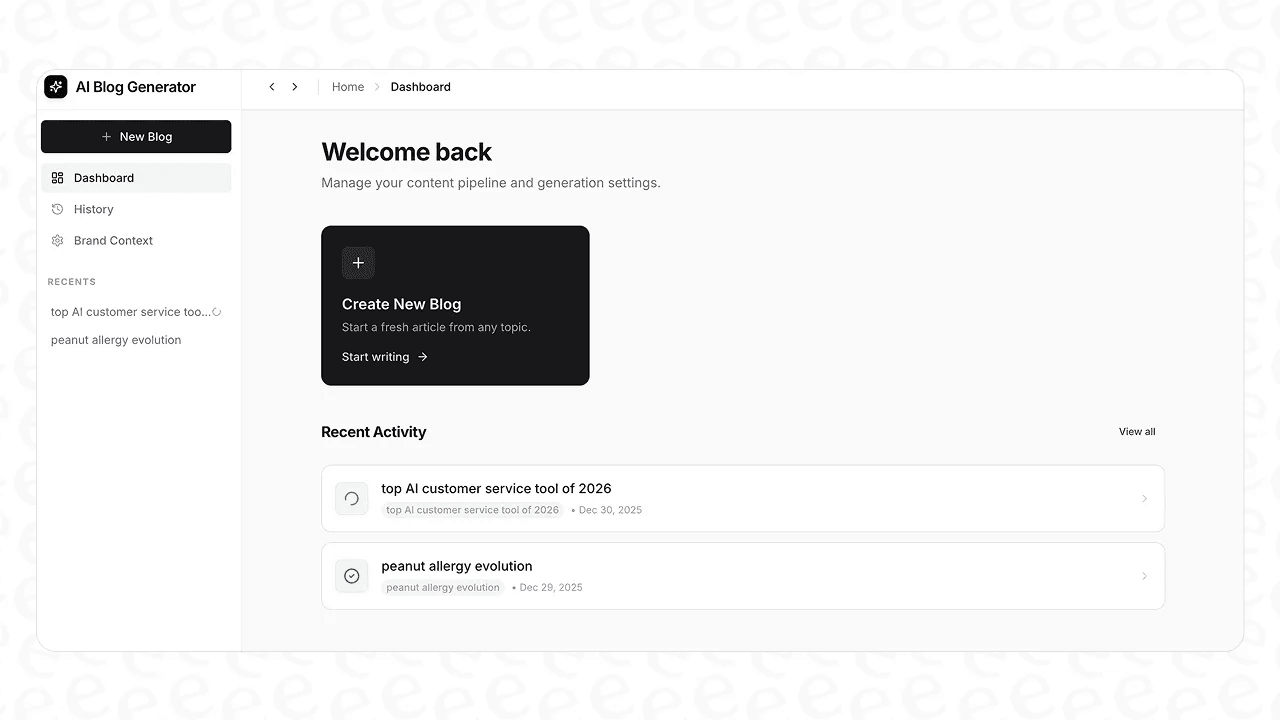
Three things make it fit comparison work specifically. It does competitor gap analysis to surface the "vs" and "alternative" terms you should own. It hits a 94% brand voice match from day one by learning from your past posts, so the verdict sounds like you and not a bot. And it grounds every claim in primary sources rather than guessing the table, which is the whole point of an AI blog writer that ranks. Draft the page, keep a human on the publish button, and add the one number only you have, that part is still on you.
Frequently Asked Questions
What is an AI comparison page writer?
Do AI comparison pages hurt your SEO?
How well do comparison pages actually convert?
Should a comparison page be neutral or take a side?
Can I use a free AI tool to draft comparison pages?


Article by
Kurnia Kharisma Agung Samiadjie
Kurnia is a software engineer and writer at eesel AI with two years of SEO experience, writing about AI tools, helpdesk software, and customer support. He pairs a developer's understanding of how these products are built with search-driven research into what actually ranks and resonates with the people searching for them.