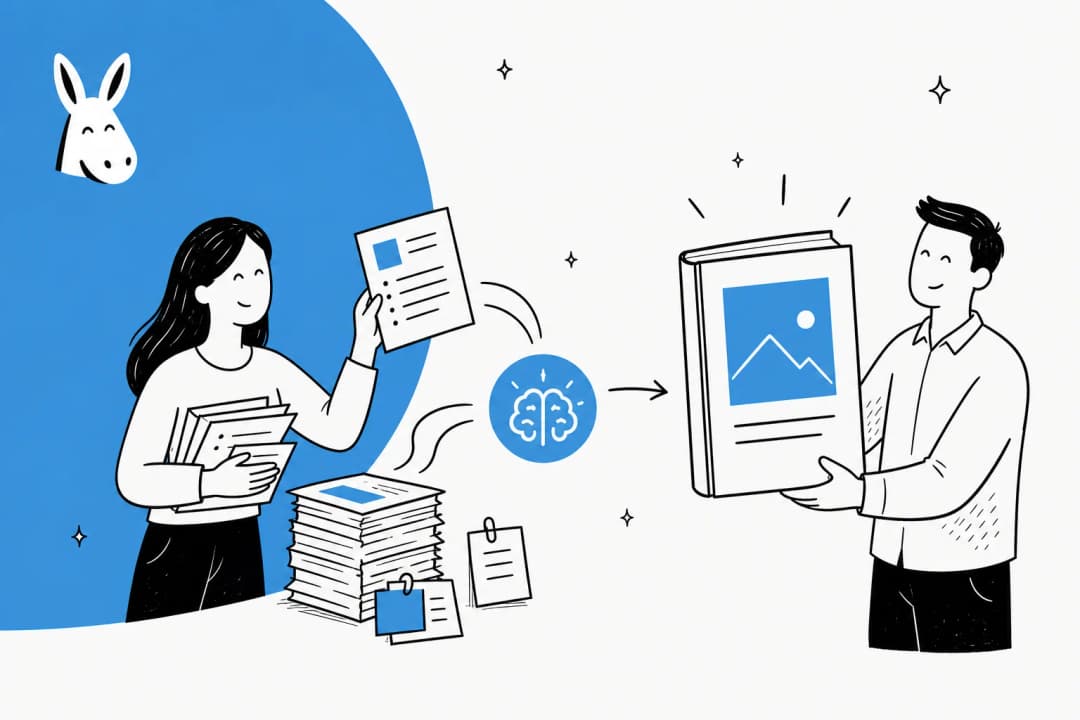

Case studies are your highest-converting content, and the biggest slog
Here is the thing every B2B marketer already knows and quietly dreads. Case studies close deals. A prospect reading about a company exactly like theirs, hitting the exact result they want, does more selling than any amount of feature copy. And yet they are the content nobody wants to write.
The reason is the process, not the writing. You have to find the customer, get them on a call, chase the legal sign-off, dig the real numbers out of someone in ops, and only then sit down to draft. By the time you do, the momentum is gone. So the case study sits in a backlog for a quarter, and the deal it could have closed goes cold.
This is where an AI case study writer changes the maths. The drafting that used to eat an afternoon collapses into a few minutes, which means the bottleneck moves back to where it should be: getting the real material. I have watched this play out on the eesel blog. I publish customer stories like the Yellowdig case study and the GENERAL BYTES write-up, and AI does a lot of the heavy lifting on the draft. But I have also watched AI produce case studies that read like every other AI case study on the internet. The difference is never the tool. It is what you put in.
What an AI case study writer actually does (and doesn't)
Let me set the ceiling before the floor, because the marketing around these tools tends to oversell.
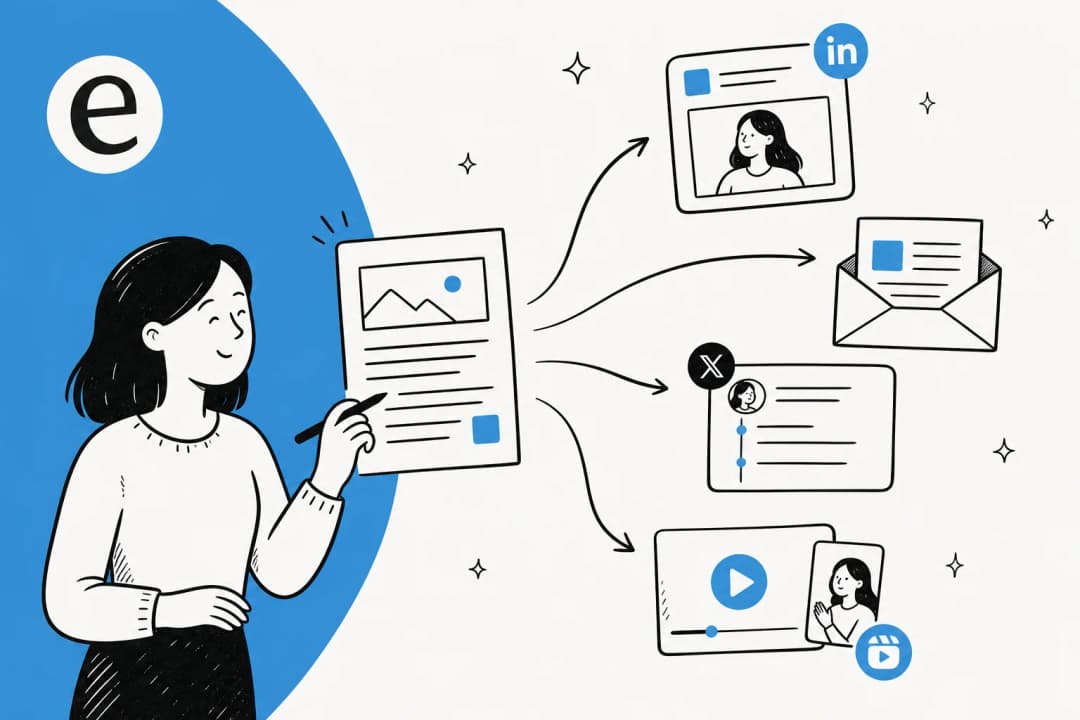
An AI case study writer is very good at the mechanical parts of writing. It structures a messy interview transcript into the challenge, solution, result arc. It drafts in a consistent brand voice once you show it a few examples. It tightens flow, fixes length, and turns one finished story into five different formats without complaint. That last point is the underrated one, and I will come back to it.
What it does not do is supply the truth. It cannot know that your customer cut response times by 40% unless you tell it. It cannot quote your customer accurately unless you paste the quote in. And if you ask it to fill those gaps anyway, it will, with plausible-sounding numbers that are completely made up. That is the fastest way to ship a case study your customer's legal team makes you retract.
So the honest division of labour looks like this.
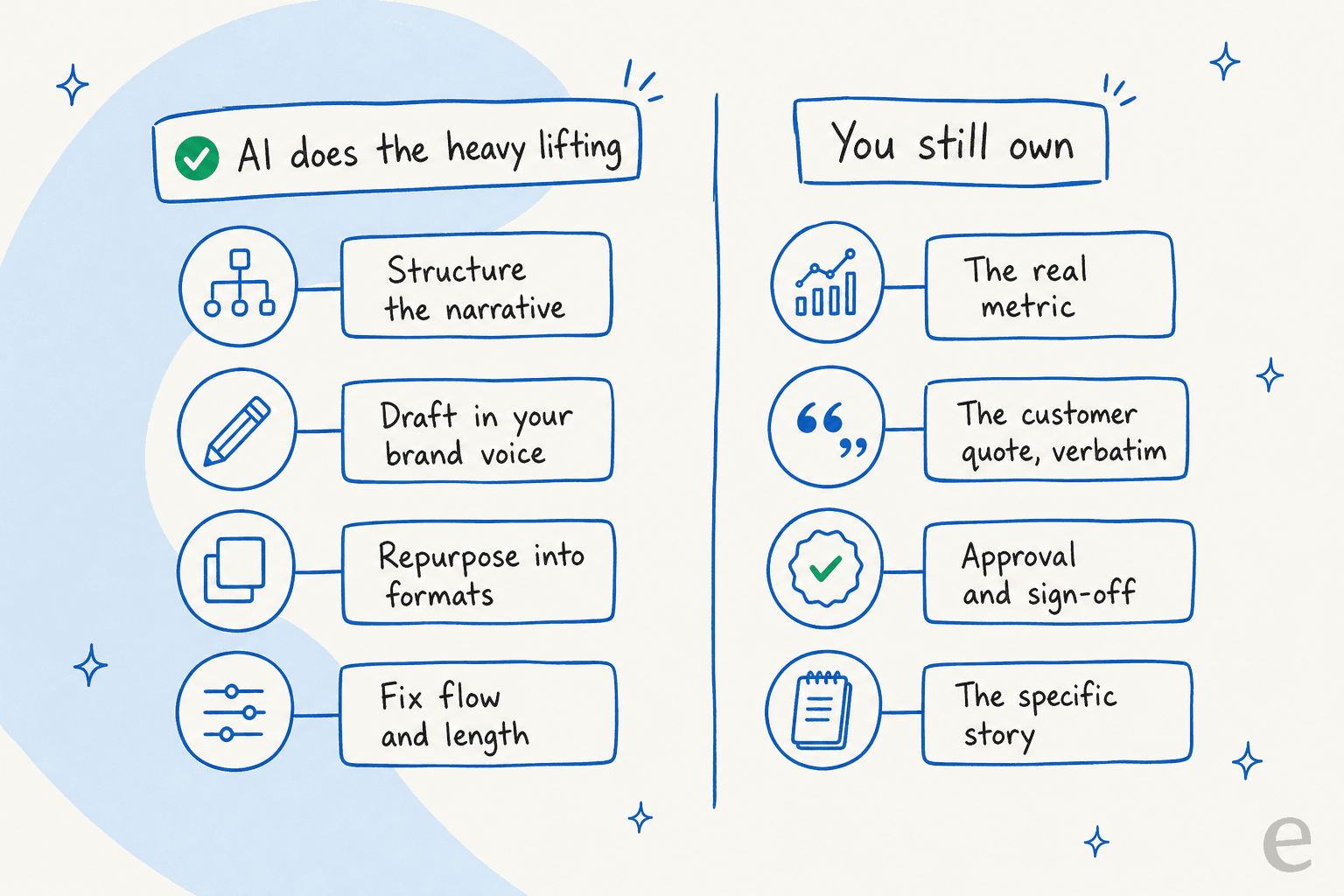
Keep that split in your head and an AI case study writer becomes a force multiplier. Forget it, and you are just generating filler faster. If you want the broader version of this argument, it is the same logic behind how to create E-E-A-T content with AI: the parts that prove a human with real experience wrote it are exactly the parts you cannot delegate.
The three things AI can't fake (and why most AI case studies flop)
If you read a hundred AI-written case studies, the bad ones all fail the same way. They are smooth, grammatical, and say nothing. No real number, no real voice, no real situation. They could be about any company.
A case study that converts is built on three things, and all three come from you.
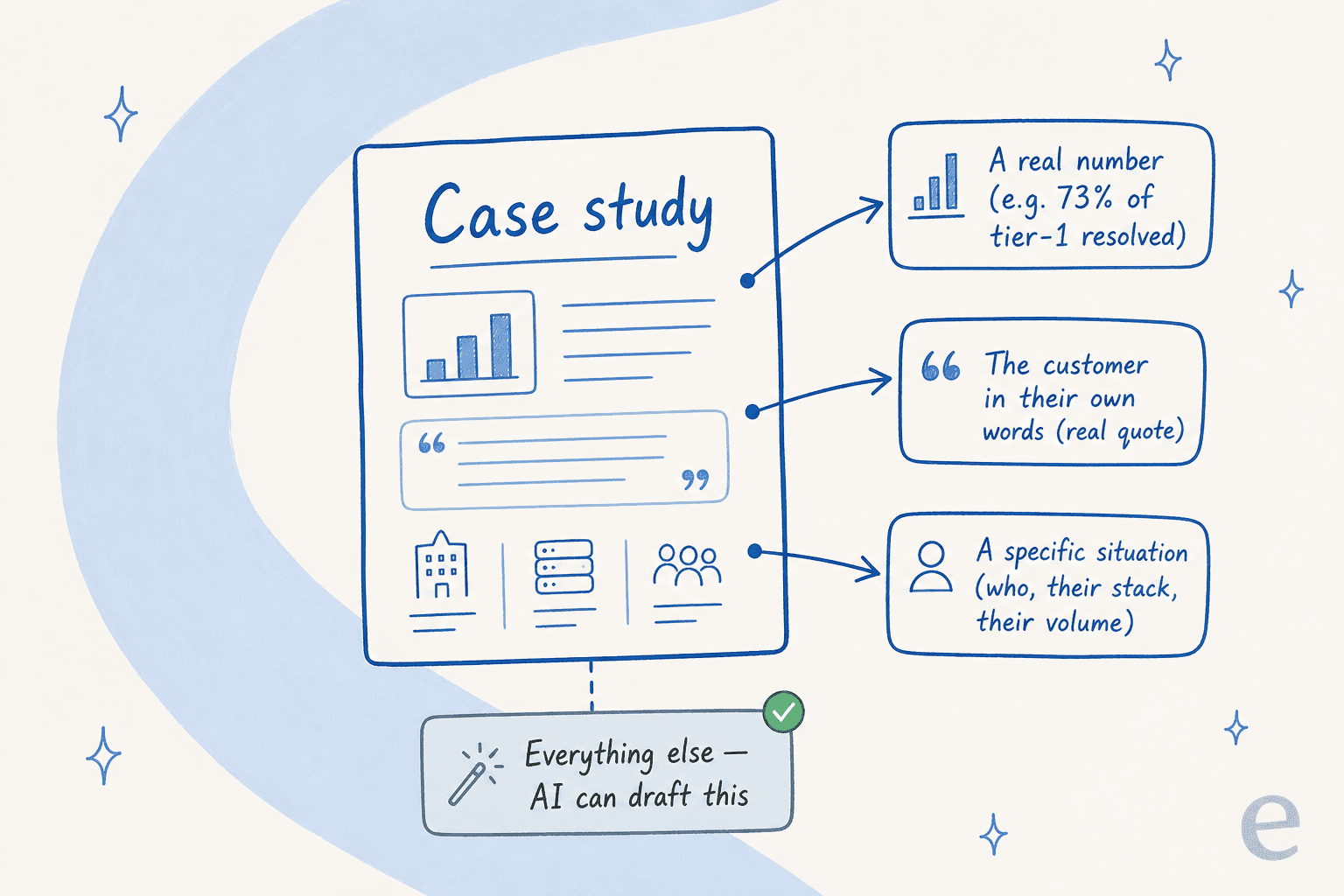
A real number. "Improved efficiency" is worthless. "Resolved 73% of tier-1 requests in the first month" is a story. When Gridwise hit exactly that figure on a 7-day trial, that one number did more work than three paragraphs of adjectives. Numbers are also what AI search engines and human skimmers both grab first, so lead with the figure, do not bury it.
A verbatim customer quote. The moment you paraphrase a customer, it stops sounding like a customer. Real people say specific, slightly odd things that no AI would generate. Here is a line from one of eesel's own case studies:
"It feels like a partnership, rather than a vendor relationship... Recently, a new customer success hire joked that our eesel AI bot was their best friend during onboarding."
Jon Miron, Director of Support & Operations, Yellowdig, eesel case study
No AI writes "their best friend during onboarding." That detail is the proof. Capture quotes like that on the call and keep them word for word.
A specific situation. Who is the customer, what stack do they run, what scale are they at? A story about "an e-commerce company" is forgettable. A story about a fast-growing startup whose customers far outnumber its support team, running on a specific helpdesk, is one a reader recognises themselves in. Specificity is what makes a case study blog post land instead of float.
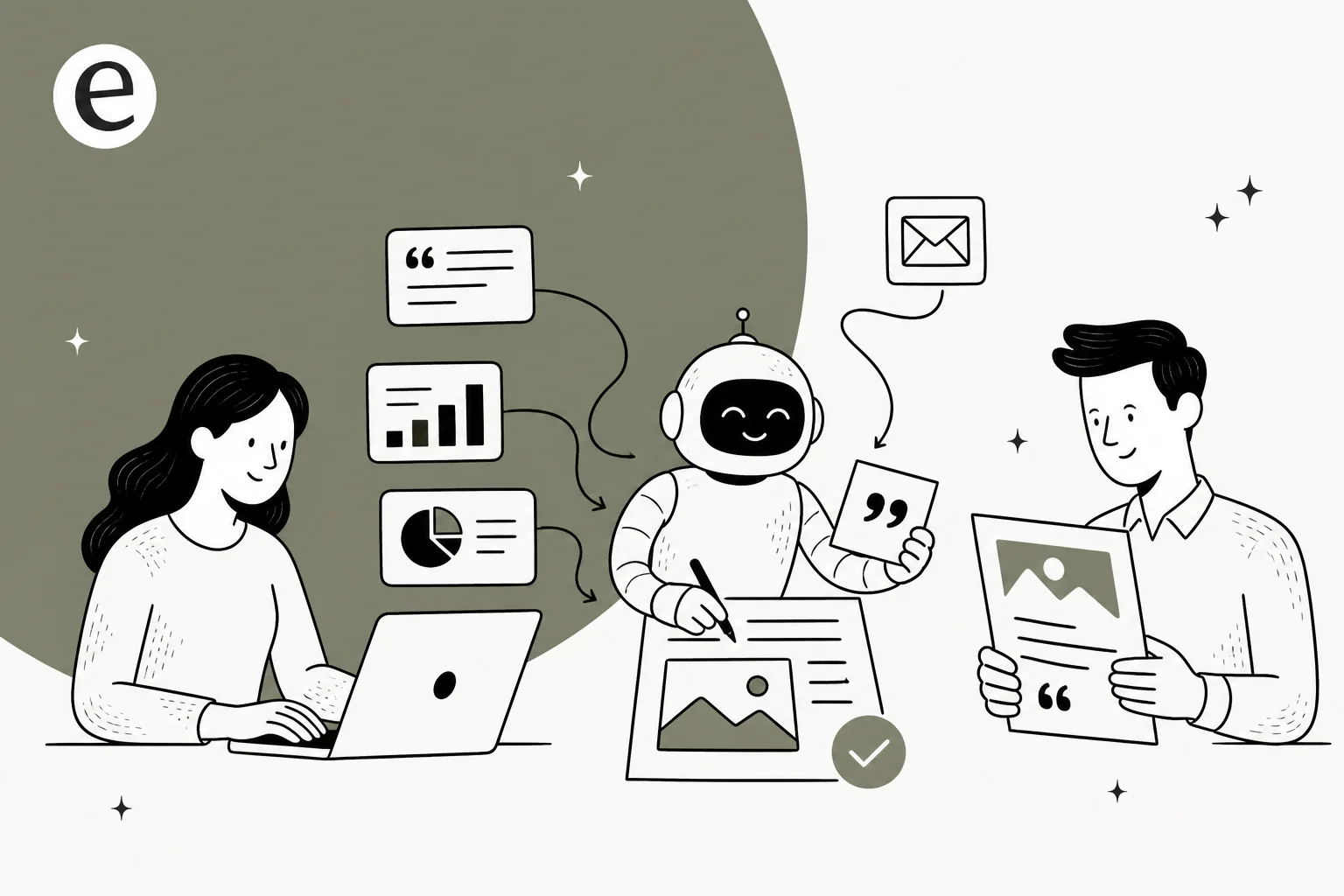
Get these three on the page and the AI can write everything around them. That is the right order of operations, and it is the opposite of how most people use these tools.
How to write a case study with AI, step by step
Here is the actual workflow. It is a content pipeline, not a single prompt, and the order matters more than the model you pick.
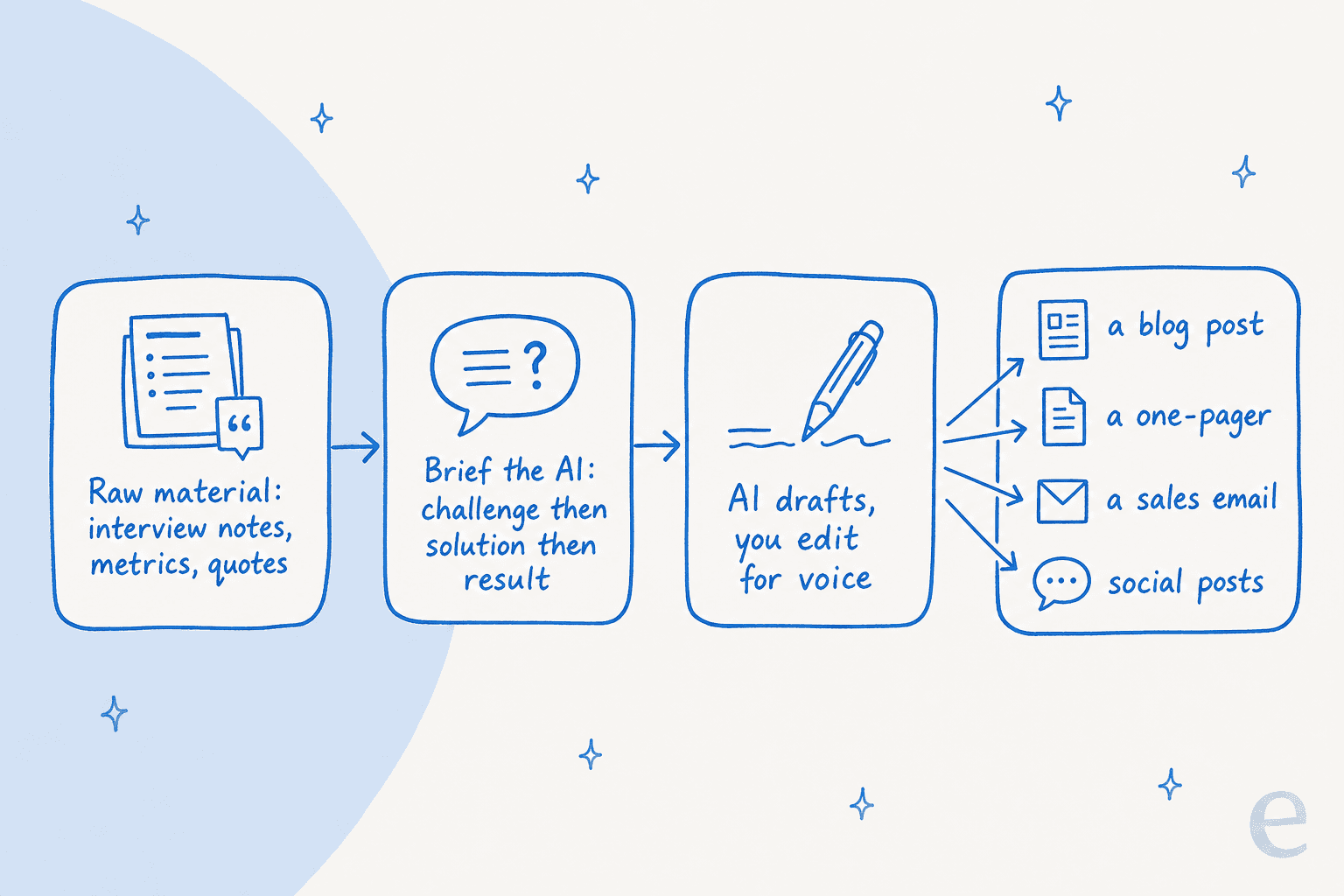
1. Gather the raw material first. Before you open any AI tool, collect the interview notes, the metrics, and two or three direct quotes. I keep this in a short content brief so the AI gets everything at once. If you skip this step, no tool will save you.
2. Brief the AI with the arc, not just the topic. Don't say "write a case study about Acme." Give it the structure explicitly: the challenge Acme faced, the solution they adopted, the measurable result, and the quotes to weave in. Paste the real numbers. Tell it the situation. A good brief is the single biggest lever on output quality, the same way a sharp brief separates professional blog writing from a generic draft.
3. Generate the draft, then edit hard for voice. The first draft gets you 80% of the way. The last 20% is where you cut the AI tells, the "in today's fast-paced world" openers and the rule-of-three filler, and pull the customer's real phrasing back to the surface. This editing pass is not optional; it is the part that makes it sound like you. Run it through an AI writing detector if you want a gut check.
4. Repurpose one story into many. This is where AI quietly pays for itself. One approved case study becomes a case study blog post, a one-page PDF for sales, a nurture email, a LinkedIn post, and a quote card, all in the same voice, in the time it used to take to format one. If you want to see how far this scales, I have written before about how I built a near-automated blog using AI. The principle is identical: do the hard thinking once, let AI handle the formats.
A real example of the scale this unlocks: one SEO content lead on Webflow runs a keyword-to-publish pipeline that pushes 360+ posts a month, roughly a dozen a day, using bulk actions to review and publish. Case studies are just one shape that fits that same machine.
Common mistakes to avoid
The failure modes are predictable, so they are easy to dodge once you have named them.
- Letting AI invent the numbers. If you didn't supply a figure, the AI should not be stating one. Check every stat against the source before it ships.
- Paraphrasing the customer. The second you reword a quote, it loses its credibility. Keep quotes verbatim and put them in quotation marks.
- Burying the result. The headline result should be near the top, not saved for a big reveal in paragraph nine. Skimmers decide in seconds.
- Shipping the first draft. The unedited draft is where the generic AI tone lives. The edit is the job, not an afterthought.
- Forgetting the CMS. A perfectly formatted draft is useless if it breaks on the way into your site. Plan for content CMS integration before you fall in love with the output.
The tools: general AI, dedicated writers, or your own data
You have three broad options, and the right one depends on how often you write case studies.
| Approach | Best for | Strengths | Watch-outs |
|---|---|---|---|
| General chatbots (ChatGPT, Claude) | A one-off case study | Free or cheap, flexible, great at drafting from a good brief | No brand memory between sessions, no built-in publishing, you manage everything by hand |
| Dedicated AI copywriting tools | Regular marketing output | Brand voice settings, templates, repurposing features | Monthly per-seat cost, often disconnected from your real data |
| Data-grounded content writers (eesel) | A real content pipeline | Drafts from your own sources, research-grade output, usage-based pricing | Overkill if you write one case study a year |
If you write case studies occasionally, a general model and a tight brief will do the job, and you can pair it with the best AI writing tools for editing. If content is a real channel for you, look at a dedicated AI content generator or an AI content scaling tool instead, because the repurposing and brand-voice features earn back their cost quickly. For a wider survey, my roundup of the best AI blog writer tools and the best AI for blog writing covers the field, and the same logic extends to adjacent formats like white papers and content marketing more broadly.
The deciding factor, for me, is whether the tool writes from your own material or from the open web. A case study is, by definition, about your customer and your data. A writer that already knows your product, your past content, and your customer language has a head start that a blank general model does not. That is also why I would watch how each tool handles production speed at volume before committing to a pipeline.
Try eesel for case studies and content at scale
I work at eesel, so take this with that grain of salt, but it is also why I can be specific. eesel started as an AI helpdesk agent that learns from a company's own tickets and docs, and that same "learn from your real material" engine powers its content writer. For case studies, that matters, because the tool drafts from sources you connect rather than from the generic web.

The differentiator is the keyword-to-publish workflow: give it a topic and your material, and it produces a fully-formatted draft with images, internal links, and FAQs, ready to repurpose into the formats above. It runs on usage-based pricing with no per-seat fees and a free trial, so you can draft a case study or two before deciding. If you are weighing it against alternatives, it sits in the data-grounded column of the table above, which is the column I would pick for any team treating content as a real channel rather than a chore. You can start from the eesel homepage or go straight to the content writer.
Frequently Asked Questions
What is an AI case study writer?
Can AI write a case study that actually converts?
How much does an AI case study writer cost?
How do I stop my AI case study from sounding generic?
What information do I need before writing a case study with AI?
Can I turn one case study into other content with AI?
Is an AI case study writer different from a general blog writer?


Article by
Alicia Kirana Utomo
Kira is a writer at eesel AI with a Computer Science background and over a year of hands-on experience evaluating AI-powered customer service tools. She focuses on breaking down how helpdesk platforms and AI agents actually work so that support teams can make better buying decisions.